

Courier software security is a buying decision about who can access delivery information, how changes are controlled and what evidence supports the provider’s answers. A reassuring sales page is not enough. Before your healthcare team relies on a delivery platform, ask to see how the proposed arrangement protects the information and work your team will actually place there.
You do not need to become a security engineer to start a useful conversation. You do need to describe the workflow, involve your responsible IT and privacy reviewers, and distinguish demonstrated controls from features still being discussed. This guide provides ten evidence questions and a practical review worksheet. It does not certify a product, assess a particular vendor’s security or replace your organization’s approval process.
1. What work will the courier software actually perform?
Start with a diagram of the proposed order journey. A staff member requests a collection. Someone accepts the transport scope. A courier receives instructions. A receiving team checks progress. An authorized person reviews completion evidence. Those are separate activities, even when they appear together on one screen. Each activity creates different questions about access, storage and communication.
Write down which information is needed for each activity. A location, an order reference and a receiving window may serve an operational purpose. A diagnosis or unrelated clinical narrative may not. Do not upload real patient records to prove a point in a sales demonstration. Use invented references and have the responsible reviewers decide what information the actual service requires.
Also distinguish physical movement from software processing. The transport provider, application operator, hosting provider and customer administrators may have different responsibilities. A courier badge or a vehicle description cannot answer every question about the platform. Ask who operates each part and which subcontracted functions are involved, without assuming that a particular corporate structure establishes compliance.
MOVE’s request-to-delivery process is a useful starting point for discussing the operational handoffs. Then review the actual proposed data flow with your IT and privacy teams. Keep an unresolved question visible rather than filling it with an optimistic assumption.
2. Who receives access, and how is that access limited?
Ask for a demonstration using two fictitious users with different responsibilities. A staff member placing orders and a manager reviewing activity should not automatically need identical permissions. Have the provider show what each account can view, change and export. The question is not whether a role name sounds appropriate; it is whether the demonstrated access fits the agreed job.
Consider location boundaries as well as job titles. A regional manager may need several sites, while a clinic desk may need only its own work. Ask how the proposed arrangement prevents someone from reaching another site’s information through search, a copied link, a report or an export. A hidden menu item does not, by itself, demonstrate enforced authorization.
Include temporary and support access in the discussion. Who approves it? Is its purpose recorded? How does the customer learn that it has ended? Your reviewers may require different evidence depending on the system and information involved. Treat an unanswered access question as an approval issue, not an inconvenience to be postponed until launch.
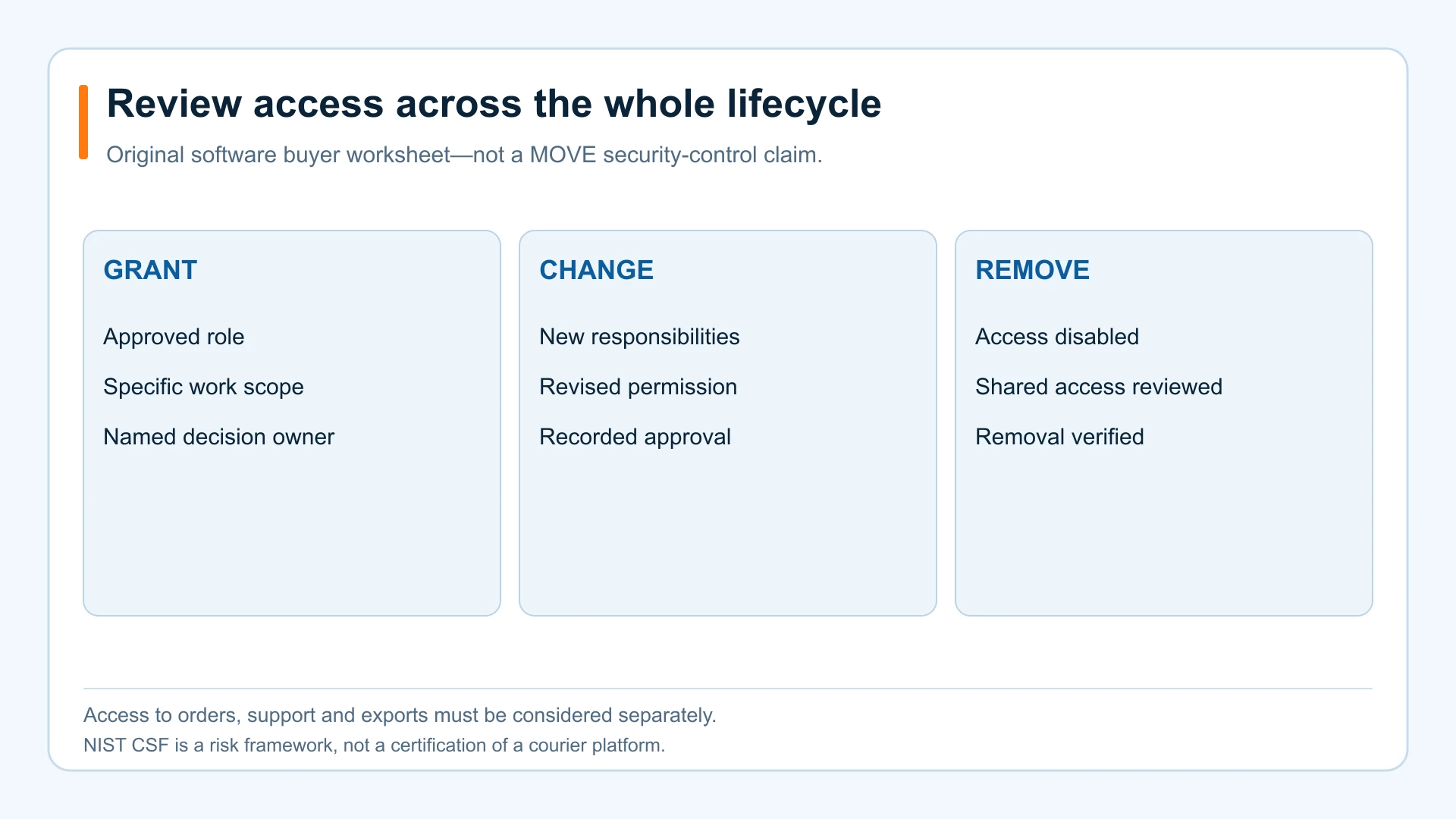
3. What happens when a person joins, changes roles or leaves?
Good courier software security review includes the ordinary personnel changes that occur after the sales meeting. Ask who can create an account, who approves the role and who maintains the current user list. A process that depends on one departing employee remembering every access path is difficult to manage.
Use a harmless test account to discuss a role change. If a person moves from one site to another, does the previous access end? What happens to saved sessions, integrations and delegated access associated with that identity? Have the provider explain the supported behavior. Do not infer that changing a password necessarily ends every possible connection.
Make the offboarding request operationally specific. Identify the customer role that sends the request, the approved channel, the provider’s response and the evidence of completion. Ask your IT team which authentication options and account protections are appropriate. This article does not prescribe a universal configuration or claim that MOVE supports every authentication integration.
4. Which security claims can the provider demonstrate?
The NIST Cybersecurity Framework offers an outcome-oriented reference for cybersecurity risk management. Its CSF 2.0 resources can help a qualified team organize a review. Referencing the framework is not a certification, and it does not prove that a courier platform has implemented a control.
Translate broad claims into questions about the proposed service. If a vendor says access is controlled, request an explanation of the boundary and appropriate supporting evidence. If it says data are protected, ask which transfers, stored records and administrative paths the statement covers. Your security reviewer should evaluate the technical detail and determine whether the evidence is sufficient.
Evidence can have limitations. A report may cover a different product, a previous period or only a particular hosting environment. Ask for the scope, date, issuer and unresolved findings that matter to your arrangement. Do not turn an unrelated certificate into a universal endorsement. A careful answer explaining a limit is more useful than a badge whose relevance nobody has checked.
5. Can reviewers understand important changes?
Operational records need context. An instruction entered before collection, an instruction changed after collection and a later correction are not the same event. Ask how authorized reviewers can distinguish them. Which identity made the change? When did the event occur? When was it recorded? Which instruction was current when the courier acted?
Demonstrate a correction using a fictional order. The reviewer should be able to understand what happened without relying on a person’s memory of the demonstration. Ask whether the system preserves an understandable history, how that history is accessed and what the export includes. The exact fields and availability require confirmation with the provider.
Do not confuse a useful delivery record with proof of every regulatory or clinical requirement. A timestamp can help reconstruct an operational sequence, but its meaning depends on the event definition and source. Review Secure Chain of Custody as part of the wider evidence conversation, while keeping product acceptance decisions with the responsible healthcare personnel.
6. Who responds when a security concern is raised?
Your team needs an approved reporting path before it needs an incident response. Ask which role receives a concern, what information the initial report should contain and how the customer can verify that it reached the right team. Do not place passwords, patient data or unnecessary screenshots into an ordinary sales email to get attention.
Agree how operational staff should behave while a concern is being assessed. A suspicious account event, a service outage and a delivery exception may need different reviewers. The clinic desk should not be expected to decide the technical cause or independently change security settings. Clear responsibilities protect the quality of the investigation and the continuity of legitimate work.
Have legal, privacy and security reviewers assess any applicable notification obligations and contract language. A generic blog cannot supply that determination. For procurement purposes, document the provider’s supported contact process, the relevant escalation roles and the open questions. Avoid inventing a response-time guarantee that the provider has not accepted.
7. What evidence supports recovery and continuity claims?
Ask what an outage would mean for the specific workflow. Could staff submit a new request? Could they confirm whether an earlier request was accepted? Could authorized reviewers access completion evidence? Different functions may recover at different times. A website returning to view does not necessarily mean all operational records have been reconciled.
Request an explanation of the agreed fallback and recovery process. It should address order identity, duplicate requests, approved communications and the return to normal work. Your IT reviewers can evaluate relevant backup and recovery evidence. Do not assume that a provider supports offline order entry, automatic replay or a particular recovery interval unless it has confirmed those capabilities.
Keep a distinction between a technical objective and a customer promise. A target written in a system plan may not be the contractual service commitment. Ask who approves the actual agreement and how customer responsibilities affect it. A continuity demonstration using invented orders can reveal ambiguity before a real clinic is waiting for an answer.
8. What can your team retrieve when the arrangement ends?
Exit planning is part of the initial purchase. Ask which customer records can be exported, which formats are supported and what context accompanies them. An export that loses order relationships, time zones or relevant correction history may be difficult to interpret. Have authorized reviewers evaluate a sample containing fictional data.
Separate retrieval from retention and deletion. A downloadable report does not establish how long records remain available or what happens to other copies. Those questions require the actual agreement and the appropriate reviewers. Do not ask a dispatch contact to improvise a legal retention rule because a procurement deadline is approaching.
Identify responsibility for disabling accounts, ending integrations and confirming that the approved exit tasks are complete. Preserve the existing arrangement until the authorized decision is made. The security review should make the transition understandable, not encourage staff to erase records or revoke access prematurely.
9. How will you record evidence and unresolved questions?
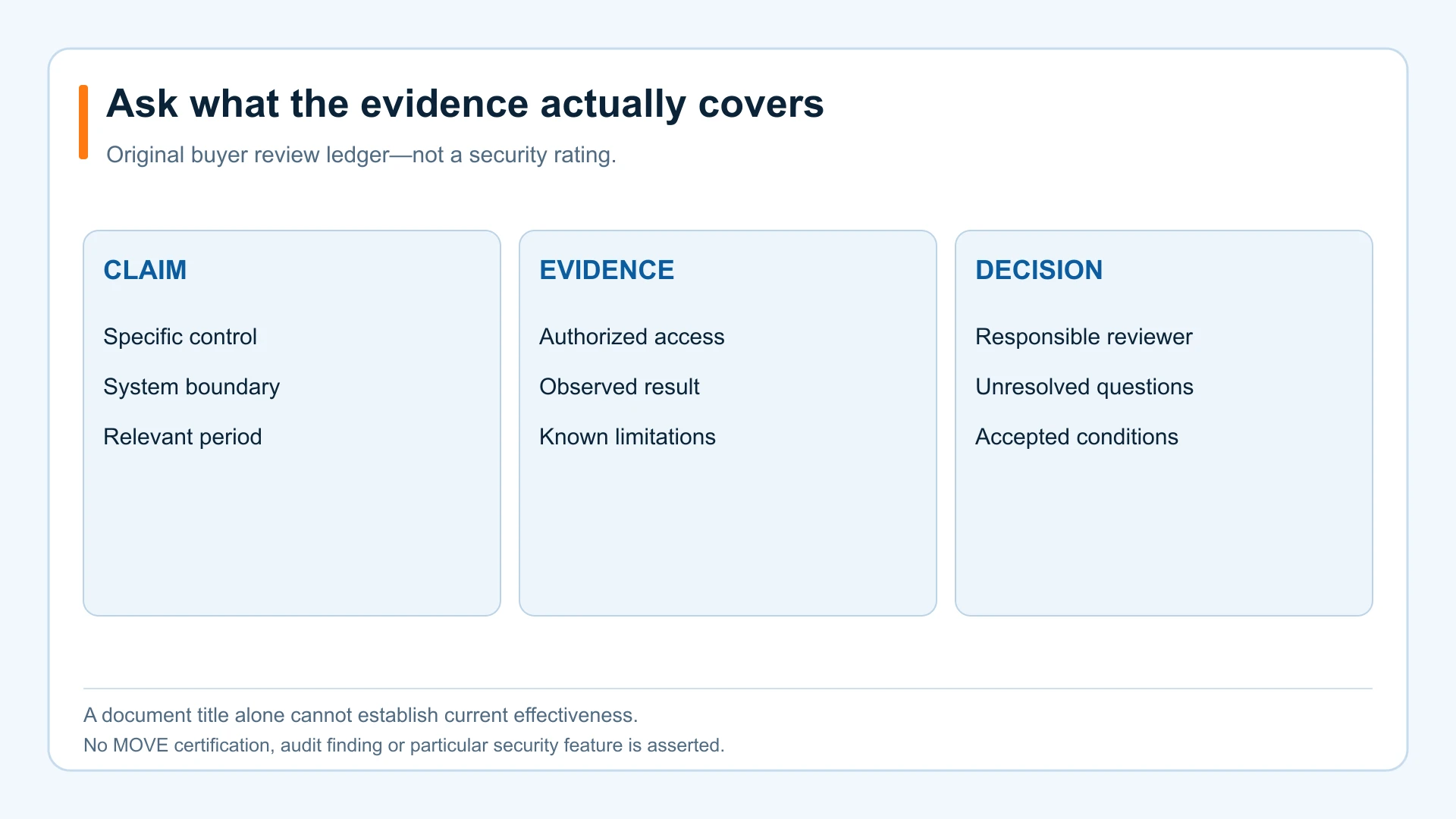
Use a short review ledger that separates a vendor answer from the evidence and the customer’s decision. Avoid a single green check that means different things to different reviewers. A demonstration can be complete while a contract question remains unresolved. Conversely, a written policy can exist without showing how the customer workflow behaves.
| Review area | Evidence to request | Customer decision |
|---|---|---|
| Data flow | Proposed functions, information and operators | Responsible IT/privacy review |
| User access | Fictitious role and location demonstration | Approved access boundaries |
| Account changes | Join, role-change and exit workflow | Named customer owner |
| Security claims | Relevant scope, dates and supporting material | Qualified security assessment |
| Change history | Fictional correction and reviewable sequence | Usable operational evidence |
| Continuity | Supported fallback and recovery explanation | Accepted responsibility split |
| Exit | Sample export and agreed offboarding tasks | Approved transition conditions |
Give each unresolved item an owner and an actual next step. “Ask IT” is less useful than identifying the reviewer, the material required and the decision that cannot yet be made. Use your organization’s approved tools for the ledger. A public article worksheet is not a place to store sensitive security documentation.
Keep the review proportionate to the real arrangement. A limited operational report and a deeply integrated application may present different questions. The purpose is not to collect the largest possible folder; it is to obtain relevant evidence that supports a defensible decision.
10. What must be true before your team starts using it?
Finish with a launch decision that names the approved scope. Which sites, users, information and functions are included? Which demonstration results were accepted? Which conditions remain restrictions rather than completed tasks? An approval for a small pilot should not quietly become permission for every department to upload everything.
Review the ordinary work after launch as well. A new site, new integration or changed data use may require a fresh conversation. Keep the owner of that conversation visible. Security due diligence is most useful when it follows the actual service rather than remaining a document that nobody opens again.
For MOVE, begin with the proprietary-platform overview and describe the delivery workflow your team wants to support. Ask which functions and evidence are available for your proposed arrangement. This guide does not assert specific encryption implementations, certifications, interfaces or recovery commitments.
For a single local delivery, Quick Quote with the operational details needed to assess the work. For recurring service, start an account conversation and include your responsible technology reviewers. The right next step is a clearer decision—not a faster signature on an unexplained promise.
Courier software security questions buyers ask
Does a security badge prove that a platform fits our workflow?
No. Examine the badge or report’s scope, date and relevance, then have qualified reviewers assess the actual arrangement. A provider’s demonstration and written answers should connect to the information, users and functions your organization intends to use.
Should we use real delivery records during a demonstration?
Use fictitious references and approved test material wherever possible. Your responsible reviewers should decide whether any real information is appropriate, through which channel and under what conditions. A sales demonstration is not a reason to disclose unnecessary patient or security information.
Is this review a substitute for legal or technical approval?
No. It organizes the operational questions so responsible teams can assess them. Contract obligations, privacy applicability and technical adequacy remain with qualified reviewers. The original worksheets are discussion tools, not a universal compliance standard or a statement that a particular provider has passed.