Multi-piece medical delivery means one delivery request involves more than one separately handled transport unit. One order might contain four sealed totes, three cartons or two equipment packages. The important question is not just whether the courier reached the destination. It is whether the right units were released, transported and received under the agreed instructions.
A single “delivered” status can leave a receiving team with an unanswered question: delivered what, exactly? That is where a package-count plan earns its place. Separate the order reference from the individual units. Agree how shortages are handled. Give the receiving contact enough information to reconcile what arrived without guessing what was inside a sealed package.
This guide provides seven buyer checks and an original unit-level worksheet for local healthcare deliveries. It is operational planning guidance, not instructions for specimen packaging, medication handling or clinical acceptance. Its examples are fictional. They do not describe MOVE performance or claim that every field, barcode or automated reconciliation feature is available in our proprietary platform.
In this article
- 1. Define the counting unit before the courier arrives
- 2. Give the order and every separate unit a clear identity
- 3. Compare the requested count with the count actually released
- 4. Use the same count language at pickup and receiving
- 5. Plan what happens when receiving is partial or disputed
- 6. Reconcile the units before relying on a completion record
- 7. Test the package-count plan with harmless examples
- An original multi-package delivery checklist and worksheet
- A fictional supplier example: three delivered is not four fulfilled
- Multi-piece medical delivery questions
- Put a clear count behind your next local delivery
1. Define the counting unit before the courier arrives
Start with a plain-language definition: what does “one piece” mean for this request? If four sealed totes move separately, the transport count is four totes. If several inner cartons have been prepared by the shipper as one accepted outer transport unit, agree how that unit is identified and counted. Do not assume that an order’s product quantity equals the courier’s package count.
The distinction has a standards-based counterpart. GS1 US explains the SSCC as an identifier for a logistics unit, which can contain multiple trade items packaged together for transport. That illustrates why a unit’s identity and its contents are different questions. It does not establish that MOVE uses SSCCs or that this worksheet is a GS1 implementation.
Use the shipper’s approved packaging and identification process. A courier count should not require opening a sealed unit to inspect its contents. The healthcare organization remains responsible for its content checks and any clinical or product-specific acceptance decisions. If staff cannot tell which outer units are included, resolve that uncertainty before describing the shipment as ready.
For a supplier, the count conversation belongs alongside dimensions, weight, access and any agreed loading assistance. Our medical supplier delivery page explains the broader service context. A precise count helps define the work; it does not by itself establish vehicle fit or authorize extra assistance.
2. Give the order and every separate unit a clear identity
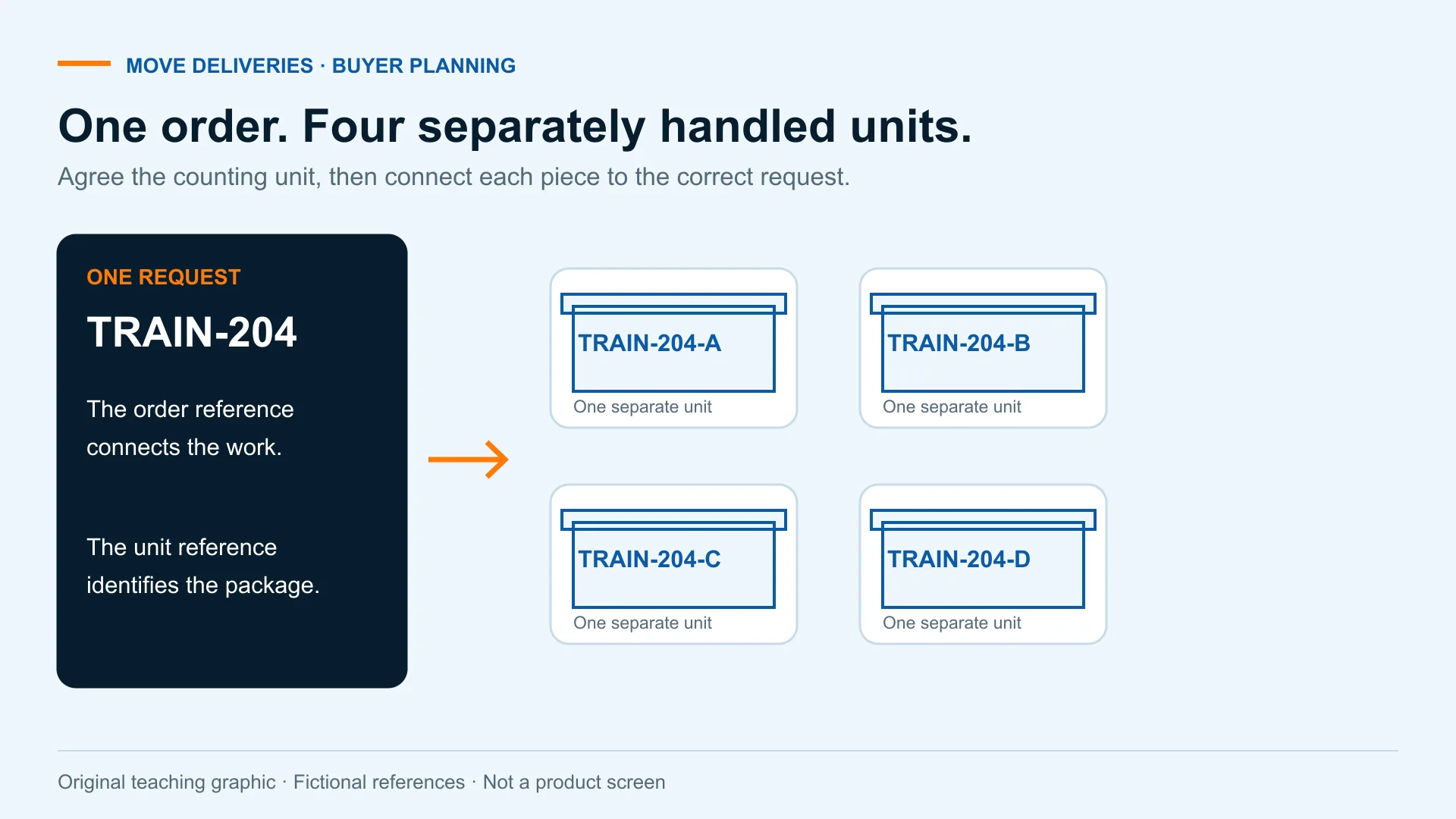
An order reference answers which request the work belongs to. A unit reference answers which physical package is being discussed. Keep both available to the authorized people preparing, collecting and receiving the delivery. “The blue tote” is weak identification when three blue totes are waiting at the same pickup point.
For a small local example, a shipper might describe fictional order TRAIN-204 with units TRAIN-204-A, B, C and D. These are teaching labels, not a prescribed barcode scheme or a MOVE screen. The actual identifiers should follow the process agreed with the shipper and provider. Confirm whether unit-level references can be recorded in the supported workflow rather than assuming they can.
Sequence labels such as “2 of 4” can help a person understand the expected set, but they still need context. Two different orders might each have a package marked “2 of 4.” A copied label may repeat a reference. A late-added unit may change the set. Your preparation check should catch those ambiguities before the courier has to interpret them.
Keep the reference meaningful for the transport task without adding unnecessary patient details. Agree the approved information and communication channel with the responsible team. A general inquiry or quote form should describe the delivery scope, not become a place to upload sensitive shipment documents. The goal is a clear identity for the work, not a public inventory of its contents.
3. Compare the requested count with the count actually released
“Requested,” “ready” and “collected” are different states. Four packages might have been requested while only three are at the approved pickup point. That is a discrepancy to resolve, not a reason to silently change four to three or mark the missing unit as collected. Record what is physically available and ask the authorized contact how the accepted work should proceed.
Before the first pickup, agree who can approve a reduced scope, a deferred unit or a revised request. The options depend on the service and the customer’s instructions. A courier should not improvise a partial release merely because most of the packages are ready. Likewise, a coordinator should not promise that a later unit will fit the original schedule without confirming it.
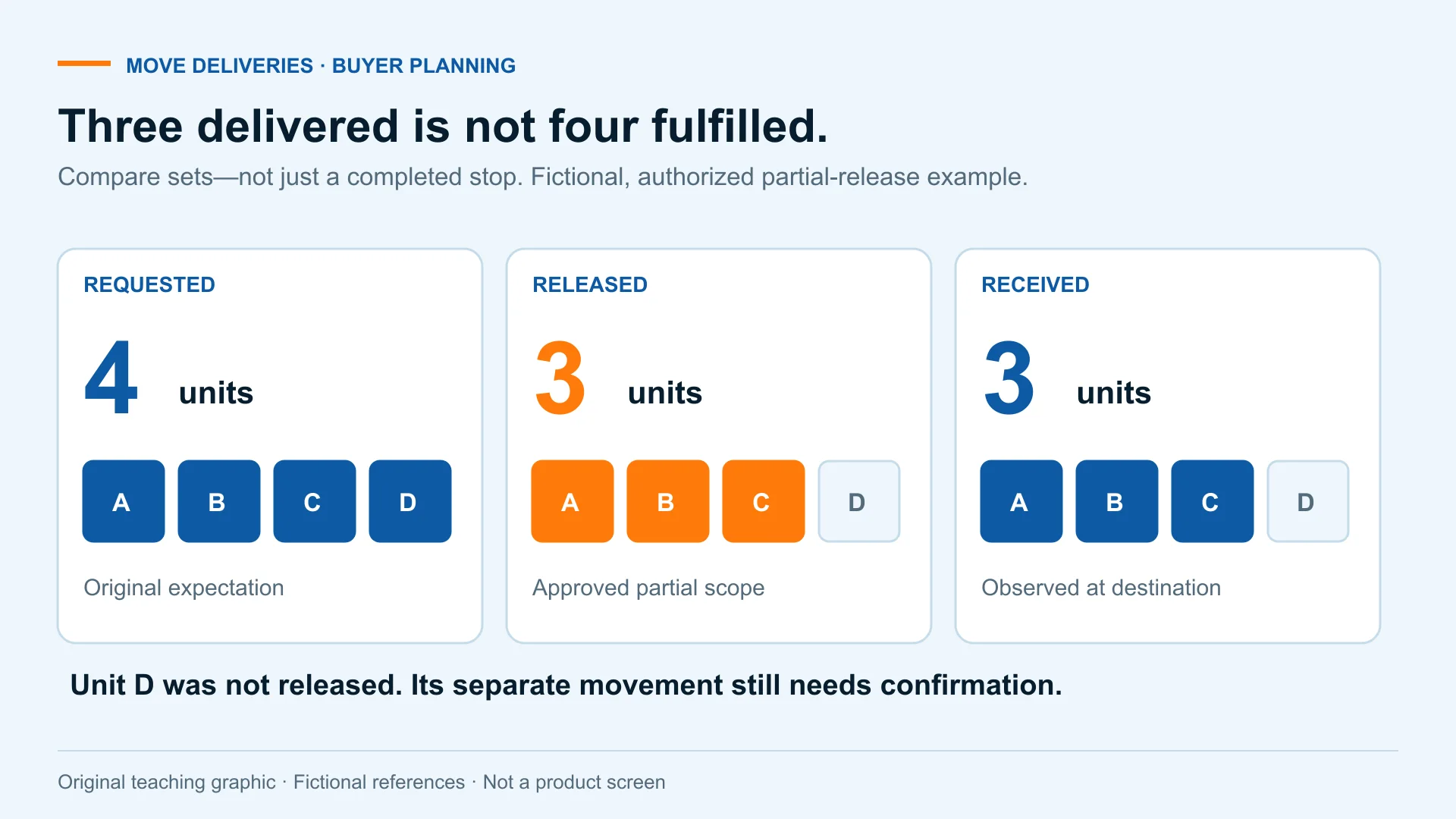
Keep the original expectation visible in the review. If three units are authorized to leave and the fourth is deferred, distinguish the approved three-unit movement from the unresolved fourth unit. The later package needs its own confirmed plan and reference connection. It should not disappear from the conversation because the first movement was completed.
When scope changes affect timing, access or receiving instructions, use the accepted change process. See how MOVE coordinates a delivery request for the broader workflow. The preparation principle here is simple: collect the units included in the agreed work, and make any difference explicit before relying on a completion summary.
4. Use the same count language at pickup and receiving
A pickup contact who says “three packages” and a receiving contact who expects “three orders” are not comparing the same thing. Agree the noun as well as the number. Totes, cartons, equipment packages and individual products may represent different levels of a shipment. The word “items” is especially easy to misread.
For a repeat local pickup, put a short count description into the preparation instructions: for example, “three separately handled sealed totes under order TRAIN-204.” Use the actual approved wording for the service. The receiving team should know which outer units are expected and where they are to be accepted. They should not need to infer the count from an unrelated invoice or an ETA message.
If a unit is repacked, divided or combined by authorized shipper personnel before release, confirm the new transport description and identifiers. Do not reuse the old count without checking whether it still describes the physical units. This guide does not authorize a courier to repackage medical shipments; it highlights a planning question for the parties responsible for preparation.
For pharmacy delivery arrangements, separately prepared recipient orders may be grouped into transport totes. Discuss both the approved outer-unit plan and the pharmacy’s own order reconciliation process. A tote count can describe transport without proving that each prescription order inside it has been fulfilled correctly.
5. Plan what happens when receiving is partial or disputed
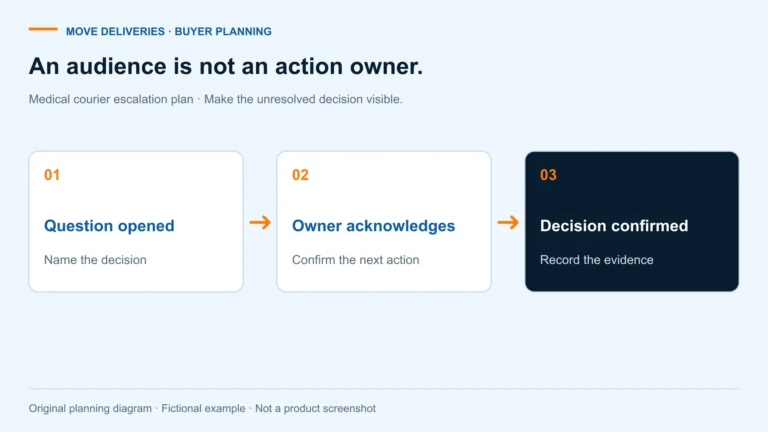
Agree an exception contact before there is an exception. If the receiving team expects four units but can identify only three, who checks the released count? Who reviews the unit references? Who can authorize a revised receiving arrangement? A plan that says only “call someone” leaves the most important responsibility unnamed.
Use neutral observations. “Units A, B and C were observed at the receiving point; unit D has not been located in this review” is more useful than “the driver lost a package” before the sequence has been checked. Compare the request, release information and receiving information. If the evidence is incomplete, record that uncertainty rather than choosing the most reassuring explanation.
Separate the immediate delivery question from any clinical or product decision. Qualified healthcare personnel decide what an incomplete set means for their work. A transport contact can describe the units and events available for review, but should not decide whether a patient’s treatment, a specimen or an equipment package is clinically acceptable.
Partial receiving is also different from an authorized partial release. In the first case, fewer units are observed at the destination than were released. In the second, the accepted outgoing scope was deliberately reduced before collection. Both may involve three units, but they call for different questions. Your worksheet should preserve that distinction instead of treating equal totals as the whole answer.
6. Reconcile the units before relying on a completion record
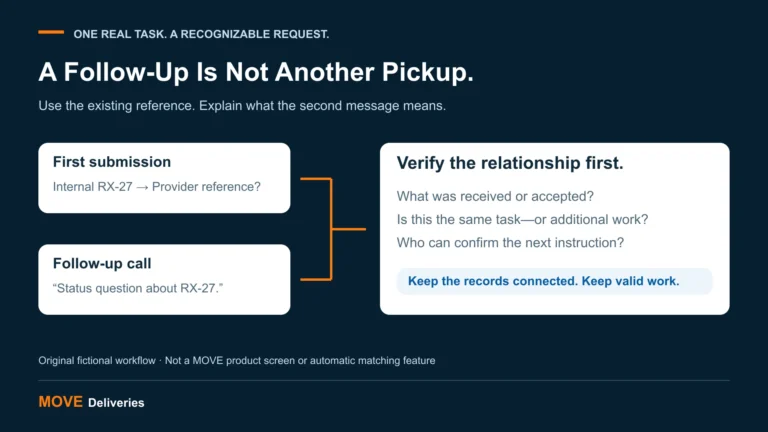
A completion record is the start of a focused review, not permission to stop asking what was received. Confirm which request it refers to, what completion means for that service and which supporting unit information is available. A receiver’s signature or a photograph does not automatically answer every count or contents question.
Our electronic proof of delivery page explains delivery confirmation in the broader workflow. For a multi-package request, ask how the supported records connect to the expected and released units. Do not assume a stop-level completion status is a separate confirmation for every piece.
Keep times intelligible too. A record may show when an event occurred and when information reached a system. OWASP’s application logging guidance distinguishes event time from logging time and discusses identifiers that connect related events. These are useful technical questions for a record review, not proof that a particular courier platform implements those controls. Read OWASP’s event-attribute guidance.
Ask for the supported clarification process if references, counts or times disagree. Preserve the information being reviewed and connect the explanation to it through the approved process. Do not rewrite an internal worksheet to make all columns match before the discrepancy has been resolved. A clean-looking total is not a substitute for an understandable account of the work.
7. Test the package-count plan with harmless examples
Before a recurring route starts, rehearse a complete set, a missing unit at release and a receiving mismatch. Use training references and empty demonstration units where appropriate. Keep actual patient shipments and sensitive documents out of the exercise. The purpose is to check shared understanding, not to create a simulated clinical emergency.
Ask each participant to explain the count they expect, the units they can identify and the contact they would use if those differ. Then compare the explanations. If pickup counts totes while receiving counts inner cartons, the test has found a vocabulary problem before it becomes a delivery question. Adjust the preparation plan and repeat the relevant part.
Record the outcome as ready, needs revision or unsupported. Unsupported is a useful result: perhaps the requested unit-level field is not available, or the parties have not agreed a partial-release procedure. Do not mark that result as passed because everyone attended the meeting. Name the decision owner and the next review point.
For ongoing work, repeat the relevant check when packaging, personnel, sites or accepted instructions change. A successful training example does not guarantee every future delivery. It gives the team a clearer operating plan to use, question and refine as real conditions change. That is a stronger basis for confidence than a broad promise that every package will always reconcile itself.
An original multi-package delivery checklist and worksheet
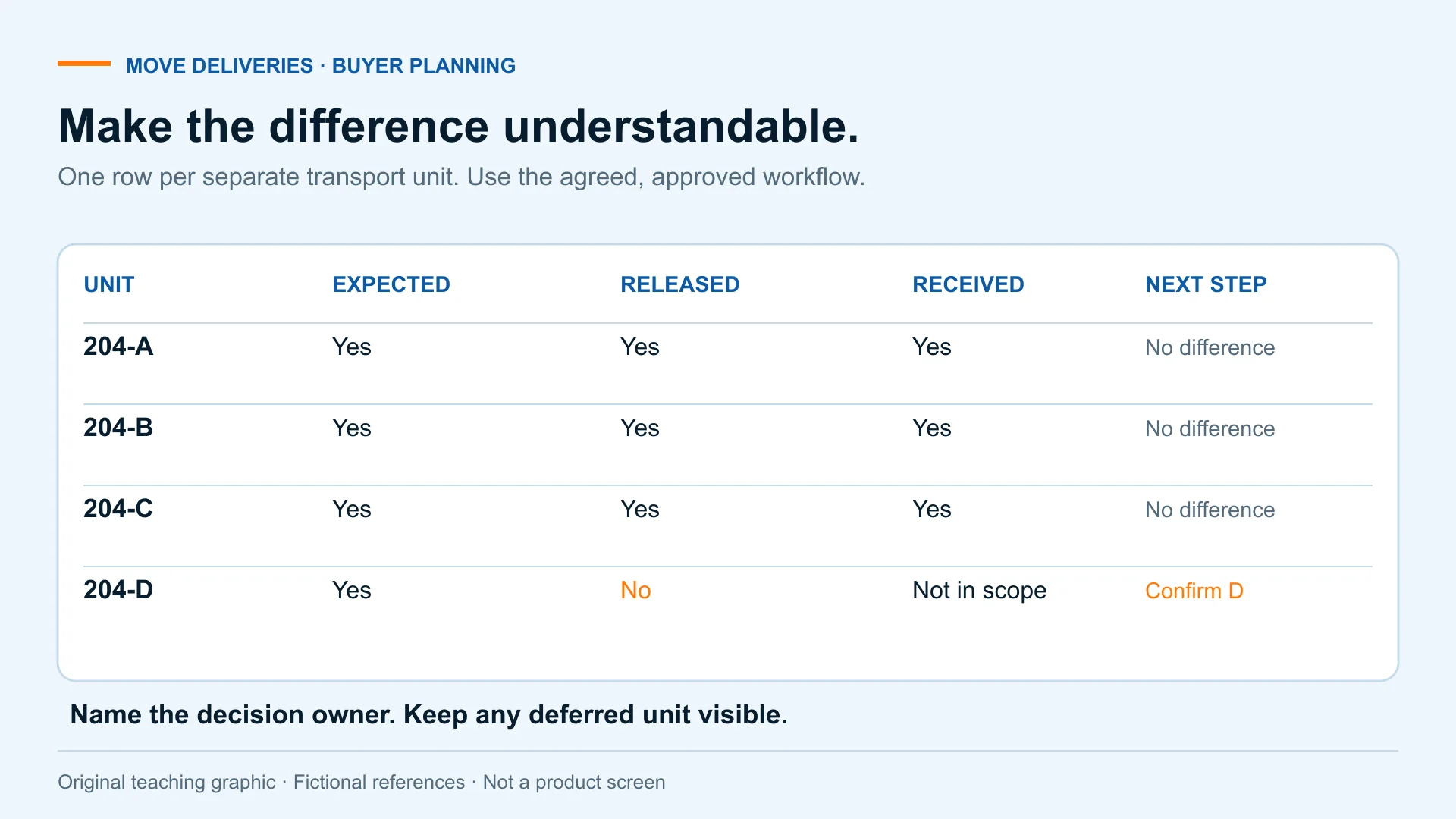
Copy the following structure into an approved internal planning tool. Use one row for each separately handled unit, not one row for each product inside it. Keep the delivery reference, planned receiving point, authorized decision contact and preparation version alongside the rows. The table is a buyer tool; it is not a product screenshot or a required MOVE field list.
| Unit reference | Expected at release | Actually released | Observed at receiving | Difference / next owner |
|---|---|---|---|---|
| TRAIN-204-A | Yes | Yes | Yes | No difference noted |
| TRAIN-204-B | Yes | Yes | Yes | No difference noted |
| TRAIN-204-C | Yes | Yes | Yes | No difference noted |
| TRAIN-204-D | Yes | No | Not part of this movement | Deferred by authorized contact; separate plan needed |
Add a concise decision note for any difference: what was observed, which unit it affects, who authorized the next step, when that decision was recorded and how the remaining work will be confirmed. Avoid unrelated contents details. If a field cannot be verified, use “not verified” rather than assuming that it agrees with the other columns.
- Define the outer transport unit and the expected total.
- Connect each separate unit to the correct delivery reference.
- Check the released set against the accepted scope.
- Use the same unit language at the receiving point.
- Name the exception owner and approved communication path.
- Connect the completion information to the units actually involved.
- Keep deferred work visible until its own plan is confirmed.
A fictional supplier example: three delivered is not four fulfilled
A medical supplier requests a local delivery of four prepared cartons. The pickup contact finds three at the agreed collection point. The fourth is still being prepared elsewhere. No unit has been lost in transit at this stage: the discrepancy is between the original expectation and the available release set. That distinction changes the first question the team should ask.
The responsible customer contact and provider confirm that cartons A, B and C can move under revised instructions. Carton D is deferred, with a separate movement to be confirmed. The outgoing worksheet identifies the approved three-unit scope and keeps D visible. This is an assumed decision in a teaching example, not a statement that partial service is automatically available.
At receiving, staff identify A, B and C. Their observed set matches the released set. The original four-carton request is still not fully fulfilled, because D has not moved. An account contact can now explain both facts without blaming the courier for a unit never collected or telling the customer that everything arrived.
Now change one fact: receiving can identify only A and B. The release set still contains A, B and C, so C needs review. Start with its reference, the release information and the actual receiving observation. Do not close the question because the stop shows completed, and do not dispatch a replacement blindly before the responsible parties have checked the available facts.
The same worksheet supports both situations, but the next action is different. A deferred package requires a confirmed remaining-work plan. A receiving discrepancy requires a focused unit review. Neither total alone tells that story. The value of the tool is the relationship between the expected, released and received sets.
Multi-piece medical delivery questions
Do all separate packages need a new barcode?
Not necessarily. Confirm the identification process supported by the shipper, receiving team and courier. Existing approved references may be useful. Do not introduce a competing label or a standard-specific identifier without the responsible organization’s agreement. The requirement in this worksheet is distinguishable units, not a claim that MOVE supports a particular barcode standard.
Can a courier collect three packages when four were requested?
Only under the accepted instructions and any required authorization for the changed scope. Do not assume that a partial release, later collection or revised receiving plan is available. Record the difference and confirm the next step with the authorized contact and provider.
Does an outer-package count verify the medical contents?
No. It describes the transport units observed under the agreed process. Content accuracy, packaging suitability and clinical or product acceptance remain separate responsibilities. A count of three sealed totes does not establish which products or orders are inside them.
Can tracking alone confirm every piece arrived?
No. Live tracking helps follow delivery progress; it does not replace receiving reconciliation. Review the supported completion information and compare it with the actual released units. Ask how unresolved differences are handled for your arrangement.
Put a clear count behind your next local delivery
Bring the unit description, expected count, pickup readiness, receiving instructions and exception contact to the service conversation. MOVE coordinates local same-day medical delivery through our proprietary platform. Confirm the route, accepted work and documentation available for your account rather than assuming that a general feature description covers every multi-piece requirement.
For a new delivery scope, request a Quick Quote. For an ongoing arrangement, Start An Account and discuss the preparation and receiving process your team needs. Clear package counts do not remove every exception. They give the right people a better starting point when a question needs an answer.