
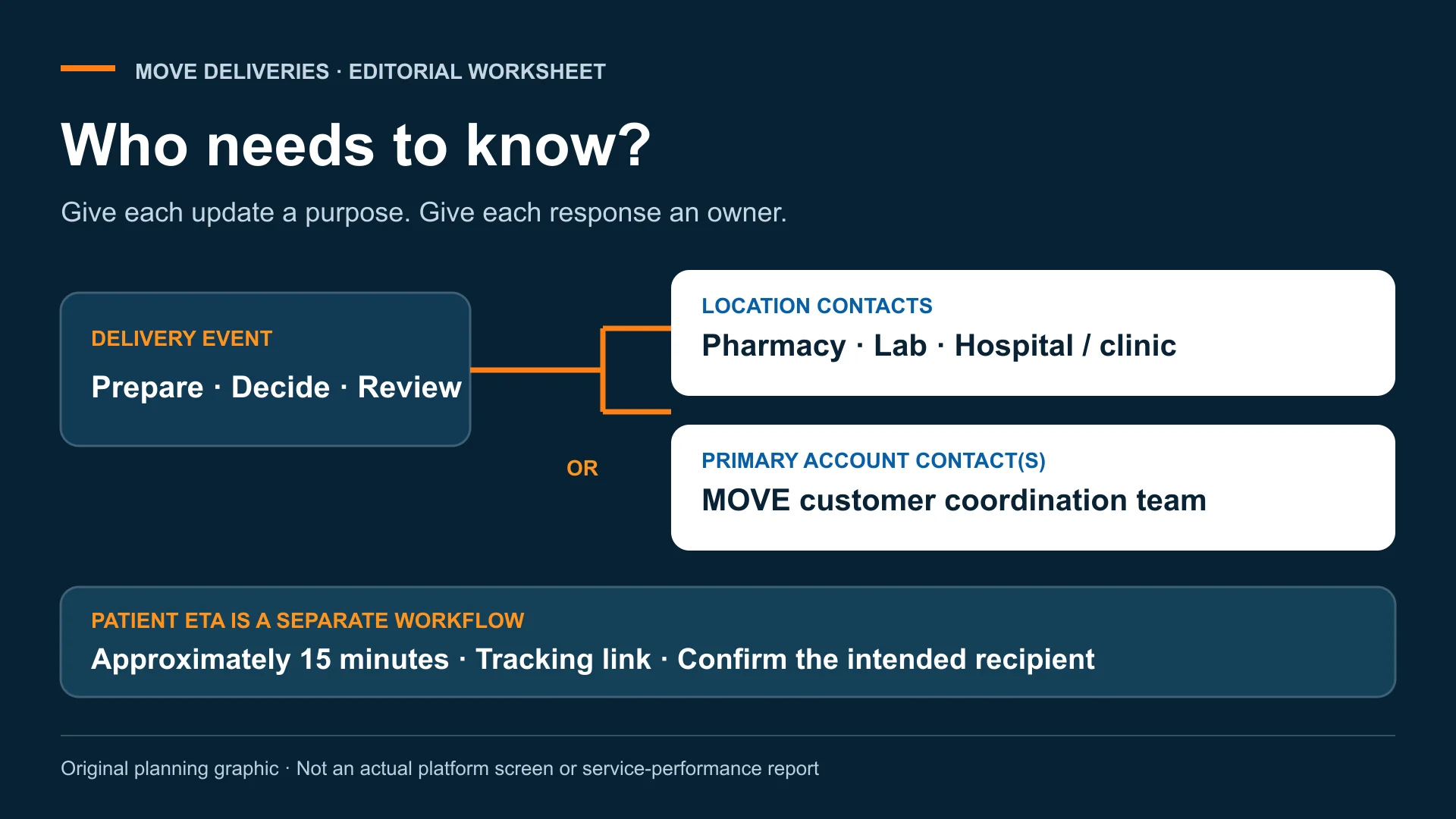
Medical delivery notification recipients should be chosen by the action they need to take—not by how many people you can add to a contact list. A pharmacy manager, a laboratory receiving team and the primary account contact may need different updates about the same local delivery. Give each message a purpose, each decision an owner and each recipient a clear next step.
More messages do not automatically mean better communication. A clinic may receive every update but still not know who should meet the courier. An account manager may see an exception after the location has already acted. A patient may receive an arrival estimate without knowing where to check progress. The useful question is simple: who needs this information to prepare, decide or confirm?
This guide gives healthcare operations buyers an original recipient-routing worksheet, an exception acknowledgment plan and a practical prelaunch test. It is about operational delivery communication, not clinical advice, a legal compliance assessment or a claim that every provider offers the same notification features. The examples are fictional and contain no actual shipment or patient information.
View the recipient-routing graphic at full size.
Start with one question for every recipient
Ask, “What should this person do differently after receiving the update?” If the answer is nothing, reconsider whether they need that routine notification. A receiving desk may need to prepare for arrival. A release coordinator may need to resolve an access question. The account owner may need to approve a requested service change. Those purposes belong in the plan before you discuss channels or message frequency.
Separate an action recipient from an awareness recipient. The first owns a response; the second needs context but is not being asked to decide. A message copied to both roles should still identify who acts. Otherwise, everyone can reasonably assume someone else is handling it. Adding another address does not repair that ambiguity.
Write the purpose in ordinary language: “Prepare the receiving desk,” “Contact dispatch about access,” or “Review the completion record.” Avoid vague instructions such as “Please handle.” The reader should not have to reconstruct the entire delivery history to understand what the message is asking them to do.
Location contacts or primary account contacts?
A location contact works at, or is responsible for, a specific pharmacy, laboratory, hospital or clinic. That person may know the entrance, release point and receiving routine better than the central account team. Direct operational updates can be useful when the site itself needs to prepare or respond. The contact still needs a defined role and current instructions.
A primary account contact oversees the customer relationship or the delivery program across locations. Centralizing routine messages can fit an organization that wants one team to coordinate its sites. It can also create an extra relay: the account contact sees the update, interprets it and informs the location. Confirm who performs that relay when the primary contact is unavailable.
MOVE’s system can notify location contacts or just the primary MOVE customer account contact or contacts. Discuss the recipient arrangement and available updates during setup. Do not assume that choosing a location contact also grants account-wide visibility, or that every alert can be independently routed to any combination of people. Ask the team to demonstrate the configuration that applies to your service.
For multi-site programs, begin with the organization’s preferred recipient scope and identify any operational gaps it creates. If an additional routing option is needed, confirm it with the provider rather than writing it into the worksheet as an available feature. A useful plan describes both the requested outcome and the actual arrangement the provider has accepted.
Build a medical delivery notification recipients worksheet
Use the table below as a conversation tool. Complete one row for each relevant event and site, then review the proposed recipients against the configuration available for your account. “Action owner” is an organizational responsibility; it does not imply that the platform automatically assigns tasks, tracks acknowledgments or creates the escalation described here.
| Event or question | Recipient purpose | Action owner to name | Decision to confirm |
|---|---|---|---|
| Pickup recorded | Understand that collection has occurred. | Site or account role reviewing progress. | Which available update reaches the selected recipient scope? |
| Approaching a receiving location | Prepare the agreed receiving point. | Receiving coordinator for the current shift. | How does that person receive timely context? |
| Access or recipient question | Clarify the instruction with dispatch. | Designated operational contact and backup. | Who acknowledges the issue and who may approve a change? |
| Patient arrival estimate | Prepare for an expected home handoff. | Patient or approved recipient under the agreed workflow. | Are the contact details and tracking-link arrangement confirmed? |
| Completion recorded | Review the configured handoff evidence. | Authorized record-review role. | Where does the person find proof of delivery if they need it? |
Add the contact-list owner, backup procedure, operating hours, last review date and effective instruction version. Keep real names and contact details in the organization’s approved system, not in a publicly shared worksheet. The article’s table provides the structure; your team supplies the current authorized information.
A notification, a tracking link and proof of delivery answer different questions
A notification brings attention to an event or question. Tracking supplies available journey context. Proof of delivery supplies the configured completion evidence. A person can receive an update without opening a tracking link, and an arrival estimate can change before the handoff is complete. These tools work together, but one should not quietly stand in for another.
For example, a “pickup recorded” update can tell the account contact to follow progress. It does not establish that the receiving site is ready. A tracking position near a building does not establish that an authorized recipient accepted the shipment. A completion message can direct a reviewer to a record; the message alone may not contain the evidence the reviewer needs.
Set expectations before launch. Explore MOVE’s live tracking information and electronic proof of delivery with the team responsible for your arrangement. Ask what a recipient can see, where they find the record and how they ask a question when the information does not resolve it.
Plan the approximately 15-minute patient ETA update
MOVE can send patients an ETA update when the courier is approximately 15 minutes away, with a tracking link. That gives the recipient an opportunity to follow the delivery and prepare for arrival. Treat the estimate as preparation information, not an exact appointment or a guaranteed delivery time. Conditions can change between the estimate and the door.
Before using the update, confirm the intended recipient, current contact details, approved communication workflow and any handoff instructions. Decide who handles an unanswered arrival question. Do not assume a patient can reply to the notification, change the destination through the link or reach the driver directly unless those capabilities have been confirmed.
Use plain language in any approved message template. A fictional planning example is: “Your courier is approximately 15 minutes away. Follow the delivery using the tracking link and prepare for arrival.” Add the agreed support direction where appropriate. Do not paste medication, diagnosis or other unnecessary sensitive details into a routine status template.
A timing alert cannot decide whether a shipment may be left unattended, accepted by another person or returned. Those instructions need their own approved handoff plan. For a broader discussion, use our pharmacy home delivery handoff guide. Keep the ETA message focused on preparation rather than asking it to resolve every delivery decision.
Make the next action easier to understand
The CDC Clear Communication Index guidance starts with the intended audience, communication objective and main message. It also emphasizes understandable wording and a clear action. It is a public communication resource, not a courier-platform standard or evidence that a particular delivery message improves clinical outcomes.
Apply that planning lens to operational updates: state the current event, identify the delivery through the approved reference, and explain the relevant next step. A site contact should not need to decode an internal dispatch abbreviation. Where a time matters, make the local time or estimate understandable instead of leaving the recipient to infer it.
Separate “for awareness” from “action needed.” A routine progress update should not sound like an emergency. An access question should not be buried under a cheerful completion-style heading. Avoid promising that a problem is resolved simply because a notification was sent. Use the wording and reply or support instructions the provider has approved for the actual channel.
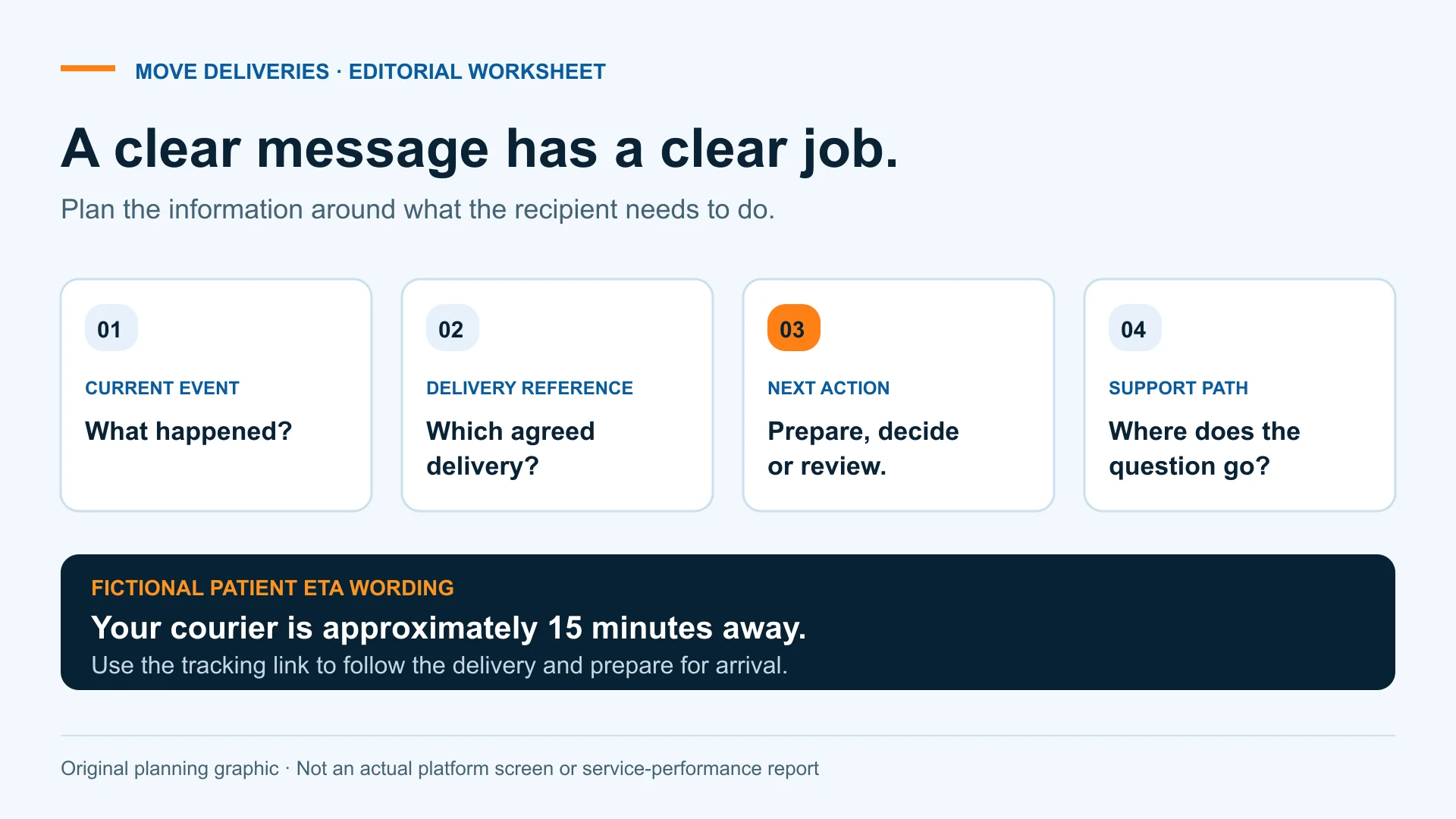
View the message-design graphic at full size.
Give exceptions an owner—not just an audience
For an exception that requires a response, name the person or role that acknowledges the issue, the backup and the authorized decision maker. These can be different people. A receptionist may confirm an entrance instruction; an account manager may need to approve a requested extra stop. Seeing an alert does not automatically supply authority to change the accepted delivery plan.
Agree how the operational contact reaches dispatch and how the next action is confirmed. The AHRQ TeamSTEPPS communication overview describes check-backs that verify shared understanding. Its context is healthcare teamwork and patient-care communication. The limited planning lesson here is to confirm an important instruction rather than assume that sending it completed the exchange.
For example, an alert may identify an access problem. The contact clarifies the approved entrance with dispatch; dispatch confirms the current instruction and next step through the agreed process. That is an organizational acknowledgment plan, not a claim that MOVE automatically records read receipts, runs acknowledgment timers or escalates unanswered messages.
Set a follow-up point suited to the accepted service and operating hours. This article does not recommend a universal response interval. If the primary contact is off shift, a maintained backup should be able to identify the current instruction and the person authorized to act. A longer copied-recipient list is not a substitute for that arrangement.
Keep the contact list as current as the route
Assign an owner for recipient details. Staff changes, shared-device handovers and altered receiving hours can make a previously correct contact unsuitable. Review the list when a site opens, a role changes or an exception exposes a gap. Ask how updates are submitted, checked and made effective for your account before relying on a new address or number.
Distinguish a role from the person covering it. “Lab receiving coordinator” may remain the right role while the person and shift change. Document the primary and backup coverage through your approved internal process. A former employee’s address should not remain the hidden bridge between dispatch and the current receiving team.
Test with non-sensitive demonstration details. Confirm the intended person receives the relevant information and knows the next step. Record a failed test honestly; do not mark the setup complete because the system accepted an address. If delivery or acknowledgment evidence is unavailable in the chosen channel, identify a practical verification method with the provider.
Run six recipient tests before depending on the messages
First, walk through a routine delivery to one site. Can the selected recipient explain what the update means and what, if anything, they should do? Second, use the account-only arrangement in a demonstration. Can the account team describe how information reaches the site when the local team needs to prepare?
Third, make the primary contact unavailable in the exercise. Identify the actual backup and follow-up channel without improvising new access. Fourth, simulate an access question using fictional details. Confirm the receiving person distinguishes acknowledgment from authorization and knows how an accepted instruction is confirmed.
Fifth, review a patient ETA message and tracking link with the responsible team. Check the wording, intended recipient and support path without sending a demonstration to an actual patient. Sixth, compare a completion update with the configured completion record. Verify that the reviewer knows where evidence lives and what the message itself does not prove.
Write the result of each exercise as pass, needs revision or not available. Include the observation and action owner. These are setup tests, not clinical validation, a certification checklist or a measured service-performance report. Repeat the relevant exercise after a material recipient, channel or instruction change.
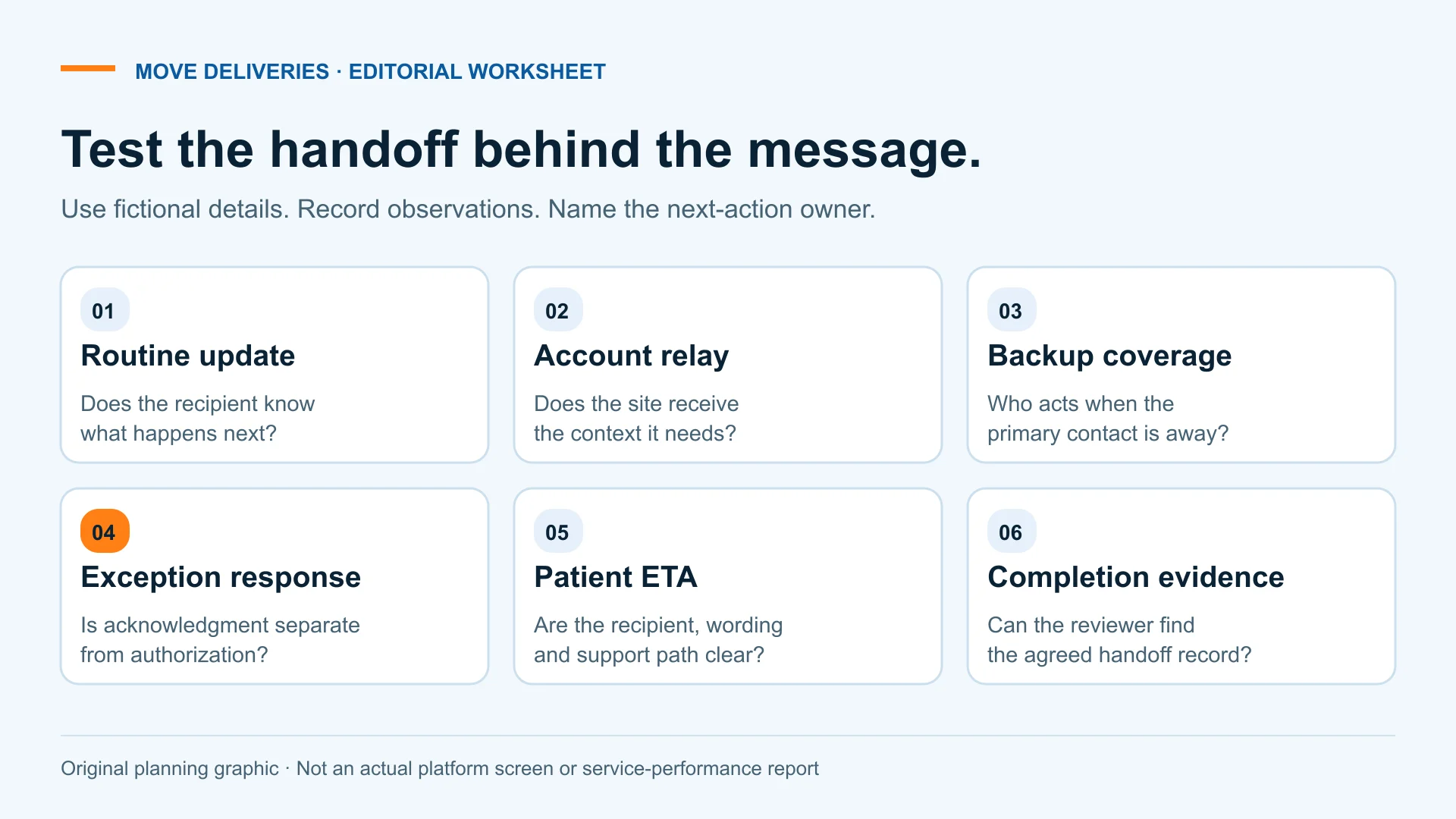
View the recipient-test graphic at full size.
A fictional two-location example
Imagine a pharmacy group with one central delivery coordinator and two local receiving teams. It chooses account-only routine notifications. The central coordinator owns the relay that prepares each location. The setup exercise reveals that the coordinator is unavailable during one site’s later receiving period. The issue is coverage of the relay—not the volume of messages.
The group names a backup through its approved account arrangement and tests the relay again. It also asks MOVE whether a different available recipient configuration would better fit the program. It does not assume a new feature exists or add unrelated people to a group message. The objective is a responsible person with current information at the time the location needs it.
For a home delivery, the approved recipient receives an approximately 15-minute ETA update with a tracking link. The business team’s selected account notification arrangement remains a separate setup question. A patient arrival update is not evidence that every business contact is notified, nor is it permission to change the handoff instructions.
Common recipient-planning questions
Should every location receive every update?
Not necessarily. Choose the available recipient scope that fits the organization’s workflow, then assign responsibility for any internal relay. A location may need preparation information while the account team manages the broader relationship. Confirm which updates and routing options are supported rather than assuming every event can be separately configured.
What if the expected update does not arrive?
Use the agreed status and support channels to clarify the delivery. Check the current recipient details and configuration with the responsible team. A missing message does not prove that pickup or delivery did not occur. Likewise, a sent message does not prove that the intended person understood or acted on it.
Can a notification approve a delivery change?
Do not treat awareness as authorization. Confirm who may request or approve a change and how dispatch accepts the new plan. A person copied on a status update may have no authority over the destination, recipient, return or additional work. Keep approval separate from routine progress communication.
Bring the right people into the delivery conversation
Bring the locations you serve, the questions staff repeatedly answer and the roles that need preparation or decision information. MOVE can discuss local same-day delivery and the recipient arrangement available through our proprietary platform. Nationwide driver presence does not replace route-specific availability confirmation.
For a single local delivery, begin with Quick Quote. For recurring pickups or a multi-location program, Start An Account. Explore our pharmacy and laboratory solutions, and confirm the actual delivery addresses through MOVE locations. Keep inquiry details operational; public inquiry forms are not a channel for patient records.