
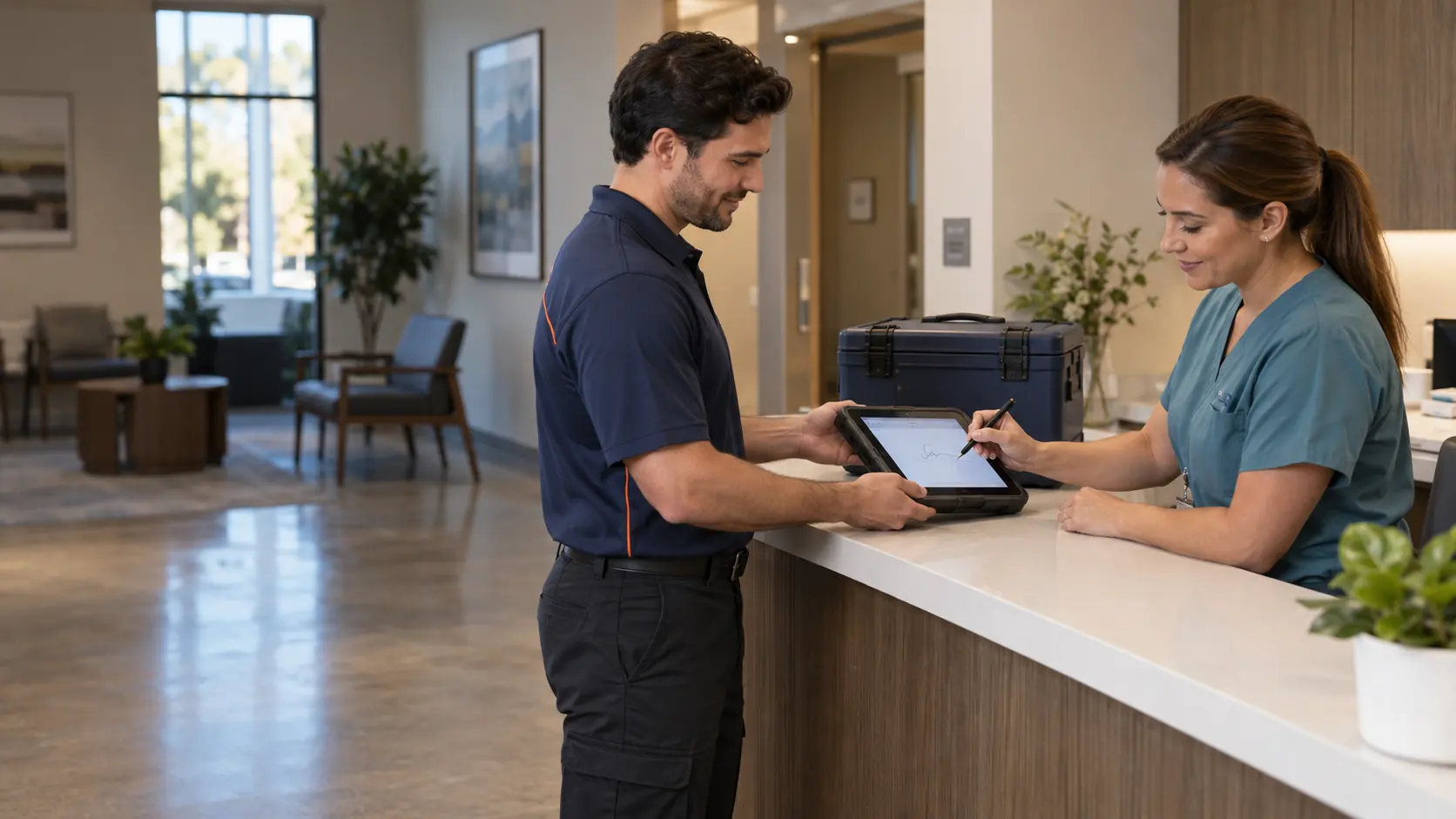
Close the delivery. Open the record.
Delivered.
With a record
to back it up.
Electronic proof of delivery through MOVE’s proprietary platform. Connect the delivery to the recipient, completion time and evidence agreed for your service—so your team has a clearer answer when someone asks.
Local same-day delivery. Clear receiving instructions. A record to reference.
“Delivered” shouldn’t start another round of calls.
Who received it?
Your team deserves a better answer.
A pharmacy needs to confirm receipt. A lab needs to reconcile a pickup. A hospital receiving desk wants the delivery reference. A completed status is a starting point—not the whole answer. Put the available completion details in one record your team can review.
Who accepted it?
The configured recipient details.
What was recorded?
The evidence required for your delivery.
Which delivery was it?
A consistent reference to follow.
Look past the completion flag.
One delivery.
The details behind it.
Explore a clinic, pharmacy or lab receiving example. The setting changes. The question stays the same: does the record give your team what it needs to confirm what was received?
One journey. A documented finish.
Who accepted it at the clinic?
Connect the receiving role, delivery completion time and signature to the delivery reference. Your team has one record to review—not three different recollections.
- Pickup recorded
The journey starts.
- Courier arrived
At the receiving location.
- Delivery recorded
The configured evidence is recorded.
Arrival tells you where the courier is.
The delivery record documents receipt.
MOVE Deliveries
Delivery record
- Received by
- Receiving attendant
- Completed
- 2:18 PMPacific time · Sample record
- Receiving point
- Clinic reception
- Delivery item
- Sealed medical transport tote
Receiving role confirmed.
No signature required in this example.

Answer the question. Keep the day moving.
Less piecing it together.
More clarity when it counts.
When someone questions a delivery, how much of your day disappears finding the answer? A message to the driver. A call to the receiving desk. Another search for the right order. Your staff have more important work than reconstructing a delivery from memory.
MOVE’s proprietary platform brings the available completion evidence together around the delivery reference. Customer service and operations can review the same record, compare it with the receiving instructions and identify the question that still needs an answer.
A useful record supports the conversation. It doesn’t replace judgment.
Talk through your delivery needsA signature is a detail. The workflow gives it meaning.
The right evidence.
For the right delivery.
One receiving rule won’t fit every doorstep, laboratory desk or hospital department. Define what completion means before the courier arrives—not after your team needs to explain it.
Know who can receive it.
Agree on the authorized receiver, location and instructions. A name on a record is useful when it matches the receiving instructions you agreed on.
Choose the proof that matters.
Recipient details, completion time, a signature or a permitted photo can answer different questions. Confirm what your program needs and which information is appropriate.
Keep an exception an exception.
Nobody available? Entrance changed? Follow the agreed escalation process. An attempted delivery should not look like an ordinary completed delivery.
A documented finish is part of a bigger story. Proof of delivery captures the configured final handoff. Chain of custody connects the pickup, transfers and exceptions around it.
Explore chain of custodyMake the record useful. Keep the details appropriate.
Document the delivery.
Not the patient’s story.
Your team needs enough information to confirm receipt—not every piece of information that could be collected. Keep proof fields and photographs focused on the approved delivery purpose. Review access and information requirements as part of your workflow.
Permitted information.
Agree on recipient details and photo content. Avoid unnecessary patient identifiers, clinical history or visible sensitive documents.
Authorized access.
Confirm who needs to review completion evidence and the access process for your program. Revisit that plan when responsibilities change.
Records that remain usable.
Review retrieval, retention expectations and the support path for questions. Do not assume one record-access or storage rule applies to every service.
Start with the answer your team needs.
What should “delivered”
mean for your operation?
Tell us who is receiving, what needs to be recorded and what happens if receiving plans change. We’ll work through the proof-of-delivery requirements for your local service.
- 01
Define the receiver.
Who is authorized to accept the delivery? Confirm the desk, contact, hours and fallback instructions.
- 02
Agree on the evidence.
Choose the recipient details, timestamp, signature or permitted photo appropriate to your program.
- 03
Plan for the exception.
If nobody can accept the delivery, name the contact who can confirm what to do next.
- 04
Make the record useful.
Review who can access completion evidence and how your team will handle a question afterward.
Better questions. Clearer records.
Before you close the loop.
Electronic proof of delivery, recipient rules and the details worth agreeing on before your first delivery.
What is electronic proof of delivery?
Electronic proof of delivery, or ePOD, is a digital record of delivery completion and the required receiving evidence. It connects a delivery reference with completion details such as a recipient, timestamp, signature or permitted photo. MOVE’s proprietary platform brings the available evidence together so your authorized team can review what was recorded.
What can a MOVE proof-of-delivery record include?
The record can include recipient details, a signature, a photo or a completion timestamp according to your service requirements. Confirm the fields, evidence and receiving procedure for your program before deliveries begin. Not every field or proof type is required on every delivery.
Is a signature required for every medical delivery?
Not necessarily. The service defines the authorized recipient and required evidence. A signature, recipient confirmation, timestamp or permitted photo may be appropriate. Agree on those requirements with MOVE instead of assuming one rule applies to every pharmacy, laboratory or hospital delivery.
Does a tracking pin or arrival update prove delivery?
No. A location or arrival event provides journey context; it does not by itself establish recipient acceptance. The required receiving procedure must be completed and the configured evidence recorded. Live tracking, delivery notifications and proof of delivery answer different questions.
Can electronic proof of delivery help with a customer inquiry?
Yes. The available record gives customer service and operations a shared reference when reviewing who received a delivery, when receipt was recorded and what evidence is attached. Review it alongside the original request and instructions; no single proof field answers every possible dispute.
What happens if nobody can accept the delivery?
Follow the receiving and escalation procedure agreed for your service. An unavailable recipient, changed entrance or unsuccessful attempt should not be represented as a normal completed delivery. Contact the designated operations or dispatch support contact to clarify the next step.
How is proof of delivery different from chain of custody?
Proof of delivery documents the final configured receiving handoff. Chain of custody connects the broader sequence of pickup, transfer, exception and completion events. A completion record is one part of that sequence, not a substitute for every custody event.
Should the record include patient or clinical information?
Collect only the information appropriate to the approved delivery workflow. Review permitted fields, photo content, authorized access and your organization’s privacy requirements. A useful operational record should not gather unnecessary clinical information. Public quote and account forms are not a PHI intake channel.
Can our team access or retain delivery records?
Discuss record access, retrieval, available formats and retention expectations with MOVE during setup. Confirm which roles need the evidence and the agreed process for reviewing a discrepancy. This page does not promise a universal download feature or a fixed retention period for every program.
How do we set up electronic proof of delivery with MOVE?
Tell MOVE where your local deliveries go, who receives them and which questions your team needs the record to answer. Review recipient rules, required evidence, exceptions and authorized record access as part of the service conversation.
Clearer proof starts with a clearer plan.
Your next delivery.
An answer your team can use.
Single point-to-point order
One pickup. One destination.
Use Quick Quote for a single STAT or Milk Run order. Share the route, packages and timing, then confirm the receiving requirements.
Quick QuoteOngoing delivery support
Delivery built around your team.
Start An Account for recurring pickups, fixed routes or dedicated courier coverage. Discuss the proof your receiving and operations teams need.
Start An Account