
Last-mile delivery service levels describe the work a customer and courier have actually agreed to assess. “Fast,” “reliable” and “same day” can introduce a service, but they cannot settle every contract question. You need a defined starting point, an accepted destination requirement and evidence that shows what happened between them.
For a healthcare buyer, the final local leg is not just a van reaching an address. A releasing team must be ready, access must work and the receiving role must be available. A delivery contract that ignores those dependencies leaves staff arguing about whose clock started first instead of making the next handoff clearer.
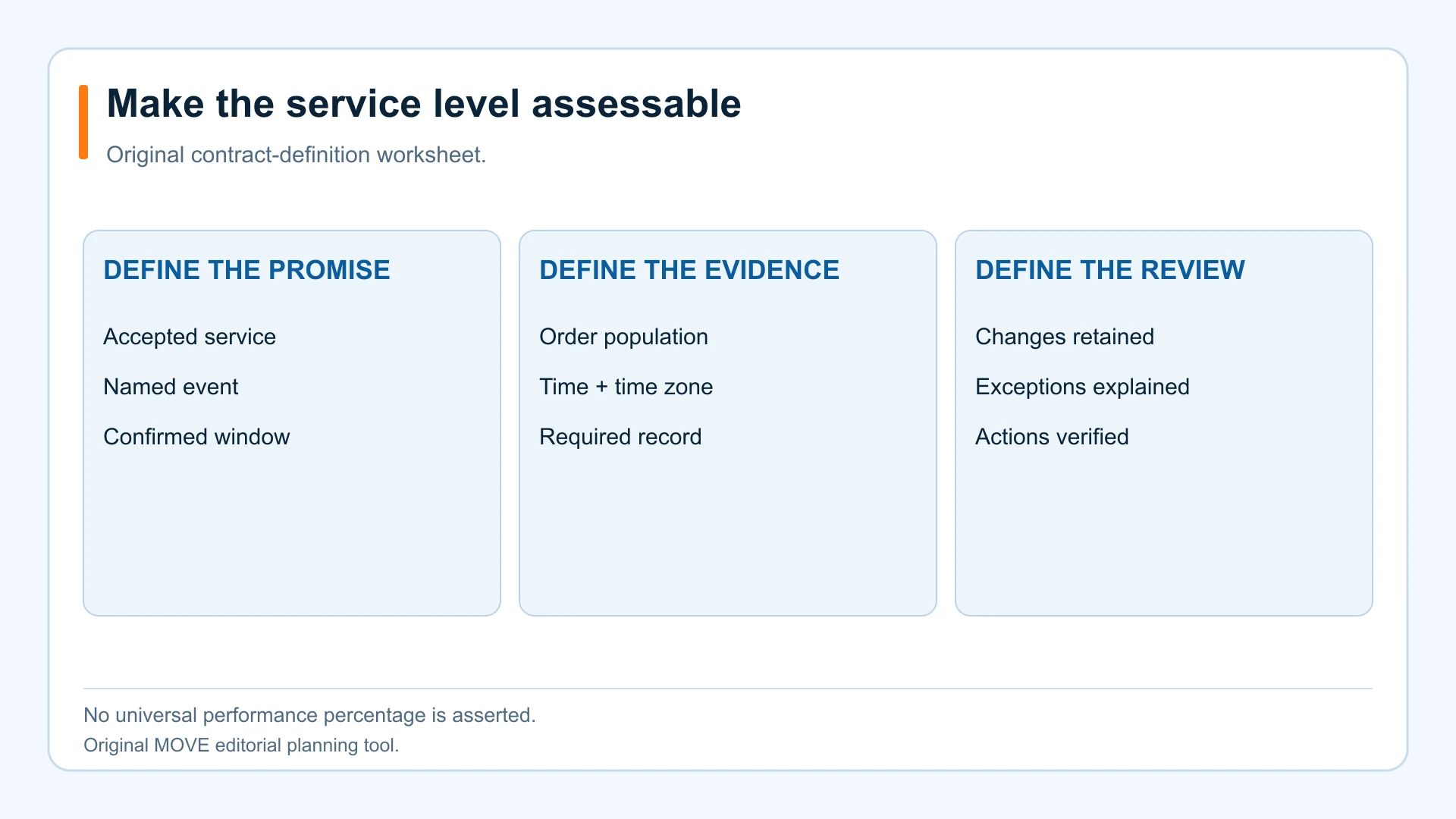
This article provides an original service-level drafting worksheet, a source-based retail market graphic and a fictional acceptance test. It does not offer a universal delivery guarantee, legal contract language or clinical transport criteria. Have procurement, operations, privacy and qualified technical reviewers approve the arrangement appropriate to your organization.
Use market data for context, not a service promise
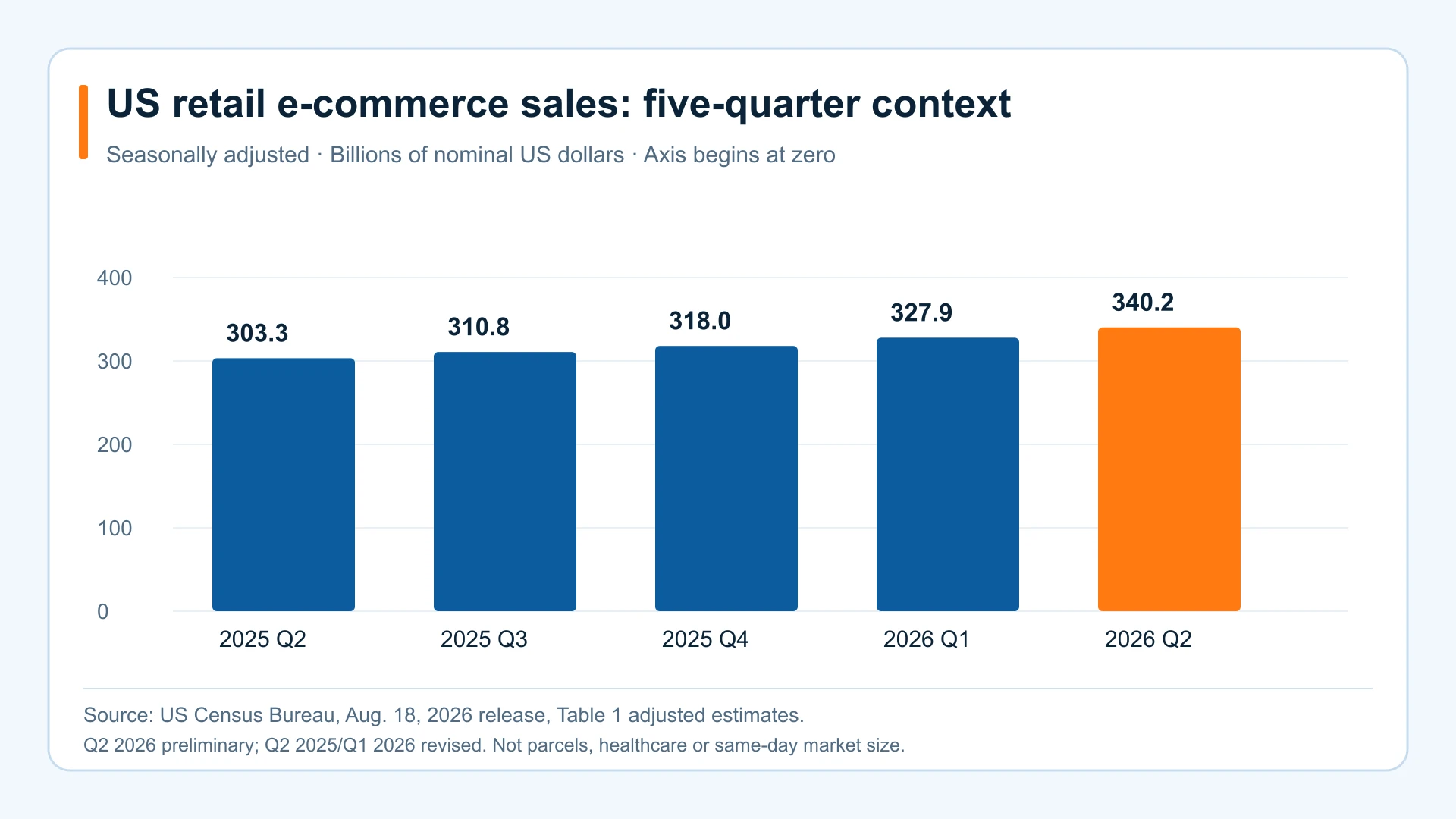
The Census Bureau’s August 18, 2026 release estimates seasonally adjusted US retail e-commerce sales of $340.244 billion for the second quarter of 2026. The comparable published estimate for the second quarter of 2025 is $303.284 billion. These are sales-value estimates for retail employer businesses, not counts of parcels, same-day orders or medical deliveries.
Our graphic uses the same release’s adjusted quarterly series. The second-quarter 2026 estimate is preliminary and the first-quarter 2026 and second-quarter 2025 values are revised. The values are not adjusted for price changes. Keeping those labels matters: nominal sales growth is not proof that physical shipment volume grew at the same rate.
The practical buyer lesson is narrower than a market-size claim. A broad delivery environment does not explain your particular receiving requirement. Do not infer medical-courier demand, a national same-day market share or MOVE capacity from retail spending. Use your own authorized order pattern to specify the local work, then ask a provider to confirm what it can accept.
| Quarter | E-commerce sales | Share of total retail | Release note |
|---|---|---|---|
| 2025 Q2 | $303.284 billion | 16.3% | Revised estimate |
| 2025 Q3 | $310.817 billion | 16.4% | Published adjusted series |
| 2025 Q4 | $317.999 billion | 16.7% | Published adjusted series |
| 2026 Q1 | $327.861 billion | 17.0% | Revised estimate |
| 2026 Q2 | $340.244 billion | 17.1% | Preliminary estimate |
Method: divide Table 1’s million-dollar values by 1,000 for billions. Calculated year-over-year e-commerce growth is approximately 12.2%; the published share rises by 0.8 percentage points, not 0.8% growth. Census is the source of the input data, not the author of this operational analysis. Sampling, nonsampling error and future revisions remain relevant.
Define the accepted service before the service level
List the locations, transport units, handling responsibilities and access conditions that belong to the arrangement. An assessment of “on-time service” is difficult to interpret if staff can change the destination, add units or request extra loading assistance without recording a scope change. Start with the work the provider accepted, not an unlimited description of everything the buyer might eventually need.
Separate standard included work from work requiring further acceptance. That distinction can cover additional stops, changed release points, waiting, attempted handoffs, return movements and equipment requirements. The goal is not to make every exception expensive. It is to let both organizations identify when the original plan no longer describes the task.
Confirm availability at the actual sites. National presence, a state map and a service category are useful ways to start a conversation; none individually establishes that a particular location, vehicle and receiving window have been accepted. Our locations information should lead to a local confirmation, not replace it.
Choose the event that starts the clock
A request being entered, a provider accepting it, a shipment becoming ready and a courier collecting it are four different events. Your service-level document should say which event begins each assessed interval. If readiness occurs later than expected, preserve that fact rather than silently moving the original start time or blaming whichever party appears first on the report.
Write the start event in operational language. For instance, a pickup-window assessment may compare the recorded collection event with the accepted pickup window. A transit assessment may begin at the agreed physical collection event. A response assessment may begin when a complete request reaches an approved monitored channel. These are drafting examples, not claims about MOVE’s contract terms.
Specify what happens when an event is missing or cannot be verified. An incomplete record should not automatically count as meeting a target. Keep evidence completeness visible alongside service timing, and assign a review owner. Otherwise, the arrangement rewards whoever can edit a timestamp instead of whoever can explain the handoff.
Describe completion in terms the receiving team can recognize
A vehicle arriving near a destination is not the same event as an agreed recipient accepting a shipment. Define which event marks completion and which evidence supports it. Include the receiving location, role and approved exceptions if relevant. Avoid a vague “delivered” label that means something different to dispatch, finance and the person working at the receiving desk.
Discuss what an attempted handoff means. The courier may reach the specified location while the authorized recipient is unavailable. That observation needs a record and next action. It should not be silently presented as successful recipient acceptance, nor automatically become a clinical determination about what must happen to the shipment.
Explore electronic proof of delivery to understand the operational questions a handoff record can address. Confirm the actual evidence available for your arrangement. Courier completion does not independently establish specimen acceptance, medication suitability or clinical use of a device.
| Contract element | Decision to document | Test to run |
|---|---|---|
| Eligible work | Which accepted orders, sites and service types belong in each assessment? | Reconcile the report with an authorized order sample. |
| Start event | Which observation starts the interval, and who records it? | Follow a request that becomes ready later than planned. |
| Completion evidence | Which handoff event counts, and what is required to verify it? | Compare a normal receipt with an attempted handoff. |
| Approved change | Who may revise the scope or commitment, and how is acceptance recorded? | Review a destination change after the original acceptance. |
| Exception response | Who must receive the issue, decide the next action and close the record? | Rehearse an unavailable receiving contact. |
| Measurement period | Which date basis, time zone, numerator and denominator apply? | Check an order crossing midnight or a period boundary. |
| Commercial remedy | Which verified event triggers a contract remedy or billing review? | Match the agreed clause to its evidence, with procurement review. |
Keep the original promise and approved revisions
A service plan can change legitimately. The releasing site may alter readiness, or the destination may confirm a different receiving arrangement. Record the original commitment, the proposed change, its decision owner and the provider’s acceptance. The current instruction should be clear, while the prior version remains explainable where appropriate.
Do not let a deadline changed after completion automatically determine the historical result. Agree how the assessment treats revisions and distinguish approved operational changes from retrospective corrections. The reporting process should not erase the reason the plan changed. A revised arrival can be reasonable and still reveal a recurring coordination problem worth addressing.
Identify changes the driver can report but cannot authorize. A driver at the doorstep may discover a different department or an additional transport unit. That observation belongs in the agreed escalation process. The receiving organization and courier coordinator should resolve the scope question within their authority rather than expecting a rushed improvised answer from the driver.
Measure response and resolution separately
Notifying a buyer of a problem and resolving that problem are different outcomes. Your service-level discussion should describe both where needed. A message may reach the approved contact promptly while the shipment remains held awaiting a qualified decision. Calling that entire exception “closed” would conceal the remaining responsibility.
Use a maintained escalation chain with role names, approved channels and backups. Discuss the response intervals appropriate to the actual arrangement rather than importing a universal number from an unrelated service. Confirm what acknowledgment means: message received, action proposed, action authorized and revised work accepted should not collapse into one ambiguous confirmation.
A resolution record should identify the outcome and any remaining owner. A shipment returned through an accepted process may close the transport task while leaving a separate clinical or inventory decision open. Keep those records linked through appropriate references without claiming that one organization’s closure resolves every other organization’s obligation.
A fictional contract test before signing
Imagine a fictional clinic request accepted for a specific release point and receiving window. The clinic later proposes an extra stop, but the destination for that stop has not confirmed access. Ask the team to show which part of the existing order remains accepted, which proposed work is awaiting a decision and how the driver receives the current instruction.
Then add a missing completion record. The physical handoff may have occurred, but evidence is incomplete. Ask how the report treats that uncertainty, who investigates it and whether a correction preserves history. Do not supply an invented successful record just to make the demonstration finish neatly. The uncertain case is often where a contract’s definitions become most useful.
Finally, review an invoice containing additional work. Can finance trace it to an accepted change and relevant transport event? If not, the problem may be a missing authorization record rather than the rate itself. This three-part test connects scope, evidence and commercial assessment without needing a large production dataset or real patient information.
Choose a small set of measures you can explain
Give every reported measure a named owner and version date. When the organization changes its definition, preserve the previous basis and explain the change before comparing periods. A cleaner chart is not a reason to overwrite the history that makes the comparison meaningful. Procurement should be able to tell whether a trend reflects changed service, changed workload or simply changed measurement.
Favor a manageable set: accepted workload, verified pickup timing, agreed completion timing, unresolved exceptions and evidence completeness are possible starting points. Your organizations choose the actual measures. Display counts beside rates and keep exclusions explicit. Do not choose a composite score that nobody can translate back into the events the receiving team experienced.
Review results by relevant site or service type when the breakdown supports a decision. A large easy-to-serve location can dominate a blended result and conceal a small location’s repeated access problem. Conversely, a changing service mix can make overall performance look different even when existing stops are stable. Show the context before drawing conclusions.
Set improvement actions against a specific condition. Replacing an obsolete entrance instruction is testable; “be more reliable” is not. Name the owner, instruction version and review date. The next service review should establish whether the action changed the intended process, not merely whether a reminder email was sent.
Last-mile delivery service levels: common questions
Is same-day delivery a complete service-level agreement?
No. It describes a timeframe at a high level. The accepted locations, release readiness, receiving access, completion event, evidence and exception process still need definition. Confirm those conditions for the specific local request before relying on a service name.
Can retail e-commerce growth prove demand for medical courier service?
No. The Census figures describe retail sales value and do not identify medical-courier work or same-day shipments. Use them as broad market context only. Build healthcare service requirements from your own release, cargo and receiving needs.
Should the contract promise no exceptions?
An operational plan should make exceptions visible and define a responsible response. A promise that ignores changed readiness, weather, access or qualified decisions is not a substitute for a workable process. Procurement and operational reviewers should agree realistic, evidence-based terms.
Turn a service name into an agreed local plan
Bring your locations, transport requirements and receiving conditions to MOVE. Review STAT delivery for an individual time-sensitive request or fixed-route delivery for consistent multi-stop work. Use Quick Quote or Start an Account to confirm the arrangement and the evidence your team needs.