
Courier ETA planning should answer when the agreed receiving handoff is expected—not simply how long a vehicle might spend on the road. A map estimate may help with the transport segment, but it does not by itself account for package release, loading, site access or the receiving process. Separate those components before your team gives someone an arrival expectation.
This guide helps healthcare operations teams discuss local same-day delivery timing with a provider. It includes an original timing worksheet and a clearly fictional worked example. It does not set clinical deadlines, prescribe a universal buffer or promise a specific MOVE arrival time. Qualified healthcare staff establish cargo-specific limits; the provider confirms what transport work and timing it can accept.
1. Define the event your ETA describes
An expected arrival at the property is not necessarily an expected completed delivery. The courier may still need to park safely, reach a designated entrance, follow the site’s access process and connect with the authorized receiving function. If your team is planning around completion, the time estimate should identify that endpoint.
Ask what the displayed or communicated estimate means. Does it refer to the vehicle reaching the site, the courier reaching the receiving point or the completed handoff? Is it a current estimate, a requested deadline or an accepted service window? Those terms answer different questions. Use them consistently in orders, messages and review records.
Also identify the starting event. A request submitted by the customer, an order accepted by the provider and a package actually released are not interchangeable. A calculation starting before release may not describe the remaining transport work. Record the relevant event and its time zone before discussing the expected receiving event.
For a broader explanation of request, dispatch, tracking and completion, see how MOVE delivery works. Use that process conversation to identify the event your team needs, rather than treating every status or clock time as an identical promise.
2. Separate the components of courier ETA planning
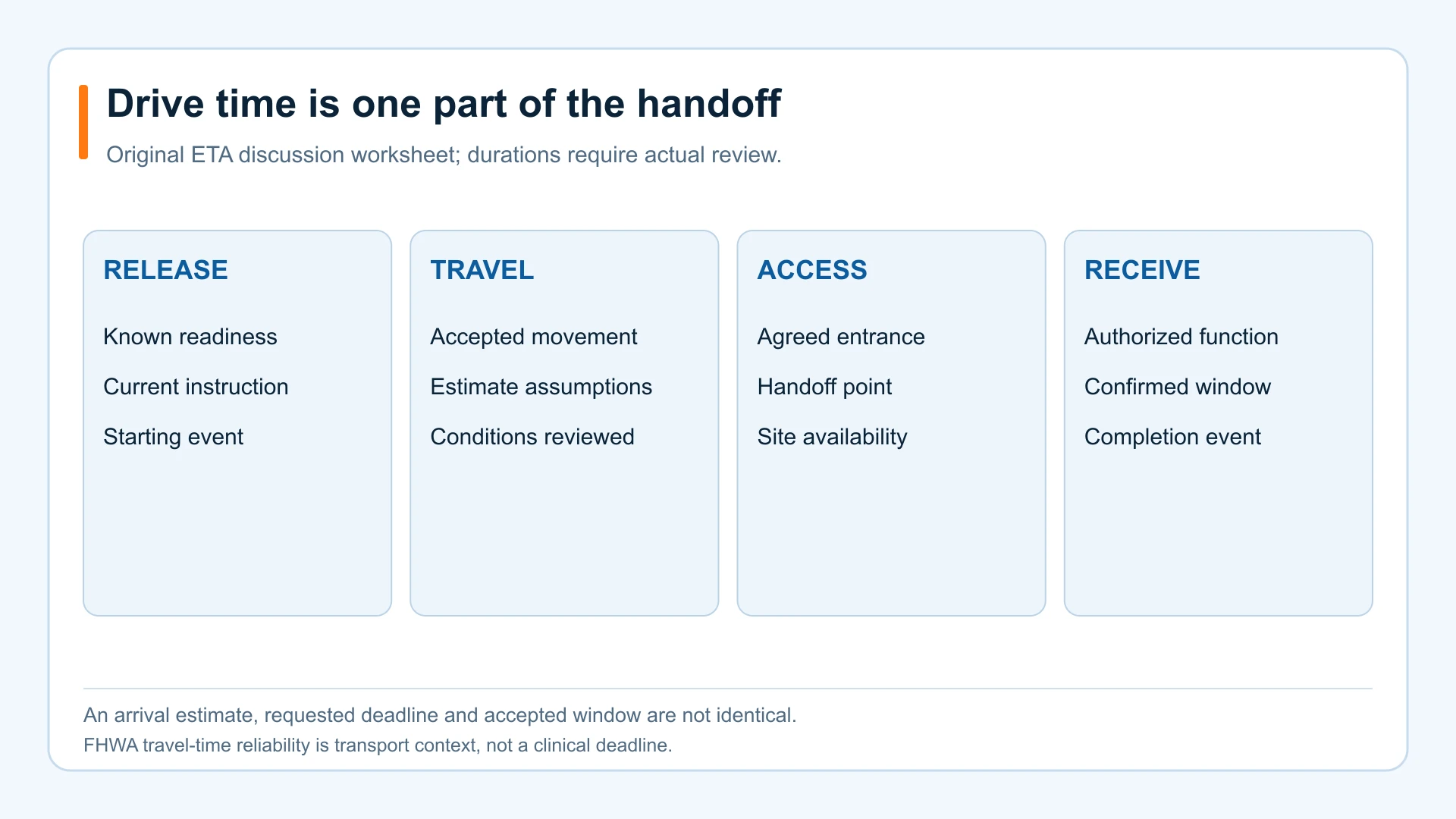
Start with a simple event chain: release readiness, collection and loading, road travel, site access and receiving handoff. Your arrangement may contain different or additional tasks, so confirm the actual sequence rather than making this editorial worksheet a universal procedure. The aim is to expose missing work, not to force every delivery into a standard duration.
For each component, name the responsible source of information. Pharmacy or laboratory staff may confirm readiness. The transport provider may assess the requested collection and travel work. Site contacts may explain the approved entrance and receiving availability. Nobody should guess another party’s requirement simply to produce a complete-looking ETA.
Keep unknown components visible. If the receiving desk has not confirmed its window, mark it unresolved. If a cargo description is incomplete, seek the information needed for transport acceptance. An estimate built on unresolved prerequisites should be communicated as such, not presented as a precise delivery commitment.
| Component | Question to answer | Relevant evidence or owner |
|---|---|---|
| Release readiness | When is the accepted transport unit ready to be released? | Responsible sender and current instructions |
| Collection and loading | What agreed collection tasks must occur? | Provider acceptance and site conditions |
| Road travel | Which trip and departure assumptions underlie the estimate? | Relevant travel information and stated limitations |
| Site access | How does the courier reach the agreed receiving point? | Verified receiving-site instructions |
| Receiving handoff | Who can receive, and within which accepted window? | Authorized receiving function |
| Changed conditions | What has changed since the previous estimate? | Time-stamped update and decision owner |
Review this chain whenever the service changes materially. A new entrance, additional loading task or different receiving function can affect timing even if the road distance stays the same. A map route that looks unchanged is not evidence that the full handoff process is unchanged.
3. Understand why an average trip is not a dependable arrival promise
The Federal Highway Administration’s travel-time reliability primer distinguishes typical travel time from its variability. Its framework considers how predictable travel times are across trips and conditions. The important buying question is not only whether a journey is usually short, but how much uncertainty remains in the estimate.
Averages can hide a spread of experiences. A route with a familiar typical duration may still have substantially different trips. The FHWA discusses reliability measures that use travel-time distributions and planning allowances. That is transportation context, not a claim that a particular allowance guarantees your courier handoff or satisfies a product’s clinical limits.
For your own arrangement, ask which assumptions the estimate uses and which conditions may change it. Do not transplant a national highway metric into a clinic receiving promise without checking whether its data and endpoint are relevant. A transport-segment measure still leaves release, access and receiving questions to be answered.
There is no single percentage to add to every delivery. Local conditions, departure time, task scope and the receiving process matter. If a provider uses a planning allowance, ask how it is determined and reviewed. Keep a discussion of uncertainty separate from any accepted commercial window and any qualified cargo-specific deadline.
4. Work through a fictional timing example
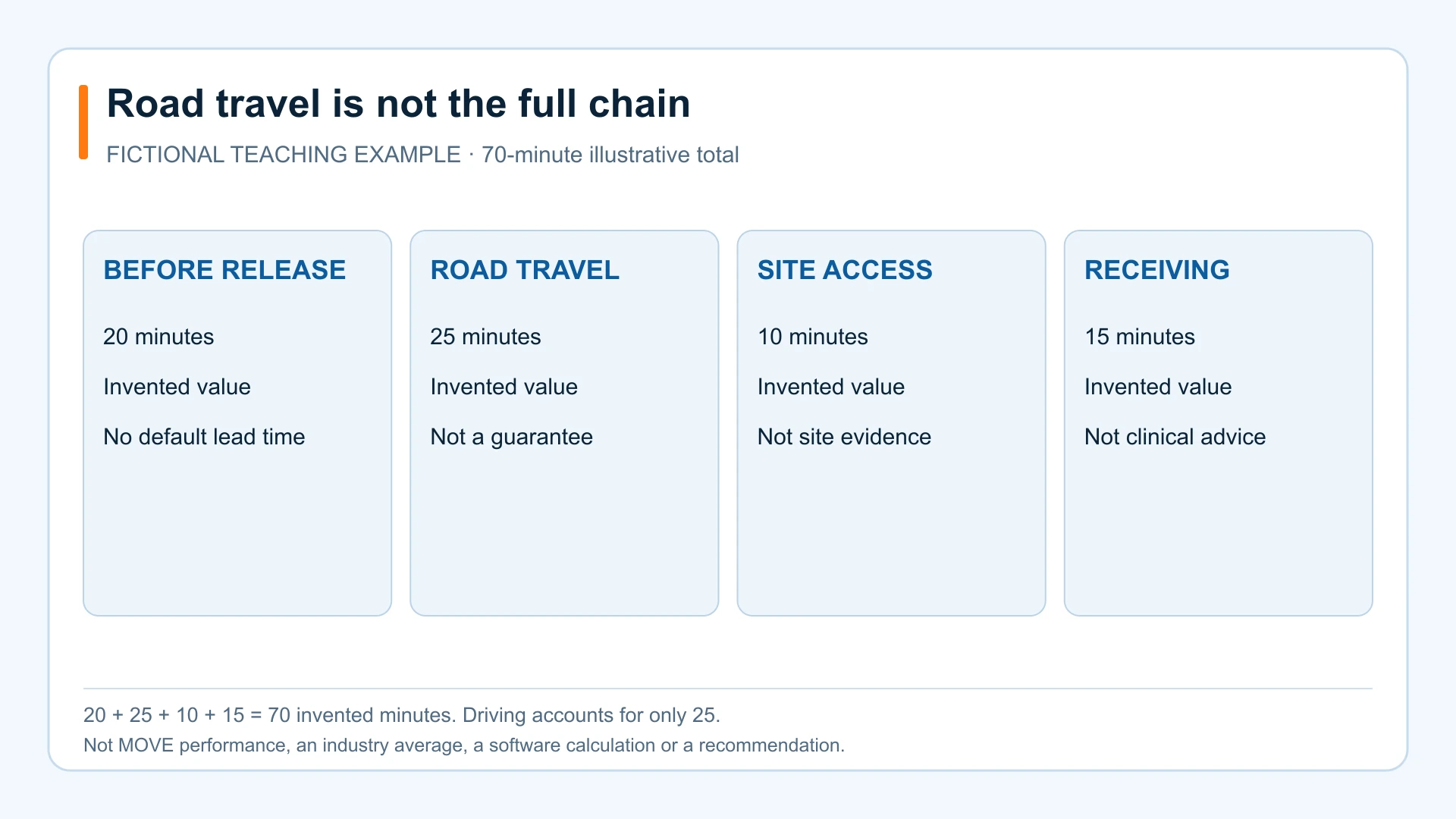
The following invented example explains the difference between driving and the entire handoff chain. It is not a measured route, an industry average, a MOVE software calculation or a recommended allowance. Suppose an illustrative task includes 20 minutes before release, 25 minutes of road travel, 10 minutes of site access and 15 minutes for the receiving handoff.
Those invented components total 70 minutes from the stated starting point. Road travel represents only 25 of the 70 minutes. Reporting that driving estimate as a completed-delivery ETA would leave 45 minutes of the fictional chain unexplained. The arithmetic illustrates the boundary; it does not establish actual durations for your work.
| Illustrative component | Invented minutes | What the value does not establish |
|---|---|---|
| Before release | 20 | Actual sender readiness or collection availability |
| Road travel | 25 | A guaranteed journey duration |
| Site access | 10 | Current entrance conditions |
| Receiving handoff | 15 | Recipient availability or product acceptance |
| Total illustrative chain | 70 | An accepted service window or promised arrival |
Now change one assumption: the receiver has a different accepted window. You cannot simply add a guessed delay and announce a new delivery time. The changed condition needs review by the responsible parties, including confirmation that the revised plan is suitable and accepted. A spreadsheet can calculate a total without establishing that the delivery can actually take place.
Try this exercise using your real workflow, but replace the fictional values only with appropriate evidence and confirmed requirements. If a component has no reliable estimate, identify that uncertainty rather than forcing a number. The result should help your team ask better questions, not manufacture precision.
5. Give a useful timing update when conditions change
An update should explain the current situation in language the receiving team can use. Identify the affected order through an approved reference, state the relevant event and distinguish what is known from what is still being assessed. Avoid sending unnecessary patient information or vague messages that force the recipient to guess what they should do.
Where an estimate has changed, identify its timestamp and endpoint. An earlier message may refer to property arrival, while a later one refers to handoff completion; without an explanation, those times can look contradictory. Use consistent terms and retain the history needed for an authorized review.
Do not pressure a driver to provide updates while driving. Agree a safe communication workflow with the provider before the first collection. Automation, dispatch contact and driver interaction are separate functions whose actual availability must be confirmed. A blog diagram is not a promise that MOVE supports a particular automated ETA feature.
For the receiving team, name the next decision. They may need to confirm continued availability, identify a backup receiving role or ask qualified personnel to review a cargo-specific concern. A revised time is helpful only if the people affected understand what it means for the agreed handoff.
6. Plan around a receiving window rather than a hopeful timestamp
A receiving window is a real operating constraint, not decoration on an order. Ask whether the authorized receiving function is available throughout the window or only at a particular appointment. Confirm what happens when a collection or estimate no longer fits. The answer may involve a revised plan rather than a promise to arrive faster.
Work backward through the actual tasks only after the endpoint is understood. If your team starts with a receiving deadline but the sender cannot release the unit in time for the accepted transport work, the conflict needs resolution. Do not assume a faster service label will repair every mismatch.
Separate operating hours from receiving availability. A building may be open while its approved receiving function is not. Likewise, an accessible entrance does not mean someone is authorized to accept the delivery. These are site-specific questions to resolve with the responsible contact, not universal assumptions about hospitals or clinics.
For an individual time-sensitive request, explore STAT and point-to-point delivery. For repeat work, discuss the ready-time pattern and receiving constraints as part of a recurring plan. In either case, timing depends on the actual request and accepted arrangement.
7. Review estimates against the right evidence
When evaluating an ETA process, compare like events. An estimate of vehicle arrival should be reviewed against the matching arrival event, not a later handoff-completion record. If the question is whether the receiver could prepare appropriately, consider the communication history and its meaning, not only the final timestamp.
Document the relevant period and population. Review accepted work whose conditions are understood, and keep cancelled, changed or unresolved work identifiable. Do not quietly remove difficult orders from a timing report to make it look better. Explain the chosen review population and the limitations of the evidence.
Look for patterns that lead to an actionable question. Repeated access uncertainty may call for a site-instruction review. Repeated release changes may call for a readiness conversation. Road-travel variability and receiving availability require different responses. Avoid treating every difference between estimate and outcome as driver performance.
Ask for provider-specific evidence instead of assuming an attractive tracking interface proves accurate forecasting. Confirm what users can actually see, what the terms mean and how stale or missing updates are handled. MOVE’s live-tracking page introduces delivery visibility; your service conversation should establish the available information for your arrangement.
8. Use an ETA discussion checklist before the first order
Bring five questions to the conversation: What event does the estimate describe? Which event starts the remaining-work calculation? Which site and cargo prerequisites are confirmed? How are changed conditions communicated safely? Who can approve and accept a revised plan? Write down the answers and keep their source and version understandable.
Test the terminology with a dummy order. Ask your sender, provider contact and receiver to explain the same update independently. If they describe different endpoints, fix the wording before using it with real work. This is a practical usability check, not a mandatory regulatory test or guarantee that future estimates will be exact.
Include a scenario where travel information is unavailable or unsuitable. The provider should explain how it communicates uncertainty and confirms the available service rather than inventing a map result. Your staff should know how to avoid turning missing information into an unsupported recipient promise.
Review the process after a meaningful change in site conditions, requested work or communication tools. Timing language can drift as teams add features or adopt informal shorthand. A short shared definition may be more useful than a precise-looking timestamp whose meaning nobody has agreed.
Build an arrival expectation your team can understand
Effective courier ETA planning connects the transport segment to the whole receiving task. It identifies the endpoint, keeps assumptions visible and gives the responsible people a clear way to respond when circumstances change. It does not make uncertainty disappear, but it can make the next decision easier to understand.
Start with Quick Quote for one local delivery, or Start an Account for a repeat routine. Share your real ready time, receiving requirements and cargo scope. MOVE can review the requested work and help confirm an accepted plan—not substitute a generic driving estimate for your entire delivery.