What medical courier pickup cancellation actually means
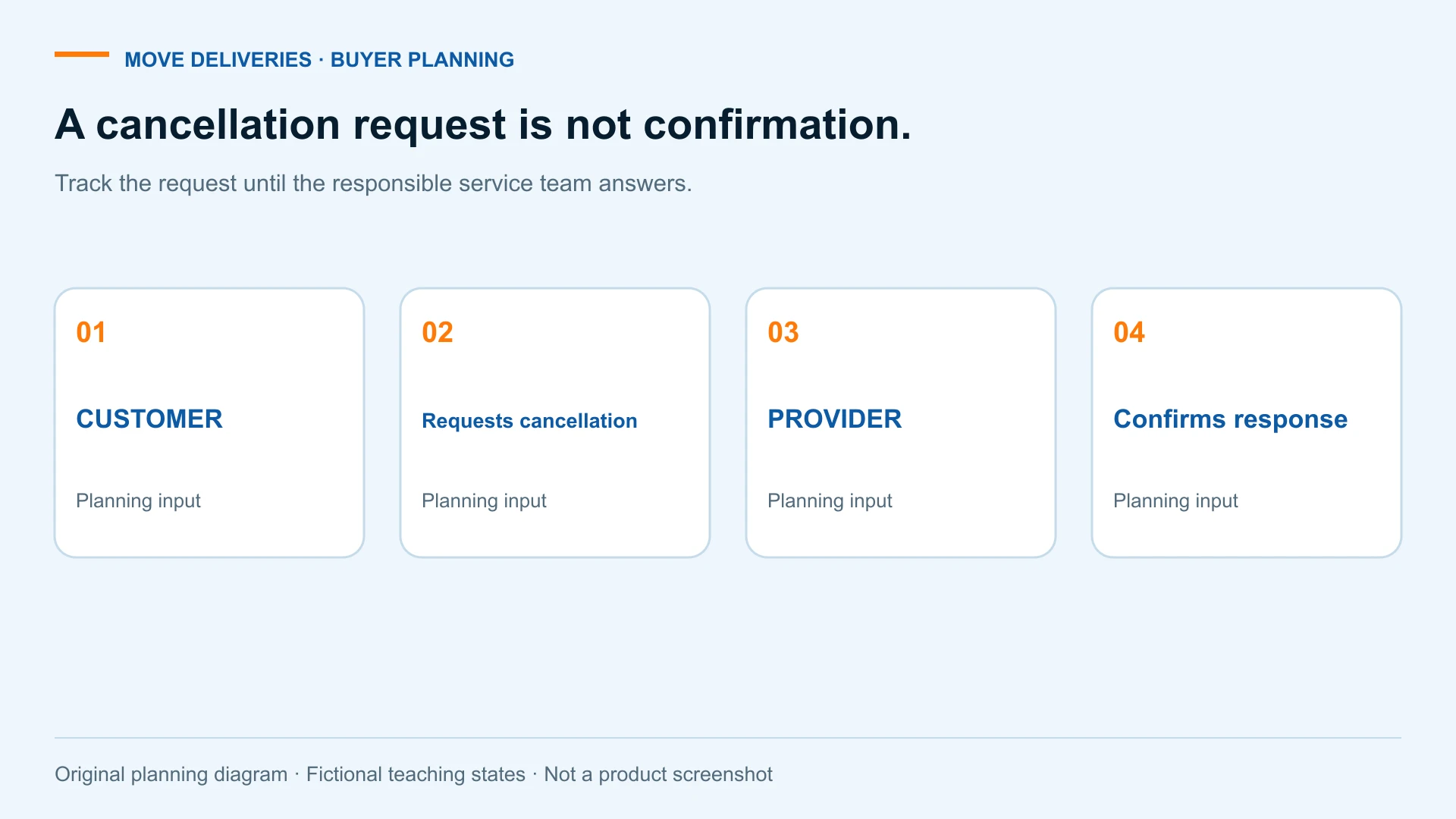
Medical courier pickup cancellation means asking the provider to stop an identified collection that has not yet taken place, then confirming the response through the agreed service process. It is not the same as deleting an internal note, postponing preparation or telling a colleague that the package is no longer needed. A request can remain active for the service team until the cancellation has been acknowledged and resolved.
The practical problem is easy to picture. A clinic changes its plan. One employee tells the supplier not to prepare the carton, while a previously accepted collection still appears in the operational routine. The driver, releasing team and customer may now hold three different instructions. Nobody needs a longer message. They need an exact reference, an authorized decision and a clear response about what will happen next.
This guide addresses the period before pickup. If the courier has already collected the shipment, use the approved process for changes after collection instead. A shipment in transport is not a cancelled pickup. Handling, return and alternative receiving decisions may require different people and instructions. Do not infer any of them from a stop-work message.
The seven decisions below are operational planning suggestions, not a MOVE cancellation policy, refund promise or interpretation of a service contract. Fees, cutoffs, authority and available actions depend on the accepted arrangement. Healthcare personnel remain responsible for deciding whether the underlying clinical or supply need can change. The courier conversation concerns the resulting transport request.
In this article
- What medical courier pickup cancellation actually means
- 1. Identify exactly which collection should stop
- 2. Confirm whether collection has already occurred
- 3. Name the person authorized to request the change
- 4. Ask for a response, not just message delivery
- 5. Reconcile the commercial arrangement separately
- 6. Treat rescheduling as a separate request
- 7. Tell affected teams which instructions now apply
- Build a cancellation acknowledgment log
- A fictional duplicate request: close one, preserve the other
- Run a short cancellation exercise before you need it
1. Identify exactly which collection should stop
Start with the accepted request reference, the actual collection date and the releasing location. Include the service version or revision when your workflow provides one. A description such as “cancel the afternoon pickup” may be ambiguous if the site has recurring work, an additional request or several departments using the same entrance. Identify the work, not just the building.
State whether the entire request or only a proposed part is affected. If one carton is no longer expected but other prepared units still need collection, the appropriate action may be a scope change rather than cancellation. Do not label a partial adjustment as a cancelled request if staff still expect transport under that reference. Ask the provider which supported process applies.
For recurring service, name the specific stop-date. Cancelling tomorrow’s visit does not necessarily cancel the standing routine, and stopping the routine does not automatically resolve already accepted one-time requests. Record the requested period explicitly. The scheduled delivery option supplies the wider service context; the cancellation decision still needs to identify the exact affected work.
2. Confirm whether collection has already occurred
Before requesting cancellation, verify the transport stage through the agreed records and responsible people. “The package is not on the shelf” does not establish whether it was collected, moved internally or never prepared. Similarly, a map position does not prove whether a particular package is in the courier’s possession. Use the available collection record and contact the service team when the stage is unclear.
Keep uncertainty visible. If the releasing employee cannot confirm whether the driver collected the units, state that fact and ask for a stage check. Do not send a categorical cancellation instruction based on an assumption. The response might establish that collection is still pending, or it might move the request into the approved post-pickup change process.
Your cancellation record should identify the stage evidence used and who supplied it. It does not need unnecessary shipment contents or patient details. A concise operational note might say that the release owner confirmed the request remained uncollected at the time of the message. That is more useful than an unsupported “not picked up” status copied from an old screen.
3. Name the person authorized to request the change
Determine which customer role can request cancellation and which service contact can confirm the response. A receiving employee may know that a department no longer needs the delivery without being authorized to alter a paid service arrangement. A releasing employee may stop preparation while another customer team owns the courier request. Clarify those roles before treating a message as a complete decision.
Describe authority by role and approved workflow rather than adding everyone to every conversation. If a primary coordinator is away, identify the available backup who can make the decision. Record the reason in operational terms where appropriate, such as a duplicate request or changed readiness. Clinical reasoning belongs with responsible healthcare personnel, not in a public inquiry or a broadly copied cancellation email.
A service provider’s acknowledgment may also need a specific person or supported system action. Ask what establishes acceptance under your arrangement. An automated delivery notice, a read receipt or a colleague’s reply may not be the required confirmation. Avoid constructing your own approval rule from a convenient notification.
4. Ask for a response, not just message delivery
Use the approved cancellation channel and request a clear response about the identified work. A sent message means the request was transmitted; it does not establish that the driver’s current instructions changed. If the workflow provides a cancellation status, verify what that status means. If it uses an operational contact, ask the responsible team to confirm the decision and any remaining action.
AHRQ’s check-back tool supports verifying that exchanged information was received and understood. Used narrowly for this transport conversation, the response should restate the affected reference and the cancellation decision. This is an operational communication analogy, not a claim that MOVE performs automatic acknowledgments or that the technique changes clinical outcomes.
Until the response is clear, keep the request marked as cancellation requested or unresolved in your planning record. Do not turn silence into confirmation. Agree whom to contact if the collection is approaching and the cancellation remains unanswered. The escalation path should help the right people resolve the instruction, not encourage a customer employee to issue unsupported directions to a driver.
5. Reconcile the commercial arrangement separately
Ask whether the cancellation changes the commercial scope and where the answer is recorded. This article establishes no free-cancellation window, refund entitlement or universal charge. The provider and customer should review the accepted terms and the actual stage of the work. A requested cancellation and a resolved billing question are related records, but they are not identical events.
If the response includes a charge, credit proposal or another commercial outcome, connect it to the same request reference. Record the applicable explanation from the responsible team. Do not have staff interpret contract language from a generic checklist. Where advice or an unresolved dispute is needed, use the appropriate qualified and commercial review channels.
Later invoice review should distinguish work cancelled before collection from work collected and subsequently redirected, returned or completed under changed instructions. The courier cost guide provides wider pricing context, not cancellation fees. A clear cancellation record gives commercial review better evidence without pretending the operational coordinator can resolve every issue.
6. Treat rescheduling as a separate request
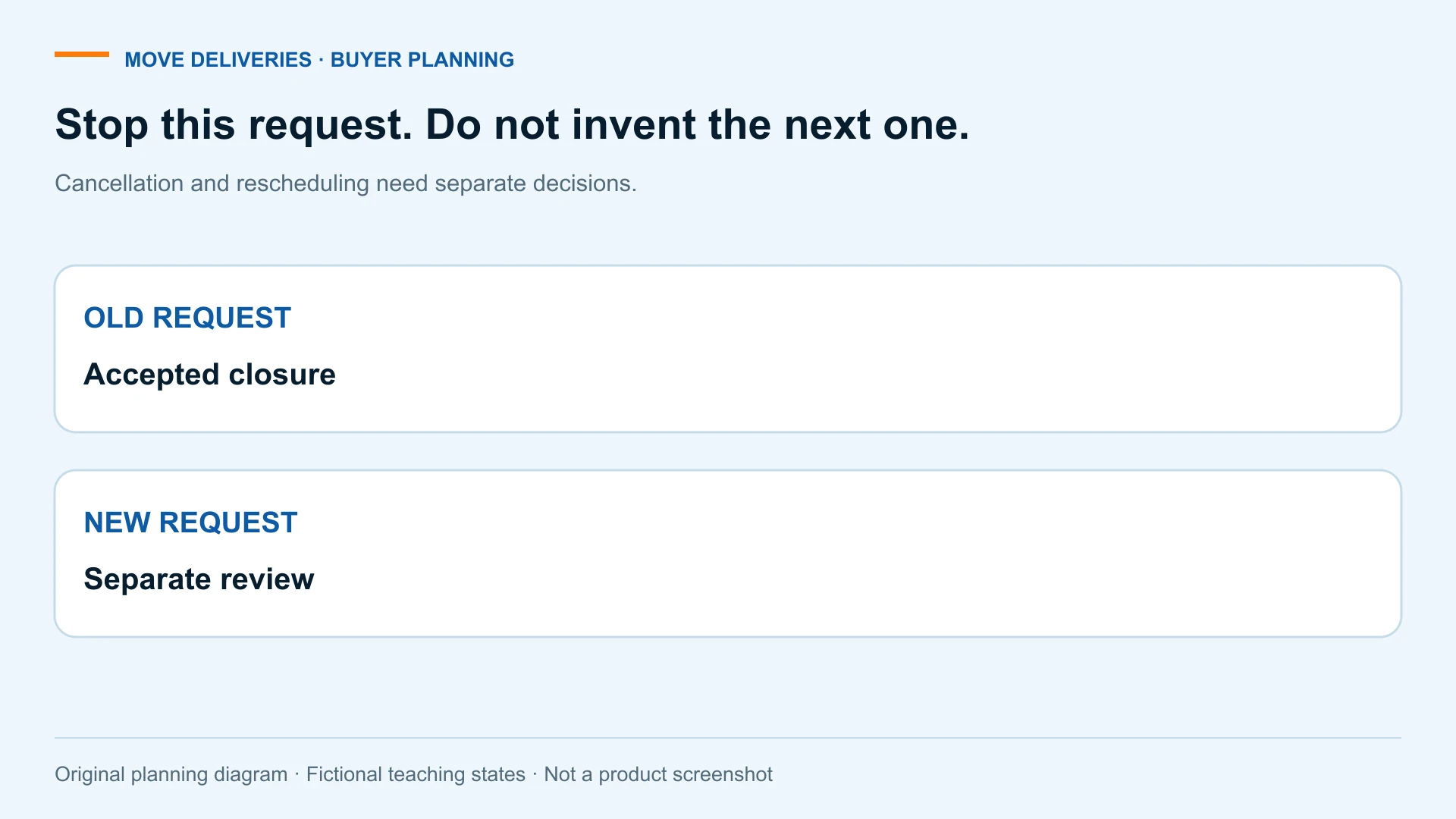
“Cancel today and come tomorrow” contains two decisions. One stops identified work. The other proposes a new collection with its own readiness, receiving and availability requirements. Ask the provider how to submit and connect the new request. Do not assume the old service window, package scope or commercial arrangement automatically transfers to another date.
Confirm tomorrow’s release conditions and destination arrangements before telling staff the new pickup is booked. A previously prepared package may require the healthcare organization to review its suitability and handling requirements. This guide does not authorize holding medications, specimens or equipment under different conditions. Qualified personnel decide the underlying readiness; the courier team reviews transport scope and availability.
Keep references for the cancelled request and the proposed replacement visible together without merging their states. Staff should be able to see that one is resolved while the other remains under review. If the replacement is not accepted, it should not appear confirmed merely because the original work was stopped. The distinction is especially important when a recurring schedule and an exceptional request share the same site.
7. Tell affected teams which instructions now apply
After the provider confirms the response, inform the releasing and receiving teams that need the decision. State the affected date and reference, the confirmed outcome and any separate unresolved replacement. Remove or supersede obsolete local preparation instructions through your normal process. Do not delete the evidence of the original request and cancellation merely to make the board look clean.
Check whether a standing route, a department’s preparation list or another local planning tool still contains the stopped work. This does not mean every system must have identical fields. It means people acting on those tools should understand the current instruction. Where a supported integration is involved, verify its actual behavior rather than assuming cancellation propagates everywhere automatically.
MOVE uses its proprietary platform to coordinate local same-day medical delivery. Discuss the supported cancellation workflow and notification behavior with the service team. The notification page describes communication options; it is not a substitute for agreement about who can stop a request or which record establishes the accepted outcome.
| Fictional reference | Original pickup | Cancellation response | Separate replacement |
|---|---|---|---|
| TRAIN-C1 | Not yet collected | Requested; response pending | None requested |
| TRAIN-C2 | Not yet collected | Acknowledged by service owner | None requested |
| TRAIN-C3 | Not yet collected | Acknowledged by service owner | Tomorrow proposed; not accepted |
Build a cancellation acknowledgment log
Use the log below as an original planning tool. Recommended fields include original reference, specific stop-date, transport stage evidence, authorized requester, cancellation request time, provider response, releasing-team update and any separate replacement reference. Add an unresolved owner where an answer is missing. Keep the log in the approved internal channel, not a public form with private package information.
The fictional rows intentionally show different states. TRAIN-C1 remains cancellation requested until the responsible service team responds. TRAIN-C2 has an acknowledged cancellation with no replacement. TRAIN-C3 has a cancelled original request and an unconfirmed new proposal. None is a real MOVE shipment, a statement of contractual entitlement or evidence of a particular software feature.
Read the log from the perspective of a shift replacement. Can that employee identify what no longer happens, what remains open and whom to contact? If the answer depends on reading an entire message thread, shorten the decision record and link the supporting context through the approved process. Keep the essential outcome explicit rather than burying it beneath explanations.
A fictional duplicate request: close one, preserve the other
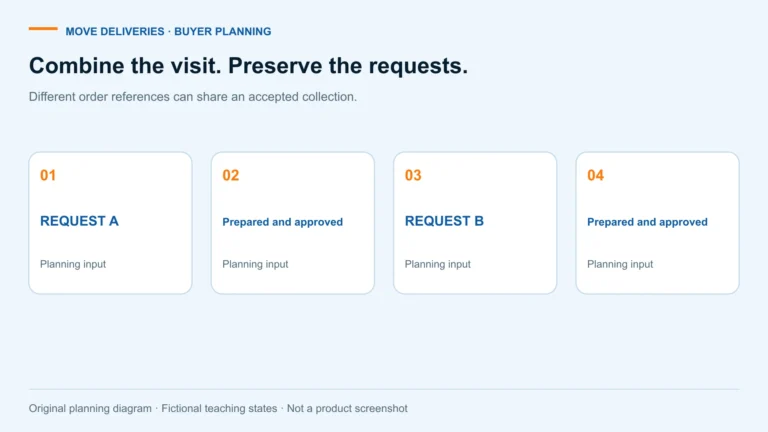
Imagine a supplier discovers that two customer coordinators requested transport for the same planned cartons. In this fictional exercise, both references remain visible and neither collection has occurred. The supplier cannot resolve the issue by erasing one entry from its preparation list. The authorized customer role identifies which reference should remain active and asks the provider to stop the other through the accepted channel.
The response should distinguish the two references explicitly. Staff need to know which collection remains accepted, which has been cancelled and whether the outgoing package scope has changed. A message saying “duplicate fixed” leaves room for someone to stop both requests or prepare the same cartons twice. Keep the actual agreed outcome attached to each reference, with the responding service role and the operational time.
If the provider’s response indicates that one collection has already taken place, the exercise changes direction. The coordinator verifies what was collected and uses the appropriate post-pickup process. Do not force the situation into a pre-pickup cancellation label because that was the original intention. The transport stage determines which question the teams must answer next. The log should preserve that progression without pretending a cancellation reversed a physical collection.
Run a short cancellation exercise before you need it
Choose a fictional request and ask the releasing team, customer coordinator and service contact to walk through the process. Who can request the stop? Where is the reference? How do they check that collection has not occurred? What response establishes acceptance? Use a training reference clearly marked as fictional; do not create an actual pickup or send an operational cancellation just to test a checklist.
Include a case where the stage is unknown and one where tomorrow’s replacement remains unconfirmed. These reveal whether staff confuse a transport-stage check, cancellation response and future booking. Record the gap in the instructions, not a broad judgment about a person. Update the agreed process through the responsible owners and repeat the exercise when a material workflow changes.
Should a driver stop based on a message from any staff member? Do not assume so. Use the accepted authorization and dispatch process. Does a cancellation response establish the billing outcome? Not necessarily; review the commercial record separately. Can an internal deleted order stand in for provider confirmation? No. The provider needs the relevant instruction through the supported channel.
For a new local delivery, request a Quick Quote. For recurring work, Start An Account and agree the cancellation path alongside the pickup routine. Stopping work cleanly protects the next decision: nobody should have to guess whether yesterday’s instruction is still active.