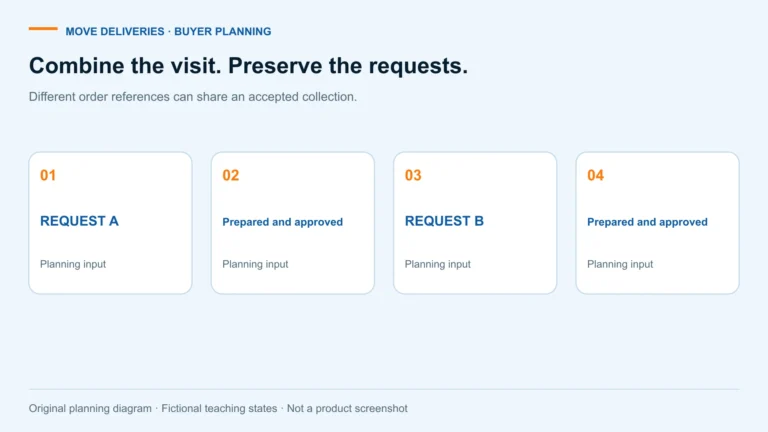

Medical delivery changes become harder to manage after pickup because the cargo, the instructions and the authority to change the plan are no longer in one place. A new address in a message is not automatically an accepted reroute. Confirm who requested the change, who can authorize it and whether the courier can carry out the revised work.
The practical problem is familiar: a receiving team is unavailable, a customer asks for a different handoff point or a staff member wants the courier to return an item. Everyone wants to help. Without a decision path, however, helpful messages can create conflicting instructions while nobody owns the final plan. The safest useful response is clarity, not a guess about which person sounded most confident.
This guide provides an original change-authorization framework for healthcare delivery teams. It is not a clinical, privacy or hazardous-materials protocol. Responsible qualified personnel determine those requirements, and the transport provider must accept the actual work. Use the framework to connect a request, a decision and a traceable operational instruction.
1. Identify what has changed before deciding what to do
Describe the requested change in concrete terms. Is the destination different, the receiving person unavailable, the handoff point moved or the requested completion window revised? Is the customer asking for a return, an additional stop or an entirely different task? These are not necessarily equivalent changes. Their effect on accepted work and the people who need to decide can differ.
Separate a factual correction from an instruction change. Correcting a misspelled department name may leave the accepted destination unchanged. Replacing the destination with another building changes the transport plan. Record both accurately, but do not allow the label correction to hide a material reroute. The distinction matters for acceptance, evidence and any later billing review.
Also record whether the request is urgent and who supplied that assessment. The courier should not infer clinical urgency from a short message, a product label or an anxious tone. The responsible healthcare team determines the requirement. Operational coordination then needs to establish what revised transport can actually be accepted.
2. Confirm the requester through an approved contact path
Someone who knows an order reference may still lack authority to redirect the cargo. Agree how the provider recognizes an authorized customer contact and how an unfamiliar request is checked. Use the actual arrangement’s controlled contact process. Do not invent a new verification shortcut in the middle of a delivery because the change seems convenient.
Record the requester’s role and the source of the request without copying unnecessary personal information into widely shared notes. Your team needs enough evidence to understand the decision, not every detail of a conversation. Keep sensitive information in the approved system or channel and provide access only to the people who need it under the applicable arrangement.
Distinguish acknowledging a request from approving it. A message such as received can reasonably mean the provider has seen the request, not that the revised handoff is accepted. Use explicit language for each stage so the customer does not tell the receiving team a reroute is underway before anyone has agreed that it can happen.
3. Name the customer role that can authorize the change
Choose the decision owner for the relevant change category. A customer service representative may be able to correct a receiving contact, while a product-specific or clinical question needs a different reviewer. A facilities contact can describe access but may not decide whether an item should be released elsewhere. The authority matrix should reflect the actual responsibilities.
Set a backup path before the primary owner is absent. The backup needs a defined authority boundary, not just a telephone number. Identify which decisions can proceed, which require escalation and what the team should do while waiting. An unstaffed decision path can be as disruptive as a missing receiving contact.
Document any limits on standing instructions. An instruction to contact dispatch when reception is closed is not a standing authorization to choose any alternative recipient. Review ambiguous language with the customer owner. The courier should be able to follow an approved instruction without interpreting the healthcare organization’s internal permissions.
4. Obtain provider acceptance of the revised transport
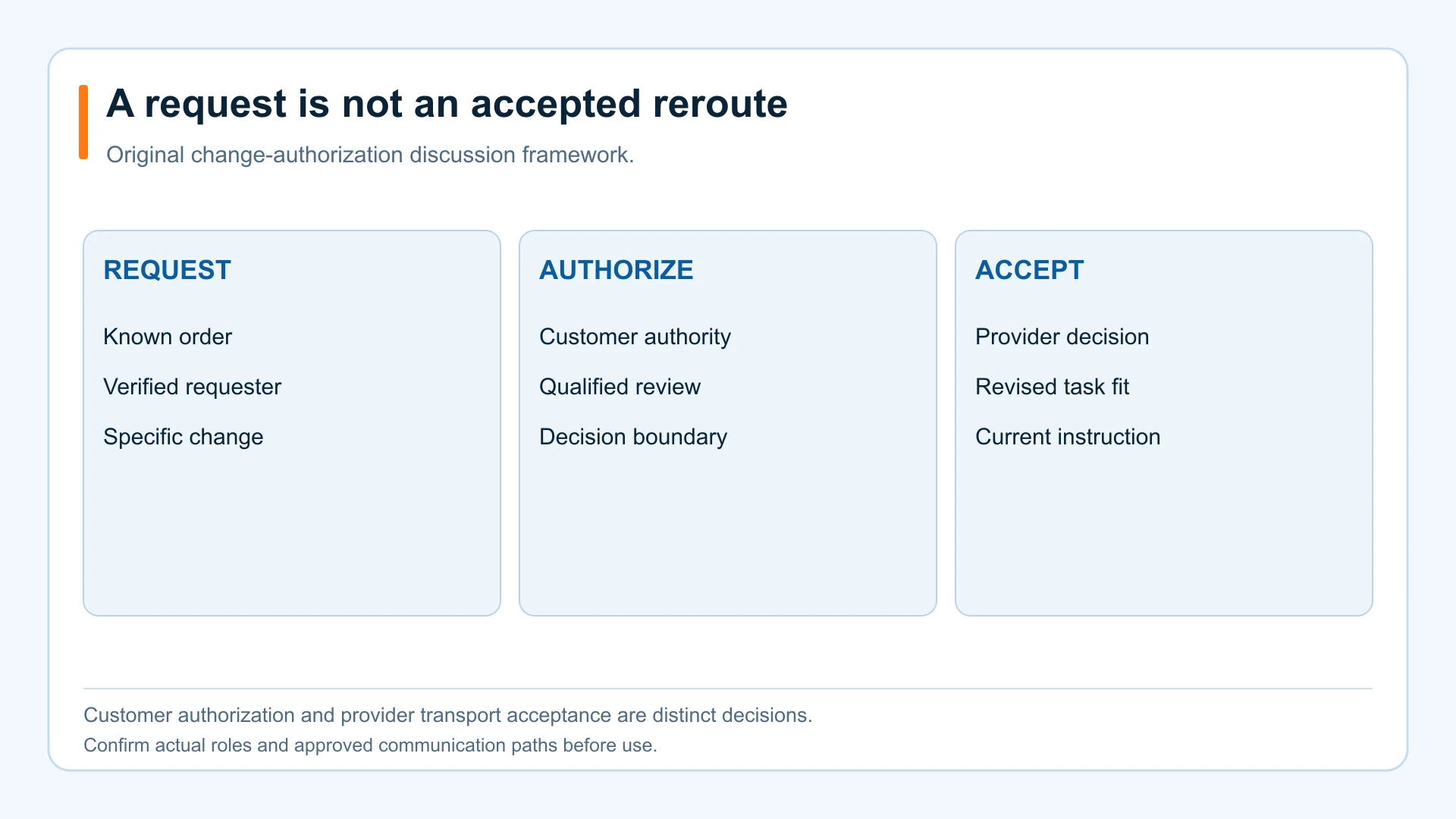
Customer authorization and provider acceptance are separate decisions. A customer may be permitted to request a new destination while the transport provider is unable to accept that destination, timing or task. The revised plan may conflict with existing accepted work, cargo requirements, site access or vehicle constraints. Confirm those conditions with the responsible provider contact.
Describe the accepted revision clearly: the order reference, changed element, effective instruction, receiving requirement and any confirmed timing or scope limit. Do not treat an estimated possibility as a commitment. When an answer remains conditional, say what condition must be satisfied and who will confirm it before the customer relies on the revised plan.
Ask how the decision reaches the courier through the actual operating process. This guide does not claim a specific MOVE rerouting interface, mobile edit feature or automated authorization workflow. A practical demonstration is more useful than an assumed feature. Confirm how current instructions replace superseded instructions and how the provider knows the courier has the accepted plan.
5. Keep information changes within the approved privacy arrangement
A reroute can require a different receiving role or a new contact channel. That raises an information question as well as a transport question: who is allowed to receive the operational details, and which details are needed? Ask the responsible privacy and healthcare personnel to determine the requirements for the actual use or disclosure.
HHS minimum-necessary guidance describes applicable limitations and explicit exceptions, including certain treatment disclosures and requests by healthcare providers. It should not be reduced to a universal rule that every delivery message contains the same permissible fields. Use the guidance with your responsible privacy team, not as a substitute for its assessment.
Avoid moving sensitive information into an uncontrolled conversation merely because an approved channel is inconvenient. A practical change process identifies the authorized channel beforehand. If the ordinary channel is unavailable, use the agreed escalation or continuity process rather than turning a public comment, personal group chat or unrelated email thread into the operational record.
An authorization matrix for delivery changes
| Requested change | Customer question | Provider question | Record to retain |
|---|---|---|---|
| Different receiving contact | Is the person authorized for the intended handoff and information? | Does the accepted destination and task remain unchanged? | Approved receiving role and current instruction. |
| Different destination | Who can authorize redirection of this transport unit? | Can the revised local route, timing and receiving requirement be accepted? | Requester, decision owner, old and new destinations, accepted scope. |
| Return to origin | Who determines the item may be returned, and under which instructions? | Is a return task accepted, and what happens until acceptance? | Return decision, applicable instructions and linked transport record. |
| Additional task or stop | Who approves the additional work and any product-specific requirements? | Does it fit cargo, vehicle, service period and other accepted obligations? | Separate or amended order scope and acceptance evidence. |
| Receiving unavailable | Who selects an authorized next step? | Which safe operational options are available within the accepted arrangement? | Exception, contact attempts, authorized next step and unresolved questions. |
6. Preserve the decision history without leaving old instructions active
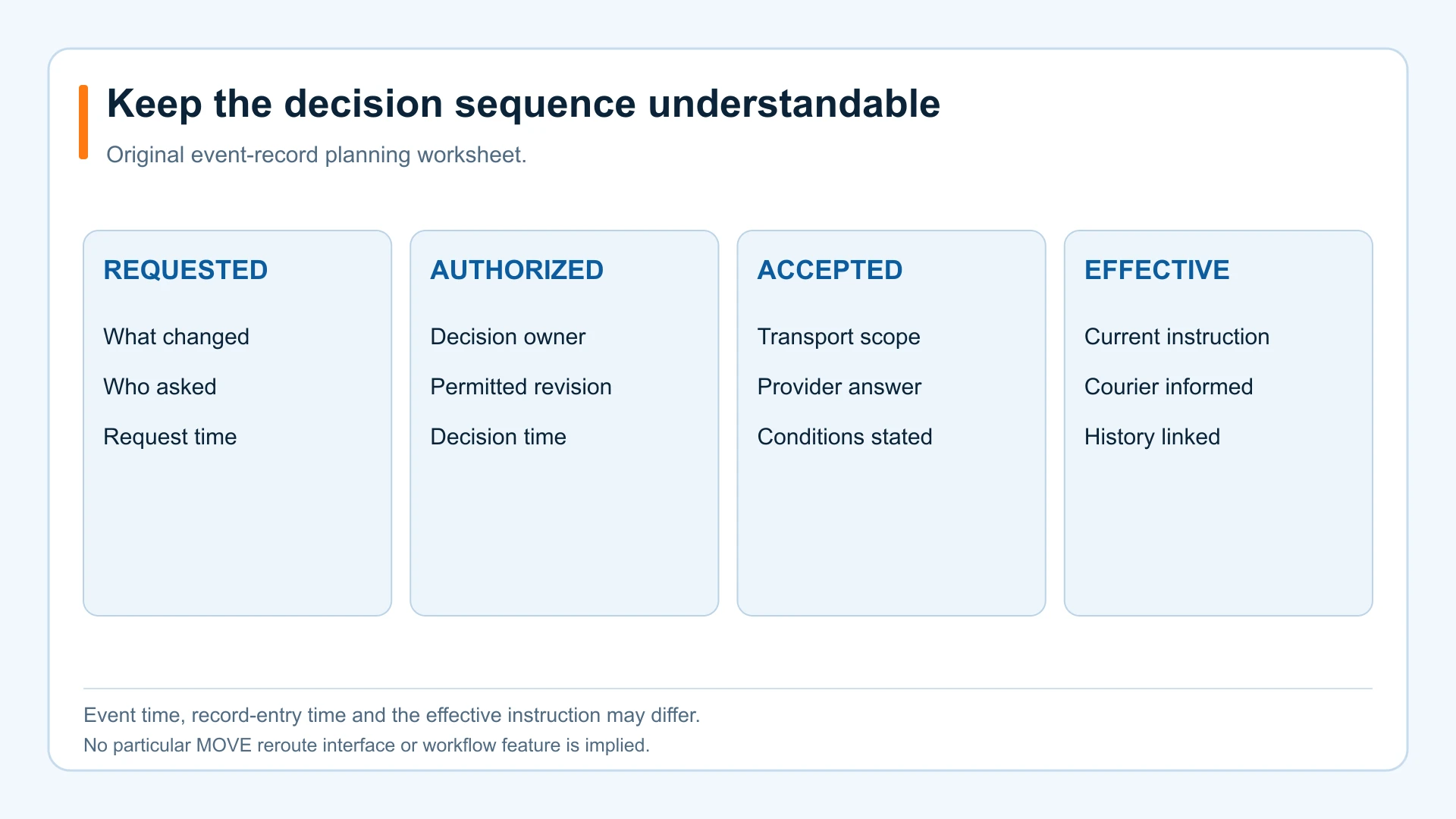
A change record should explain what was requested, when it was requested, who decided and what transport was accepted. Keep the original order reference connected to the amendment. If a return needs a separate reference, link the records rather than relying on someone to remember that two entries refer to the same physical transport unit.
Separate history from the current instruction. Retaining the previous destination is useful for reconstruction; displaying it as equally current can confuse the handoff. Ask how the operational view identifies the latest accepted plan while preserving appropriate history for authorized review. A long collection of unstructured messages is not automatically a usable change record.
Record event times unambiguously, including the relevant time zone. The time the request arrived, the time authorization was given and the time the revised instruction took effect may differ. Avoid substituting a later data-entry timestamp for the actual event. If the event time is uncertain, retain that uncertainty rather than inserting an invented exact minute.
7. Decide what happens when a change remains unresolved
Agree a decision path for the period before authorization or acceptance. The right next step depends on the cargo, the existing instructions and the actual conditions. This article does not prescribe a holding location or a clinical disposition. Those decisions need the responsible qualified people and the provider’s accepted operational limits.
Use an update that tells the customer what is known, what is awaiting a decision and who owns it. An unresolved instruction should not be disguised as an unexplained ETA change. Likewise, a pending reroute should not appear as completed work. Shared vocabulary helps the customer and provider avoid making different assumptions about the same status.
Include a route for disagreement. If two customer contacts issue conflicting requests, escalate to the named authority rather than allowing the courier to choose the most recent message. Record the resolution and how the current instruction was confirmed. Conflict is a decision issue, not a reason to overwrite the history or quietly improvise the destination.
An illustrative scenario: two different destinations in one message chain
Imagine an invented clinic order already collected from its release point. A staff member asks for delivery to another building because the original receiving desk is closed. A second staff member replies that it should return to origin. Both know the order, but the provider’s agreed contact list does not identify either as the decision owner for redirection.
The coordinator acknowledges both requests and contacts the named customer authority through the approved path. That owner selects the authorized destination after the relevant healthcare review. The provider then evaluates whether it can accept the revised transport and communicates the accepted instruction. Any unresolved condition remains explicit instead of becoming an invisible assumption.
The record links the original order, the competing requests, the customer decision and the provider’s acceptance. This is a fictional teaching example, not a MOVE customer story or evidence that every reroute can be accommodated. Its useful point is that authority and transport acceptance answer different questions; both belong in the change process.
8. Review repeated changes as a planning signal
A single change may reflect an unusual day. Repeated changes of the same kind may reveal a gap in the ordinary service plan. Group observations by meaningful condition: receiving closure, inaccurate contact, cargo not ready or a destination change. Do not reduce all amendments to a single failure count without examining what they represent.
Use the review to update the accepted process where appropriate. A regularly unavailable receiving function may need a different confirmed window or a different responsible contact. A stale instruction may need a controlled revision. Confirm the change with the provider and relevant customer owners; the review should not silently expand transport or clinical authority.
For visibility into recorded delivery progress, explore live tracking and proof of delivery. Ask which records are available for the actual arrangement. Software visibility supports the discussion, but a status display does not replace the required human decision.
Medical delivery changes: practical questions
Can the courier follow any customer’s text message?
Use the agreed verification and authority process. A message must be connected to an authorized decision and accepted transport scope where the change requires it. Knowing an order number or being associated with the customer does not, by itself, establish every permission needed for redirection.
Does customer approval guarantee a reroute?
No. The provider still needs to evaluate and accept the revised transport. Local availability, timing, cargo and existing obligations may limit the options. Communicate the actual answer and any unresolved conditions before others rely on a new destination or arrival promise.
Make the change path part of the service plan
Review MOVE’s delivery process and bring your ordinary and exceptional change needs to an account conversation. Agree requester verification, customer authority, transport acceptance and usable records before a change is needed. Clear communication makes the next decision easier to understand; it does not turn an unconfirmed request into a promise.