

Chain of custody records should help an authorized reviewer connect a specific transport unit with the handoffs that occurred. A collection of signatures or status messages is not enough if your team cannot establish which unit changed hands, at which event, under which instruction and with what supporting evidence.
For healthcare buyers, the useful question is not whether a provider uses the phrase chain of custody. It is whether the records available for your arrangement can answer the questions your team needs to review. A laboratory, pharmacy and medical supplier may require different information, different access and different responsibilities. Agree the actual evidence before the first handoff.
This guide provides eight record-review questions and an original reconstruction worksheet. It is not a clinical traceability protocol, a legal evidence standard or a promise that every field is available in MOVE’s platform. Responsible healthcare, privacy and compliance personnel determine applicable requirements. Ask the courier to demonstrate the records relevant to the accepted service.
Understand the difference between an event and its data
GS1’s traceability overview distinguishes critical tracking events from the data that describe individual instances of those events. This is a useful conceptual distinction: a handoff occurs, and a record describes that particular handoff. The framework does not establish that a courier has implemented GS1 standards or that one universal record layout fits every healthcare shipment.
Apply the distinction to a concrete review. Collected is an event label; the transport-unit reference, event time and release evidence help describe the actual collection. Handed over is another event; its receiving role and completion evidence answer different questions. A status label without its relevant context can be hard to interpret after the people involved have moved on to other work.
Start by defining what your team needs to reconstruct. If the question concerns a transport unit’s handoffs, the evidence should follow that unit rather than relying only on the customer account or a route name. If the question concerns clinical acceptability or product tracing, different qualified records and responsibilities may apply. Physical delivery evidence should not be presented as proof of requirements it does not actually address.
1. Which physical unit does the record identify?
Ask how the record distinguishes the actual transport unit. A shipment may contain several pieces, a reusable container may hold more than one item, and one customer order may create separate transport tasks. Determine the relationship among the identifiers your arrangement uses. An order reference is useful, but it may not answer a unit-level question by itself.
Check what happens when an identifier changes or a unit is split, combined or returned. The record should preserve the relationship needed for authorized reconstruction rather than presenting each entry as unrelated. Do not infer the physical contents of a closed container from a generic vehicle or route reference. The responsible shipper supplies the applicable identity and description requirements.
Use dummy references for a demonstration. Your team can examine whether the system connects the records without placing real patient information in a sales presentation or broad procurement spreadsheet. The purpose is to test the evidence path, not to expose sensitive operational details simply to make the example look realistic.
2. What does each handoff event actually mean?
Define the event represented by each status. Order accepted, courier arrived, cargo collected and receiving handoff completed are not interchangeable. A driver arriving at a building does not necessarily mean that custody transferred there. A later completion entry may summarize a handoff but still need supporting information to explain what occurred.
Ask who records the event and what observation supports it. Different events can originate from different people or systems. The reviewer should understand whether a timestamp reflects an actual handoff, a manual confirmation or a later administrative update. This is about understanding evidence, not assuming that one recording method is always suitable for every task.
Write down the definitions used in the accepted service. A familiar label can mean something different in another customer’s arrangement. Preserve the relevant definition when reviewing historical records, especially if the operating process has changed. Without that context, a seemingly simple comparison can join records that describe different events.
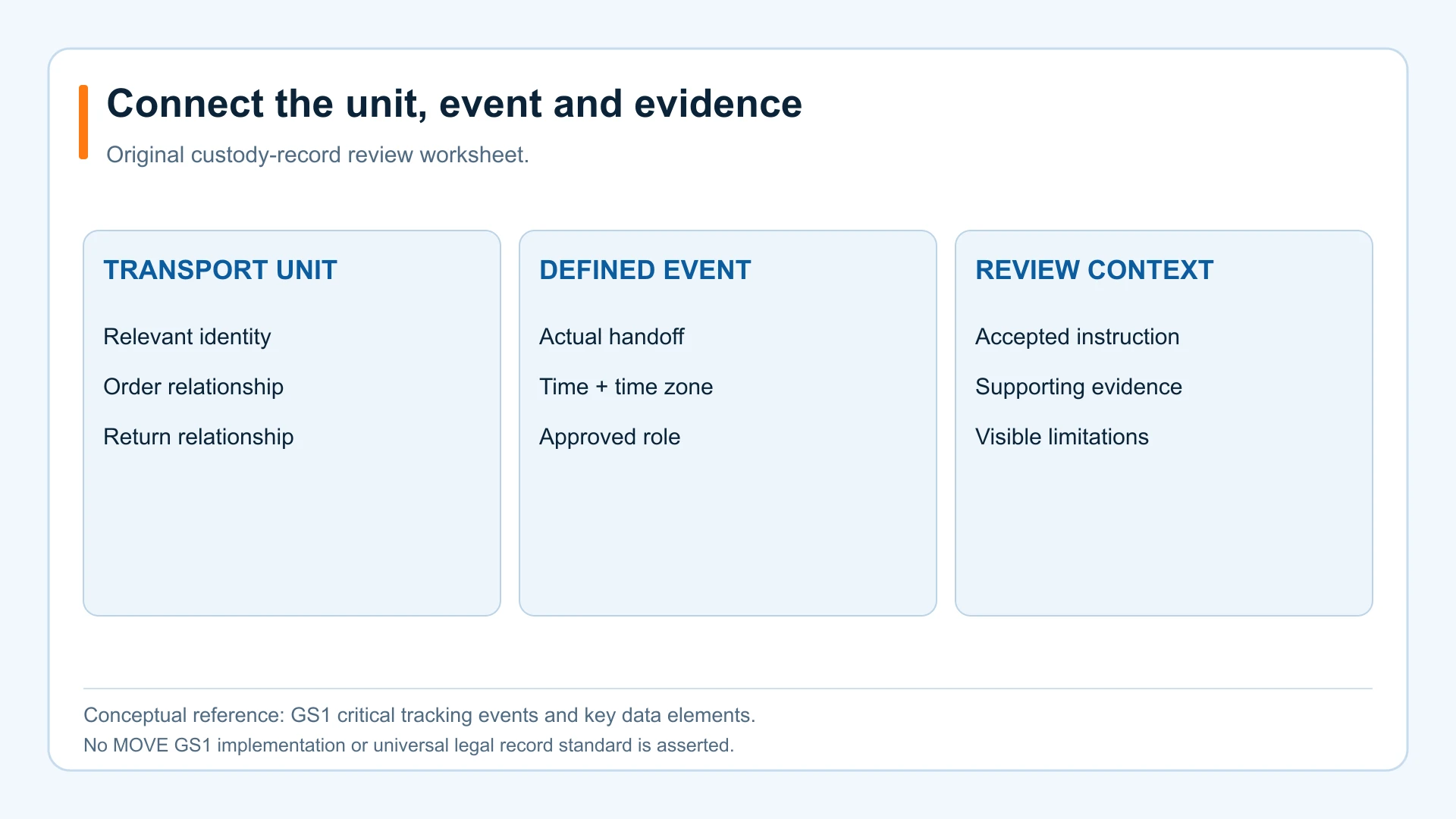
3. Are event times distinct from entry and correction times?
Separate the time an event occurred from the time the record was entered or synchronized. A record created after a communication interruption may legitimately refer to an earlier event. It should not hide the distinction. Ask how the actual event time, entry time and any uncertainty can be represented in the available record.
Confirm the time zone and how local times are interpreted. Two sites may use different zones, and a repeated local hour around daylight-saving changes can be ambiguous without additional context. Your team needs an unambiguous way to compare events across locations. A time printed without its zone can look precise while remaining unclear.
Do not manufacture a missing exact timestamp to make a record appear complete. Retain the evidence that exists and flag what is unknown under the arrangement’s approved process. A qualified reviewer can assess the gap more effectively when the uncertainty is explicit than when a later estimated time is presented as direct observation.
4. What receiving or release role is connected to the event?
Determine which participant information is needed for the actual review. A role, authorized recipient reference or other approved identifier may be appropriate depending on the work. The aim is to establish the relevant handoff responsibility without collecting or disclosing unnecessary personal information. Your responsible privacy and healthcare teams should determine the required fields and access.
Ask how an unexpected receiving person is handled. The record should not imply that any person encountered at an address is an authorized recipient. The accepted instructions need to define the receiving path and who can decide when that path is unavailable. A signature’s existence and the signer’s authority are different questions.
Review how backups and site changes appear. If a designated receiving function moves to another entrance, the event needs the current accepted location and role rather than an obsolete instruction. Historical records should remain understandable without suggesting that a superseded receiving contact is still authorized for future deliveries.
5. Can you connect the handoff to the accepted instruction?
A record is easier to interpret when the reviewer can identify the instruction in effect for the handoff. That includes the accepted destination, receiving requirement and relevant authorized changes. The record does not need to reproduce every message in an operational conversation, but it should connect the event to the plan that people were expected to follow.
Ask how a material change is authorized and linked. A new destination may require both customer authority and provider acceptance. Keep the original order connected to the revision, and distinguish current instructions from history. An edited field that erases its previous meaning can make later reconstruction difficult even if the final destination looks correct.
Confirm what the provider actually retains and can demonstrate. This guide does not assert a particular audit-log feature, immutable record design or amendment interface in MOVE’s proprietary platform. Ask for the relevant demonstration and any limitations. A capability claim should be supported by the arrangement’s evidence, not assumed from the word secure.
6. What does the supporting evidence prove—and what does it not?
Review the meaning of signatures, photos, location information and other evidence individually. A photograph may show a package at a location without establishing every condition of an authorized handoff. A location observation can support an arrival event without proving a clinical acceptance decision. Each item should be used for the question it can actually support.
Ask what evidence is expected for your service and what happens when an expected item is absent. A missing photograph is not automatically evidence of a failed delivery if the agreed process did not require one. Conversely, an available image does not resolve every missing handoff field. Agree the evidence standard and exception review rather than evaluating historical work against an unstated expectation.
Keep clinical condition, regulated product tracing and physical transport evidence distinct. Qualified healthcare or product personnel decide the requirements and acceptability within their responsibilities. Courier records can support the transport discussion without becoming a substitute for a laboratory result, a product-specific assessment or a separately required regulatory record.
A custody-record reconstruction worksheet
| Reconstruction question | Evidence to request | Gap to keep visible |
|---|---|---|
| Which transport unit? | Relevant unit reference and relationship to order or return references. | Ambiguous identity, split units or unlinked records. |
| Which handoff? | Defined event and its supporting observation. | Arrival confused with collection or completed handoff. |
| When did it occur? | Event time, zone, entry time and any correction context. | Unknown event time or later entry treated as direct observation. |
| Who was involved? | Approved release or receiving role appropriate to the arrangement. | Participant information that does not establish authority. |
| Which accepted plan? | Current instruction and linked authorization for relevant changes. | Superseded instructions or an unaccepted reroute. |
| What can be concluded? | Relevant evidence, limitations and qualified review where needed. | Transport evidence mistaken for clinical or regulatory acceptance. |
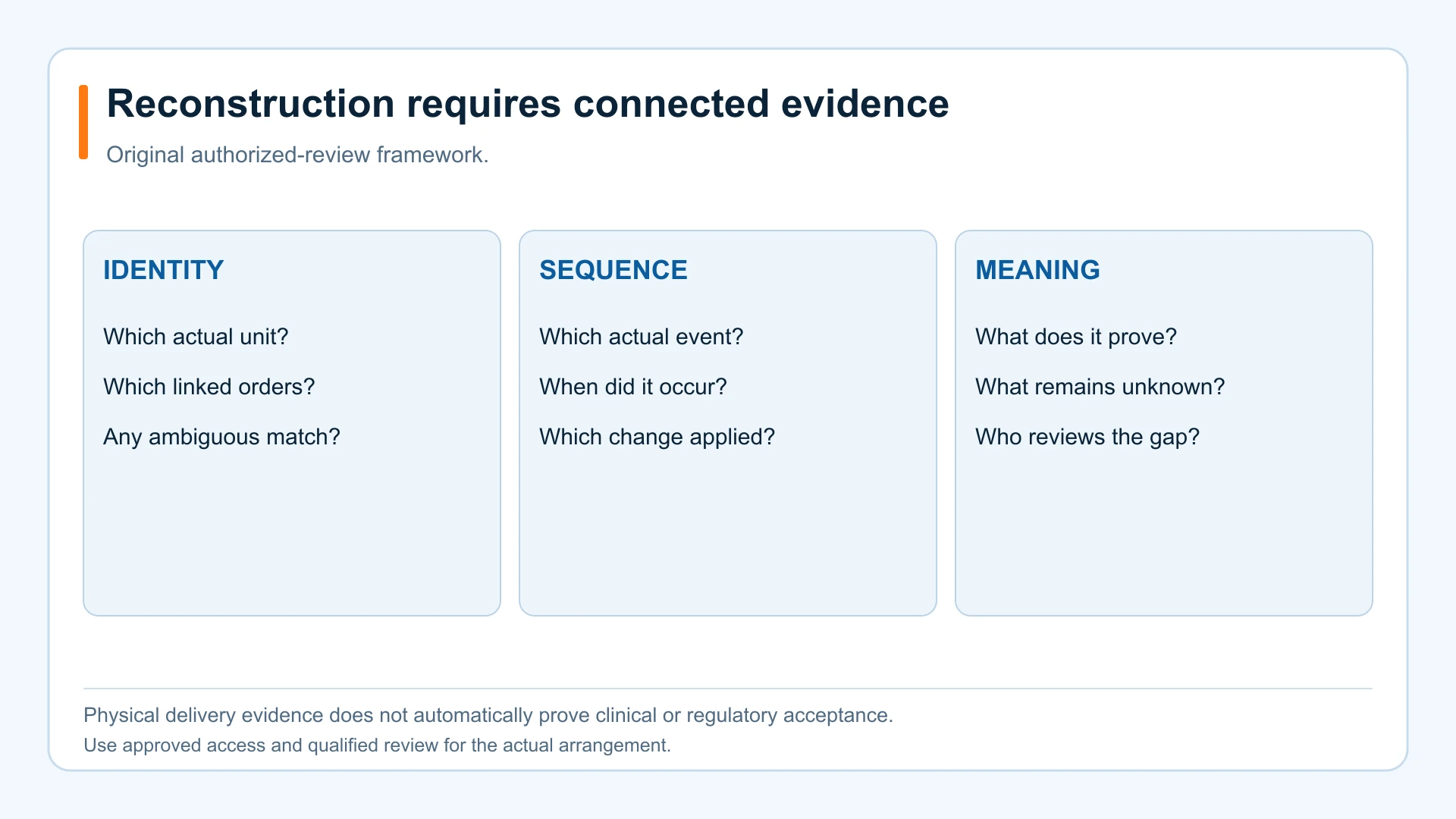
7. Are corrections visible without presenting them as new handoffs?
Records sometimes need correction: a site name is inaccurate, an event was entered late or a participant reference needs clarification. Ask how corrections are distinguished from new physical events. A later edit should not unintentionally look like a second collection or a second delivery, and the relevant history should remain available for authorized review.
Confirm who may correct a record and which supporting explanation is needed. Different fields can warrant different controls. Correcting a typographical description is not the same as changing the recorded destination after an exception. The actual policy should match the evidence and responsibilities involved; it should not depend on which user happens to be available.
Use the correction process to preserve truth, not improve a service score after the fact. If a time was uncertain or an expected record was absent, retain the appropriate explanation. A tidy final display is less valuable than a trustworthy account of what is known, what changed and what remains unresolved.
8. Can authorized reviewers retrieve and interpret the records later?
Agree access, retrieval and retention needs before assuming a record will be available indefinitely. Ask which record types can be viewed or exported, by whom and under what contractual and privacy conditions. A screenshot supplied during a demonstration does not prove that your team can obtain the same evidence during a later operational review.
Check whether an export preserves the relevant meaning. Column labels, event definitions, time zones and relationships among order, unit and amendment references should remain understandable outside the original view. An exported value without its definition may create more questions than it answers. Include the necessary context without exporting more sensitive information than the review requires.
Define the escalation path when a record cannot be found or interpreted. A named customer reviewer and provider contact can identify the needed evidence and the relevant limits. Do not solve an access problem by sharing credentials or placing private transport records in a public folder. Use the arrangement’s approved process and involve the responsible reviewers.
An illustrative review: one unit, two different references
Consider a fictional transport unit collected under one order reference and returned under another after the receiving arrangement changed. A reviewer sees two entries and initially assumes they describe unrelated cargo. The useful evidence is the relationship between the unit, the original collection, the authorized change and the accepted return task.
If the available records establish that relationship, the reviewer can ask more precise questions about the actual sequence. If the relationship is missing, the gap should remain visible and be investigated through the approved process. The missing link should not be replaced with a confident guess based solely on similar dates or site names.
This is a teaching example, not a MOVE case study or a claim that a particular software workflow is available. Its purpose is to demonstrate why reconstruction needs connected evidence. The number of stored entries matters less than whether an authorized reviewer can understand what the entries describe.
Chain of custody records: buyer questions
Is proof of delivery the same as the complete custody record?
Proof of delivery can document the completion handoff. Your broader reconstruction may also need collection, unit identity, accepted instructions and relevant changes. Agree which records support the actual review instead of using the two terms as if they always describe identical evidence.
Does live tracking establish every custody event?
Live tracking helps teams follow delivery progress. It should not be assumed to establish every physical or authorized handoff by itself. Ask which events and supporting records are available for your service and how they relate to the transport unit.
Agree the evidence your team needs before transport begins
Explore MOVE’s Secure Chain of Custody information and bring your reconstruction questions to an account conversation. Our proprietary platform supports delivery visibility; confirm the actual records, access and accepted work relevant to your organization. Clear evidence helps your team review the handoff without asking a status label to prove more than it can.