
Dedicated courier capacity is the amount of accepted work a courier arrangement can realistically handle within its agreed time, vehicle and task boundaries. For a medical supplier, it is not simply the number of deliveries a driver can make. Loading, site access, receiving coordination and the mix of equipment can consume capacity before mileage becomes the limiting factor.
You may have an apparently short route and still struggle to fit another order into the day. One destination needs an appointment. Another has a narrow access point. A return collection needs cargo space that was available on the outbound trip but will not be available later. A useful capacity plan makes these conditions visible instead of treating every stop as interchangeable.
This guide offers an original planning worksheet for medical suppliers considering dedicated local courier coverage. It is not a promise of vehicle availability, unlimited deliveries or installation services. Product requirements and safe task methods need the responsible reviewers; the provider must accept the actual work. Use the worksheet to ask a sharper question: what is reserving the capacity, and what work can it serve?
1. Define what the dedicated arrangement reserves
Begin with the commitment, not the vehicle photograph. Ask which service periods, locations, tasks and resources are included. A reserved courier period is different from a guarantee that every request during that period will be accepted. Geography, cargo fit, receiving restrictions and already committed work still matter. Put those boundaries into the scope that your team uses when requesting a delivery.
Clarify the meaning of dedicated in the proposed arrangement. Does it reserve agreed driver coverage, a particular vehicle class, a fixed service block or another defined resource? What happens during breaks, unavailability or a task that requires additional people? Your purchasing team needs the provider’s actual answer, not a definition inferred from another company’s marketing. The operational plan and pricing assumptions should describe the same reservation.
Separate ordinary included work from work that needs a new acceptance decision. For example, collection of a prepared boxed item may be included while moving bulky equipment through stairs is not. A delivery location can be covered without every task at that location being covered. This distinction protects the capacity plan from silently growing into a different service.
2. Describe demand as a pattern, not just a monthly total
A monthly order count hides when requests compete for the same resource. Record the time requests arrive, the time cargo becomes ready and the receiving constraints that govern completion. Group the observations by relevant operating periods. A day with evenly spaced work can fit differently from a day with the same count concentrated around one receiving deadline.
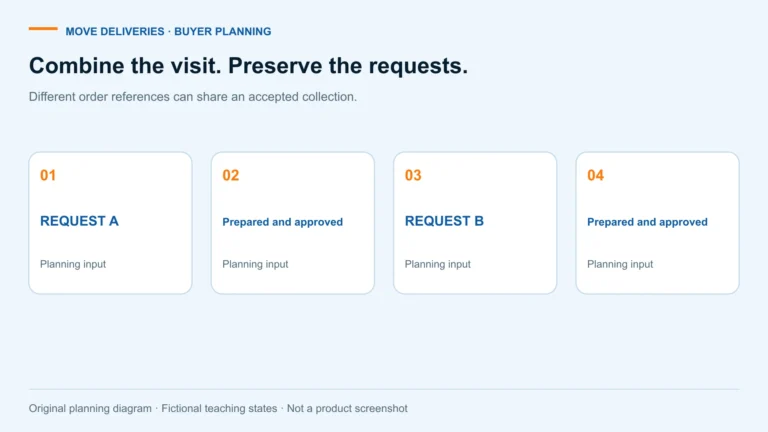
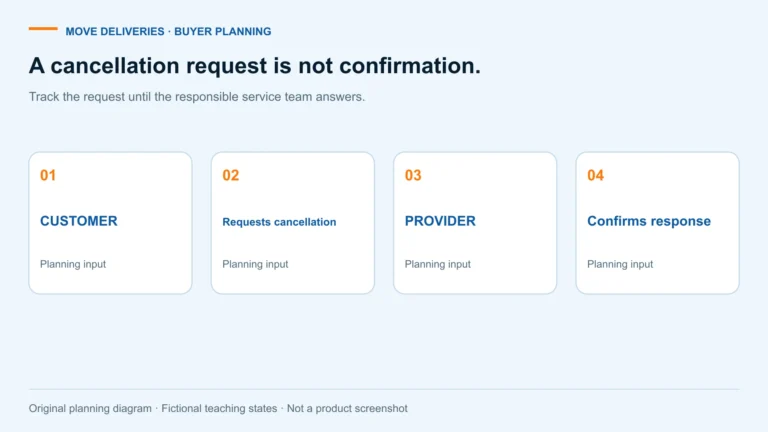
Distinguish requests from accepted orders and completed handoffs. If your history contains unaccepted requests, cancelled work or duplicate entries, those should not be counted as identical delivered demand. Retain them as separate planning information: an unaccepted request may reveal unmet need, while a cancellation may reserve time without ultimately generating a handoff. The definitions should remain visible beside the figures.
Record equipment categories at a useful operational level. A small carton, a folded mobility aid and a larger assembled item may have different footprints and handling requirements. Avoid putting unnecessary patient details into the planning export. You need evidence of demand and task conditions, not a broadly circulated copy of the underlying care record.
3. Build a time ledger for the work that occupies the resource
Separate driving from staging, loading, site approach, receiving handoff and return work. Record the events you can actually observe, with a consistent definition. If loading time includes waiting for the warehouse release, say so. Otherwise two teams may debate the same number while referring to different parts of the job.
Track ordinary variation rather than designing the plan around the shortest successful run. Site conditions can make the same address consume different amounts of time. A receiving queue, unavailable staff member or changed access point can affect the task even when the road journey is unchanged. Review relevant observations with the provider before deciding what allowance is appropriate.
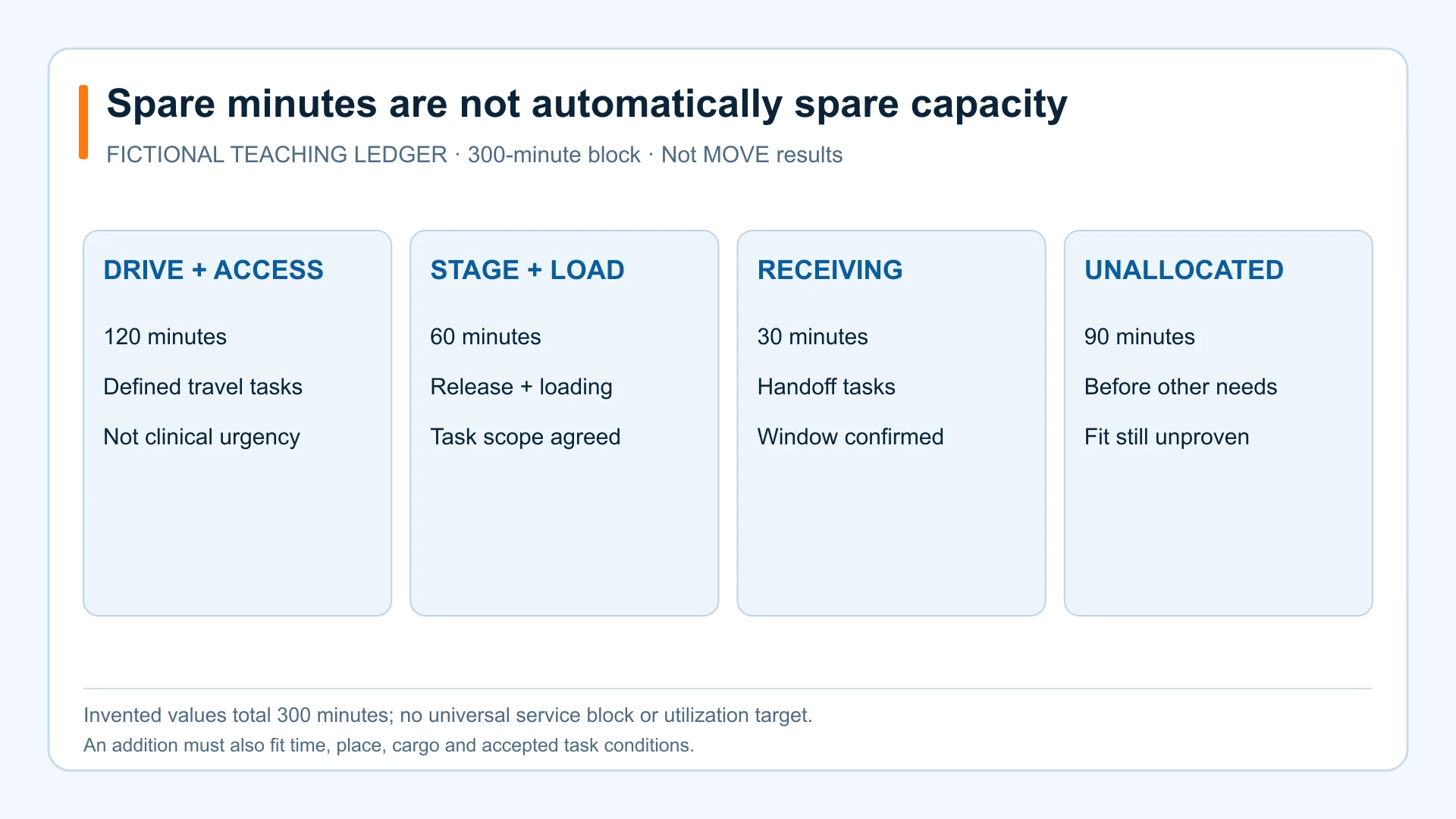
A simple planning identity is useful: reserved service time is allocated among committed task time, operational requirements and genuinely unallocated time. It is not a universal utilization benchmark. A positive remainder does not prove that a new delivery fits, because the remainder may occur at the wrong time or place. The ledger identifies where to investigate; it does not replace an acceptance decision.
4. Treat vehicle fit as a separate capacity constraint
Time is only one limit. Record the cargo’s dimensions, weight, orientation and any product-specific requirements supplied by the responsible owner. Then confirm the vehicle’s usable space, access opening and relevant accepted limits. Exterior vehicle size or the phrase cargo van does not answer these questions. Verify the configuration that will serve the actual arrangement.
Consider what will be inside the vehicle when the new task occurs. A return collection can conflict with remaining outbound items. A folded wheelchair may fit alone but need a different loading sequence beside other cargo. Do not multiply a one-item demonstration into an assumed daily vehicle capacity. The mix and sequence can be more important than the total number of pieces.
Keep transport separate from installation, clinical setup and product acceptance. The fact that an item can be transported does not mean a courier is authorized or equipped to perform work at the recipient’s location. Identify who receives the equipment and which tasks end at handoff. Any additional assistance must be discussed and expressly accepted, not inferred from a friendly driver’s previous favor.
5. Check the people, tools and site conditions behind loading
Ask who stages the cargo, who moves it to the vehicle and who assists at the destination. Confirm the tools and site access that the accepted task requires. A warehouse loading aid does not automatically exist at a residential destination. Those differences can affect both the available service and the time needed to carry it out.
OSHA’s ergonomics resources identify lifting, pushing, pulling and awkward or repetitive work as relevant risk factors. Use that context to involve the responsible safety and operational personnel in reviewing the task. It does not provide a universal safe lifting weight or certify a particular courier arrangement.
Record a boundary for unexpected conditions. If the destination presents stairs that were not disclosed or the item differs from the agreed description, the courier needs a decision path. Capacity should not be maintained by pressuring someone to improvise unsafe work. Review the changed conditions and obtain an accepted plan, including the responsible customer contact and any revised timing.
A dedicated courier capacity worksheet
| Constraint | Evidence to gather | Question for acceptance |
|---|---|---|
| Reserved service period | Agreed coverage block, ordinary scope and existing commitments. | Which resource is reserved, and which tasks are included? |
| Demand concentration | Ready times and receiving windows for distinct requests. | Do tasks compete for the same part of the service period? |
| Task time | Consistently defined driving, staging, loading, waiting and handoff observations. | Which condition is consuming time, and how variable is it? |
| Cargo mix | Actual dimensions, weights, product instructions and return collections. | Does the accepted vehicle configuration fit the proposed sequence? |
| Site and assistance | Loading aids, access route, receiving person and task boundaries. | Are the right people and tools available at both ends? |
| Change and recovery | Authority, provider contact and limits on additional work. | Who can accept an amended plan when a constraint changes? |
An illustrative time ledger: spare minutes are not spare capacity
Suppose an invented supplier reserves a 300-minute service block. Its planning ledger assigns 120 minutes to driving and site approach, 60 to staging and loading, and 30 to receiving handoffs. That leaves 90 minutes before accounting for other agreed operational requirements. These are fictional teaching values, not MOVE results, industry averages or a recommended service block.
Now suppose the next request requires cargo that will be ready near the end of that block, while the receiving function closes earlier. The arithmetic shows unallocated time, but the requested handoff does not fit the stated timing. Another request might require space occupied by a return item. It fails a different constraint even though the time remainder is unchanged.
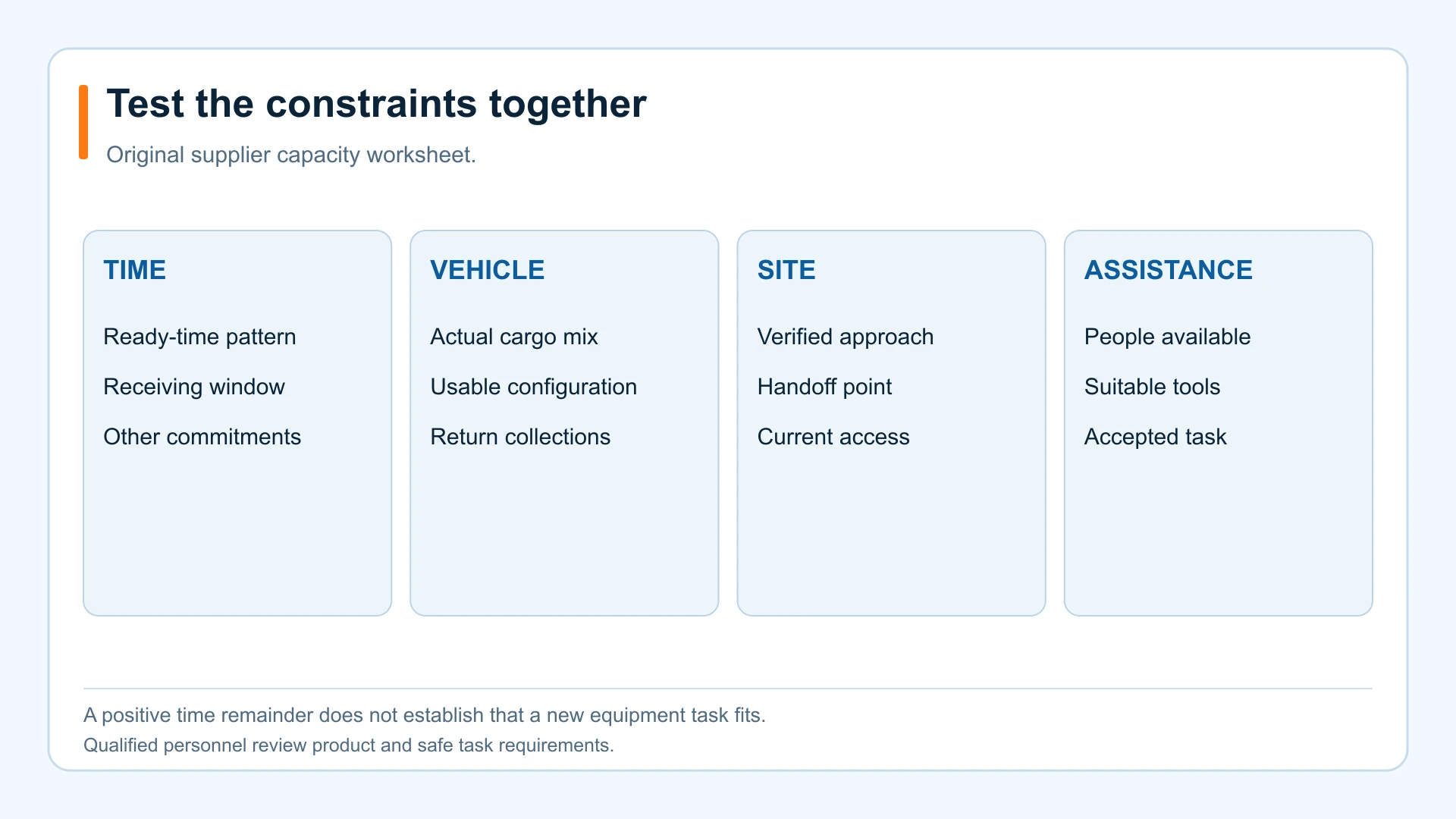
The lesson is to test a proposed addition against the relevant dimensions together. Time, location, vehicle fit, task assistance and receiving availability are not substitute measurements. Your team can use the ledger to ask where flexibility may exist, but should not approve a new promise based only on an unused-time percentage.
6. Review the constraint before choosing a bigger reservation
When the plan is crowded, identify the binding condition. If warehouse releases arrive together, additional staging coordination may be more relevant than more vehicle space. If a particular receiving window creates the conflict, a different accepted timing plan may help. If bulky cargo cannot fit the actual configuration, a scheduling adjustment alone will not solve it.
Ask the provider to evaluate alternatives with the same assumptions. Compare a changed service block, a different accepted vehicle arrangement, separate point-to-point work or an adjusted recurring plan. Record what each alternative includes and which constraint remains. A larger reservation that leaves the original task conflict untouched can be expensive without making the handoff more workable.
Also identify what evidence would change the decision. You may need more observations of loading dwell, a verified destination walkthrough or a better description of return volume. Collect the missing information before treating uncertainty as either unlimited spare capacity or an automatic need for more coverage. A disciplined review can explain the choice without inventing a universal utilization threshold.
7. Keep the capacity report connected to the accepted work
Use a report that ties observations back to order references and current service definitions. Show the period covered and any important gaps in the records. If a site changed its access process during the period, do not average away the change and present the result as a stable future assumption. Identify the condition that the current plan must accommodate.
Separate descriptive figures from commitments. An average number of completed stops describes the recorded period; it is not a guaranteed quota for a different day, cargo mix or route. A maximum observed count is even less reliable as a standing promise. Explain how your team used the evidence to inform the provider discussion.
Agree who updates the report when volume or scope changes. The warehouse, customer service and courier contact may each see a different part of the demand. A named service owner can reconcile those observations and obtain revised acceptance where necessary. The goal is a plan people can use, not a dashboard that looks busy while hiding an unresolved constraint.
Dedicated courier capacity: supplier questions
Does dedicated coverage mean unlimited medical supply deliveries?
No universal definition establishes unlimited work. Ask what the specific arrangement reserves and how extra or changed requests are accepted. MOVE’s dedicated courier service can be discussed around your team’s workload and service needs. The actual local scope, task fit and availability require confirmation.
Should every supplier request use the same delivery model?
Not necessarily. Predictable repeat work may fit scheduled delivery; an agreed multi-stop sequence may fit fixed-route delivery; a separate single order may need its own quote. Compare models against the work rather than forcing every request into one label.
Can a capacity worksheet decide whether equipment is safe to move?
No. It organizes the information needed for a qualified task and acceptance review. Product requirements, site conditions, equipment and assistance still need the responsible people. An arithmetic remainder or cargo photograph cannot authorize a task that has not been assessed and accepted.
Bring the constraints into the courier conversation
Start with the service period, the actual cargo mix, the ready and receiving patterns, and the assistance available at both ends. Explore MOVE’s medical supplier solutions and discuss recurring coverage through an account conversation. Our proprietary platform supports delivery visibility; confirm the evidence and arrangement relevant to your work. A clearer scope is the starting point for a capacity plan your team can trust.