
Courier site onboarding is the work of turning a new address into a delivery location people can actually use. A street address does not identify the right entrance, release owner, receiving window or escalation path. Confirm those details before the new care site becomes another stop in a recurring service.
For a growing pharmacy group, laboratory network or outpatient organization, adding a location can look like a small administrative change. The real work is connecting the new site’s routines with the existing transport plan. A collection that fits the address list may still conflict with a release time, building restriction or receiving obligation somewhere else.
This guide provides an original commissioning plan for one new location. It is not a clinical protocol or a promise that every cargo type or service is available. Qualified healthcare staff determine product and specimen requirements; the courier confirms the actual transport scope. Use the plan to expose unanswered questions before the first live handoff.
1. Give the site a commissioning owner
Choose one person who can assemble site information and obtain decisions from the right departments. That person does not need authority over every clinical, security or purchasing question. They need a way to identify who does. Without a commissioning owner, several teams can each assume another team has confirmed the detail that makes the pickup possible.
Make the owner’s responsibilities concrete: gather current instructions, obtain release and receiving contacts, coordinate a walkthrough, record unresolved requirements and confirm the launch decision. Give the courier a corresponding contact for operational acceptance. A shared contact list is useful, but a named decision path is more useful when two instructions contradict one another.
Set the scope of the commissioning exercise. Is this an additional collection from an existing customer, a new receiving site, a new cargo category or a different service period? Those changes can require different reviews. Do not treat an established account as evidence that every new site automatically fits its accepted arrangement.
2. Build a profile around actual handoffs
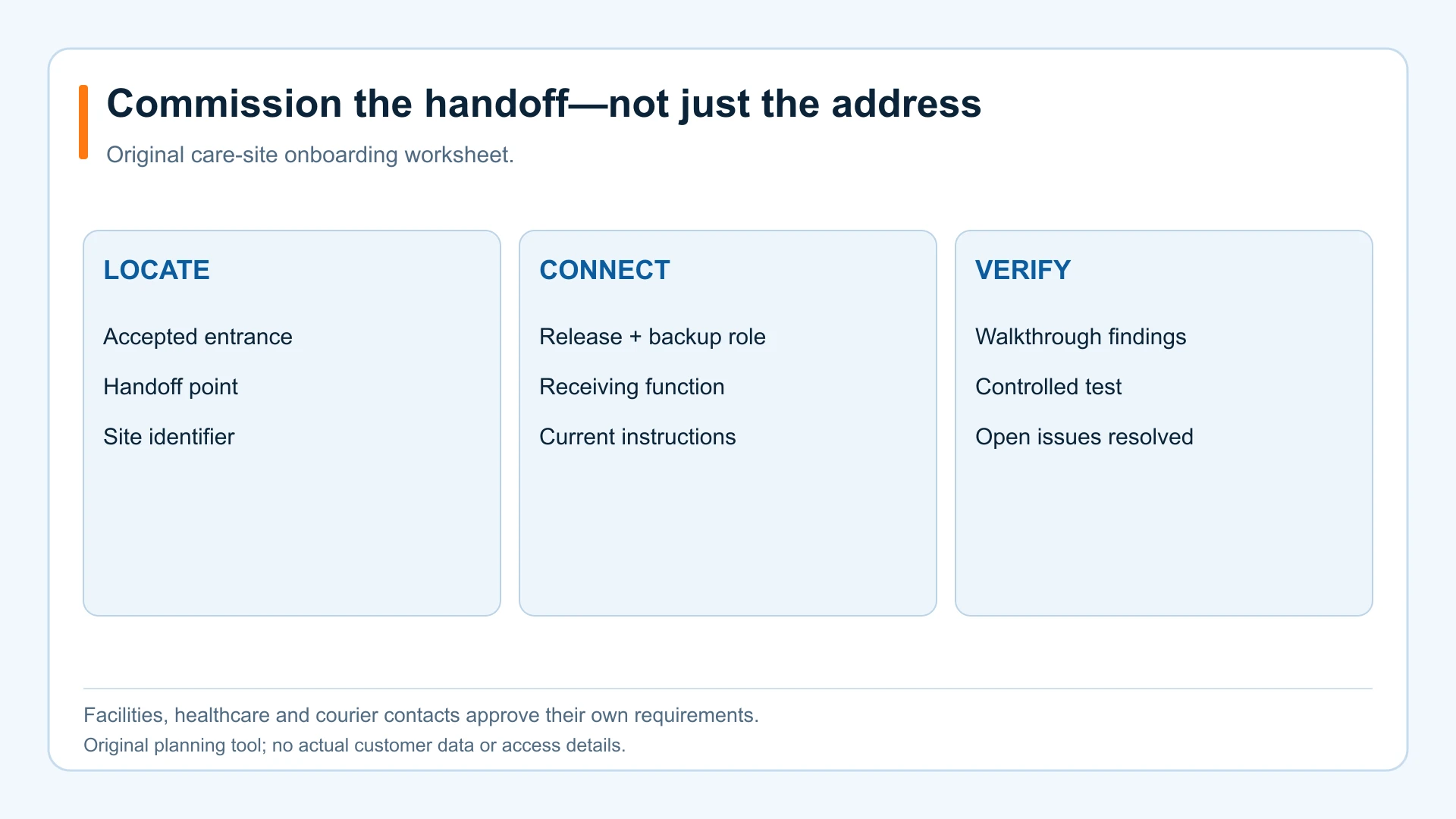
Begin with the location’s official name, street address and the exact handoff point. Include a stable site identifier when your systems use one. Similar names within a healthcare group can cause avoidable confusion. A clinic nickname that works internally may not distinguish two buildings on a courier’s route or two destinations in a billing report.
Describe what is being collected or received without placing unnecessary patient information in a broadly distributed instruction sheet. The responsible privacy and healthcare teams should determine the information needed for the actual work. A site profile is an operational reference, not a place to copy patient records or substitute informal notes for approved handling instructions.
List ordinary operating periods and relevant exceptions. A business may be open while its receiving department is closed. A pharmacy counter may serve the public while transport releases occur elsewhere. Confirm the hours of the actual handoff function, including how closures, lunch coverage and changed schedules are communicated.
3. Verify access from the road to the handoff point
Walk the route a courier will need to use. Identify the entrance, parking or loading area, intercom process and any reception step. Check whether the address points to the public entrance while the accepted transport entrance is on another street. A map pin can locate the building without resolving the final approach.
Ask facilities or security to confirm any access permissions. Do not publish access codes in a public blog comment, an unrestricted spreadsheet or a photograph used for marketing. Agree a controlled method for providing current instructions to authorized people. Also decide what the courier should do when the expected access method does not work.
Observe physical constraints with the responsible site and transport personnel: stairs, thresholds, narrow doors, long corridors and space for a trolley can affect the task. OSHA’s ergonomics resources identify lifting, pushing, pulling and awkward work as relevant risk factors. They do not supply a universal safe weight or certify a specific loading arrangement.
4. Observe the release routine rather than guessing it
Ask the site to describe the last completed release in practical terms. Who prepared it? Who confirmed it was ready? Where did it wait? Who answered a question from the courier? Walking through one example can reveal a gap that a generic statement such as “the front desk handles it” leaves unresolved.
Separate readiness from opening hours. A collection should be planned around the agreed ready time, not the earliest moment someone can unlock the building. If readiness varies, document how the site signals that variation and who can approve a changed plan. Do not quietly use an unconfirmed estimate as a recurring pickup commitment.
Identify the release owner’s backup role. A backup should know the current instructions and the boundary of their authority. Giving the courier a second telephone number is not enough if the person answering cannot confirm readiness or find the transport unit. Test the backup path as part of commissioning, not only after the primary contact is absent.
5. Connect the new stop to its receiving requirement
A new pickup affects more than the pickup location. Confirm where the transport unit is going, who can accept it and when that function is available. The receiving requirement can expose a timing conflict that is invisible when the site is considered alone. An agreed collection time has limited value if the destination cannot accept the resulting arrival.
For laboratory work, the responsible laboratory supplies applicable specimen acceptance and transport requirements. For pharmacy or equipment work, the relevant product and healthcare professionals confirm the instructions. Do not infer acceptable timing, temperature or packaging from another site’s similar-looking cargo. Similar appearance does not establish identical requirements.
Review the effect on existing accepted stops. Additional access or waiting time can consume capacity that was previously available for another handoff. Ask the provider to evaluate the revised service as a whole. A new stop is not truly commissioned if it works only by making the existing plan unrealistic.
A commissioning worksheet for the new care site
| Commissioning item | Evidence to collect | Decision before launch |
|---|---|---|
| Handoff location | Verified entrance and exact release or receiving point; current site identifier. | Authorized people can locate and use the handoff point. |
| Readiness routine | Release owner, backup role, ready signal and applicable instructions. | Ordinary and changed readiness can be communicated without guesswork. |
| Transport scope | Cargo description, required task, vehicle/access constraints and qualified reviews. | The provider has accepted the actual work, with unresolved limits visible. |
| Receiving connection | Destination function, receiving window and exception authority. | The proposed service fits both ends and existing accepted obligations. |
| Instruction control | Current version, effective date, approved distribution and review owner. | Obsolete directions will not remain the operational default. |
| Commissioning evidence | Walkthrough findings, controlled test, open issues and sign-off. | A named owner has decided whether the site is ready for live service. |
6. Run a controlled test before the first live collection
Choose a test that answers a real commissioning question. A walkthrough may resolve entrance access; a dummy order may reveal an incorrect site identifier; an empty transport unit may help the responsible personnel examine space and handoff flow. Select the method with the relevant reviewers. Do not use live specimens or patient information casually to make a demonstration look realistic.
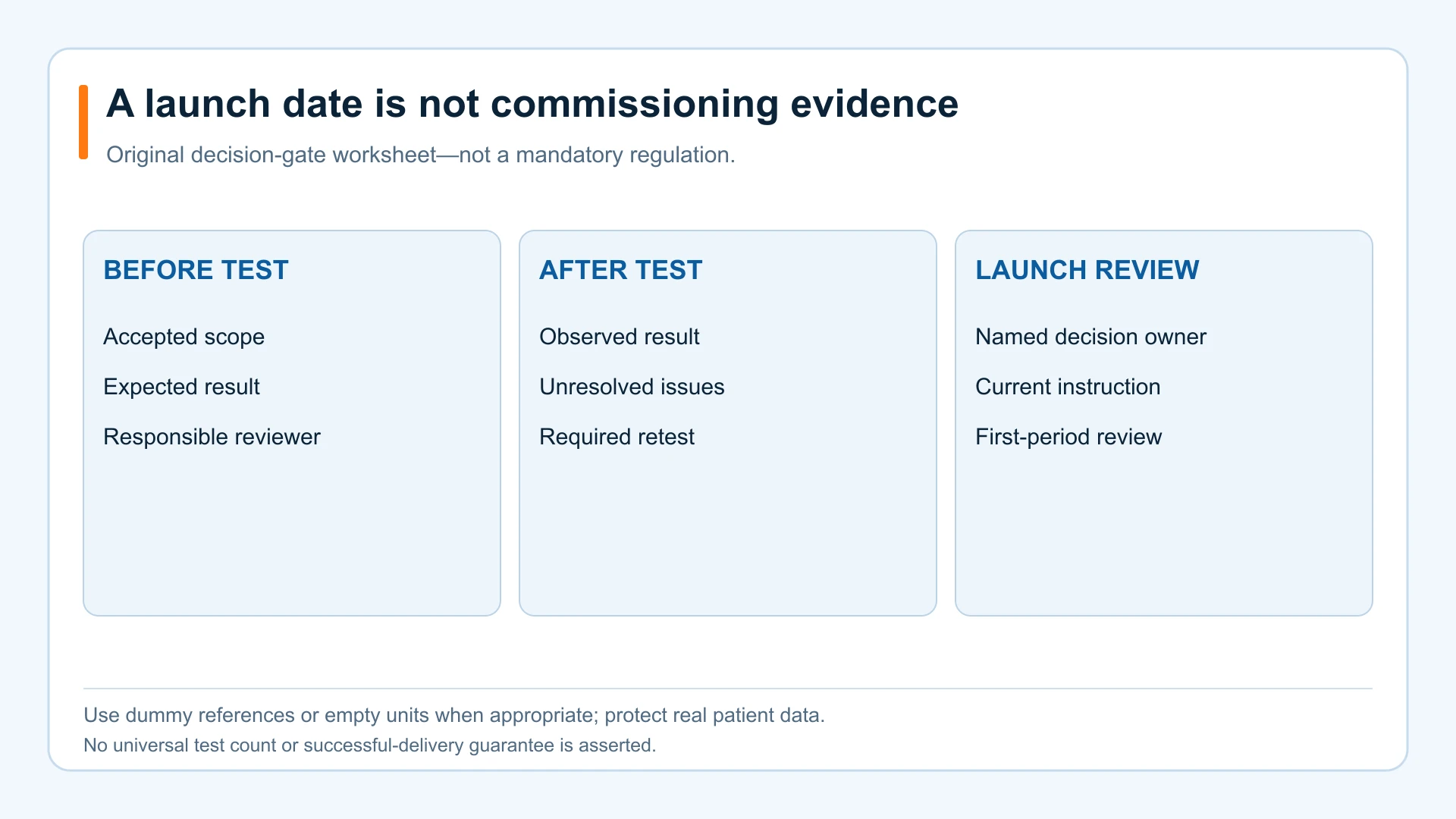
Write the expected result before running the test. For example: an authorized courier can reach the designated point, the receiving role recognizes the order reference and the current instruction is available. Record what actually happened. A test without an expected result can become a tour rather than evidence that the planned handoff is usable.
Give failures an owner and a retest condition. An entrance that remained locked is not resolved because someone promised to tell reception. The commissioning record should show what changed and how the relevant people confirmed it. Keep unresolved work visible; launch should be an explicit decision, not the result of an approaching calendar date.
7. Make the approved instruction the only current instruction
Site instructions often exist in several places: an email thread, a dispatch note, a reception binder and a staff member’s memory. Identify the approved operational source and how authorized people receive updates. You do not need a complex document system to recognize the risk of conflicting directions, but you do need an owner who can correct them.
Record an effective date and the change being made. When the pickup entrance moves, say what replaces the previous entrance and whether the old direction remains valid during a transition. Preserve appropriate change history without presenting every historical note as a current instruction. The person doing the handoff should not have to interpret a long conversation to find today’s plan.
Confirm the provider’s actual method for updating site details. This guide does not promise a particular MOVE editing interface, integration or alert. Ask for a demonstration of how the accepted location information is maintained in your arrangement and how a material change reaches the people who need it.
8. Review the first operating period without declaring victory early
Define a short commissioning review period appropriate to the service. The goal is not to manufacture a universal number of successful runs. It is to collect enough relevant observations to check the assumptions that mattered at launch. A site used once each week needs a different review plan from one with several handoffs each day.
Review access, readiness, receiving coordination and evidence separately. A completed delivery can still reveal obsolete entrance instructions or a backup contact who did not know the plan. Correct those conditions before staff normalize an improvised workaround. A good commissioning review asks what made the handoff possible, not only whether an order was marked complete.
Use order references and agreed event definitions to connect the review to evidence. If you need help specifying the review, explore proof-of-delivery information and confirm what records are available. The evidence should support the operational question without creating unnecessary copies of sensitive information.
An illustrative scenario: the right address, the wrong entrance
Consider an invented outpatient site where the published address leads to a public reception desk, but prepared transport units are released through a staff entrance. Procurement adds the address to a recurring plan. The first courier arrives on time at reception, while the release owner waits elsewhere. Each person followed the information they had.
The remedy is more specific than asking the driver to arrive earlier. The commissioning owner verifies the accepted entrance, obtains the site’s approved access process and gives the provider a current instruction. The backup release role tests the handoff path. The service plan is reviewed to account for the actual approach and receiving requirement.
This is a teaching example, not an actual MOVE case study or a measured outcome. Its purpose is to show why an address-only onboarding process can leave a material question unanswered. The useful action is identifying and testing the missing detail; there is no invented time-saving percentage or promise that every delay disappears.
Courier site onboarding: practical questions
Can we add the site and correct instructions after launch?
Some noncritical refinements may emerge during operation, but access, release ownership, accepted scope and receiving requirements should not be treated as optional later details. Identify what must be resolved before live service and who can approve remaining limitations. An explicit conditional launch is more understandable than silent assumptions.
Does the new site need a completely separate courier service?
Not necessarily. The answer depends on its location, cargo, timing and effect on existing work. A recurring collection may fit scheduled delivery or a fixed-route arrangement. Confirm the actual local plan rather than assuming an account or coverage map settles capacity.
Who should approve the site instructions?
The people responsible for the information should approve their part: facilities for access, healthcare or product personnel for applicable requirements, the service owner for timing and the provider for accepted transport. The commissioning owner coordinates those decisions. A single signature should not be used to imply that every specialist requirement has been reviewed.
Add the site with a plan your team can use
Bring MOVE the new location, the cargo description, release and receiving requirements, and the current access instructions. We can discuss how local same-day or recurring delivery may fit the accepted work and the visibility available through our proprietary platform. Start an account conversation for ongoing support or Quick Quote for a single order. Local availability and task acceptance must be confirmed.