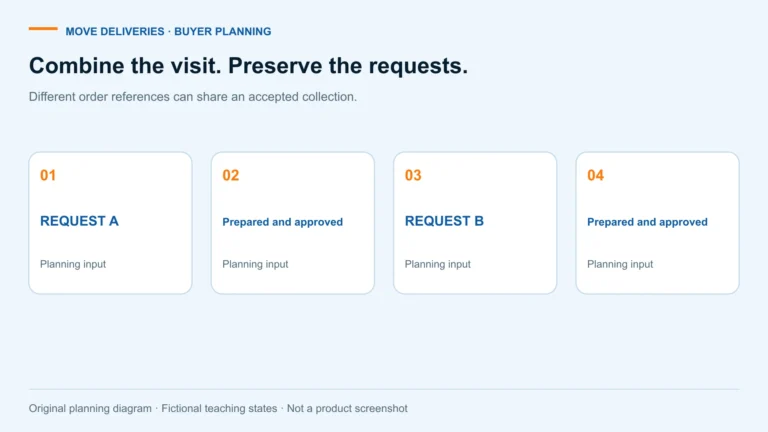

Courier order integration should remove unnecessary re-entry without removing the checks that make a delivery instruction usable. Before you retire a manual step, verify which system owns the order, what the courier has actually accepted and how the workflow behaves when a message fails, repeats or arrives after a change.
Healthcare operations teams often feel the friction first: one person enters a request, another copies an address and a third checks a separate screen for a status. Connecting systems can help, but a successful connection is not the same as a reliable operational workflow. The real test is whether the next responsible person has the correct instruction when a handoff needs a decision.
This guide offers an original field-mapping worksheet, nine acceptance tests and a fictional recovery scenario. It does not claim that MOVE supports every interface or integration described. MOVE’s proprietary platform is part of the service conversation; compatibility, available functions and implementation scope must be demonstrated and confirmed for the actual arrangement.
Test 1: Identify the system of record
Name the authoritative owner of the request, accepted transport instruction and completion evidence. These may be different records in different systems. Document how their references connect. A request record in the healthcare system should not automatically be described as an accepted courier order merely because a connector attempted to send it.
Distinguish internal request identification from provider order identification. Keep both where needed and test how a user follows one to the other. If staff cannot reconcile the references, they may create a second request when the original appears missing. A connected workflow should make the existing state easier to find, not encourage duplicate work.
Assign a maintenance owner for each mapping. Addresses, site roles and service descriptions can change independently. A connector that continues sending an old release location may function perfectly from a technical perspective while producing an unusable instruction. Versioned operational ownership matters as much as a successful network response.
Test 2: Map the fields that change the handoff
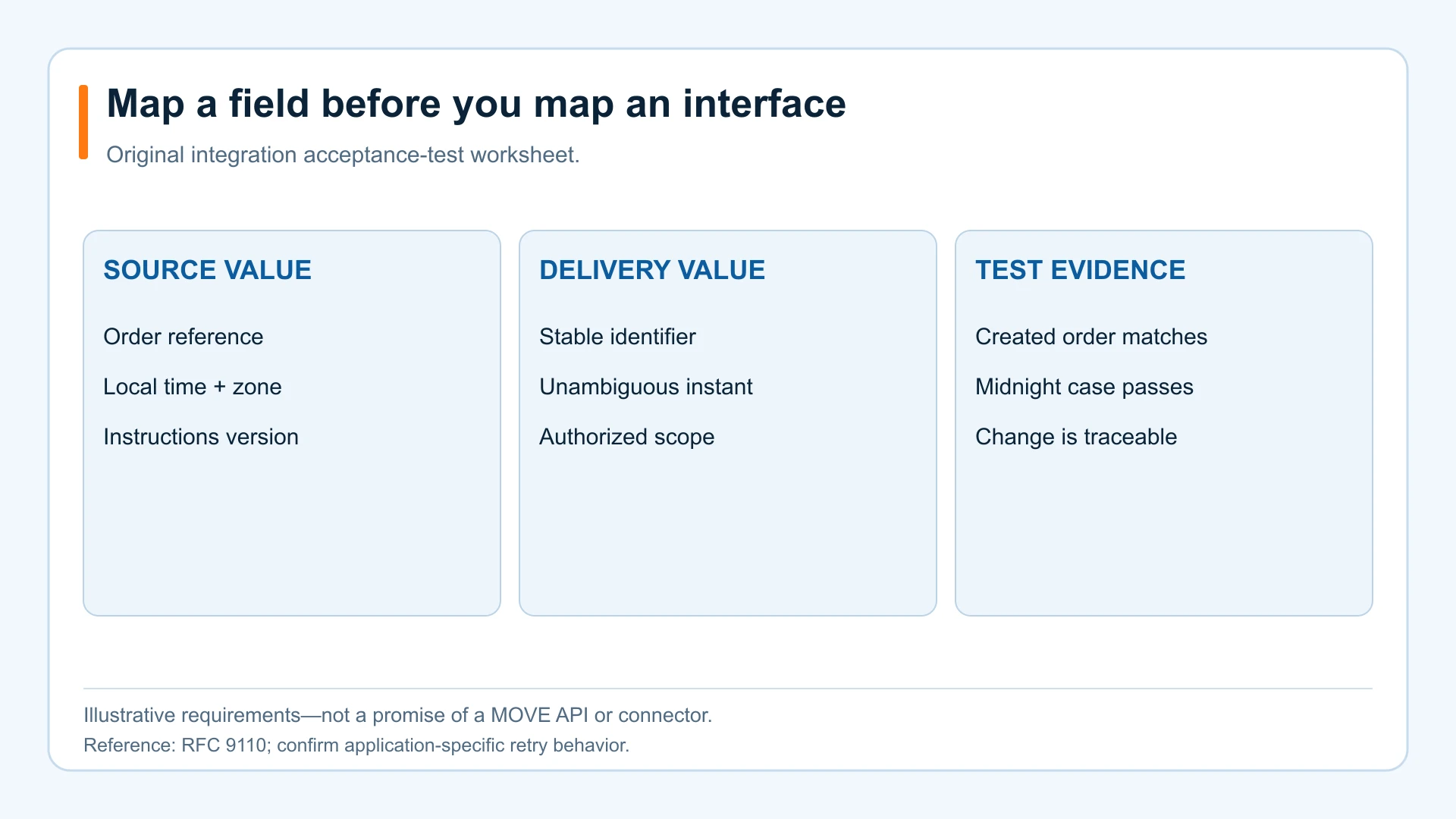
Map release location, destination department, ready time, receiving requirement, transport-unit count, relevant dimensions and approved instructions deliberately. Do not assume similar field names have identical meanings. A “date” might mean request date in one system and pickup date in another. A “contact” might refer to a billing administrator rather than an authorized releasing role.
For each field, record its source, destination, validation rule and accountable role. Define what happens if it is missing, malformed or inconsistent with another field. A useful integration stops an incomplete instruction for review rather than filling a critical gap with a convenient default nobody authorized.
Use a field dictionary that operational staff can understand. Technical specifications remain important, but the releasing and receiving teams should be able to explain the instruction produced. If only the integration developer understands the mapping, the organization may not notice an incorrect assumption until it affects an actual handoff.
| Field or relationship | Meaning to define | Acceptance test |
|---|---|---|
| Request and order references | Separate internal intent from the provider’s accepted transport record. | Follow one fictional request through acceptance and reconcile both identifiers. |
| Release location | Specify the approved pickup point, not only the property’s street address. | Use a site with separate patient and staff entrances. |
| Timing | Identify ready time, proposed window, accepted commitment and time zone separately. | Check an order crossing midnight and an approved timing change. |
| Transport units | Describe the units the provider can review for accepted scope. | Test a unit-count change after original acceptance. |
| Receiving instruction | Identify the authorized destination role and maintained access details. | Test a department name that differs from the facility name. |
| Technical requirements | Qualified owners supply applicable instructions through approved channels. | Hold an order whose required qualified instruction is unresolved. |
| Evidence reference | Connect agreed transport events without copying unnecessary sensitive content. | Retrieve a permitted completion reference and verify its order relationship. |
Test 3: Keep submission and acceptance separate
An interface can confirm receipt of a message without confirming that transport is accepted. Define the actual response semantics with the provider. Staff need to know whether the request is received, awaiting review, accepted or requires a correction. These are suggested workflow distinctions, not an asserted MOVE software status list.
Test a technically valid request that cannot yet be accepted operationally. Perhaps the destination access is unconfirmed or the proposed cargo scope needs review. The workflow should make the unresolved decision visible. A green network response should not become an unsupported promise to the receiving team.
Specify which person monitors unanswered requests. Automation can move the message, but an accountable role still needs to act when acknowledgment is missing or acceptance remains unresolved. Decide the escalation process with the organizations involved rather than inventing a universal response-time guarantee.
Test 4: Prevent duplicate transport when a message repeats
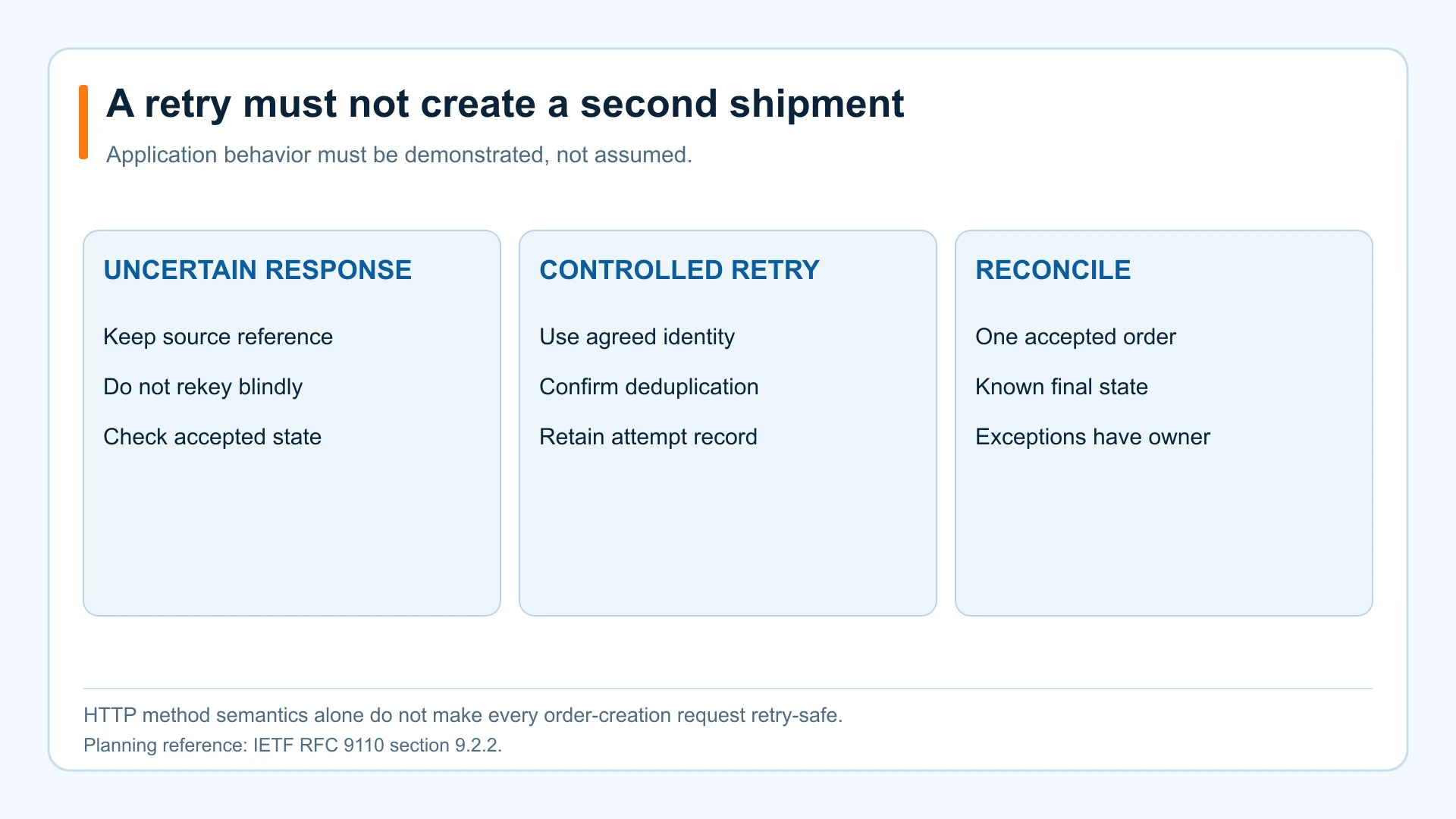
Networks and applications can repeat submissions during recovery. Ask how the particular interface recognizes a repeated request and returns the appropriate existing result. Do not assume that a client retry is safe simply because the software allows it. The test must show whether one intended request creates one operational order under the supported process.
The HTTP standard RFC 9110 explains idempotent method semantics. That does not make every order-creation POST automatically duplicate-safe. Application-level behavior, identifiers and the actual interface contract need review. Ask the integration owner to demonstrate the supported repeated-submission case.
Use fictional request data in testing. Submit the same intended request through the approved retry process, then inspect the resulting operational records. Confirm how the user sees the existing order and how a genuinely new request is distinguished. The aim is not simply to suppress messages; it is to preserve the correct meaning of each instruction.
Test 5: Handle changed instructions in a clear order
A later instruction can arrive before an earlier message if systems queue and recover differently. Ask how the workflow identifies the current version and preserves the history required for review. It should not allow a delayed old address to silently overwrite a newly accepted destination change.
Record the proposed change, its authority and the provider’s acceptance where required. An editable field in the requesting system does not necessarily authorize the courier to perform different work. Ensure the integration communicates the distinction between a change request and an accepted revised transport instruction.
Test two successive changes and a late original message. Ask the responsible operational users which instruction is active and why. If the answer depends on reading several raw messages and guessing, the workflow needs clearer version and decision semantics before staff depend on it.
Test 6: Keep occurrence time, recording time and local display understandable
A physical handoff may occur before its event reaches another system. Preserve the distinction between occurrence and recording times where relevant and available. Otherwise, a delayed sync can appear to be a delayed delivery. Define how each report uses the timestamp rather than allowing the receiving application to substitute its import time without explanation.
Agree unambiguous time-zone handling and test cross-midnight work. If the systems serve locations with different zones or encounter daylight-saving transitions, include those cases in the acceptance plan. Do not rely on a screenshot of one ordinary daytime order to establish that every boundary behaves correctly.
Operational users should understand the displayed time. A technically accurate stored timestamp can still confuse staff if the interface silently changes the display zone. Include the zone or other clear context where the task requires it, and confirm the reporting basis with the people who assess service performance.
Test 7: Share the information the function needs
Map information flows before sending production data. Identify which organizations and roles receive each field, why they need it and what happens when access ends. A connected workflow should not copy a complete clinical record into a general transport note because the source system makes that field convenient to export.
The NIST Privacy Framework offers a risk-management reference for discussing data processing. It does not certify an integration or replace applicable healthcare privacy requirements. Your responsible privacy and security teams assess the actual arrangement, access and safeguards.
Test using synthetic or appropriately approved data. Check permissions, error messages, exports and operational screens as well as the primary form. A sensitive field omitted from the normal view may still appear in a failed-message log. Confirm the actual controls rather than assuming that a hidden interface element prevents access.
Test 8: Recover without creating two versions of the same work
Agree the monitored response to an interruption before it occurs. Staff need to know which pending requests require review, which work remains accepted and which approved continuity channel can be used. Do not assume the platform supports offline ordering or another fallback function until it is demonstrated for the arrangement.
If temporary records are permitted, identify them clearly and reconcile them when the connection recovers. Preserve their relationship to accepted orders and physical events. Blindly resending every pending request can create duplicates; silently discarding the queue can lose work. The recovery process needs a responsible owner and explicit reconciliation rules.
Run a controlled rehearsal with fictional references. Stop the supported flow, process a permitted continuity case and restore it. Show that each intended order and evidence record can be accounted for afterward. A successful login after an outage is not enough to prove that operational records survived coherently.
Test 9: Let operational users verify the whole handoff
Invite a requester, release coordinator, receiving representative and courier coordination contact to follow an authorized test. Each should identify the instruction they receive, the decision they own and the evidence they need for the next step. Technical success matters, but the connected process must also make sense to the people doing the work.
Include a correction, not just a perfect request. Change a release detail through the approved process and check whether the current instruction reaches the permitted users. Then test missing receiving access. The workflow should assign that unresolved decision rather than treating transport completion as a substitute for recipient authorization.
Record the acceptance result, outstanding limitations and approved next step. Do not sign off a feature that was only discussed or represented in a mockup. A narrowly tested working flow with clear boundaries is more useful than a broad integration claim that nobody can demonstrate.
A fictional retry case worth testing
Imagine a fictional clinic request sent to a provider interface. The clinic does not receive the expected acknowledgment, so the operator proposes resubmitting it. Before doing so, the approved process checks whether the original request already created an order. If it did, the operator links that existing record rather than creating another pickup.
The clinic then changes the release point. The change is recorded as a proposed revision, reviewed by the appropriate parties and accepted through the supported process. A late response to the original submission must not silently restore the obsolete release point. The test demonstrates both duplicate handling and instruction ordering without using real patient data.
This example does not describe a verified MOVE integration function. It illustrates what the buyer and implementation team should ask to see in the actual proposed workflow. Confirm supported behavior before removing a manual check that currently prevents duplicate orders or outdated instructions from reaching a driver.
Courier order integration: common questions
Does an API connection mean transport has been booked?
Not necessarily. The interface may acknowledge a message while operational acceptance remains pending. Confirm the actual response meanings and the record that establishes acceptance. Staff should not promise a receiving team a delivery based only on a technically successful submission.
Can every healthcare system connect with MOVE?
This guide makes no blanket compatibility claim. Discuss your system, supported interface, necessary fields and service scope with MOVE. Any proposed integration should be demonstrated, reviewed and accepted before your organization depends on it.
Should automation remove every human review?
Automation can reduce repetitive entry, but decisions about technical requirements, changed scope and exceptions still need appropriate owners. Remove a manual step only after the tested workflow preserves its necessary control or replaces it with an approved equivalent.
Connect the workflow before you connect the screens
Explore MOVE’s technology and discuss the actual request-to-handoff process your team needs. Live tracking and proof of delivery address different operational questions. Use Start an Account to review the service and any confirmed implementation scope with clear responsibilities from the beginning.