Duplicate courier orders can start with a reasonable question: “Did that request go through?” A pharmacy employee submits a delivery request, sees no confirmation and calls a colleague. The colleague sends another request through a different channel. Two people were trying to protect the same delivery, but the transport team may now be looking at two instructions. The useful response is to verify the first request—not assume that another submission will fix the uncertainty.
This guide is for healthcare buyers coordinating local pharmacy, laboratory, clinic and medical-supply deliveries. It explains how to recognize a possible duplicate, separate it from a genuine additional trip, and give the right person enough evidence to decide. It is not a description of an automatic MOVE duplicate-detection feature. Confirm the capabilities and procedures available to your account rather than assuming every courier system handles retries in the same way.
You will find seven practical checks, an original request-review card and a fictional two-channel example. The goal is a clearer transport instruction, not fewer records at any cost. Two requests with the same addresses can represent different shipments, different ready times or a necessary return collection. Never cancel or merge legitimate work solely because a pair of fields looks similar.
In this guide
- Separate a duplicate from additional work
- Use seven checks before another request is sent
- Copy the request-review card
- Follow one shipment across two channels
- Ask the right software retry questions
- Test the process before expanding it
- Get answers to buyer questions
- Plan your next delivery conversation
A second message does not always mean a second delivery.
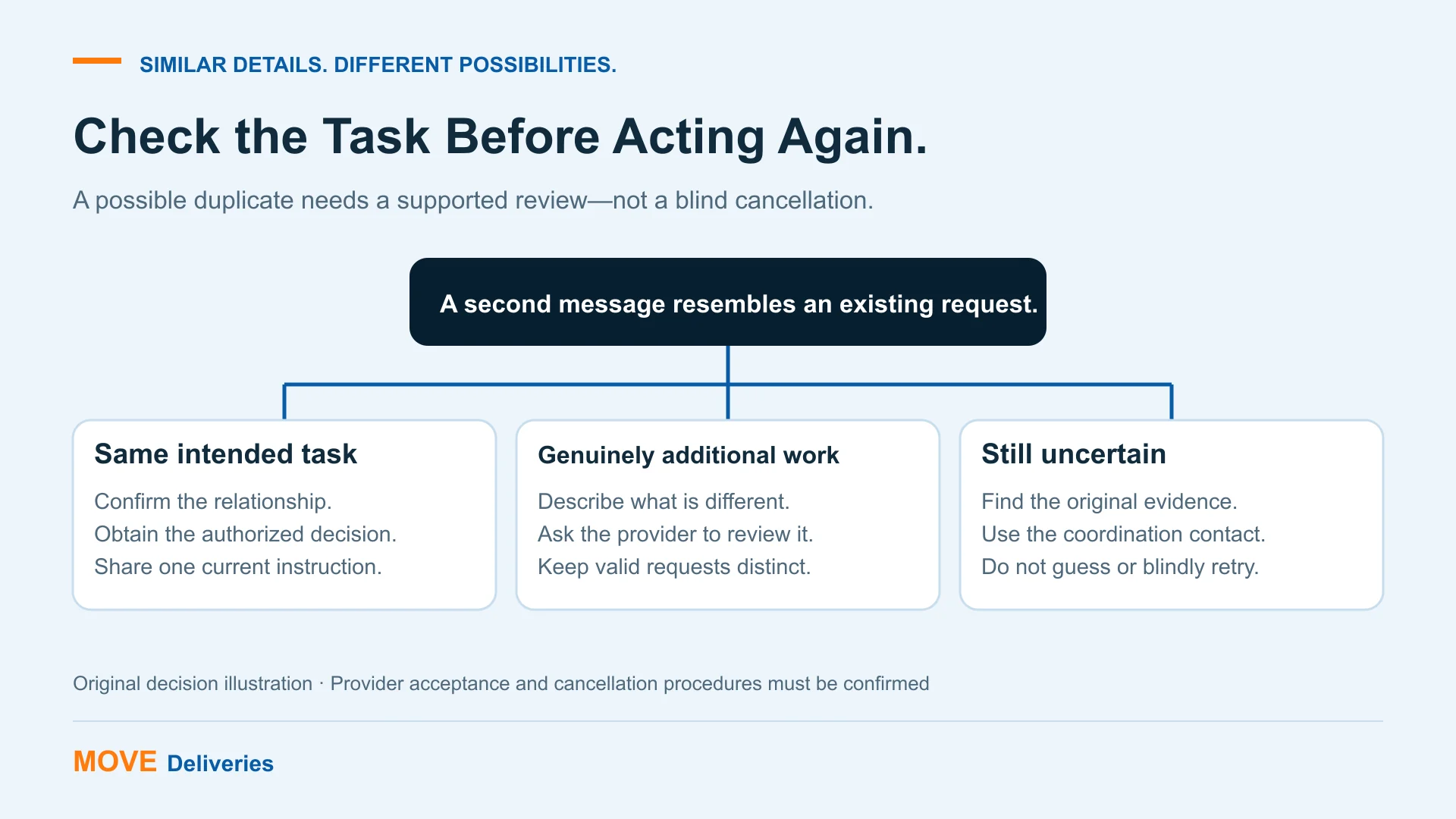
For this article, a possible duplicate is another transport request that may describe work already requested. It remains a possibility until an authorized reviewer establishes the relationship between the records. A confirmed duplicate describes an unintended repeat of the same requested transport task. That definition is different from two packages traveling together, two separate deliveries to the same clinic or a planned return trip.
Keep three identifiers distinct. Your organization may have an internal work reference, the courier provider may issue its own request reference, and individual packages may carry handling or item identifiers. One is not automatically a substitute for another. Use the agreed operational references to connect the conversation. Avoid putting patient names, prescription details or other unnecessary sensitive information in a general coordination spreadsheet merely to make matching easier.
A clear process should also distinguish a new request from a status question, a change to an existing request and a cancellation request. If all four arrive as an unlabeled email saying “please handle this,” people must infer the intended action. Establish a simple message purpose and name the existing reference when one exists. A question about an order should not accidentally sound like authorization for another collection.
7 checks for preventing duplicate courier orders
1. Name the person responsible for submitting the request.
When several departments can arrange transport, agree who submits each type of work and who covers that responsibility when the primary person is unavailable. This does not require one employee to handle every delivery. It requires a visible division of responsibility. A pharmacy’s normal route, a clinic’s exceptional collection and a supplier’s return visit may have different owners, provided those owners know where an existing request can be checked.
Define what a colleague should do when helping. They might review the request status, contact the provider using the current reference or prepare the missing details for the submitting person. They should not have to guess whether taking over means creating a second request. At a staff change, transfer the unresolved question and its reference as well as the fact that someone is “working on delivery.”
2. Capture the first reference where the next person can find it.
After a request is submitted, keep the provider’s available acknowledgment or reference in the agreed work record. Include the submission channel and time zone when those help identify the event. The next person should be able to ask about the same request rather than recreate it from memory. A screenshot stored on one employee’s phone is not a dependable shared coordination method for a busy receiving or releasing team.
Be precise about what the acknowledgment means. It may indicate that a message was received, that an order record was created or that the proposed service was accepted. Those states are not identical. Ask the provider which response confirms the next operational step. Do not present an automated receipt as proof that a particular pickup time, vehicle requirement or additional task has already been agreed.
3. Treat missing confirmation as an unresolved state.
A slow screen or an interrupted connection does not tell the buyer whether the original submission reached the provider. Record what is known: the channel used, approximately when the request was sent, any reference returned and the last visible state. Then follow the provider’s supported verification procedure. Repeatedly pressing submit or sending a new request through another channel can add records without answering the original question.
If the requested service has a time constraint, communicate that constraint while asking about the existing request. An unresolved acknowledgment and an urgent operational need should both be visible. Let the authorized coordination contact decide the next step under the applicable process. Do not silently send repeated requests in the hope that one will be acted on, or tell the receiving team that a pickup is accepted when that remains unconfirmed.
4. Mark the purpose of every follow-up message.
Make the requested action visible before the route details. A colleague should not have to read an entire email chain to discover whether you are asking for an update or requesting another collection. Adapt the following fictional message starters to the communication channel agreed with your provider. They are plain-language examples, not software commands or a way to bypass authorization.
- Status question — MD-27: “Please confirm whether this existing request was accepted. This message is not a new transport request.”
- Proposed change — MD-27: “Please review this proposed change to the existing request. Confirm what can be accepted before we treat the instruction as changed.”
- Additional work for review: “This is a separate prepared consignment with a different required collection time. Please review the new need and confirm how it should be booked.”
Use the real operational reference available to your team and supply the necessary nonclinical details through the approved channel. If no reference was received, say that explicitly and identify when and how the original request was submitted. A clear subject line helps interpretation; only the responsible person’s confirmation establishes the accepted next action.
There is a practical communication principle behind this step. AHRQ’s Check-Back guidance describes confirming receipt and understanding, then closing the loop with the sender. Apply that principle to the transport instruction: state the request reference and intended action, ask the receiver to confirm the interpretation, and resolve any mismatch. This is an operational adaptation, not a claim of MOVE clinical training or a measured safety outcome.
5. Compare the transport task—not just the address.
When two records look similar, compare their purpose, releasing location, receiving location, ready time and operational reference with the people authorized to clarify them. An address match is a reason to investigate, not permission to remove a record. A hospital can receive multiple legitimate consignments from the same pharmacy during one day. A return collection can reverse the route while representing a different task.
Check whether one message changes an existing request or adds work that was not previously requested. If a supplier adds another package, that does not automatically establish whether a new trip is required; the provider must review the actual change. Keep the question open until the relevant parties confirm it. Avoid a simplistic rule such as “same pickup and destination means duplicate,” which can erase the distinction the team needs.
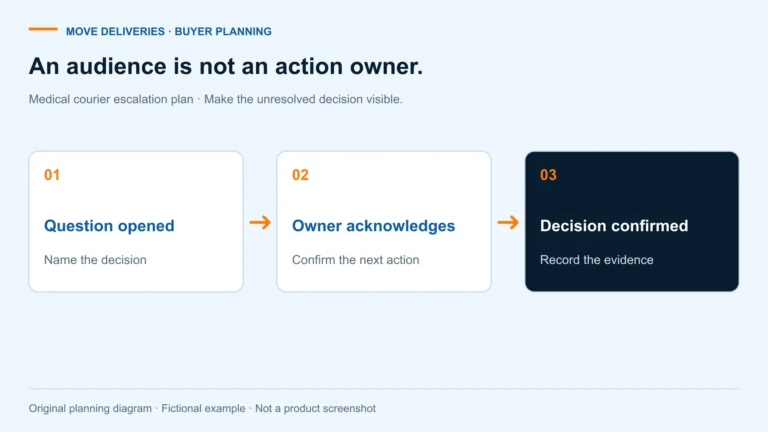
6. Let the authorized coordinator resolve the possible duplicate.
Record who can decide whether to retain, amend, cancel or otherwise reconcile the related records. The buyer may clarify its intended shipment, while the provider confirms what has already been accepted or acted on. A front-desk colleague should not have to cancel a courier’s work based on an incomplete comparison. If transport activity has begun, establish the current situation before anyone sends replacement instructions.
Do not treat a request to cancel as confirmation that the work has stopped. Ask for the response that closes the loop under the provider’s process, and preserve the original record relationship. Reconciliation should make the history understandable, not make the repeated request disappear without explanation. If the parties disagree about what was requested or accepted, use their agreed review channel rather than rewriting the timeline to fit one account.
7. Connect every affected person to one current instruction.
Once the decision is confirmed, share the applicable reference and next action with the releasing and receiving contacts who need them. Explain which prior message has been superseded without deleting the original evidence. A resolved pair of records in one office does not help if another department is still preparing for two collections. Keep the update limited to the people and operational information necessary for that delivery.
Finish with a simple check: can the next person identify what is happening, which reference to use and who answers the next question? If the answer depends on someone remembering an informal phone call, the loop is still fragile. Record the confirmation in the appropriate work record. An orderly reference trail is useful even when the final decision is that both requests are legitimate and should remain separate.
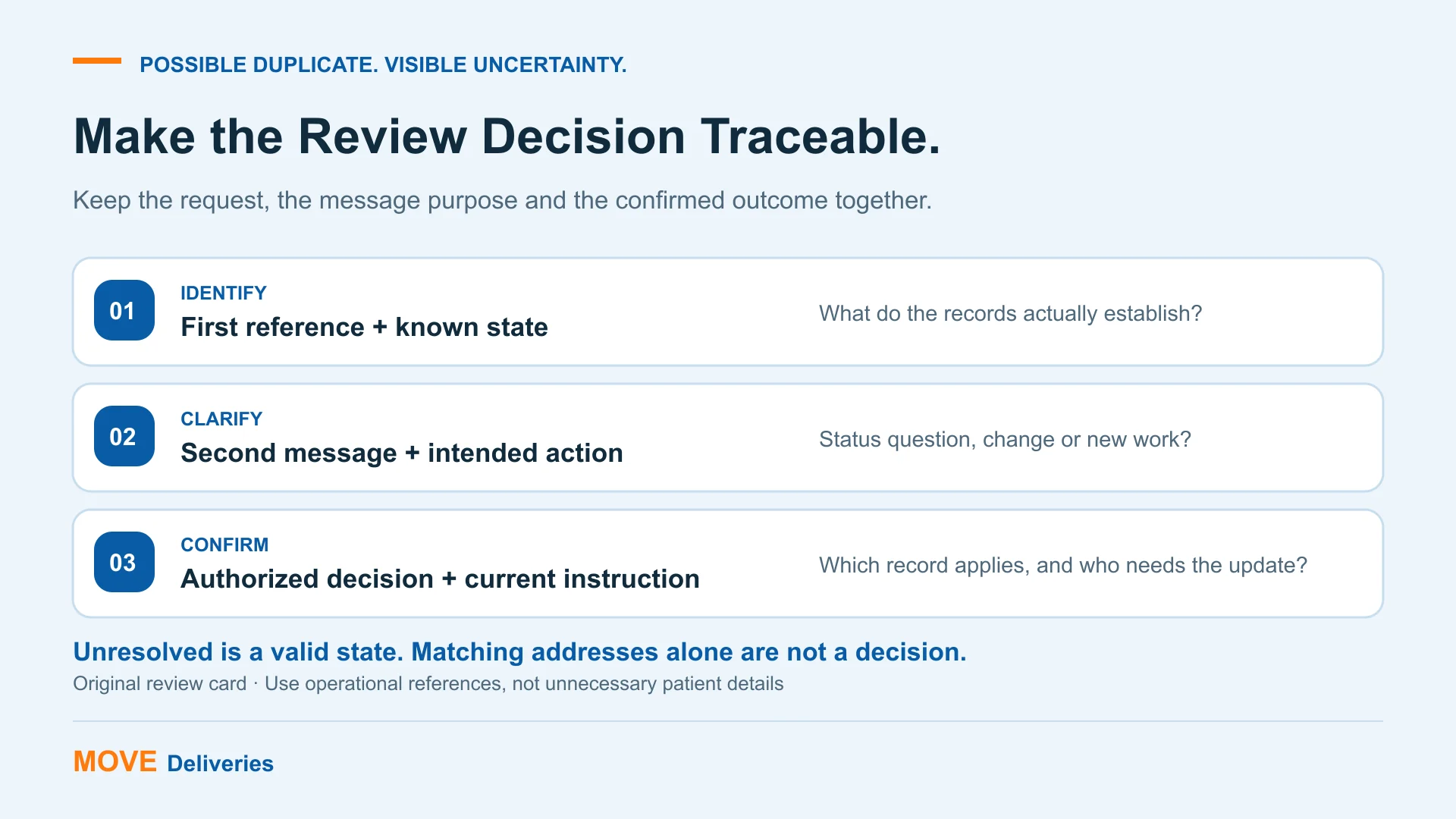
An original duplicate-request review card
Use this card when a second message may describe an existing transport request. It is a review aid, not an automatic matching algorithm. Start by documenting uncertainty and identifying the person who can resolve it. Do not collect extra patient information to fill every box. The right information is the minimum operational context that allows authorized contacts to identify the requests through their approved systems.
| Review field | Record or question | Decision boundary |
|---|---|---|
| First request | Internal reference, provider reference, channel and known state | No acknowledgment is recorded as unknown, not rejected |
| Second message | New request, status question, proposed change or cancellation? | Purpose must be confirmed, not inferred |
| Work relationship | Same intended transport task, additional work or unresolved? | Matching addresses alone do not settle the question |
| Current activity | What has the provider confirmed or started? | Do not send contradictory replacement instructions |
| Authorized decision | Responsible buyer role and provider coordination contact | Uninformed staff do not cancel or merge records |
| Confirmed outcome | Current reference, agreed next action and superseded message | Retain the evidence linking the records |
| People informed | Releasing, receiving and account contacts as applicable | Confirmation reaches those acting on the instruction |
Keep an “unresolved” outcome available. Two records may remain uncertain while the submitting employee is unavailable or while the provider checks the first acknowledgment. That is a real operational state, not an administrative failure that should be hidden. Identify the escalation contact and communicate any time constraint. Do not let a spreadsheet dropdown force someone to choose “duplicate” when the supporting facts are missing.
One shipment. Two channels. One question to resolve.
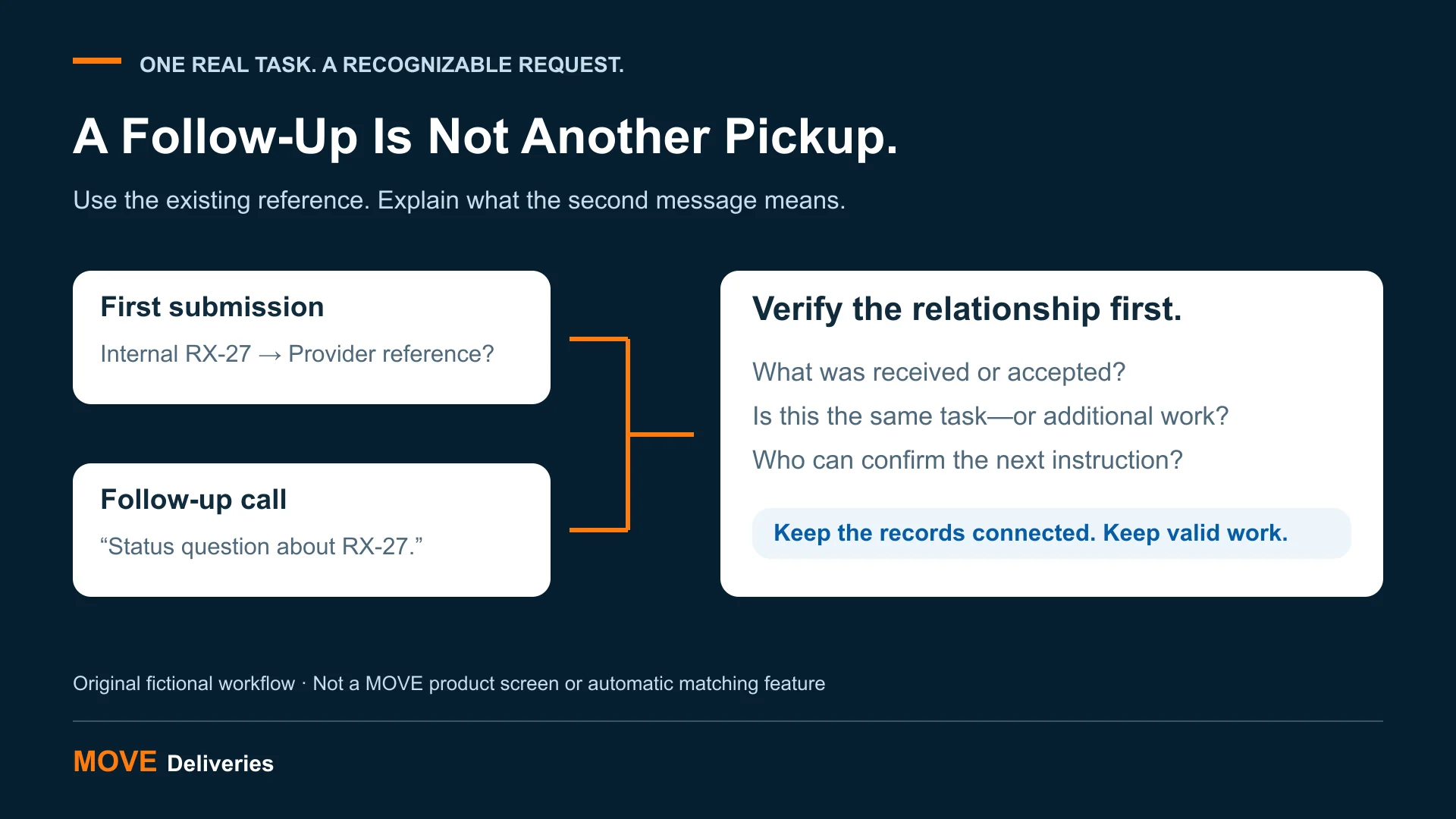
Consider a fictional pharmacy request with internal reference RX-27. The employee submits it through the agreed channel at 10:02 but does not see a response. At 10:05, a colleague calls the provider. The caller leads with the existing internal reference and explains that this is a status question—not a second pickup instruction. The provider checks whether the original request exists before discussing further action.
Suppose the provider identifies request MD-81 and confirms its applicable state. The pharmacy connects RX-27 to MD-81 in its work record and confirms that the call did not request another transport task. If a second record was already created, the authorized contacts review its relationship and agree what happens to it. Nobody assumes that deleting a browser message would cancel the underlying work.
Now change one fact: the colleague is calling about another package with a different required collection time. The same addresses and pharmacy name no longer answer whether this is the original task. The caller must explain the additional need and ask for review. The result may be a new request or an agreed change, depending on the service. The example teaches a decision process, not a universal rule to consolidate deliveries.
What to ask about courier software retries
For a connected order workflow, ask the software teams what happens if a submission succeeds but its response is not received. The HTTP standard, RFC 9110, section 9.2.2, distinguishes requests that can be repeated with the same intended effect. It cautions against automatically retrying a non-idempotent request without an appropriate basis. That does not establish how any particular courier order endpoint behaves; its documented contract must answer that question.
Turn the retry discussion into a small acceptance record. For each fictional case below, ask the provider to describe the supported behavior before any demonstration. Record the observed references and outcome separately from that expectation. A scenario the provider cannot demonstrate remains unverified; it should not receive a passing mark because someone explained what the system is intended to do. Use only an authorized test environment or a tabletop discussion with dummy details.
| Fictional case | Question to resolve | Evidence to record |
|---|---|---|
| The first submission has no visible response | How can staff check the uncertain outcome without requesting another trip? | Supported lookup or coordination path, existing reference if found, and remaining uncertainty |
| The same request is repeated through a documented retry process | Under which conditions does that process preserve the intended transport task? | Original and returned references, applicable retry limits, and resulting operational records |
| The destination changes while the original reference is retained | How is a changed instruction distinguished from an unchanged retry? | Provider’s documented response and the separate authorization needed for a change |
| A colleague calls after the online submission | Can the caller ask about the existing work without authorizing a second pickup? | Message purpose, reference relationship and confirmed next action |
| Another prepared consignment uses the same addresses | How is legitimate additional work reviewed instead of discarded as a duplicate? | Distinct work requirement and the authorized decision about how to book it |
Ask about the boundary of any demonstrated retry protection: which channel it covers, which identifier it uses and how long its documented conditions remain valid. Do not assume that an online retry mechanism also reconciles a telephone request. A field called “reference” may help people search without controlling server-side repetition. If the supported verification path is unavailable, retain the uncertain state and contact the responsible coordinator rather than inventing a new identifier to force another submission. This worksheet does not assert a particular MOVE API, retry header or automatic duplicate-resolution feature.
Test a repeat request without creating real confusion.
Choose a supported test or tabletop exercise with the appropriate contacts. Start with a deliberately uncertain acknowledgment, then ask the next employee how they would find the original request and phrase a follow-up. Add a second scenario involving genuinely additional work with similar addresses. A process that treats both scenarios identically is not yet distinguishing the decision that matters.
ASQ’s mistake-proofing guidance recommends identifying where errors arise, making the correct action easier and testing the selected prevention or detection method. Apply those ideas to the request path. A visible existing-reference prompt may help. So may a clearly labeled status channel. A warning is useful only if people know how to resolve it; an unexplained block can encourage another workaround.
Review the exercise for evidence rather than an optimistic completion label. Could the employee locate the first reference? Was the second message’s purpose explicit? Did an authorized person confirm the outcome? Was genuinely additional work preserved? Record what remains untested, including different shifts and channels. Do not report a fictional drill as a percentage reduction in duplicate dispatches, cost savings or proven production performance.
Duplicate courier orders: buyer questions
Should two requests with matching addresses be automatically canceled?
No. Similar route details do not establish that the underlying transport tasks are identical. Separate consignments, ready times, return movements or additional requirements may explain the match. Use the approved review process and responsible contacts to confirm the intended work. Automatic cancellation based on a shallow match can remove a valid request while leaving the actual coordination problem unresolved.
Does tracking visibility tell us whether two orders are duplicates?
Not by itself. Tracking can help authorized people understand the available status of a particular request, but the relationship between two requests still needs the correct references and context. Explore MOVE live tracking and confirm which information applies to your service. Do not interpret a moving map marker as proof that every related administrative instruction has been reconciled.
What if a possible duplicate is found after pickup?
Raise the uncertainty through the authorized coordination channel and establish the current transport activity. Explain which references may relate to the same work and what decision is needed. Do not issue an independent stop, return or destination change based on incomplete information. Ask the appropriate buyer and provider contacts to confirm the next instruction and communicate it to the people who need to act.
Will a shared reference eliminate duplicate requests?
No single field guarantees that result. A shared reference can make the original request easier to find, but people still need clear ownership, meaningful acknowledgment states and a supported response to uncertainty. Software behavior must also be verified where integrations are involved. Treat the reference as one part of the workflow, then test how the team uses it under realistic communication conditions.
Make the next request easier to recognize.
Before changing your courier arrangement, map the channels your staff actually use and identify where the first reference is stored. Bring examples of uncertain acknowledgments, repeated follow-ups and genuine additional requests to the conversation without unnecessary patient information. Ask the provider what its acknowledgments mean and how your team should check an existing request. That is more useful than assuming another portal field will resolve every coordination problem.
MOVE coordinates local same-day medical delivery through its proprietary platform. Review How It Works and our pharmacy delivery information to frame the service discussion. For recurring work, explore Scheduled Delivery. Confirm the actual request channels, account permissions and supported workflow with the team; this planning guide does not activate or reserve a service.
For a specific local delivery need, request a Quick Quote. For an ongoing workflow, Start An Account and discuss who submits, who confirms and who resolves an uncertain request. The objective is simple: give each real transport task a clear instruction and give every follow-up enough context to avoid accidentally asking for the same work twice.