Medical courier holiday planning means checking the delivery routine against the actual opening, preparation and receiving arrangements at every affected site. A holiday on a calendar is a prompt to ask questions. It is not proof that a pharmacy is closed, a hospital department is receiving, or a courier has accepted a revised pickup.
Your usual Tuesday pickup may be easy to run. The week around a holiday can be different: one location closes early, another works with fewer receiving staff, and someone assumes the next regular collection will handle anything left over. The problem is not the date itself. It is an exception that nobody has confirmed.
This guide gives healthcare operations teams seven schedule checks, a holiday exception worksheet and a fictional planning example. It covers local delivery coordination, not clinical decisions, specimen stability, medication supply advice or employee holiday-pay rules. Any changed service, capacity or receiving arrangement needs agreement with the responsible parties; this is not a published MOVE holiday-service schedule.
In this article
- Use holiday dates as review triggers—not closure instructions
- 1. Identify the work that actually changes
- 2. Check release and receiving separately
- 3. Confirm the courier arrangement before sharing it
- 4. Separate expected volume from release readiness
- 5. Name an available decision owner and backup
- 6. Ask teams to confirm the same dated plan
- 7. Plan the return to the ordinary routine
- Build a medical courier holiday planning worksheet
- A fictional review: the Friday pickup is not a catch-all
- Holiday medical delivery questions
- Keep the exception clear. Keep the next step confirmed.
Use holiday dates as review triggers—not closure instructions
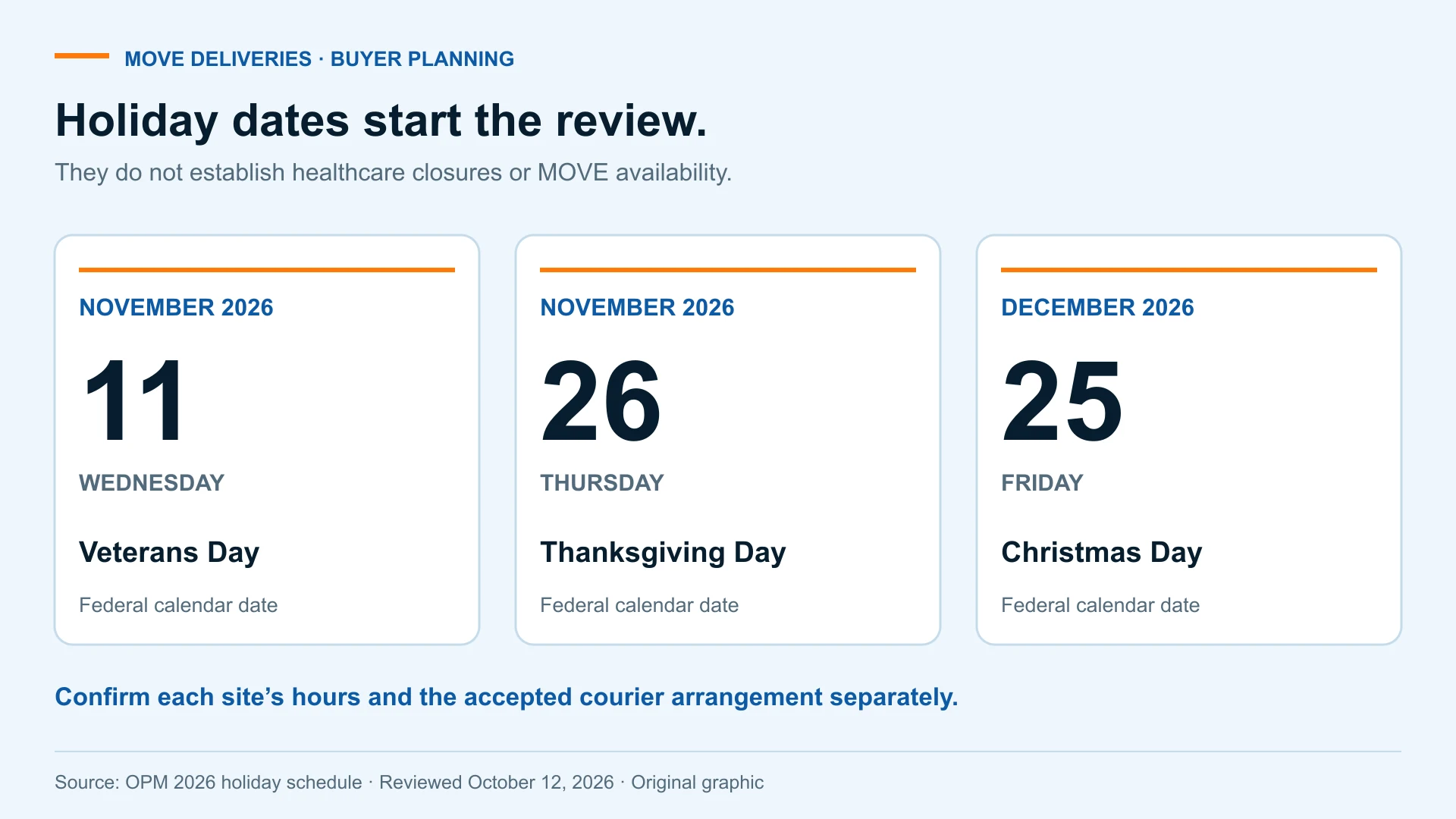
The U.S. Office of Personnel Management’s 2026 federal holiday calendar lists the following November and December dates. These are federal holiday dates, not a calendar of private healthcare closures or MOVE availability. Confirm each facility’s own arrangements, including the days immediately before and after the holiday.
| Federal holiday | 2026 date | Delivery-planning question |
|---|---|---|
| Veterans Day | Wednesday, November 11 | Which site or department has a different receiving arrangement? |
| Thanksgiving Day | Thursday, November 26 | Have the preceding day, holiday and following day each been checked? |
| Christmas Day | Friday, December 25 | Is the return-to-routine date explicitly confirmed? |
Keep the holiday name separate from the operating decision. Your internal record should say which location, department and delivery date are affected, who supplied the information, and what remains unconfirmed. A general “holiday hours apply” note leaves too much work for the employee trying to arrange a real pickup.
1. Identify the work that actually changes
Start with the recurring delivery list, not an assumption that every stop will close. For each affected date, identify the releasing site, receiving site and usual service. Mark whether the ordinary arrangement is confirmed, changed or still unknown. “Unknown” should stay visible until a named person resolves it; a blank cell is easy to mistake for business as usual.
A clinic might remain open while its supply receiving desk uses shorter hours. A laboratory may have a different collection routine without changing all of its public opening hours. Ask the person who owns the actual release or receiving process. An organization-wide announcement is useful context, but it may not describe the department involved in your delivery.
Separate a calendar exception from a permanent schedule change. If a Wednesday collection moves for one holiday week, identify the exact date on which the ordinary routine resumes. Do not leave staff to interpret a temporary instruction as an indefinite new schedule. Our scheduled delivery page provides the broader service context; the holiday worksheet addresses the dates that need separate confirmation.
2. Check release and receiving separately
A prepared package does not make the destination available. Ask the releasing location when staff can authorize and complete the collection. Then ask the destination when its designated receiver can accept that specific delivery. Record both answers for the actual date, with the relevant local time zone. The two sites may have different staffing arrangements even within the same organization.
Check more than the door’s opening time. Is the approved entrance in use? Is the receiving role staffed? Does a changed desk location apply only that day? Describe the difference in concise operational terms and keep the responsible contact attached to it. Do not assume that a hospital’s ongoing clinical operations mean every department accepts courier deliveries around the clock.
For laboratory work, qualified personnel decide preparation, suitability and any material-specific time requirements. Holiday planning does not authorize storing a specimen longer or moving collection earlier simply to fit a calendar. Use the lab’s approved requirements alongside the delivery discussion. The receiving-cutoff guide explains that separate planning question without prescribing specimen stability limits.
3. Confirm the courier arrangement before sharing it
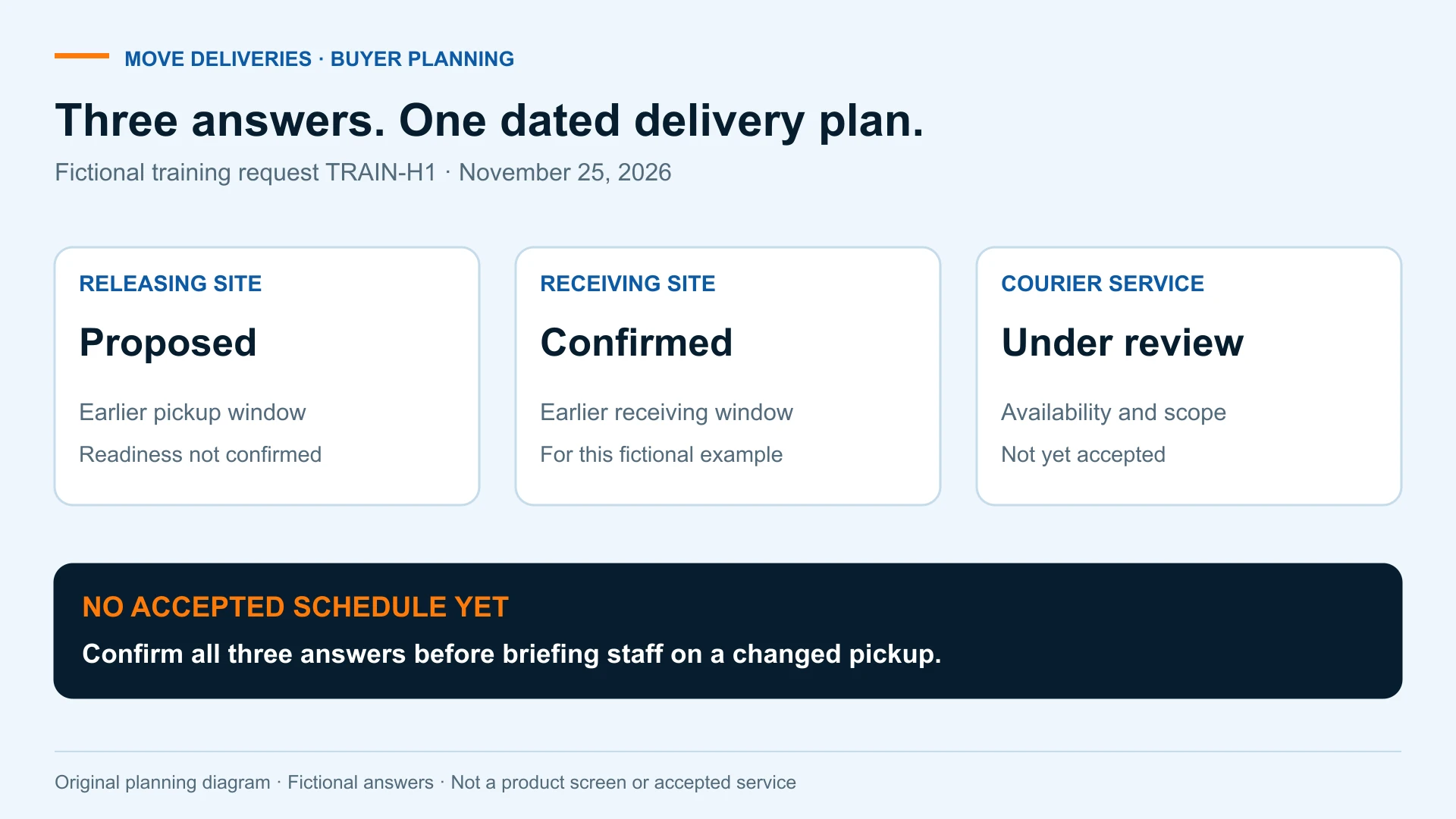
A proposed earlier pickup is not an accepted service. Present the changed dates, addresses, release window, receiving requirement and package scope to the courier provider. Ask what can be supported and what needs a different arrangement. Keep requested, under review and confirmed as separate states so a planning suggestion does not become an accidental promise to your staff.
Discuss any effect on the accepted commercial scope. An extra collection, changed stop sequence or different vehicle requirement may need separate review. Do not assume that the normal price, capacity or service window carries over unchanged. This guide sets no MOVE holiday surcharge, booking deadline or universal availability rule. Those details must come from the accepted arrangement for the actual work.
If several sites share a route, review the affected sequence together. A shorter window at the final location can make an isolated change at an earlier stop impractical. The fixed-route delivery page describes the service option; a holiday exception still needs its own confirmed stop instructions. A routine on the calendar is not automatic acceptance of every added or shifted request.
4. Separate expected volume from release readiness
Ask the releasing team whether its anticipated package count or packaged dimensions differ around the holiday. Treat that information as a forecast until the units are actually prepared and authorized for release. A prediction of more work is useful for a service conversation, but it is not a verified outgoing count or permission to collect an unfinished package.
If work is deferred, list it explicitly rather than assuming it joins the next normal run. Identify the responsible owner, the remaining package scope and the proposed date that still needs confirmation. Combine deferred and ordinary work only after the parties have reviewed readiness, receiving and capacity. “We will catch up afterward” is not a usable collection instruction.
Healthcare organizations retain responsibility for clinical priorities, medication needs and approved packaging or storage decisions. An operations worksheet must not decide those questions. For a pharmacy, the delivery conversation can clarify which prepared orders belong to an accepted request; it cannot decide whether medication should be dispensed early. Review the pharmacy delivery options with the actual transport scope, not patient details in a public inquiry.
5. Name an available decision owner and backup
The coordinator who normally approves a change may be away during the holiday period. Identify the person or role available for release questions, the receiving-side contact and the customer role authorized to approve a revised service request. These responsibilities may belong to different people. A single generic number cannot replace a clear description of who can decide what.
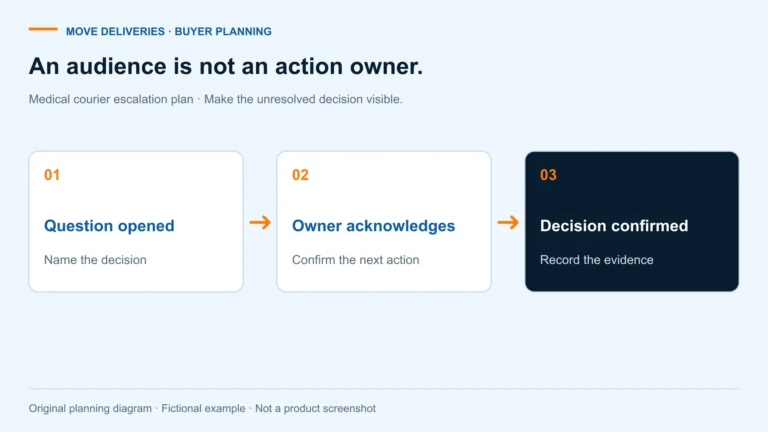
Agree an escalation path for an unconfirmed receiver, unavailable release point or changed instruction. Include a backup and the approved way to reach that person. Waiting, returning, alternate receiving and rescheduling are possibilities to discuss, not actions a driver should infer from this article. The appropriate decision depends on the accepted service and the organization’s responsible personnel.
Keep the contact plan usable by shift replacements. Staff should know which instruction version applies and where to raise a difference before a package moves. Share operational contacts through the agreed channel and keep unnecessary personal, patient or access information out of public forms. The goal is a reachable decision path, not a longer message thread copied to everybody.
6. Ask teams to confirm the same dated plan
Distributing a new schedule is different from confirming that the relevant people understand it. Ask the release owner, receiving owner and service coordinator to check the dated exception. What is happening, what is not happening, and when does the ordinary routine return? Acknowledgment should refer to the actual instruction, not just “thanks” beneath a long conversation.
AHRQ’s TeamSTEPPS communication guidance describes check-back as a way to verify shared understanding. Applied narrowly here, that suggests asking a coordinator to restate the changed collection date, receiving arrangement and next decision. This is an operational communication technique, not a claim of clinical effectiveness, a TeamSTEPPS certification or evidence that a courier platform performs automatic acknowledgment.
Keep one maintained exception record and identify its version. If a receiving window changes again, record the revision and obtain the necessary confirmations again. An acknowledgment of the first version does not confirm the second. Delivery notifications can support awareness, but they do not turn an unaccepted schedule into an approved one. Review the notification options separately from the service decision.
7. Plan the return to the ordinary routine
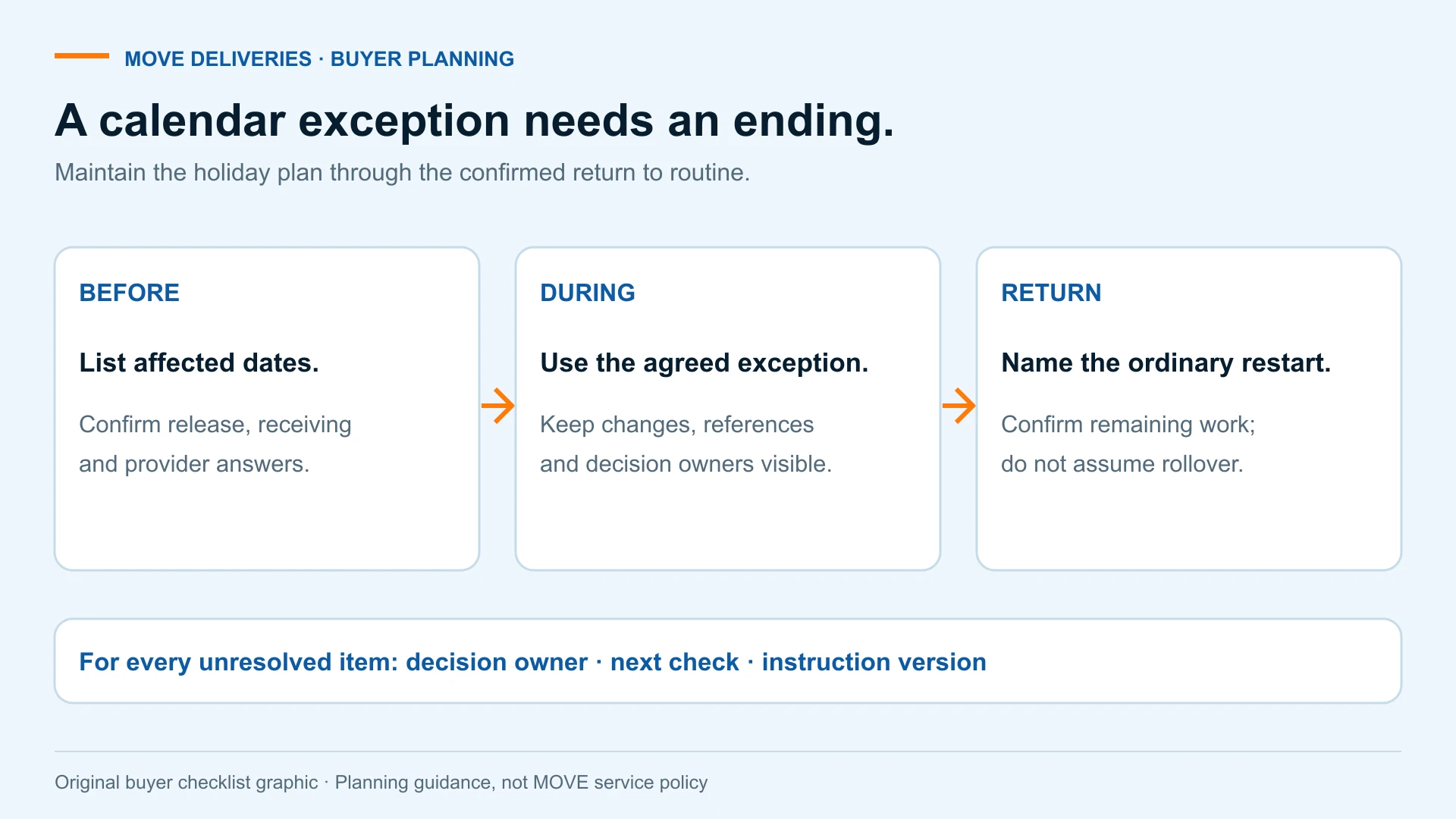
A holiday exception needs an ending as well as a beginning. Confirm the first ordinary pickup after the affected period, the receiving arrangement on that date and any deferred work still requiring a separate plan. Do not remove the exception record simply because the holiday has passed. Close it when the remaining work and current instructions are understood.
Compare the work expected during the exception with the work that was actually collected and received under the accepted scope. Keep unresolved units or requests visible. A completion status on one delivery does not establish that every deferred request moved. This review should connect references and decisions, not invent a count because a calendar slot looks complete.
Capture one specific improvement for the next affected period. Perhaps the destination’s reduced hours were learned too late, or the backup contact could not approve the requested change. Record the instruction to improve and its owner. Avoid turning a single holiday experience into a broad service-performance claim; it is evidence about the arrangement and conditions you actually reviewed.
Build a medical courier holiday planning worksheet
Use one row for each affected request or recurring stop-date. Attach the current reference, addresses and normal routine in your approved internal planning tool. The example below is fictional. It does not describe real facility hours, accepted MOVE capacity or required proprietary-platform fields. Its purpose is to separate three agreements that can otherwise get blurred into one note.
| Fictional stop-date | Release answer | Receiving answer | Provider answer | Open decision |
|---|---|---|---|---|
| TRAIN-H1 · Nov 25 | Earlier window proposed | Earlier window confirmed | Under review | Confirm accepted pickup before briefing staff |
| TRAIN-H2 · Nov 26 | No release planned | Closed for this example | No changed service accepted | Responsible customer owner confirms next plan |
| TRAIN-H3 · Nov 27 | Ordinary work plus deferred units proposed | Window not yet confirmed | Capacity not yet confirmed | Review the combined scope; do not assume rollover |
Add an owner and next decision time to every unresolved cell. Preserve the source of each answer and the exception version. Use wording that distinguishes “not requested,” “not available,” “not yet confirmed” and “accepted under revised instructions.” Those are different situations. Collapsing them into “holiday” makes the record shorter but less useful.
- Exact affected date and relevant local time zone.
- Releasing and receiving points, each with its own confirmed arrangement.
- Requested package scope and accepted courier service, kept separate.
- Decision owner, available backup and approved contact path.
- Instruction version and confirmation from the relevant parties.
- Deferred work and the explicit date for return to routine.
A fictional review: the Friday pickup is not a catch-all
A supplier normally sends prepared cartons to a clinic on Thursday. In this fictional Thanksgiving-week exercise, the clinic confirms it will not receive on Thursday, November 26. The supplier suggests Wednesday afternoon instead. That creates a new proposal—not a completed plan. The releasing site, destination and provider still need to agree the same Wednesday arrangement.
The clinic can receive earlier on Wednesday, but the supplier has not confirmed that all cartons will be ready then. The worksheet keeps those answers separate. The customer’s responsible team decides which transport work can be requested under its own preparation requirements, while the provider reviews availability and scope. Nobody treats a general holiday notice as authorization to collect unfinished work.
Two cartons remain deferred in the training example. Someone proposes adding them to Friday’s usual work. Before accepting that suggestion, the coordinator checks Friday receiving, the combined package count and the provider’s response. If those facts remain unconfirmed, the cartons remain an open planning item. A presumed catch-up run cannot resolve a missing agreement.
The exercise ends when the teams have confirmed the accepted work, any remaining decisions and the ordinary routine’s return date. It does not prove that every holiday delivery will succeed. It shows how a short worksheet can reveal a specific gap before staff rely on a schedule that only one participant has accepted.
Holiday medical delivery questions
Does a federal holiday mean the receiving location is closed?
No. A federal holiday date does not establish a private healthcare site’s operating arrangements. Confirm the specific department, approved receiving point and actual date with the person responsible for that process. Keep “unknown” visible until that answer is obtained.
Will deferred packages automatically move on the next normal pickup?
Do not assume so. Deferred work needs confirmation of readiness, receiving, package scope and service availability. Clinical or material-specific decisions remain with qualified personnel. Record the accepted remaining-work plan separately from the original schedule.
Does MOVE offer the same service on every holiday?
This article does not establish a universal holiday-service promise. Bring MOVE the actual local addresses, dates, release window, receiving requirement and packaged-shipment scope. Availability and any changed commercial terms must be confirmed for the accepted arrangement.
Does sending an update confirm a changed delivery schedule?
No. A message communicates information; it does not by itself establish that release, receiving and courier service have all been agreed. Obtain the necessary confirmations through the accepted process, then brief the people who need the current instructions.
Keep the exception clear. Keep the next step confirmed.
MOVE coordinates local same-day medical delivery through our proprietary platform. A holiday plan begins with the same practical facts as an ordinary request, plus a clear description of what changes. For a hospital or clinic, review the delivery options with the specific receiving arrangement. State-level presence alone cannot confirm a particular holiday request.
For a defined local delivery, request a Quick Quote. For recurring work, Start An Account and discuss the exception worksheet with the service team. Bring the dated changes, unresolved decisions and return-to-routine plan. Those details make a more useful conversation than a broad request to “cover the holidays.”