
Returnable courier containers need a plan for the empty unit as well as the outbound delivery. A tote can arrive at the receiving site while its return responsibility remains unclear. If your team cannot identify the unit, its latest known location and who accepts the next movement, a familiar delivery route can still leave you without the containers needed for the next release.
The problem is not solved by counting everything that looks like a blue box. Some units belong to the customer, others to a provider, and some may be unavailable for their next intended use. An open return request is not a confirmed return. A physically returned container is not automatically ready for clinical cargo. Separate asset identity, movement and reviewed availability.
This original guide helps healthcare buyers define empty-container accountability. It is not a cleaning, disinfection, packaging-validation or clinical reuse procedure. Qualified personnel determine product and reuse requirements. The guide does not claim that MOVE implements GS1 identification, provides container inventory software or guarantees a loss rate.
1. Give the Unit an Identity That Survives the Trip
Decide how the actual unit will be identified under the accepted arrangement. A visible color or size may describe a class of containers without distinguishing one unit from another. A reusable identifier should allow authorized staff to connect the same physical unit across relevant events. Confirm the method rather than assuming a barcode in a photograph proves a functioning system.
Keep the container identity separate from an order identity. One transport order can involve several units, and one reusable unit can serve many different orders over time. If the relationship changes on every trip, preserve the relevant link for that movement. Otherwise a review may mistakenly assign the current order to an earlier event.
Also identify associated components where the accepted plan requires it. A tote, lid, insert or other accessory may not follow the same return path. Qualified reviewers determine which components matter for the actual intended use. The asset ledger should describe the agreed units without inventing product requirements from their appearance.
The GS1 traceability overview distinguishes events involving an identifiable object from the data describing those events. That is narrow conceptual context for this worksheet. It does not establish that a particular courier uses GS1 standards or that its records satisfy clinical or legal tracing requirements.
2. Confirm Ownership and the Return Obligation
Document who owns the unit and who is responsible for arranging its next accepted movement. Ownership does not automatically determine operational responsibility at every handoff. A customer-owned tote at a clinic may require the clinic to release it, the customer to request collection and the provider to accept transport. Clarify those steps instead of assigning them implicitly.
Distinguish an included return arrangement from a separately requested return. Physical proximity to a scheduled route does not settle the commercial or operational question. Confirm whether a recurring collection includes empty units, which units it covers and what release conditions apply. If the scope is unclear, keep it as a named question for the appropriate contacts.
Identify the agreed return point. A unit arriving at a provider depot may not be back at the supplier location where it is needed. A location name can also describe several staging areas with different review states. Use a sufficiently specific authorized reference to avoid counting a unit available before the relevant movement and review are complete.
For recurring work, MOVE’s fixed-route delivery overview provides a starting point. Discuss the actual return scope, timing and handoff responsibilities rather than assuming that an outbound stop automatically creates an accepted empty-container collection.
3. Track Events Instead of Guessing the Current Location
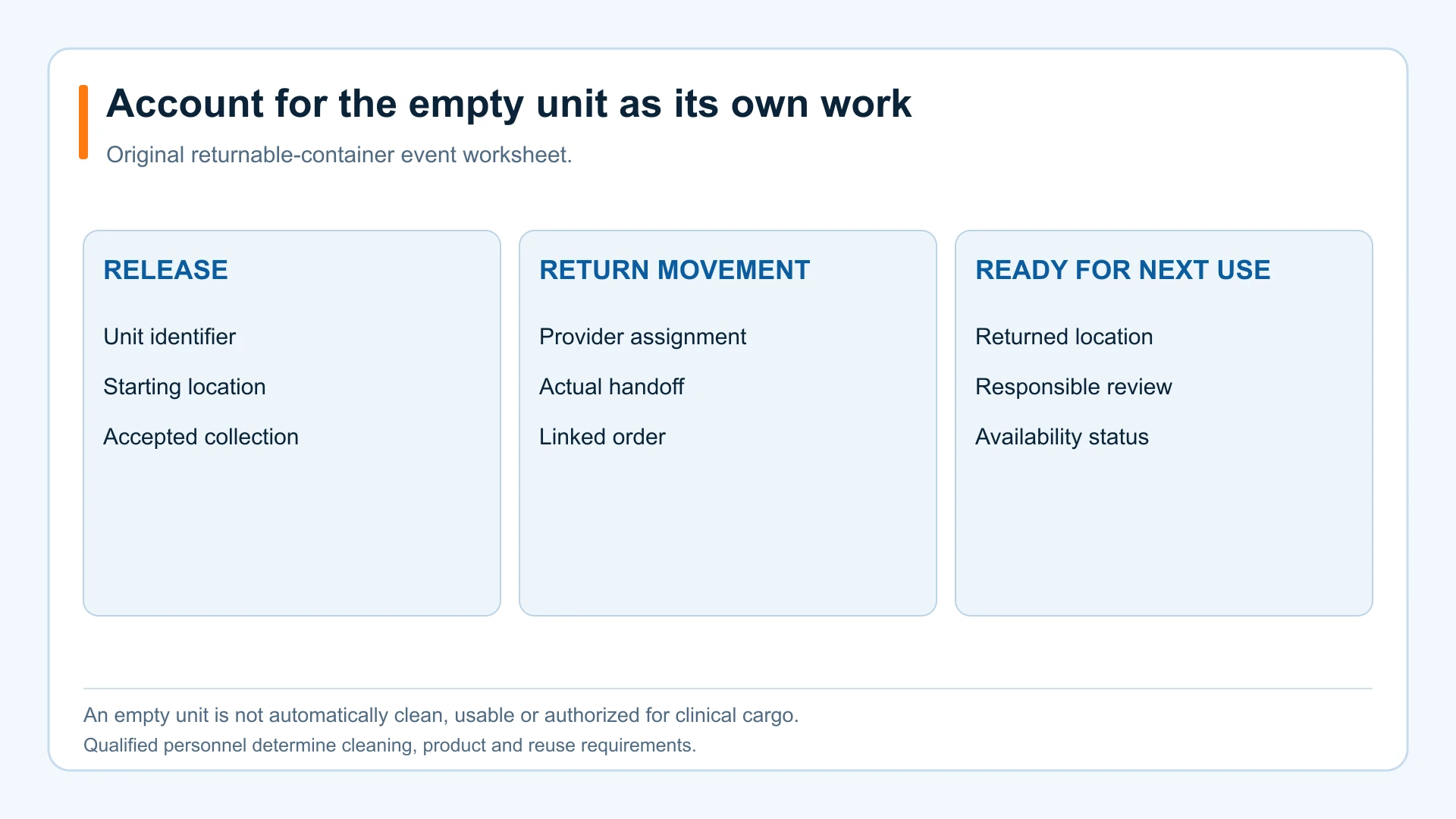
A location entry should be supported by an actual event or clearly labeled as an unverified report. Differentiate expected location, latest known location and confirmed availability. If a return is scheduled but not collected, moving its location to the destination in the ledger makes the count look complete while hiding unfinished work.
Use the relevant event time and time zone. A record entered the next day may describe a prior handoff. Preserve that distinction where it affects the sequence. Corrections should remain linked to the original record so authorized reviewers can explain why a location or status changed.
| Event | What to connect | What the event does not automatically prove |
|---|---|---|
| Released outbound | Actual unit, related order and releasing function | Every associated accessory was included |
| Received at destination | Actual handoff, receiving function and event context | The empty unit is available for immediate return |
| Accepted return | Unit, provider assignment and agreed return scope | Physical collection has already occurred |
| Collected for return | Unit identity, actual event and linked return movement | The unit has reached its next required location |
| Returned to location | Actual handoff and intended review function | The unit is clean, suitable or ready for clinical reuse |
| Available for next assignment | Responsible review and stated availability conditions | Suitability for every future cargo type |
The ledger should allow uncertainty without losing accountability. If a unit’s location cannot be established, record the last supported event, the missing question and its owner. Do not move the unit to a guessed location just to make the totals agree. A truthful unresolved item is more useful than a confidently incorrect balance.
Discuss the actual records available through the provider. MOVE’s Secure Chain of Custody information helps frame handoff visibility. It does not promise an asset-management feature or certify that every proposed ledger field exists in the platform.
4. Separate Physical Stock From Reviewed Available Stock
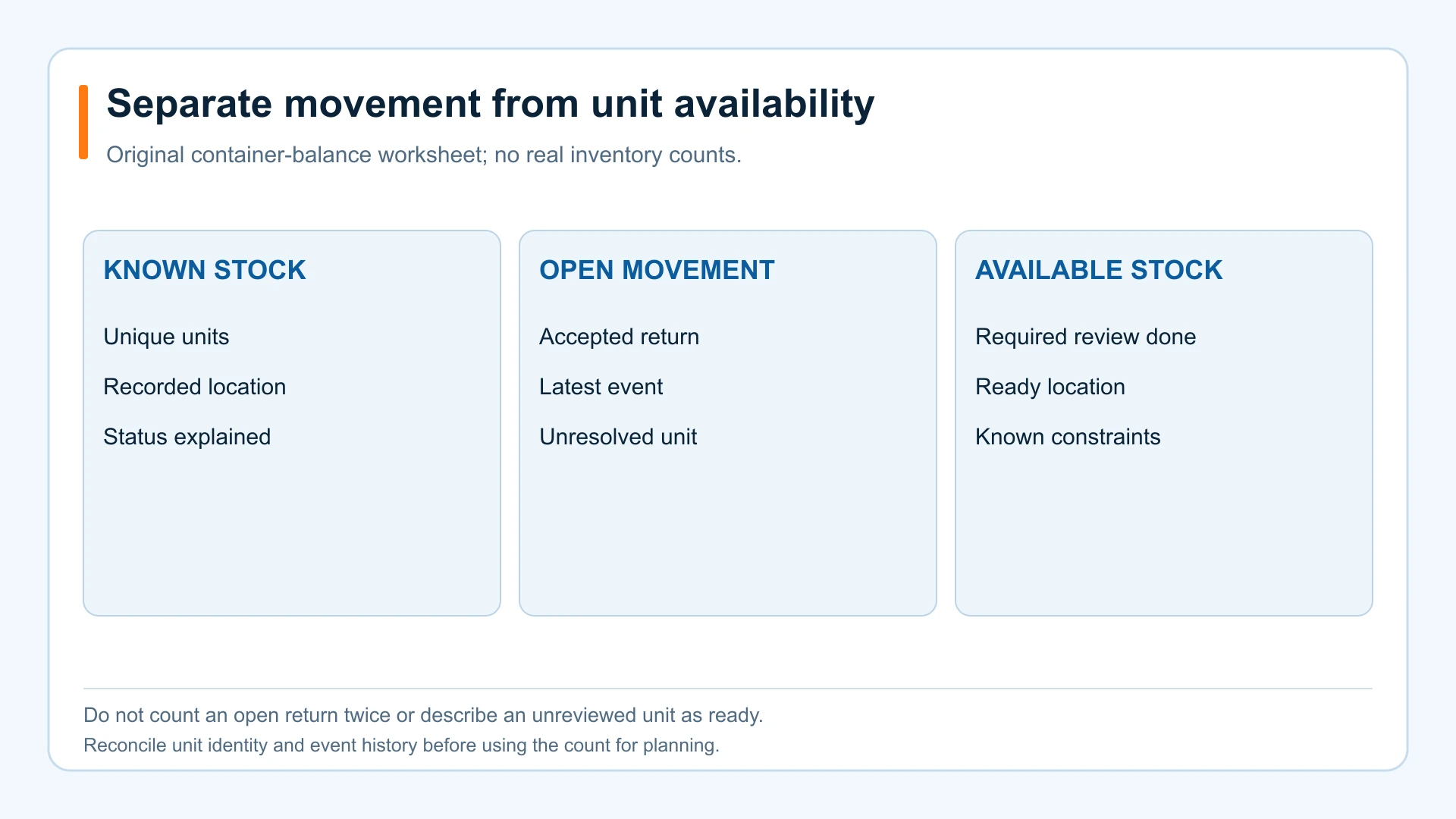
A count of physically present units answers a different question from a count ready for the next intended assignment. A unit may await the responsible review, have a condition issue or be reserved for other accepted work. Keep those states distinct. Do not use the larger physical count to imply that every upcoming release can be supported.
Define status labels with the responsible people. Returned, awaiting review, unavailable and ready should have understood meanings under the actual arrangement. If two sites use ready differently, their combined inventory can be misleading even when both local counts are accurate. Explain the difference before producing a consolidated report.
When reconciling a balance, count a unique physical unit once. An open return order and a depot receiving entry may describe the same unit at different stages. Avoid adding both as separate inventory. The identity-to-event connection is what prevents a busy movement report from becoming an inflated stock count.
Do not infer a cleaning or product-release requirement from this worksheet. The qualified reviewer decides what makes the unit acceptable for its next use. The operational record should identify that decision and its scope without publishing an improvised clinical procedure or treating a courier handoff as validation.
5. Walk Through a Fictional Container Cycle
Imagine a supplier sends one identified tote to a clinic under an accepted outbound order. The clinic completes its own work and later says the empty unit is ready for collection. The customer requests a return, and the provider accepts it. Those are several different events; a notification of readiness is not the collection itself.
When the courier collects the identified empty unit, the ledger connects that handoff to the accepted return movement. At the agreed return location, receiving staff confirm the actual unit and direct it to the responsible review function. Only the appropriately authorized decision can establish whether it is available for another intended assignment.
If a unit that looks similar arrives instead, staff should not close the original return solely because the count is one. Review identity and the relevant event evidence. The difference may be a recording issue, a physical mismatch or an unresolved question. Let the evidence determine the explanation rather than labeling a loss before reviewing the sequence.
The example uses no real MOVE shipment or inventory count. It illustrates why a container cycle needs several connected decisions and why the outbound completion, empty-unit movement and next-use availability should not collapse into one status.
6. Give Container Exceptions a Named Review Path
Common operational questions include a unit reported at the wrong site, a missing component, a return not yet accepted or a returned unit awaiting the responsible review. Describe the supported difference precisely. An empty space on a shelf does not prove theft, and an unmatched record does not prove that the physical unit is lost.
Preserve the relevant source evidence while the responsible team investigates. Avoid changing historical locations until the correction has a supported basis. Link the accepted correction to the earlier entry so later reviewers can distinguish a corrected record from a newly observed movement.
Decide who handles physical-unit questions, commercial obligations and product-suitability questions. Those responsibilities may be held by different roles. A courier coordinator can discuss accepted transport without deciding whether a container is suitable for clinical reuse. A facilities contact can report presence without settling a disputed ownership term.
For a requested change after collection, confirm the actual customer authority and provider acceptance. A return unit going to a different location creates a changed assignment, not merely a revised spreadsheet cell. Our delivery process overview helps frame that distinction.
7. Build a Report That Answers a Planning Question
Decide whether the report is intended to show open returns, latest known locations, reviewed availability or unresolved units. Those are different populations. A single number called containers outstanding can conceal which units are in accepted movement and which have no supported location. Give the audience a definition they can act on.
If you report a return-completion rate, name the accepted-return population, period, relevant event and exclusions. Do not use all outbound orders as the denominator unless that is genuinely the question being measured. Some outbound assignments may not include returnable units or may have different accepted return timing.
A missing-unit rate also requires care. Unmatched records, temporarily unlocated units and confirmed losses are distinct findings. Label them separately. Do not publish a loss reduction or cost-saving result by combining unresolved assumptions with verified outcomes. This article supplies no actual performance benchmark.
Use a small reconciliation exercise to check whether staff interpret the definitions consistently. Have authorized reviewers explain the state of selected dummy units from the same event history. If their counts differ, clarify the status meanings and identity mapping before using a larger report to make purchasing or capacity decisions.
8. Connect Return Planning With the Actual Route
An empty-container collection still has release conditions, available space and an agreed return point. Ask whether it fits the accepted route scope and receiving windows. Avoid treating an empty unit as operationally invisible just because it no longer carries the outbound contents. The provider must accept the actual work.
Review recurring accumulation at the sites where it occurs. A receiving location may hold several units before they are released, while a supplier may need reviewed units earlier for upcoming work. Discuss the actual pattern and constraints rather than adopting a universal return interval. The appropriate arrangement depends on the accepted task.
Keep unit review and transport timing separate in the conversation. Returning a unit earlier may not make it available earlier if a required review remains pending. More precise status information can be more useful than an unsupported request to speed up every movement. Confirm who owns each remaining condition.
When the arrangement changes, update the accepted instruction and reporting definition together. A new return location, ownership term or unit type can affect both the route and the balance. Leaving one unchanged can create a report that accurately summarizes an obsolete process.
Use a Fictional Balance to Test the Definitions
Imagine a review sheet lists one unit at a clinic and also lists that same unit on an accepted but uncollected return order. Counting both entries as separate physical stock would produce two units where the records describe one. The correct discussion is about its current state and pending movement, not an additional container that can serve another release.
Now imagine that the unit physically returns to the supplier but remains awaiting the responsible review. It can belong in a physical-location count without belonging in the reviewed-available count. That distinction prevents a planning team from promising the unit for new work before the remaining condition is resolved.
This simple example uses invented unit references, not an actual inventory or industry loss statistic. Apply the same distinction to an authorized sample of your own records and ask reviewers to explain their counts. Differences can reveal inconsistent status definitions or missing event links before those problems affect a recurring service plan.
Returnable Courier Containers: Common Questions
Is a returned tote automatically ready for another healthcare shipment?
No. Physical return and suitability for the next intended use are separate matters. Qualified personnel determine review, cleaning and product requirements. This guide provides no clinical reuse instruction.
Can we identify units by color alone?
A color can identify a class without distinguishing a specific unit. Confirm an accepted identification method that connects the actual physical unit across relevant events and avoids counting look-alike units as interchangeable records.
Does every outbound delivery include an empty return?
Do not assume that. Confirm the operational and commercial scope, release responsibility and accepted return movement. A recurring route or completed outbound order does not by itself establish those obligations.
How should we discuss recurring returns with MOVE?
Start an account conversation with your locations, units and review needs. For a defined one-time assignment, Quick Quote. Confirm actual availability, task acceptance and records rather than inferring an inventory feature.