
A courier weather contingency plan should tell your team who reviews changed conditions, who can accept revised work and what the receiver needs to know. It should not be a promise to keep every delivery moving regardless of safety. For local medical delivery, a useful plan connects official information with actual site conditions and responsible decisions before an uncertain situation becomes an improvised handoff.
This guide provides an original readiness worksheet, decision log and tabletop exercise for healthcare operations teams. It is not a weather forecast, driving instruction, clinical protocol or statement of MOVE’s emergency-service capability. Responsible transport personnel determine safe operating decisions; qualified healthcare staff determine cargo-specific acceptability and patient-care actions.
1. Establish the safety boundary before the delivery question
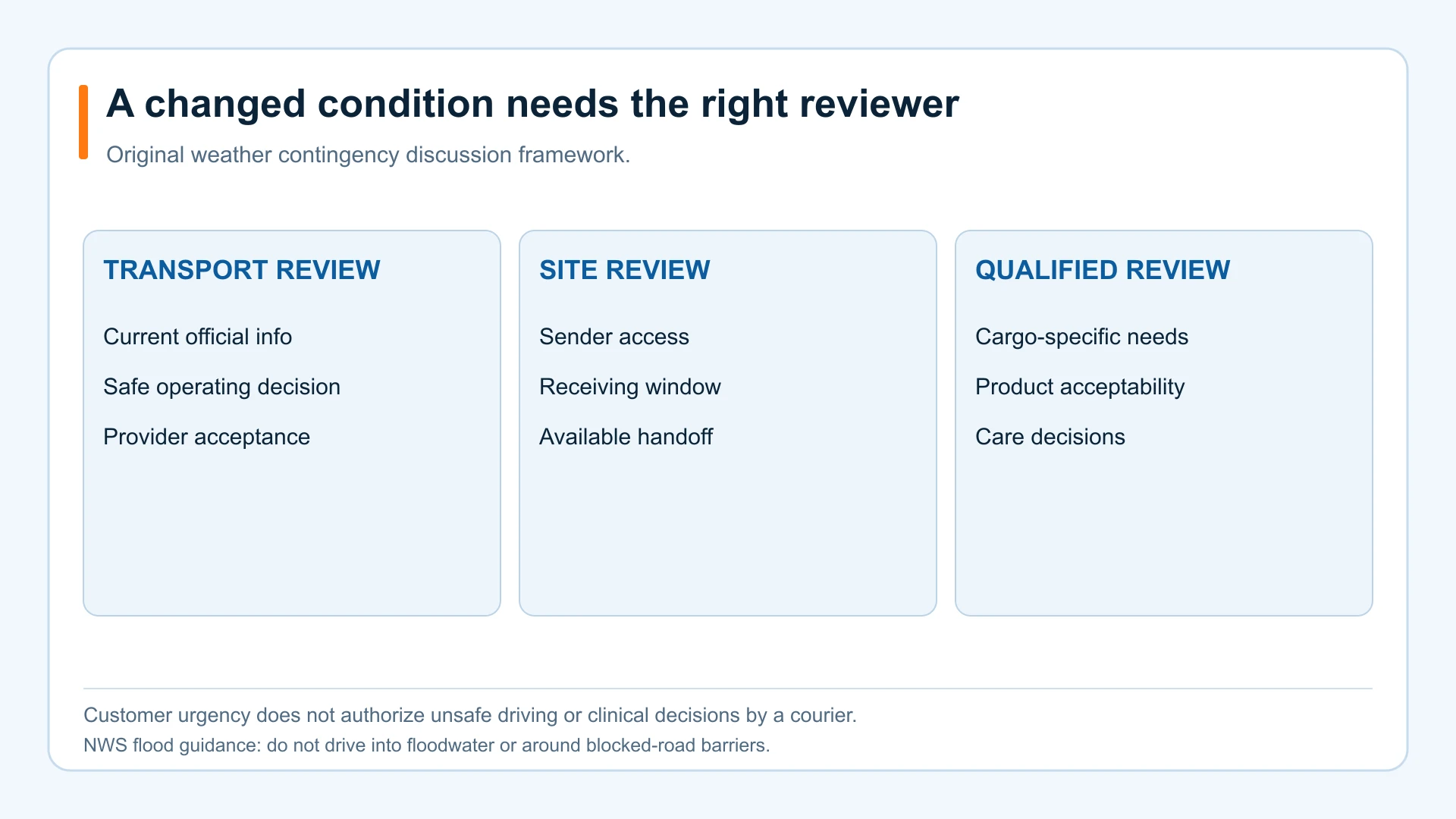
A delivery deadline does not authorize unsafe driving. The National Weather Service’s flood-roadway guidance warns against driving into floodwater or around barriers blocking flooded roads. Use that official safety source for the narrow point it supports; it is not a route assessment or forecast for a particular MOVE delivery.
Keep the customer’s urgency separate from the transport decision. A healthcare team may have a time-sensitive need, but that does not establish that a road, entrance or loading task is safe. The responsible parties need to review the actual circumstances and appropriate options. Do not imply that ordering a faster service removes those conditions.
Give staff a clear escalation route when the existing plan may no longer be suitable. That route should identify the transport contact and the appropriate customer decision owner. It should not place a front-desk employee in the position of inventing a road-safety decision or a courier in the position of making a clinical acceptability judgment.
Agree communication expectations that do not demand driver interaction while driving. Ask the provider how information can be relayed safely under the actual arrangement. Confirm what contact routes are available rather than assuming a particular automated alert or emergency response feature exists.
2. Keep official alerts, observations and assumptions separate
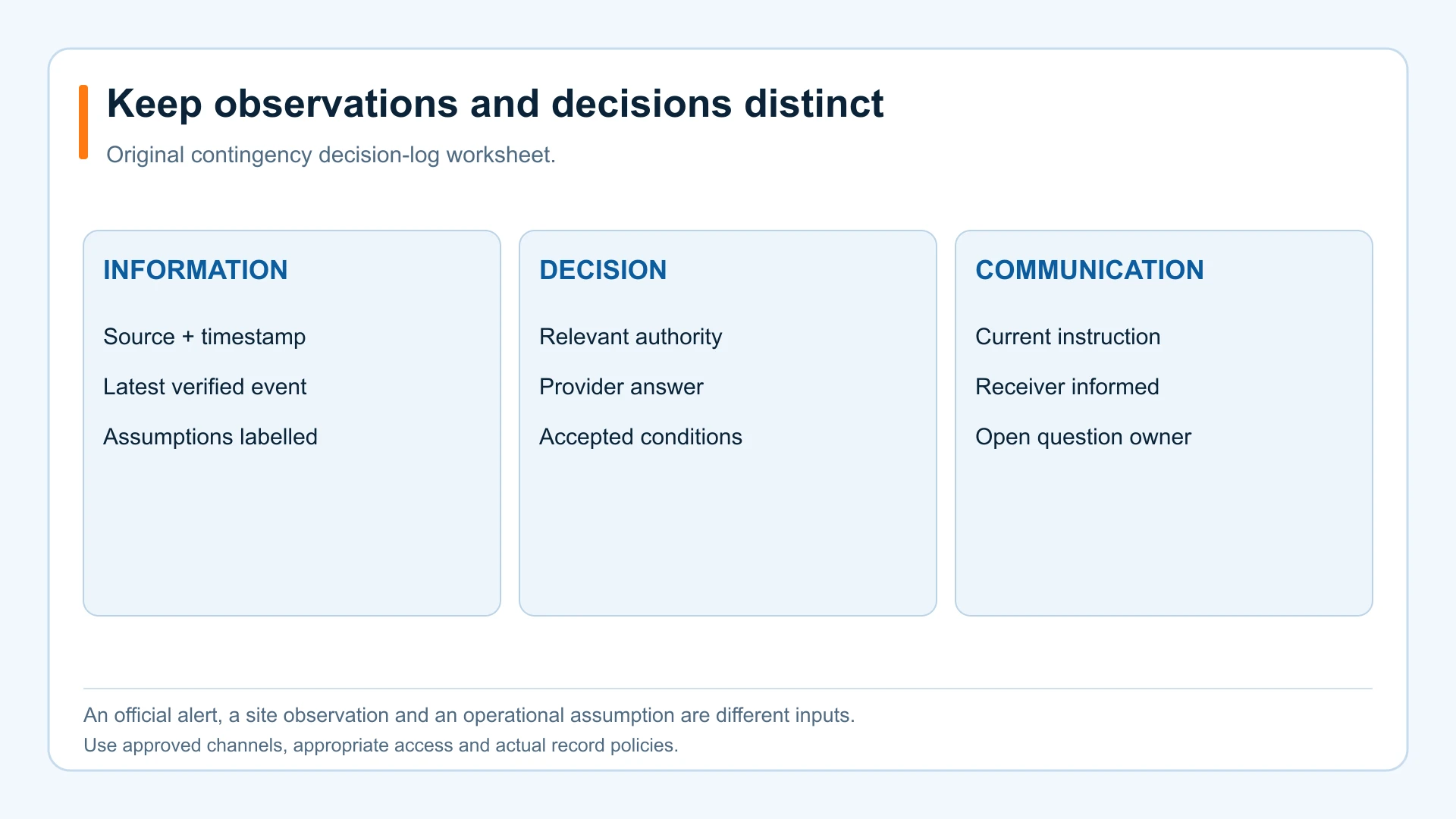
Three kinds of information may enter the discussion: official weather or roadway information, a current site observation and an operational assumption. Keep their sources and timestamps distinct. A screenshot forwarded without context may be stale or refer to another area. A report that a loading entrance is closed may be highly relevant even when a broad weather graphic looks unchanged.
Use current official local information appropriate to the place and task. Identify the source through its ordinary public channels, and check the relevant location and time period. This article does not supply current alerts. Your team must consult the information available when it is making the actual decision.
For site observations, ask what has been confirmed and by whom. The receiving facility may report that its usual entrance is unavailable, but the alternative entrance still needs confirmation. Do not convert a suggested route or doorway into an accepted instruction before the responsible contacts review it.
Label assumptions openly. “The receiver may stay available later” is different from an authorized receiver confirming an extended window. “The route usually takes this long” is not current evidence of safe passage. A useful decision log preserves these differences so later updates can replace uncertain assumptions with confirmed information.
3. Build a courier weather contingency trigger matrix
A trigger matrix describes when the existing plan needs review, not what the answer must be. Its value is assigning a relevant question and decision owner. Populate it using the actual service arrangement, site requirements and qualified review. The following worksheet is an editorial planning tool, not a mandatory regulatory process.
| Changed condition | Question to resolve | Responsible review |
|---|---|---|
| Relevant official alert or closure | Does accepted transport remain suitable under current conditions? | Responsible transport decision owner |
| Pickup entrance unavailable | Is an alternative handoff point confirmed and accepted? | Sender site and provider contacts |
| Receiving window changes | Can the receiver support the revised handoff? | Authorized receiving function |
| Cargo-specific limit may be affected | What qualified product or clinical review is required? | Responsible healthcare or shipper personnel |
| Current location or status uncertain | Which verified event is known, and what remains unresolved? | Authorized operations contact |
| Revised movement proposed | Who authorizes the change and who accepts the new transport scope? | Customer authority and provider acceptance owner |
Add your organization’s escalation details in an approved internal system, not a public blog worksheet. Names, private telephone numbers, access credentials and patient information do not belong in a public example. For prospective-provider discussions, use dummy references and role descriptions wherever that is appropriate.
Test whether each trigger leads to a decision rather than another vague status call. If staff can identify a problem but cannot identify who owns the next answer, improve the escalation path. If the owner lacks the information needed, specify how that information will be requested and confirmed.
4. Review changed conditions before collection when possible
Before the transport unit is released, confirm whether the accepted plan still matches readiness, access and receiving availability. If a known change prevents the handoff, address it with the provider before sending the courier into an arrangement that no longer exists. This is a coordination question, not a universal order-cancellation rule.
The sender should explain the current operational requirement through the approved contact route. The provider should explain whether the requested transport work can be accepted under the circumstances. The receiving function should confirm the conditions it controls. Keep these separate answers together so no party’s assumption is mistaken for another party’s commitment.
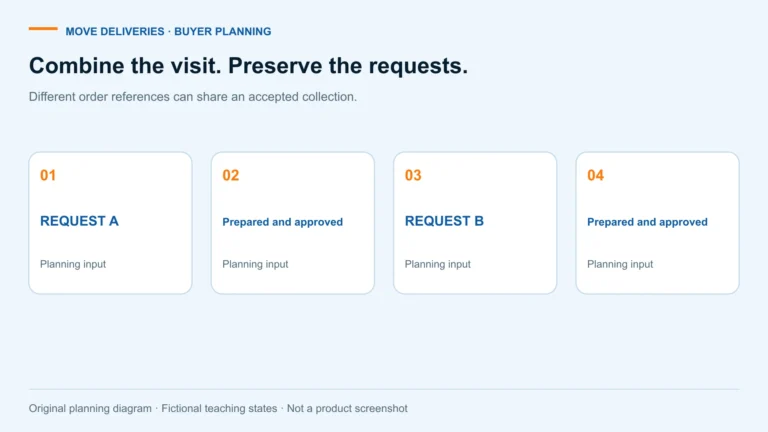
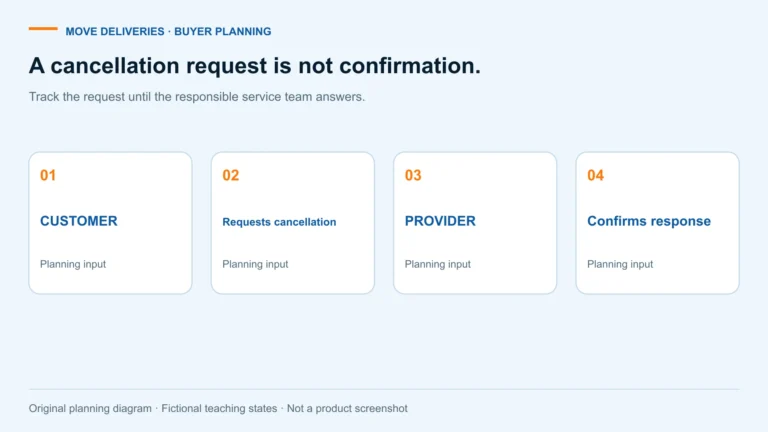
Where a request changes, retain the original reference and the revised instruction history. Ask how a cancelled request, changed window or proposed return is recorded and commercially handled. Do not silently create a second order because the first request seems uncertain; confirm the accepted state through the agreed process.
For recurring work, a pre-collection review may also involve other stops in the routine. Altering one receiving window can affect the rest of the accepted plan. Ask the responsible provider contact to review that effect instead of assuming that a change for one site has no consequences elsewhere.
5. Keep custody and decision ownership clear after collection
Once collection has occurred, changed conditions may require a different set of questions. Establish the latest verified event, the accepted transport-unit reference and the current instruction. Then identify what has changed and who can review the appropriate next action. Avoid announcing a return, storage action or alternate destination without the required authorization and acceptance.
Qualified healthcare or shipper personnel must determine cargo-specific requirements and acceptability questions. A dispatch contact may coordinate the discussion, but coordination alone does not provide clinical authority. Keep product decisions and transport decisions within their appropriate responsibilities, including any necessary privacy review.
Ask how the actual arrangement preserves a usable history when instructions change. The current instruction should be understandable to the courier, while authorized reviewers should be able to determine what decision applied at each stage. A final completion record cannot explain a changed plan if its relevant history has been lost.
Do not use a hypothetical diagram as evidence that MOVE offers a particular holding, storage, rerouting or emergency capability. Discuss the actual requested work with the provider. The purpose of the plan is to identify responsible decisions and accepted scope, not to invent services that have not been confirmed.
6. Maintain a concise, useful decision log
A decision log should help an authorized reviewer distinguish the observed situation from the action taken. Identify the approved order reference, the relevant event time, the source of the information and the responsible decision owner. Record the accepted instruction and any unresolved question without adding unnecessary personal or clinical detail.
| Field | Purpose | Common ambiguity to avoid |
|---|---|---|
| Information source and time | Show which alert or observation informed review | Undated screenshot treated as current conditions |
| Latest verified event | Describe known order state | Assumed collection or completion |
| Review owner | Identify who can make the relevant decision | A messenger mistaken for an authorized decision maker |
| Provider answer | Record acceptance, limits or further review | Customer request mistaken for accepted transport |
| Current instruction | Make the effective plan understandable | Old and new instructions circulating together |
| Next review or unresolved item | Keep open questions visible | A status message treated as a final resolution |
Make timestamps unambiguous, particularly where teams work across time zones or a decision spans midnight. Event time and record-entry time may differ. Do not revise history to make the sequence look cleaner; use the actual correction process and preserve the context necessary for responsible review.
Keep the log available only to people with appropriate access. A public messaging group is not automatically an approved incident-record system. Confirm the actual channels, access controls and record policy before use. This article makes no claim about a particular platform’s contingency interface or information-security certification.
7. Give recipients an update they can act on
The receiving team needs to understand the relevant change, the current known state and the next decision. A vague “weather delay” message may not tell them whether their receiving window is still workable. An exact-looking arrival time may be equally unhelpful if it relies on unconfirmed access or a transport decision still under review.
Use plain language and separate an estimate from an accepted commitment. State which endpoint the estimate describes and when the information was current. If the provider cannot responsibly give a new estimate, communicate that uncertainty and the next review point rather than filling the gap with a guessed time.
Confirm who communicates with the recipient and what information that person is authorized to share. The pharmacy, laboratory, clinic and courier may have different responsibilities. Agreeing those boundaries can prevent duplicate or contradictory messages. Do not ask the recipient to settle a product or transport question that belongs with qualified personnel.
For background on the normal request-to-completion process, see how MOVE delivery works. For the visibility conversation, see delivery notifications. Confirm the actual information and communication available for your service arrangement.
8. Test the plan with a tabletop exercise
Use a fictional exercise before a real disruption. Imagine that a participating clinic reports its receiving entrance unavailable while a transport unit is awaiting release. This scenario does not assume an actual storm, closure, product requirement or MOVE capability. Ask the team to identify what is known, what requires confirmation and who owns each answer.
Introduce a second condition: someone proposes a different destination. Does the sender have authority to request that change? Has the receiving function confirmed availability? Has the provider accepted the revised transport task? What qualified cargo-specific review is required? The exercise should reveal decision gaps without prescribing the answer to every real situation.
Then test the message the receiver would receive. Have a participant explain it in their own words. If they mistake an unaccepted proposal for a confirmed plan, improve the wording. If they cannot identify the contact responsible for the next question, improve the escalation instructions. Use dummy references throughout.
Record the unresolved issues and assign them for review before considering the plan ready. A completed meeting is not evidence that every contact route works or every task is accepted. Where appropriate, verify the channels and instructions through controlled checks approved by the responsible parties.
9. Review the plan after the disruption, without hindsight shortcuts
After the event, compare the information available at the time with the decisions made. Do not judge an earlier decision using facts that became known only later. Identify which instructions were current, which communications reached the right people and which questions remained unresolved when an action was taken.
Separate site-access changes, information gaps, receiving conflicts and transport constraints. Different conditions require different improvements. Replacing a vague contact list with a verified escalation path is a different action from reviewing cargo-specific requirements with qualified personnel. Name the owner and evidence needed to establish that each improvement is complete.
Avoid unsupported claims that the revised plan will eliminate delays or guarantee uninterrupted medical delivery. The practical aim is clearer readiness, decisions and communication. Review whether the changes are useful under the actual arrangement and revisit them when sites, people or service requirements change.
Build the conversation before conditions change
A good courier weather contingency discussion starts with the accepted local work and its decision boundaries. Share the ready-time routine, receiving conditions, relevant site contacts and cargo scope through approved channels. Ask how a changed condition will be reviewed safely and what your team should expect to know.
Start an Account to discuss a recurring delivery routine, or use Quick Quote for one point-to-point request. MOVE can help review the requested plan and confirm available service. Weather, local access, cargo requirements and receiving availability remain part of that actual review—not conditions a blog promise can remove.