Start with the decision your forecast must support
Medical courier demand forecasting is the process of estimating upcoming transport work by location, release period and shipment scope, while recording what is known and what may change. It helps a healthcare buyer discuss a realistic service arrangement before the work arrives. It does not reserve a vehicle, authorize collection or guarantee delivery. Those are separate decisions that require an accepted service request.
A pharmacy may know the number of orders it expects to prepare, but not when each package will be released. A medical supplier may expect several cartons, yet one bulky item can change the transport discussion. A clinic may anticipate ordinary replenishment plus a temporary project. Adding everything into one weekly total can make the spreadsheet tidy while concealing the question the courier needs answered: what work is expected at which point in the day?
This guide focuses on preparing that picture. It includes seven checks, a reusable forecast worksheet and a fictional comparison of two release patterns. It does not set clinical inventory levels, prescribe specimen timing or decide which patient need takes priority. The responsible healthcare team determines those requirements. Your operational forecast should translate approved transport needs into a clear conversation about local same-day delivery.
Begin by naming the decision. Are you discussing a recurring collection, an additional pickup window or a possible increase in packaged shipments? State the planning period and the sites included. A forecast built to discuss next Tuesday should not quietly become a commitment covering the whole month. Identify who will receive the forecast and when they need it; otherwise staff can spend time improving detail that arrives after the service decision.
In this article
- Start with the decision your forecast must support
- 1. Define requests, stops and transport units separately
- 2. Separate the release pattern from the daily total
- 3. Compare like days before choosing a baseline
- 4. Add known changes without pretending they are certain
- 5. Describe a planning range and its reason
- 6. Publish one forecast version and one revision path
- 7. Review forecast differences without rewriting history
- Use a medical courier demand forecasting worksheet
- A forecast review that changes the right assumption
- Turn the forecast into a better service conversation
1. Define requests, stops and transport units separately
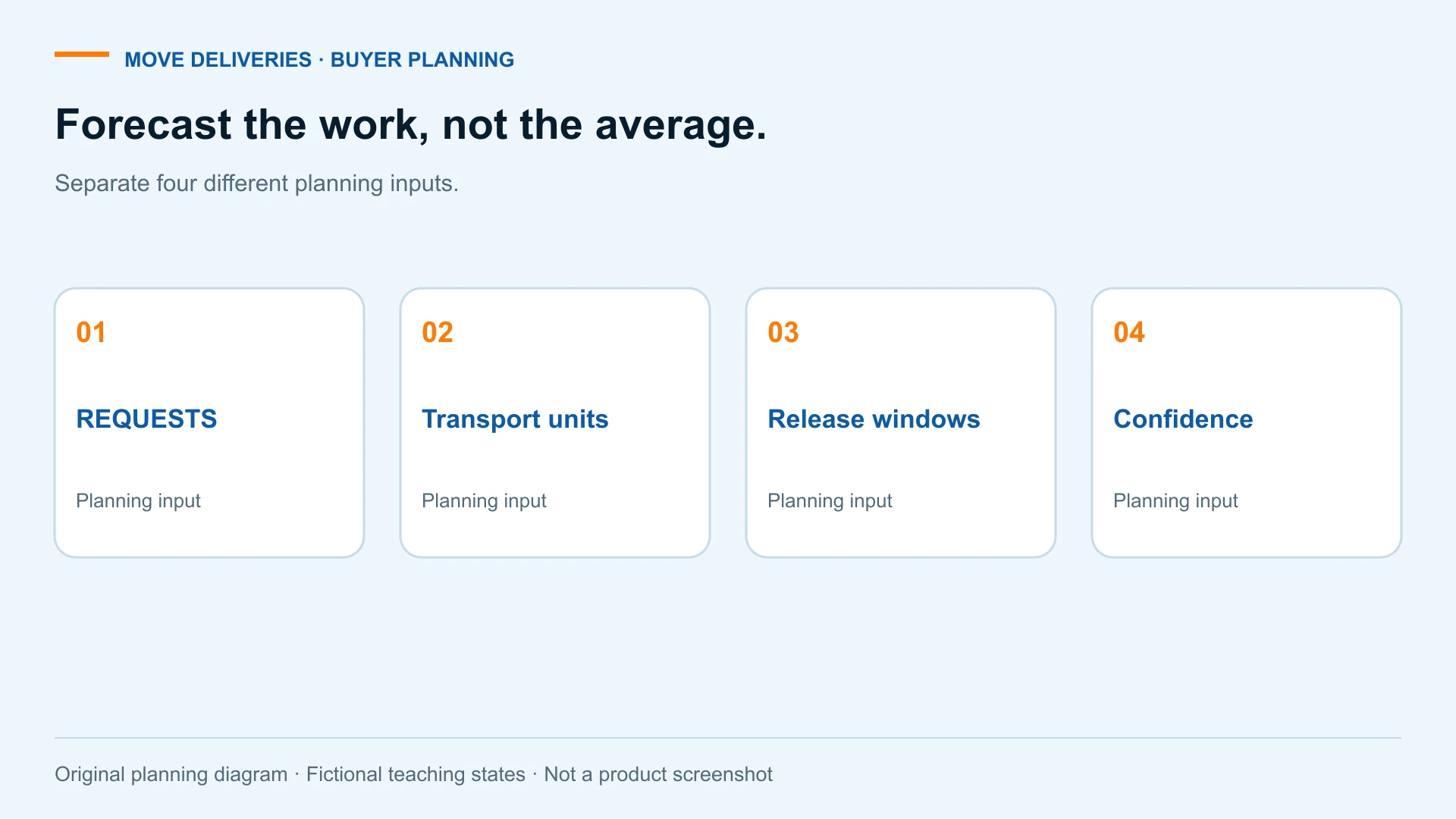
Choose counting units before collecting numbers. A request is an instruction to perform work. A stop is a visit to a location. A transport unit is the packaged item the courier is asked to collect. These quantities can move together, but they are not interchangeable. One request might include several cartons at one pickup. Several requests might be released at the same location without becoming one authorized collection.
Put the unit name in every worksheet column. If the releasing team reports orders and the provider plans around packaged dimensions and visits, record the relationship instead of assuming it. Ask the team which outgoing units are expected to belong to each request. Keep unknown dimensions or package counts visible until preparation provides a better answer. Do not invent a conversion factor simply because last week had a convenient ratio.
For recurring work, distinguish a scheduled visit from a forecast of actual units. An agreed stop can still have a changing quantity of prepared packages. Conversely, an expected shipment does not establish that an extra visit has been accepted. The scheduled delivery service is the service context; this worksheet supplies the demand assumptions that still need review.
2. Separate the release pattern from the daily total
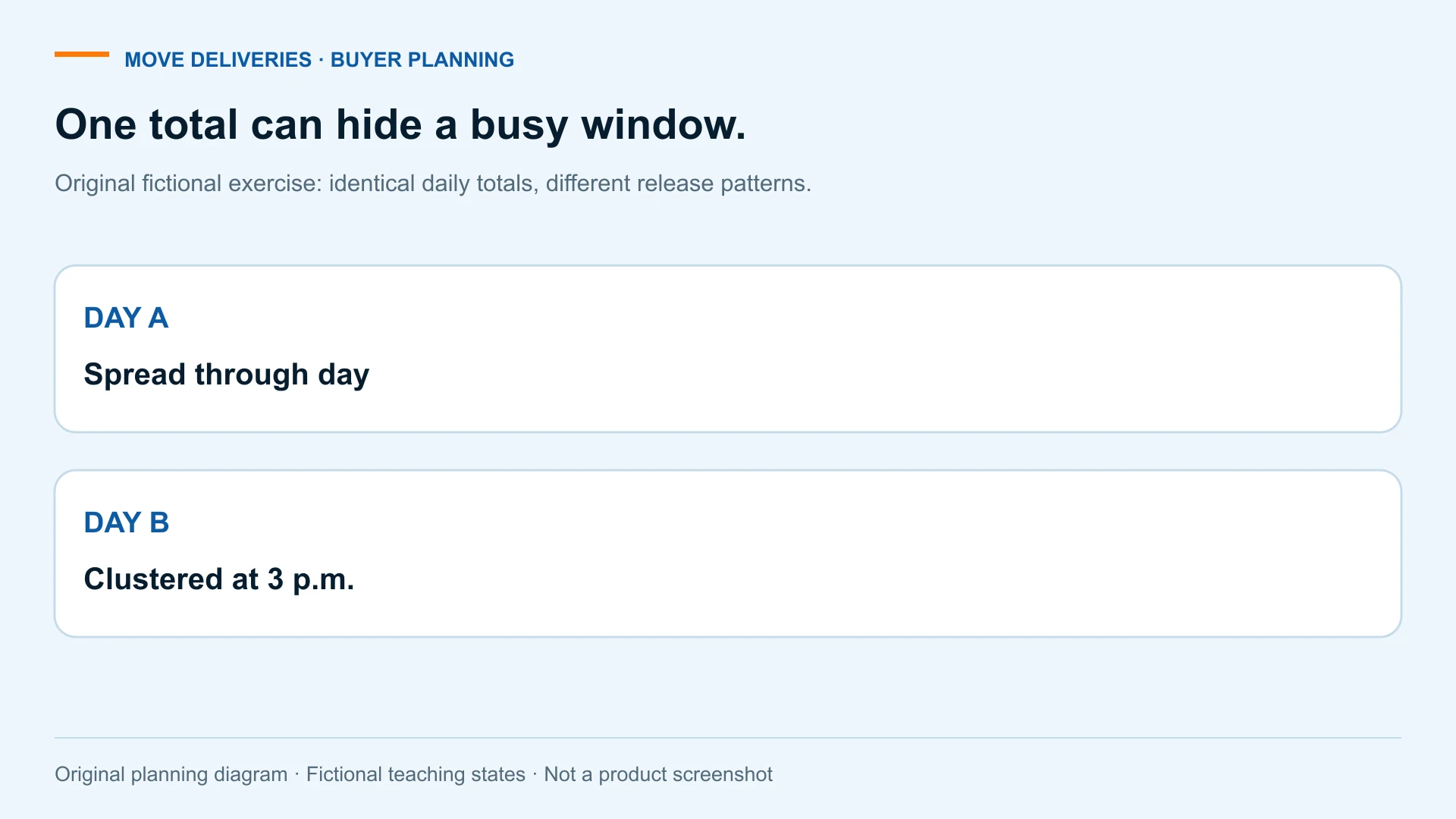
Record when work is expected to be available, not only how much is expected. A day with a steady flow of prepared packages differs from a day when most units are released together near a receiving cutoff. Both days can share the same total. Their collection discussions will not necessarily be the same, because readiness and receiving constraints occur at specific times.
Use periods meaningful to the actual operation: the ordinary collection window, an afternoon preparation batch or another agreed interval. These are planning categories, not universal courier time standards. Record the relevant local time zone. If an expected release period spans several hours, say so. Replacing a range with an exact minute creates false precision and can lead another team to treat an estimate as a readiness confirmation.
Ask the releasing owner what produces the pattern. A planned staffing change, a preparation routine or a one-time project may be more informative than the daily total. Record the operational explanation without unnecessary patient information. Then verify whether the destination can receive the proposed work in that period. A release forecast cannot override the receiving arrangement or the provider’s accepted scope.
3. Compare like days before choosing a baseline
Use your own recent, relevant records when available. Separate ordinary days from days affected by closures, unusual projects, missing records or changed preparation procedures. A historical count describes what was observed under those conditions. It does not establish what must happen next week. Keep the source period and the reason for including or excluding a day beside the baseline.
The nonprofit ASQ guidance on stratification explains why separating data into meaningful groups can reveal patterns hidden in a combined total. Applied here, grouping by releasing site and release period can support a clearer planning discussion. This is an operational use of a quality-analysis principle, not a statistical forecast model or a claim of measured MOVE performance.
Avoid choosing only smooth days to make the forecast look reliable. If a record is incomplete, label the gap and explain what it prevents you from concluding. Do not convert missing activity into zero. Ask whether a low recorded count reflected low demand, a cancellation or unrecorded work. Those distinctions matter when discussing future service, even if you do not have enough evidence for a formal statistical analysis.
4. Add known changes without pretending they are certain
List changes expected during the forecast period: a new care site, a temporary supply project, different preparation hours or an agreed change in the routine. Attach the source and owner of each assumption. A statement from the responsible site is stronger operational evidence than an unverified rumor, but it can still change. Record whether the change is proposed, confirmed by the customer or accepted into the courier arrangement.
Keep baseline and adjustments separate. If ordinary work is expected to continue while an additional project is proposed, show both. That allows the provider to understand the reason for the increase and ask the right questions. It also makes the forecast easier to revise if the project moves. A single edited total can hide which assumption changed and why the earlier service conversation no longer fits.
Do not let a commercial forecast decide clinical priorities. The healthcare organization identifies the work it needs moved under its approved procedures. The forecast can describe the resulting package scope and timing. It cannot determine medication supply, substitute equipment or extend a specimen’s acceptable conditions to make the numbers easier. Ask the responsible personnel to resolve those questions before issuing transport instructions.
5. Describe a planning range and its reason
Where the evidence is uncertain, use a clearly described range rather than a confident-looking number. Explain whether the range reflects incomplete preparation counts, an unconfirmed project or ordinary observed variation. Do not label it a confidence interval unless a qualified analysis actually produced one. A practical planning range is a conversation tool; it is not a probability guarantee.
Identify what would make the estimate more useful. Perhaps the supplier will know the packaged dimensions tomorrow, or the pharmacy will confirm its preparation batch before the next service review. Add an owner and next check. This makes uncertainty actionable instead of turning it into a general warning that everyone ignores. The provider can then explain which missing details prevent acceptance and which can be reviewed later.
Discuss what happens if the work exceeds the agreed arrangement. Additional units, an earlier receiving need or a larger package may require a new review. Do not assume that the top of your forecast range has automatically been reserved. The dedicated courier option can be part of the discussion, but capacity and commercial terms must be confirmed for the actual scope.
6. Publish one forecast version and one revision path
Date the forecast and identify the version used for the service conversation. Keep one maintained record rather than several spreadsheets with the same filename. Staff should know who can revise the forecast, who reviews the change and where the accepted service instructions are kept. A revised estimate is not automatically a revised order.
When a material assumption changes, explain the difference rather than simply sending a replacement total. State which site, date, release period or shipment scope is affected. Record whether the provider has reviewed the change. If a customer has an accepted recurring arrangement, check whether the new work remains within it. The person reading the update should not have to reconstruct the decision from an earlier message thread.
MOVE coordinates local same-day medical delivery through its proprietary platform. Discuss the supported workflow for forecasts and service requests with the team; this guide does not claim the platform includes a forecasting engine, automatic reservation or a particular spreadsheet import. Keep planning estimates and confirmed transport instructions distinct, whatever tool your organization uses.
7. Review forecast differences without rewriting history
After the planning period, compare the estimate with the work actually requested and prepared. Separate a forecasting difference from a service-performance issue. If ten units were forecast but only six were authorized for release, that does not by itself mean the courier missed four packages. The comparison must use compatible units and the actual accepted work.
Classify the reasons that can be supported by evidence. Was an expected project deferred? Did preparation finish in a different period? Did the package scope change? Mark unexplained differences as unresolved rather than choosing a convenient explanation. A small review can improve the next forecast without claiming that one week represents every season or location.
Keep the original forecast version alongside the review. Editing old estimates to match what happened destroys the ability to learn. Decide one specific improvement, such as recording dimensions earlier or separating two release periods. Assign an owner and check it next time. This review informs demand preparation; a separate service-report review addresses performance against accepted delivery requirements.
| Fictional day | Expected cartons | Release pattern | Review question |
|---|---|---|---|
| Day A | 12 | 4 in each of three periods | Can the ordinary arrangement support these periods? |
| Day B | 12 | All near the final window | What arrangement has actually been accepted? |
Use a medical courier demand forecasting worksheet
Create one row for each site, service date and meaningful release period. Recommended columns are counting unit, ordinary baseline, known adjustment, planning range, reason for uncertainty, source period, decision owner and next check. Add a separate field for provider review. That prevents a forecast from appearing accepted merely because the customer completed its own preparation.
For a fictional exercise, imagine twelve cartons expected on each of two days. On Day A, the releasing team expects four cartons in each of three periods. On Day B, all twelve are expected near the final receiving window. The total is identical. The collection discussion differs because the release pattern differs. These are invented teaching numbers, not industry averages, real customer data or evidence of available MOVE capacity.
Ask the provider to review the real addresses, packaged scope, readiness assumptions and receiving needs. Do not promise an additional run to staff before it is accepted. If the forecast remains uncertain, preserve the open question and next decision. A useful worksheet does not eliminate uncertainty; it stops uncertainty from being mistaken for agreement.
A forecast review that changes the right assumption
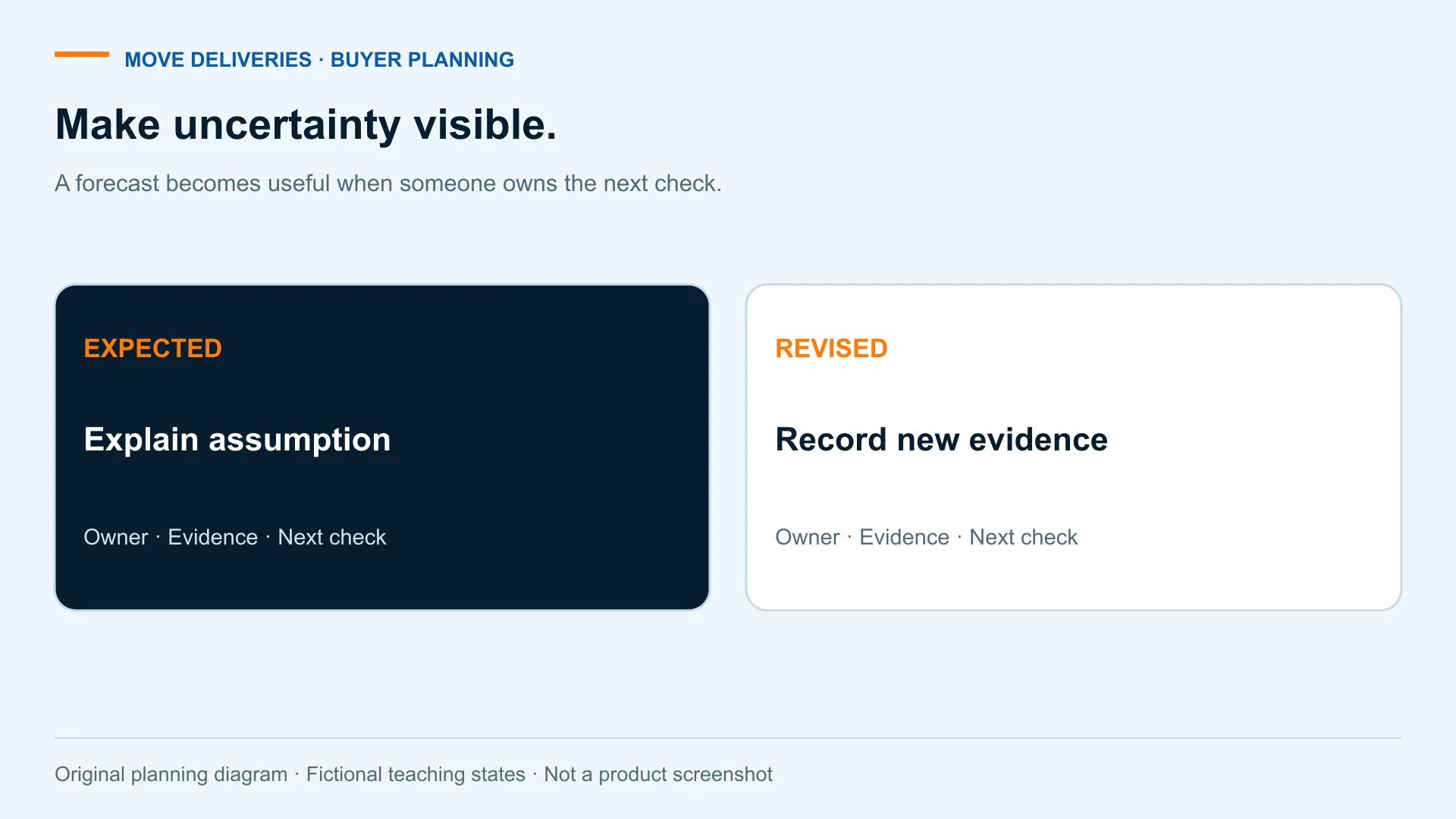
In a fictional supplier exercise, the coordinator initially forecasts the same outgoing count for every weekday because the ordinary visit is daily. The preparation owner points out that Wednesday includes a project whose packaged dimensions are not yet known. Rather than increasing every day equally, the coordinator leaves the ordinary baseline intact and adds a separate Wednesday assumption. That gives the provider a specific question to review.
On the next check, the project owner confirms fewer cartons than expected but a larger packaged item. The total unit count falls, yet the vehicle discussion may become more important. The coordinator records both changes and asks for review of the actual scope. Calling the change “less volume” would conceal the practical issue. A count is useful only when the team understands what it counts.
At the end of the exercise, compare the original assumption, revised information and accepted requests. The lesson is not to add a universal safety percentage to every forecast. It is to collect the missing dimension information earlier for this kind of project. Record that improvement beside the next review date. The example demonstrates an evidence trail, not a forecast accuracy rate or a claim about MOVE’s available equipment.
Turn the forecast into a better service conversation
How much history is enough? There is no universal number of days that makes every forecast reliable. Choose records relevant to the actual routine and explain their limitations. A new site with little history may need a short, explicitly provisional planning period rather than a complicated model with invented assumptions.
Does a forecast reserve a courier? No. It describes expected work. Reservation, service acceptance and any changed commercial arrangement require confirmation through the agreed process. Should you include patient names? Routine volume planning generally needs operational counts and site requirements, not patient stories. Share only appropriate information through the approved channel.
Can a national industry trend replace local records? Not for a specific pickup plan. Public information can provide context, but it cannot tell you which cartons your releasing site will prepare at a particular time. Use the medical supplier delivery page to frame the service need, then provide your actual transport assumptions.
For a defined local request, ask for a Quick Quote. For recurring work, Start An Account and bring the forecast worksheet. Clear counting units, visible uncertainty and a dated revision path give both teams something concrete to review—before expected work becomes an urgent surprise.