
A courier platform outage is an interruption that prevents your team from reliably using some part of the delivery system. It might affect new requests, status visibility, instructions or records. The immediate question is not simply when the screen will return. It is which orders are already accepted, which decisions remain unresolved and how people will work without creating conflicting instructions.
Healthcare teams need a continuity plan that keeps operational work and its evidence connected. This guide provides an original outage ledger, a controlled recovery sequence and practical test questions for a local delivery arrangement. It is not a claim that MOVE offers offline entry, a particular backup channel, automatic replay or guaranteed recovery times. Confirm the actual supported process with your provider before relying on it.
Define the courier platform outage before choosing a workaround
A blank status screen and a failed order submission are different problems. Staff may still be able to see previously accepted work but not create a new request. Alternatively, the request may have reached the provider even though the customer did not receive a confirmation. Treating every symptom as a completely failed order can create a second shipment.
Record the function affected, the first observed time, the site reporting it and the information source. Avoid diagnosing the technical cause from a single screen. An individual device problem, a customer network interruption and a provider service incident may require different people to investigate. The operations team can describe what it cannot reliably do without claiming to know why.
Start with the last known order reference and verified state. Which work was accepted before the interruption? Which requests have an uncertain outcome? Which new requests have not been submitted? Those three populations need different treatment. A manager should be able to identify them without interpreting an employee’s handwritten “pending” differently from everyone else.
Review the actual process on MOVE’s How It Works page, then ask the provider how an interruption affects each handoff. Keep clinical decisions, cargo suitability and urgent care arrangements with the responsible healthcare team. Software continuity cannot substitute for those decisions.
Agree continuity boundaries while the system is working
The NIST information-system contingency planning guide discusses evaluating systems and operations to establish planning priorities. It is written for federal information systems. Here it is a planning reference, not a universal healthcare mandate or proof of a courier’s recovery capability.
Use the practical question behind that reference: what work is most affected when a particular function is unavailable? A recurring route that is already accepted may have different information needs from a new urgent request. A clinic may need to reach a responsible service contact, while procurement may need access to an agreed export. Describe those needs separately.
Identify who can activate the approved continuity process, what conditions trigger it and who can decide to stop using it. Ask which channels the provider supports. A telephone number found in an old email is not automatically an approved outage channel. Confirm the contact role, the process for verifying a requester and the limits on what staff may send.
Make the arrangement usable by an authorized backup person. Store current contact instructions in an approved location that remains accessible under the interruption you are planning for. Do not publish internal access details, credentials or patient information in a public worksheet. Continuity information needs appropriate protection, not simply wider distribution.
Preserve one identity for each intended delivery
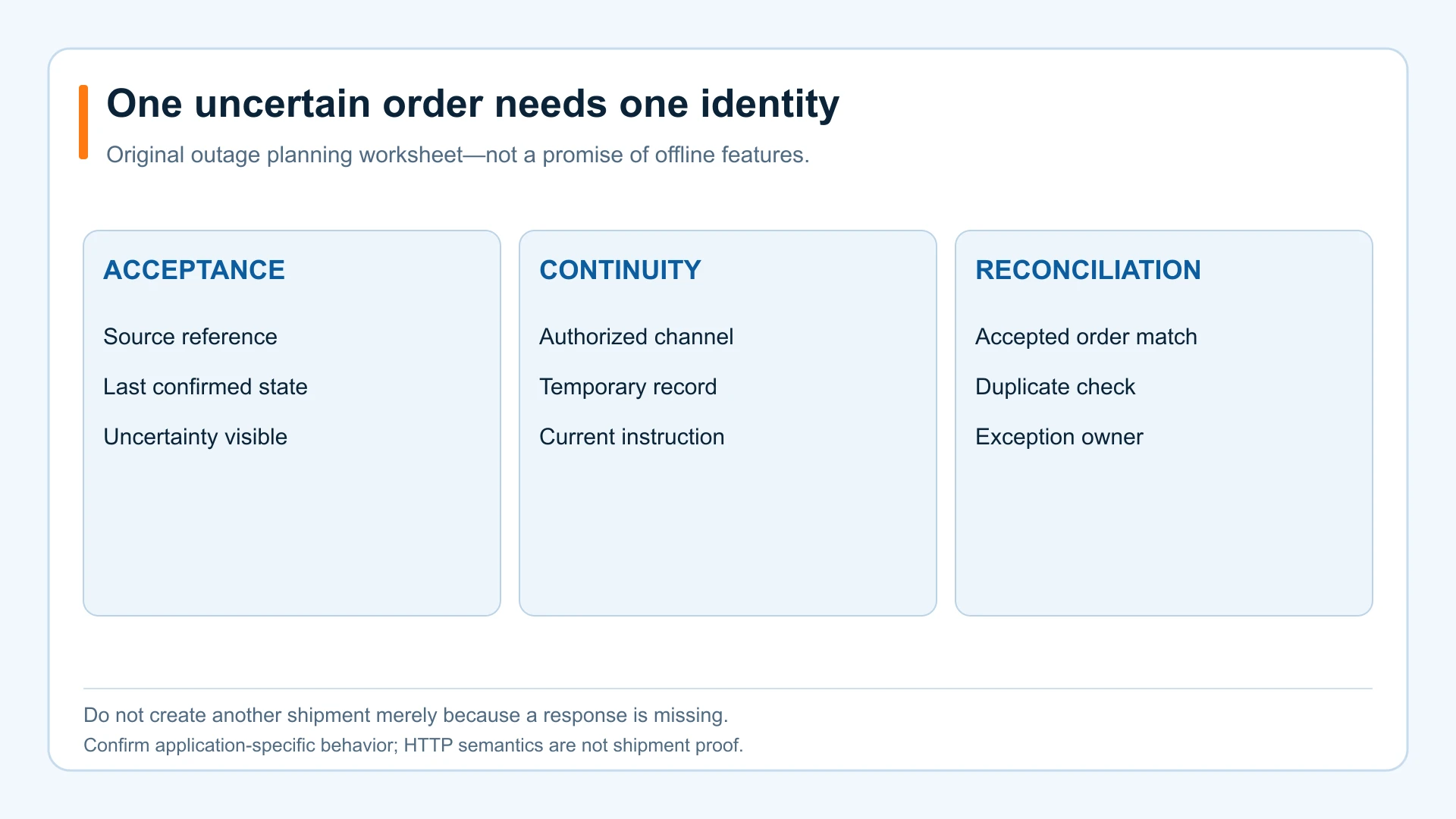
A duplicate order often starts with an understandable attempt to be helpful. One person re-enters a request, another telephones the provider, and a third submits it again when the screen returns. Without a shared reference, each action can look like separate work. The plan should establish one responsible request owner and an understandable identity for the intended delivery.
For an uncertain submission, retain the original reference and describe the uncertainty. Do not label it rejected unless the provider has confirmed rejection. Ask the supported service contact to determine whether the order was accepted. The appropriate next step depends on that answer, not on how long the customer has been looking at a loading indicator.
If a temporary reference is part of the agreed process, connect it to the original request and later accepted order. Record who made that connection and what was confirmed. Do not improvise an identifier format that could be confused with the provider’s own records. The exact process requires agreement and a harmless demonstration before use.
Order-creation retries need application-specific confirmation. RFC 9110’s idempotency discussion does not make every order-creation request safely repeatable. Ask the provider to demonstrate the supported recovery behavior rather than treating a technical term as permission to resubmit blindly.
Use a controlled temporary ledger, not scattered messages
The temporary ledger below is an original discussion tool. It is not a mandated record format or a statement that MOVE provides an offline ledger. If your organization and provider agree to temporary records, responsible reviewers should approve where they are kept, who can access them and what information is appropriate.
| Record element | Question it answers | Common ambiguity to prevent |
|---|---|---|
| Original request reference | Which intended delivery is this? | A second request mistaken for a new order |
| Last verified state | What do we actually know? | Unconfirmed submission called accepted |
| Temporary reference | How is continuity work connected? | Unrelated handwritten identifiers |
| Decision owner | Who may approve the next action? | Several staff issuing competing instructions |
| Provider acknowledgment | Which work has been accepted? | Message sent treated as message accepted |
| Event and entry times | When did it happen and get recorded? | Late entry mistaken for late collection |
| Recovery reconciliation | How was the final record matched? | Missing or duplicated history after restoration |
Keep uncertainty visible. “Awaiting provider acknowledgment” tells the next reviewer more than “done.” An instruction sent, an instruction accepted and a handoff completed are separate facts. Ask staff to record the fact they can support, the source and any decision still required.
Separate operational records from technical incident notes. The healthcare desk needs current delivery instructions, not a speculative security diagnosis. The technical team may need a timestamp and error description, but not unrelated patient information. Share each kind of information through the approved process and with the appropriate reviewers.
Control changed instructions while visibility is limited
An outage does not give every person permission to reroute a delivery. Agree who can request a change, who authorizes it and who confirms transport acceptance. A request for a new destination may affect timing, access and receiving readiness. The courier should not be left choosing between an earlier system instruction and a later unverified message.
Use the same order identity when discussing the change. Describe the previous instruction, the proposed revision, the decision owner and the provider’s answer. Keep the effective instruction understandable. If acceptance has not been confirmed, do not tell the receiving team that the new plan is settled.
Clinical or product-specific questions need the responsible healthcare reviewer. An operational continuity contact cannot decide whether a specimen remains acceptable or a product may be used. Make that boundary clear in the plan, especially when the software interruption adds pressure to an already time-sensitive request.
A useful customer update states the last verified fact, the question being resolved and the responsible contact. Avoid invented arrival estimates merely to reassure someone. If there is no confirmed estimate, say so through the agreed communication process and identify the next action.
Test the plan with harmless scenarios before relying on it
Use dummy references and empty transport units where suitable. Test an order accepted just before the interruption, a submission with an uncertain outcome and a completely new request. Ask a backup staff member to use the plan without coaching from its author. The test should reveal whether responsibilities and references are understandable.
Include a changed instruction and an unavailable receiving contact. Does the team know who may approve the revision? Can it distinguish a message left from an accepted change? Does it understand when transport should remain unconfirmed? Record the observed behavior rather than marking the exercise successful because everyone attended.
Test the record recovery too. Demonstrate how a temporary reference is matched to the final order, how duplicates are identified and how an unresolved discrepancy receives an owner. A test that stops when the screen loads again misses the part most likely to affect later reporting and billing.
Ask the provider which test conditions are safe and supported. Do not deliberately interrupt a production service, disable security protections or manipulate real orders to simulate an outage. A tabletop exercise or approved test environment may be more appropriate. The responsible teams should choose the method.
Treat restoration and reconciliation as separate milestones
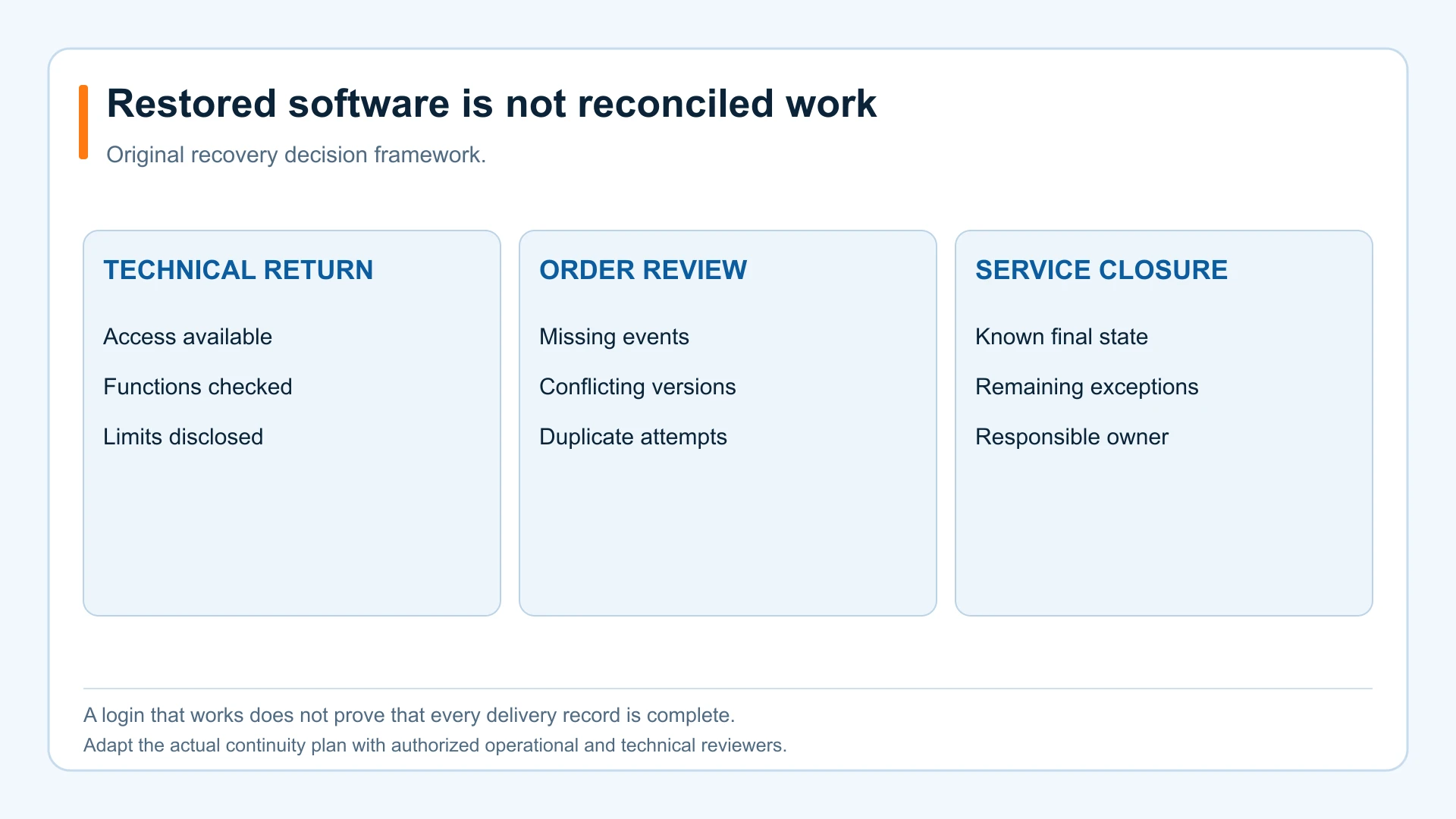
The system becoming available is a technical milestone. The temporary work being correctly connected is an operational milestone. Assign a reviewer to compare each temporary entry with the final state. Ask whether the original request, accepted work, changes and actual handoffs can be understood in one coherent sequence.
Look for missing orders, duplicate requests, conflicting instructions and events whose entry time differs from their occurrence time. Do not quietly overwrite the history to make the report appear neat. Corrections should follow the approved record process, preserve appropriate context and remain understandable to authorized reviewers.
Review any pending invoice questions after order reconciliation. A duplicated request may have an operational and a billing implication, but neither should be guessed from a temporary note alone. Link the question to the agreed work and actual evidence, then use the normal review path.
Only the authorized owner should declare the continuity process ended. Communicate that decision to the staff who may still be using temporary instructions. A clear end point prevents an old workaround from becoming a permanent alternative workflow that nobody is monitoring.
Improve the plan without claiming more than the evidence supports
After the interruption, review what was observed. Which function failed? Which work needed a decision? Which contact information was wrong? Which temporary entries were difficult to match? The goal is a better process, not a story that every shipment was protected when nobody has reviewed the records.
Choose specific improvements with named owners. Replace an outdated contact role, clarify the uncertain-order procedure or revise the reconciliation worksheet. Have the responsible people verify the change with another harmless test. Attendance at a discussion is not evidence that the new instruction works.
Keep the review proportionate and separate from any required technical, privacy or clinical investigation. This operational guide does not establish legal notification duties or diagnose a cybersecurity event. Qualified reviewers assess those questions under the actual arrangement.
MOVE’s proprietary-platform overview can frame your service discussion. Ask how the supported arrangement handles interruptions and what remains the customer’s responsibility. For ongoing local work, start an account conversation with your sites, service hours and continuity questions. For a new individual request, Quick Quote through the available approved process rather than assuming earlier work has failed.
Courier platform outage questions
Before filing the plan away, ask a person outside the original planning meeting to explain the three most important distinctions: an intended request is not accepted work, a temporary note is not provider acknowledgment, and a restored screen is not a reconciled history. If those distinctions are unclear, revise the language and test again. A shorter usable plan is preferable to a long document whose labels mean different things to the people expected to follow it.
Should staff submit the same order again after an error?
Not without checking the supported recovery process. An uncertain response does not prove that the original request failed. Preserve its reference, ask the appropriate service contact to confirm the accepted state and follow the agreed next step.
Does an offline note prove that a delivery was accepted?
No. A customer note can document what staff requested, but acceptance needs the agreed provider acknowledgment. Record request, acknowledgment and completion separately. Use approved systems and protect information appropriate to the actual arrangement.
What ends the recovery review?
A supported restoration notice alone is not enough to settle every order discrepancy. The responsible owner should verify that temporary work is reconciled, unresolved questions have owners and current instructions are clear before closing the operational review.