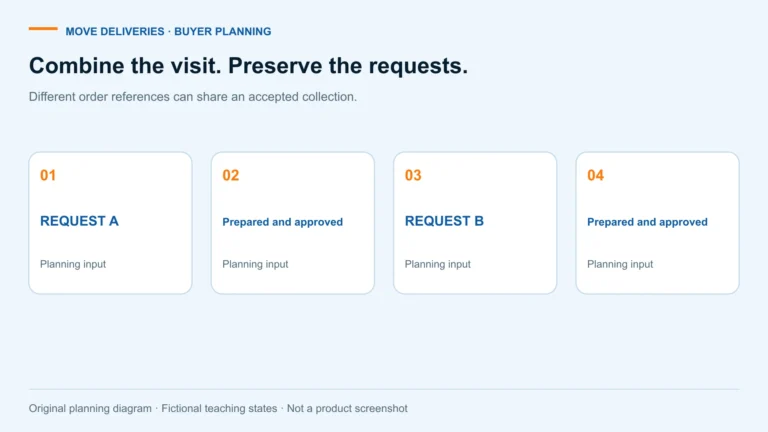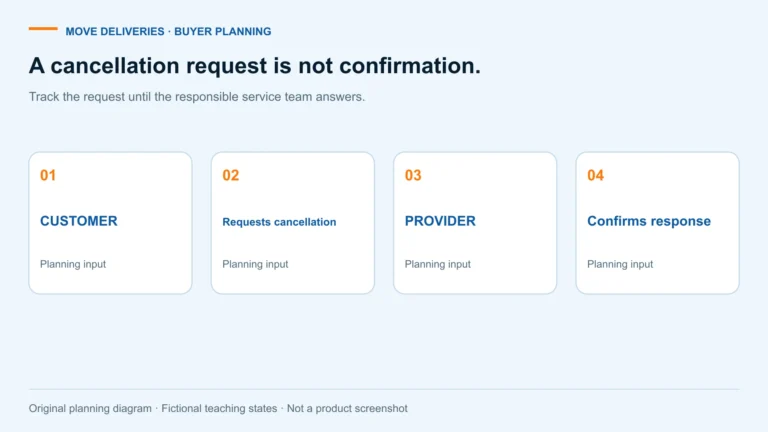

Pharmacy courier pricing is easier to compare when every provider is answering the same delivery question. A lower quoted rate may cover less work, a different receiving window or a different assumption about an unsuccessful handoff. Before you decide which proposal offers better value, bring the scope, price basis and exceptions onto one comparison sheet.
This guide is for pharmacy owners, operations managers and procurement teams comparing local delivery proposals. It provides an original proposal-normalization worksheet, clarification questions and a fictional comparison scenario without invented market rates. It is not a MOVE rate card, legal contract or estimate of patient demand. Qualified pharmacy staff determine prescription-specific requirements; providers confirm the transport arrangements they can accept.
1. Give every bidder the same starting question
Two proposals can be accurate and still be impossible to compare. One provider may price a recurring collection from your dispatch counter. Another may price individual on-demand requests from several locations. A third may assume deliveries can be combined into a route, while your team expects a separate point-to-point movement. Comparing the headline rates does not resolve these differences.
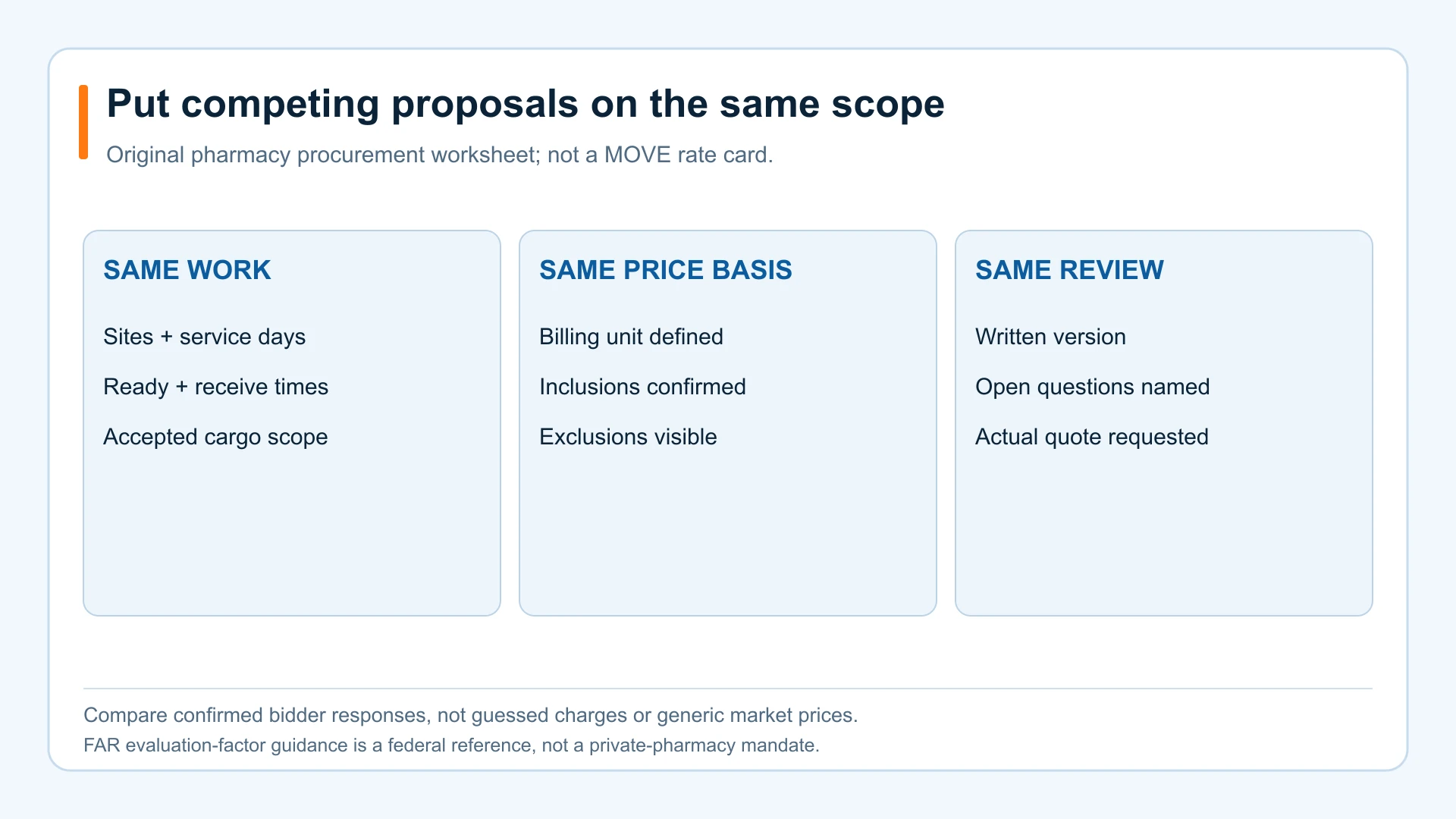
Write a shared scope statement before requesting final prices. Identify the participating pharmacy sites, accepted receiving destinations, requested service days and the operational work your staff expect the courier to perform. Describe what is ready for collection and what constitutes a completed handoff. Use approved operational references, not patient information that a prospective bidder does not need.
A useful statement distinguishes an existing routine from a possible future requirement. For example, your current work may involve a planned weekday collection, while occasional urgent requests need separate acceptance and pricing. Do not turn a possible future expansion into a guaranteed order volume. Ask each bidder to label what they have priced and what remains an assumption.
MOVE’s pharmacy delivery solutions provide a starting point for discussing the actual local workflow. A service description introduces the conversation; it does not replace a proposal covering your ready times, receiving conditions and requested support.
2. Identify what the price is actually per
A price needs a unit. Is the quote per accepted order, per completed delivery, per stop, per route, per reserved period or something else? Ask how multiple transport units going to one recipient are treated. Ask whether a return collection is a new stop, part of the original order or a separately agreed movement. Record the answers beside the price instead of relying on memory.
Then check the population to which that unit applies. A recurring route charge cannot be multiplied by the number of individual orders and compared with a point-to-point quote without understanding the route’s scope. A per-stop proposal needs an agreed definition of a stop. A dedicated arrangement needs an agreed description of the time, vehicle and tasks being reserved.
Do not assume that a proposed billing unit is the same as an operational event. Arrival at a building, reaching the correct receiving desk and completing the recipient handoff may be different events. The proposal should identify the billable work and the evidence used to establish it. When that distinction is missing, ask for clarification before treating the number as final.
Keep the original proposal intact. Your comparison sheet should reference its version and date, not replace it. If a clarification changes the price basis, request a revised written proposal. A neatly edited spreadsheet can otherwise make an uncertain verbal explanation look like an accepted commercial commitment.
3. Build a pharmacy courier pricing comparison sheet
Use the same rows for every bidder and let unanswered questions remain visible. Do not substitute your preferred answer for a provider’s missing response. Separate a confirmed inclusion, an explicit exclusion and a point awaiting clarification. These are different states and should not all appear as a check mark.
| Comparison row | What to record | Clarification to request |
|---|---|---|
| Price basis | Unit, currency, proposal version and applicable scope | What event or accepted commitment produces this charge? |
| Timing | Ready time, collection expectation and receiving window | Which timing conditions have been priced? |
| Included work | Collection, transport, handoff and agreed assistance | Which tasks remain with pharmacy or recipient staff? |
| Exceptions | Waiting, unsuccessful handoff, changes and returns | What authorization and evidence support additional charges? |
| Recurring commitment | Service days, reserved scope and volume assumptions | What changes if the actual routine differs? |
| Records and review | Completion evidence and billing-question process | How can an authorized reviewer match a charge to work? |
Add a final column for the next action and responsible person. A missing receiving-window answer may belong with your pharmacy team, while a missing return-charge explanation belongs with the bidder. Assigning these questions prevents procurement from repeatedly circulating a comparison that nobody can finish.
It can help to organize evaluation criteria before reviewing the final price. The Federal Acquisition Regulation’s evaluation-factor guidance provides a government procurement reference for making evaluation factors clear. It applies to its federal procurement context, not automatically to a private pharmacy purchase. The worksheet here is an editorial buying tool, not a statement that your pharmacy must follow federal source-selection procedures.
4. Compare the timing commitment, not the fastest label
Service labels can conceal different assumptions. A bidder might describe a delivery as urgent while another uses a named time window. Neither label tells you when the package must be ready, when the request is accepted or when the receiving party must be available. Bring those events into the written comparison.
Specify whether you are asking for one collection, recurring pickups or a routine with separately accepted urgent work. Record the delivery window that pharmacy staff and the recipient can actually support. Ask how a late release or changed receiving condition is handled. A price based on stable, ready-to-release work may not represent an order that changes after the courier has arrived.
Do not infer clinical suitability from a commercial service tier. Prescription handling, recipient eligibility and product acceptability remain with the responsible qualified staff. The courier proposal should address the transport work requested and its limits. A fast quoted option is not evidence that every product or recipient circumstance fits that arrangement.
For an existing routine, ask each provider to price the same documented period and scope. For new work, identify the assumptions you still need to test. Comparing an established route with an untested collection pattern as if both are equally certain can hide the very uncertainty that affects your purchasing decision.
5. Put exception charges next to their decision rules
A proposal’s exception section deserves the same attention as its headline rate. Ask what happens when the package is not ready, the receiving person is unavailable or the destination changes. The answer should connect the operational action, the person authorized to request it and the commercial consequence. Those three elements belong together.
A waiting charge, for instance, needs more than a number. Your team should understand which event starts the agreed waiting period, how that event is evidenced and who receives the escalation. If the provider cannot complete the handoff, establish who can approve the next action. Do not assume that an unsuccessful handoff automatically authorizes a return, a second attempt or a changed location.
Ask about changes made after acceptance. What information must the pharmacy supply? Who can approve a revised scope? Must the provider separately accept the change? How will the revised terms appear on the invoice? This keeps a customer request from being mistaken for an already accepted transport commitment.
A clear exception process is not a promise that exceptions disappear. Its value is that your staff know how to make the next decision and how the agreed work will be documented. Ask for an illustrative walkthrough using dummy references rather than actual patient details or an unsupported statement that every situation is covered.
6. Test two proposals against one fictional operating day
Consider this fictional teaching scenario: a pharmacy has a planned collection, several accepted receiving destinations and a returnable container to bring back. One receiving location changes its window before collection. There are no invented shipment counts, quoted prices or claims about MOVE operations in this scenario. Its purpose is to test whether competing proposals explain the same work.
For proposal A, ask which priced unit covers the planned collection and which covers each receiving handoff. For proposal B, ask the same questions, even if its unit is a route instead of an order. Then introduce the changed window and container return. Record whether each task is included, excluded, separately accepted or unresolved.
You may discover that the lower-looking proposal excludes the return movement, while the other includes it under specific conditions. That does not make either proposal inherently better. It identifies a difference that needs an actual revised quote before you compare cost. Do not add a guessed return charge or a generic market average to make the sheet look complete.
Walk the scenario through with the people who release packages and handle recipient questions, not procurement alone. They may identify a receiving step that the original scope omitted. Update the shared scope for every bidder when you find a genuine omission. Giving one bidder extra information and leaving the others on the old brief creates a misleading comparison.
7. Use a transparent cost model without pretending it predicts demand
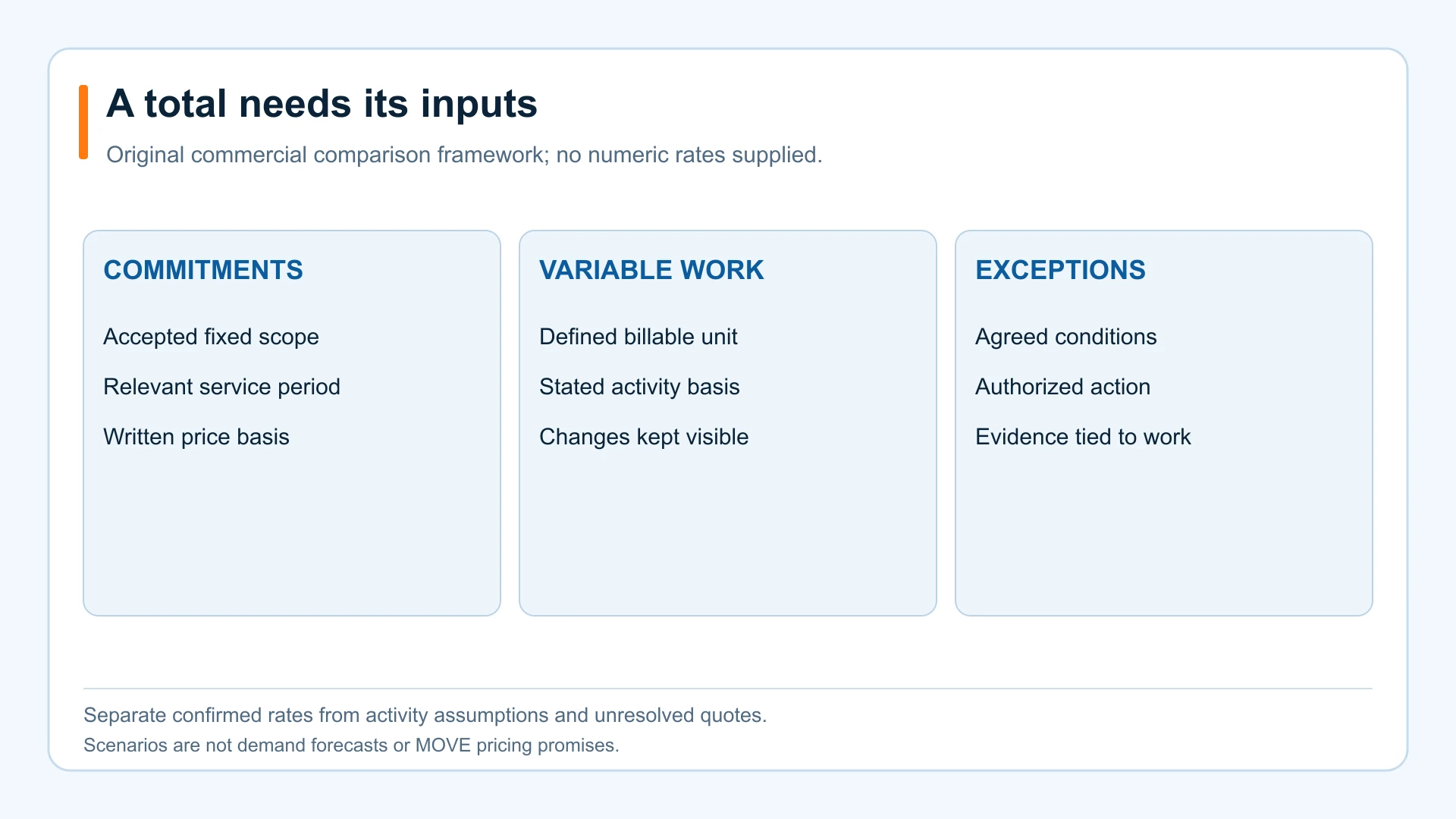
Once scope and rates are confirmed, an estimate can combine the actual quoted components with clearly labelled activity assumptions. Keep fixed commitments separate from variable work and authorized exception charges. Show the time period, the proposal version and the assumed activity pattern. A total without those inputs is not a reproducible comparison.
Use your own approved operational history when it is available and relevant. Check whether that history represents the work you are now buying. A period with different sites, service days or receiving practices may not be a sound basis for the new arrangement. Share only the information each bidder is authorized to receive.
If your routine is changing, create clearly labelled scenarios rather than one confident-looking forecast. You might compare an agreed base routine with an additional-site scenario whose scope is still awaiting acceptance. Keep unresolved prices blank and request a quote. A scenario is a discussion tool, not a statement that demand will occur or that the provider has reserved capacity.
Do not confuse the lowest projected transport total with the best overall fit. Your staff may need usable records, a practical escalation route or a receiving arrangement that another proposal has not addressed. Explain how these requirements affect the decision instead of converting them into invented savings or claiming a quantified clinical benefit.
8. Resolve the final questions before choosing a provider
Before approval, reconcile the comparison sheet with the current proposals. Confirm that the bidder has accepted the described work, the priced unit is understood, the timing assumptions are current and exclusions have named owners. Remove stale revisions from the decision packet while retaining them under your organization’s record policy.
Ask the prospective provider to explain a sample bill using dummy order references and the agreed price basis. Ask your staff to locate the corresponding acceptance and completion evidence. This is not a financial audit or a guarantee of perfect invoices; it is an early check that the commercial explanation can be understood by the people who will use it.
Document what remains outside the decision. An accepted weekday routine does not automatically approve a different pharmacy location, additional cargo, after-hours work or another receiving process. Give future changes a defined review path so the original proposal does not quietly become the assumed answer to every new request.
For broader context, read what drives local medical courier costs. That article explains pricing inputs; this comparison tool helps you normalize actual proposals before selecting one. Keeping those purposes distinct gives your team a clearer buying process.
Bring your real scope to the pricing conversation
Better pharmacy courier pricing conversations start with a shared description of the work, not a request for the cheapest generic rate. Prepare the participating sites, ready-time pattern, receiving conditions, cargo scope and exception questions. Then ask for a proposal that addresses the actual local arrangement.
Use Quick Quote for a single point-to-point request, or Start an Account to discuss recurring delivery needs. MOVE can help review the requested service and confirm the accepted plan. Availability, timing and commercial terms depend on the actual request; no sample rate in a blog should replace that confirmation.