

Medical courier reports should help you decide what to improve, what to keep and what to ask next. A percentage on a dashboard cannot do that alone. Before you accept a service score, establish which orders it counts, which event it measures and whether the underlying records support the conclusion.
If you manage procurement for a pharmacy, laboratory, clinic or medical supplier, you need more than a reassuring monthly summary. Your receiving team may be describing a different experience from the report. Both accounts can be accurate when they use different definitions. The answer is not another colorful chart. It is a reporting agreement that makes the service understandable.
This guide provides an original report-specification worksheet and a practical review agenda. It does not publish MOVE performance statistics or industry benchmarks. The examples are fictional teaching cases. Use them to agree measurable outcomes with your provider, then calculate results from your own authorized delivery records.
Start with the decision, not the dashboard
Choose the business question before choosing the metric. Are you deciding whether a scheduled collection fits a laboratory’s release pattern? Whether a clinic needs a different receiving window? Whether an invoice reflects additional work that was actually authorized? Each question needs different evidence. Combining every event into a single service score can conceal the reason a process needs attention.
Write one sentence describing the decision the report should support. For example: “We want to identify which release locations need revised instructions before adding another recurring stop.” That purpose calls for site-level readiness and access evidence, not just a national completion percentage. It also identifies the people who need to attend the review: the site owner and operational coordinator, not only finance.
Federal performance-based contracting provides a useful design reference. FAR 37.601 connects service standards with assessment methods. That federal rule is not a private healthcare procurement mandate. The transferable idea is to specify both the outcome and how it will be assessed. Your contract and qualified reviewers determine the requirements for your arrangement.
Question 1: Which orders belong in this report?
A report’s population is the set of orders it intends to describe. Requested work, accepted work and completed work are not interchangeable populations. If the buyer requested a collection that the provider did not accept, a completed-order report will not show it. That omission does not automatically prove poor performance, but procurement should understand it before using the report to assess capacity.
Identify the date range, locations, service types and inclusion rules. State whether the period follows request date, pickup date or completion date. An order collected on the final evening of the month and completed the following morning can appear in different periods under different rules. Pick a consistent basis, and retain enough context to reconcile the boundary.
Keep canceled, rejected, rescheduled and still-open orders visible as separate categories when they matter to the decision. A cancellation should not disappear merely because it is inconvenient to explain. Equally, do not label a buyer-withdrawn request a courier failure without checking the agreed definition. Report the count and reason separately, then explain how it affects any calculated rate.
Question 2: What does each recorded event actually mean?
“Delivered” can mean a driver marked an order complete, a recipient accepted the transport unit or an internal system imported a completion message. Those are different observations. Ask your provider to demonstrate the event record and explain its creation. A map position near a building is useful context, but it is not, by itself, evidence that an authorized recipient accepted a shipment.
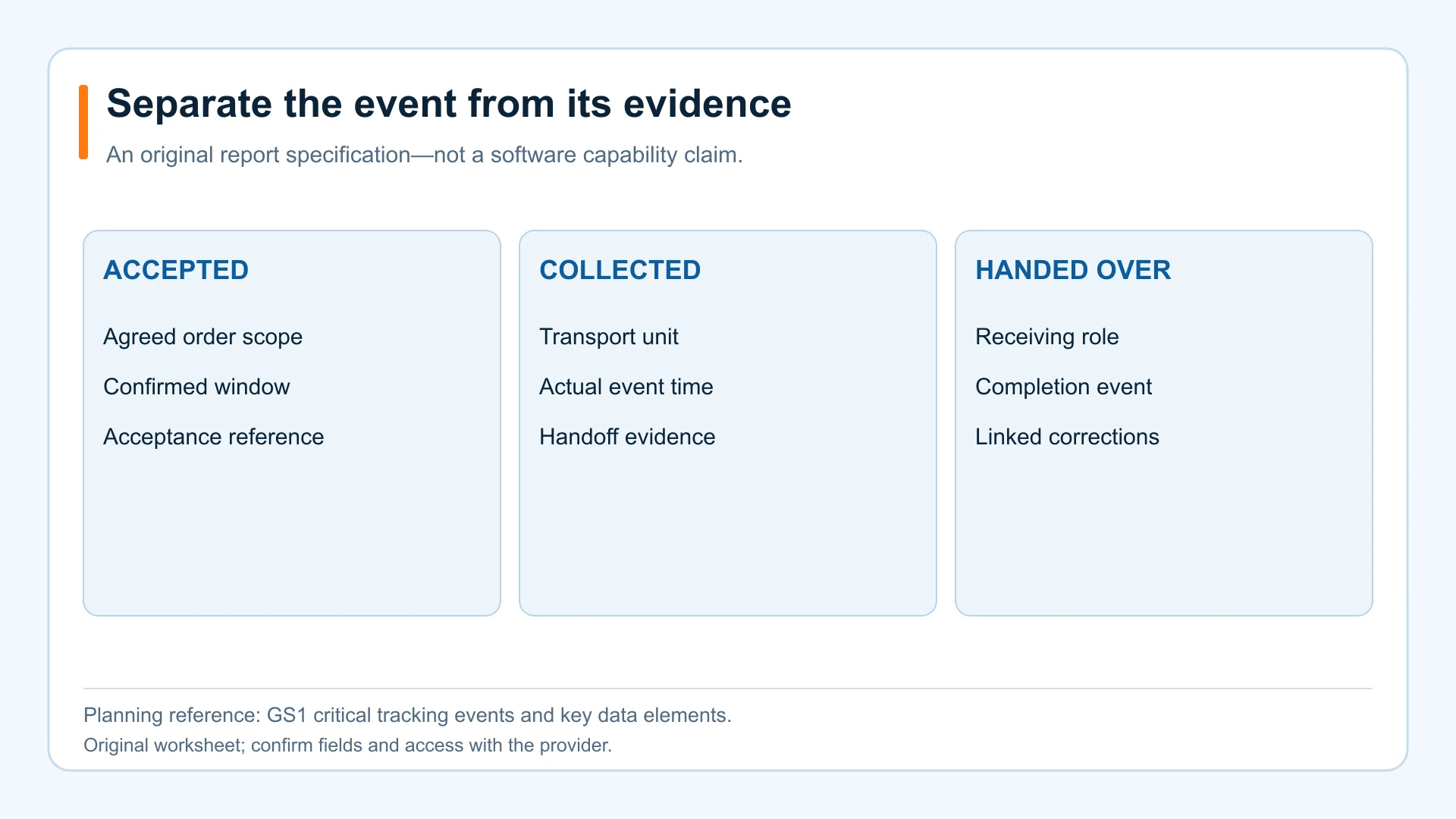
Create a small event dictionary. For each event, record its meaning, responsible role, required fields, correction process and source system. Include actual occurrence time and recording time if both are available and relevant. A delayed synchronization should not silently turn an earlier physical event into a later arrival. Preserve the distinction rather than “fixing” the timeline to make it look tidy.
The nonprofit GS1 traceability framework distinguishes events from the data describing them. This article uses that distinction as a planning reference, not a claim that MOVE’s platform implements a particular GS1 standard. Ask for evidence of any specific interoperability or standards claim before relying on it.
Question 3: What is the denominator?
A rate is only interpretable when the denominator is named. “On time” among completed orders answers a narrower question than “completed on time” among all accepted orders due in the period. Neither definition is automatically wrong. The danger is comparing the two as if they measure the same outcome, or changing the definition without notifying the buyer.
Use a plain-language formula alongside the percentage. Name the event, threshold, eligible population and treatment of missing records. Show the numerator and denominator as counts. Small counts make percentages unstable: one additional exception can substantially change a site-level result. A count does not eliminate uncertainty, but it makes the scale of the observation visible.
Do not convert missing evidence into a positive result. If an agreed timestamp is absent, classify the record as unverified under the report’s rules and investigate it. A separate data-completeness metric can help distinguish service exceptions from evidence problems. That separation avoids blaming the courier for every synchronization issue or overlooking an actual delay because the record is incomplete.
| Measure | Definition to agree | Evidence to request |
|---|---|---|
| Accepted workload | Orders explicitly accepted for the named locations and service period, with withdrawn work separately identified. | Order reference, acceptance event, current scope and any linked withdrawal or change. |
| Pickup timing | Actual agreed collection event compared with the confirmed pickup window, not request creation time. | Original window, approved revisions, collection record and the relevant time zone. |
| Delivery timing | The defined completion or recipient handoff event compared with the accepted receiving requirement. | Recipient/handoff evidence, actual event time, recording time and missing-record flag. |
| Exception follow-through | Exceptions with an identified next action and owner; notification alone is not resolution. | Exception reference, communication record, accepted action and closure evidence. |
| Record completeness | Eligible orders containing the specifically required evidence, with exclusions explained. | Field-level missing-data list and an agreed process for review or correction. |
Question 4: Which promise are the timestamps compared against?
The original requested time, the provider’s accepted window and an approved later revision need separate fields. If the report simply compares completion with the latest editable deadline, an after-the-fact change could make a late order appear on time. Procurement needs the history of the promise, not just its final value.
Agree how legitimate changes are handled. A receiving site may close early and approve a different arrival time. The revised plan can be appropriate, while the original disruption still deserves review. Report performance against the agreed current commitment and retain the change record for context. Do not erase the operational fact that the plan changed.
Time zones and daylight-saving transitions matter when systems exchange timestamps. Prefer unambiguous stored timestamps and display the local zone used in the review. Test a cross-midnight order and a time-change boundary if relevant to your program. These are reporting acceptance tests, not promises that every platform uses the same implementation.
Question 5: Are exceptions categorized without hiding responsibility?
Use categories that support action: release not ready, pickup access unavailable, receiving contact unavailable, route disruption, scope mismatch and missing evidence are examples for discussion. They are not an official MOVE status list or an exhaustive regulatory taxonomy. The category should lead to a next step and a responsible role rather than function as a label that closes the conversation.
Let a record carry more than one contributing condition where appropriate. A late release and an inaccurate entrance instruction can both affect a collection. Assigning one broad cause too early may produce the wrong corrective action. Preserve the observations, verify the sequence and distinguish what is established from what remains uncertain.
Review whether one party controls the classification process. If a category affects invoices, credits or contract performance, the buyer needs a way to question it and see the supporting evidence. An exception marked “customer delay” should have an identifiable event and agreed basis, not merely a free-text opinion entered after a difficult stop.
A fictional example: the same orders, two different rates
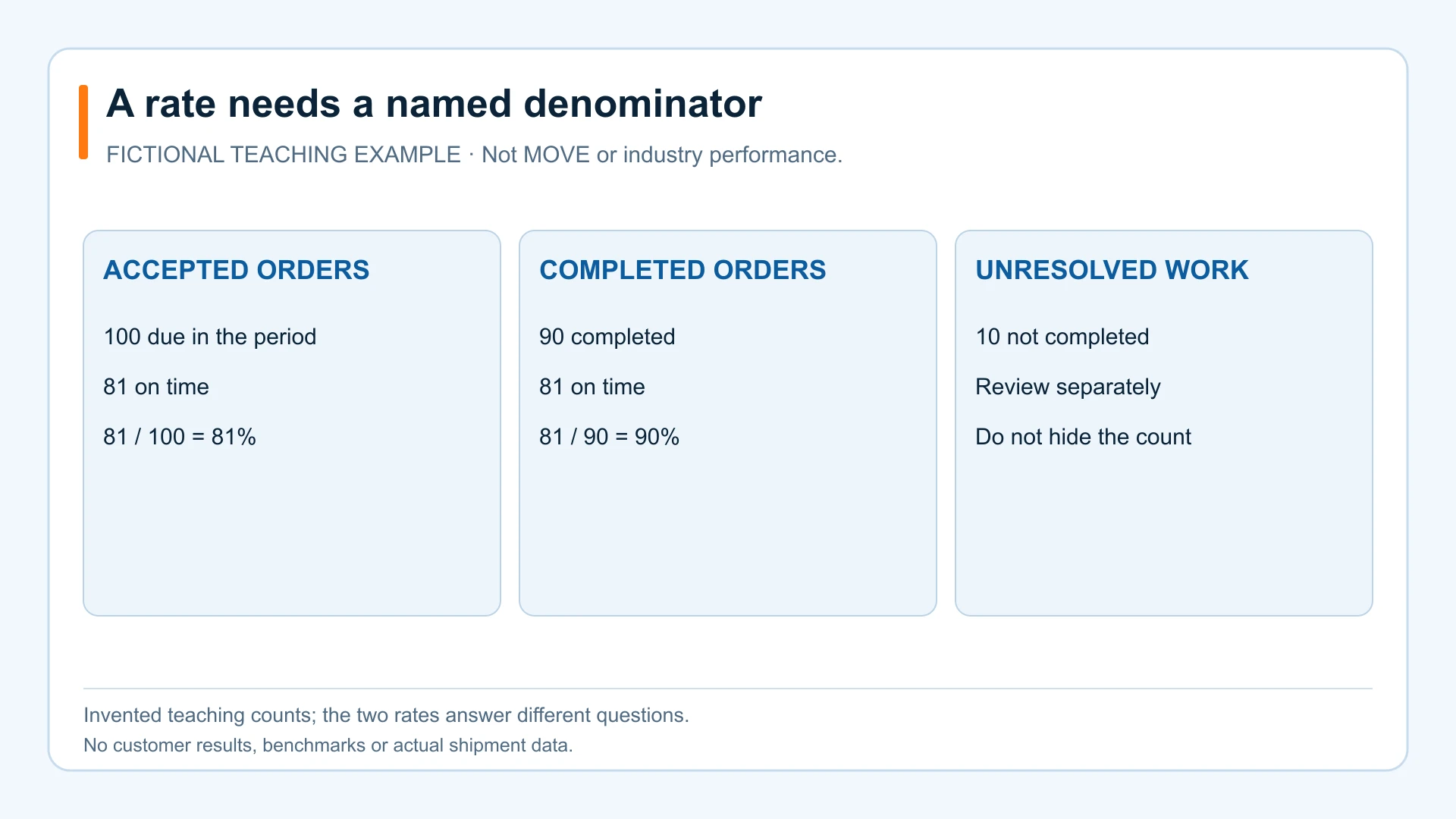
Imagine a teaching dataset with 100 accepted orders due in a month. Of those, 90 are completed, and 81 meet the agreed completion deadline. Ten remain unresolved at the reporting cutoff. An on-time-among-completed calculation is 81 divided by 90, or 90%. An on-time-among-accepted-due calculation is 81 divided by 100, or 81%. These are invented counts for explaining denominators, not measured customer or industry results.
The nine-percentage-point difference does not tell you which provider is better. It tells you that the measures answer different questions. The first describes timing among completed work. The second keeps unresolved accepted work in view. A useful report can present both with a clear label and a separate account of the ten unresolved orders.
Now ask what happened to those unresolved orders. Some may await evidence, some may have an approved reschedule and others may represent service problems. The correct next action depends on those facts. If the review stops at “90%,” your team has no basis for deciding whether to fix a record feed, a release process or an operational response.
Question 6: Does the report show the locations that need attention?
A blended result can conceal a recurring problem at a small location. Segment only where the breakdown supports a decision: site, service type, release period or exception category may be useful. Avoid creating dozens of tiny groups just to produce impressive-looking charts. Every segment should still show its eligible count and missing evidence.
Compare like with like over time. A new location, changed service window or expanded cargo scope can alter the mix. Record those changes beside the trend. Without that context, a lower overall rate might reflect a more demanding population rather than a deterioration in the existing service. Conversely, an improved blended rate might hide worsening results at a particular clinic.
Use charts to direct investigation, not to certify clinical outcomes. Courier records may show a transport event and its timing; they do not independently establish specimen acceptability, treatment success or product integrity. Those assessments belong to the responsible healthcare and product professionals using the appropriate evidence.
Question 7: What decision follows the report?
Build a short recurring agenda: confirm the population and evidence quality; examine material exceptions; select a small number of actions; name each owner; and agree how the next review will check progress. Keep the underlying order references available through approved access. You should be able to move from the summary to an explainable example without emailing sensitive records around unnecessarily.
For each action, write the condition you intend to change and the evidence that will show whether it changed. “Improve communication” is too broad. “Replace the obsolete entrance instruction and confirm the backup receiving role at this location” is more testable. Set a review date and keep a record of the instruction version that became effective.
Do not close an action because someone sent a reminder. Check that the intended people received the current instruction and that the relevant process works. If the result remains uncertain, say so. Honest uncertainty is more useful than a green indicator that prevents the buyer from asking the question that matters.
A report request you can adapt
Ask your provider: “For the named locations and period, please show accepted orders due, completed orders, agreed handoff timing, unresolved work and missing required evidence. Include the definitions and counts behind each rate, approved changes to commitments and the records supporting material exceptions. Identify which report fields are available in our arrangement and which require additional setup.”
Then test the request with a small authorized sample. Choose a straightforward completion, a revised instruction, an exception and an order crossing the reporting boundary. Confirm that the summary and event records reconcile. This small demonstration can reveal ambiguity before the organization makes a contract decision using a larger but equally ambiguous dataset.
If you are still defining procurement scope, use our vendor evaluation scorecard to organize evidence requests. For operational visibility, explore MOVE’s live tracking and proof-of-delivery information. Confirm the actual reporting fields and access available for your service rather than assuming every illustrated feature is included.
Medical courier reports: common questions
Is a high completion rate enough to renew a courier contract?
No single rate answers every renewal question. Review the accepted scope, evidence completeness, exceptions, service changes and the decisions your team needs to make. A high rate can coexist with an unresolved problem at a critical location. Use the report as evidence in a broader service review, not as a substitute for that review.
Should we require an industry-standard on-time percentage?
Start by defining the event, commitment and eligible population. A numerical target without shared definitions is difficult to assess fairly. Set appropriate expectations through procurement and operational review; this guide does not provide a universal benchmark or recommend importing an unrelated provider’s performance claim.
Does live tracking replace the need for a custody record?
Location visibility and custody evidence serve different purposes. Tracking can help staff prepare for arrival. A custody record describes an agreed handoff and the relevant parties, objects and events. Ask how both are available and linked in your arrangement, and how missing or corrected evidence is handled.
Give your next service review a clearer starting point
Bring three things to the conversation: the locations you need to understand, the operational decision you want to make and the evidence your team needs to support it. MOVE can discuss the local delivery arrangement and the visibility available through our proprietary platform. Begin with a Quick Quote for a single order or an account conversation for ongoing service.