
Same-day clinic delivery starts with a decision your front desk should not have to improvise: what needs to move, who can release it and what the receiving location can accept. A clear request-triage process turns several competing messages into one transport instruction the clinic and courier can actually confirm.
At a busy clinic, delivery work often reaches the person who is already answering phones, checking visitors in and locating the next available member of staff. One department asks for a pickup. Another adds a box. Someone remembers that the receiving desk closes early. Without a shared process, the coordinator becomes the place where everyone else’s unfinished decisions accumulate.
You do not need a complicated command center to make the next request clearer. You need a maintained intake record, a named decision owner and an agreed route for questions the coordinator cannot answer. This guide offers an original clinic request board, a fictional worked example and a short daily coordination routine. It does not determine clinical urgency, specimen suitability or product-handling requirements.
Give requests one intake point
Start with one approved place for delivery requests to enter the clinic’s operational process. That might be a maintained internal form or another channel the organization already controls. The useful feature is not its appearance. It is that the request can be found, assigned and updated without asking staff to reconstruct a chain of messages from several personal inboxes.
Assign an internal request reference before sending the confirmed transport instruction. Keep the courier order reference alongside it once work is accepted. Two related identifiers can serve different purposes: one connects the clinic’s internal task, while the other identifies the provider’s transport arrangement. Do not assume that copying a message into a form automatically creates a booking.
Decide who monitors intake when the normal coordinator is absent. Give the backup access appropriate to their role, not a shared personal password. A simple workflow can be resilient if another authorized person can explain which requests are awaiting decisions, which have been accepted and which need attention before the end of the shift.
Separate clinical priority from transport feasibility
The clinical team determines clinical priority. The responsible laboratory, pharmacy or product specialist supplies the relevant handling and acceptance instructions. The clinic coordinator gathers those instructions and discusses a transport arrangement with the courier. These responsibilities connect, but they are not interchangeable. A front-desk label such as “urgent” does not resolve what an authorized clinician means by urgency.
Ask the requester to identify the decision owner when clinical or product questions are unresolved. Do not ask the driver to select a specimen stability limit, decide whether a medication can wait or judge the clinical consequence of a delay. A better intake process reduces that pressure by identifying the right contact before the shipment reaches the pickup area.
For laboratory work, CDC’s laboratory-collaboration guidance is a useful context-specific reference for consulting the receiving laboratory and shipping specialists. It is not a universal clinic packing procedure. Ask the laboratory responsible for your shipment to confirm the current instructions that apply to it.
Ask for the details that change the plan
Capture the actual release location, not just the clinic’s street address. A facility may have a patient entrance, a staff entrance and a separate pickup desk. Include the releasing role, availability, transport-unit count, relevant dimensions and the receiving contact or department. These details help distinguish a feasible handoff from a request that only looks complete on a screen.
Use a ready time and a receiving requirement as separate fields. The ready time describes when the clinic can release the shipment under its procedures. The receiving requirement describes when and where the destination can accept it. A requested pickup time between those two facts is a proposal to confirm, not evidence that the complete transport can be achieved.
Record special requirements only through approved channels and at the level needed for the transport task. Avoid putting diagnoses, unnecessary clinical narratives or unrestricted access credentials into general notes. Your privacy and clinical teams determine what can be shared and how. More information is not automatically a better instruction when it introduces a different risk.
| Request state | Question to resolve | Next responsible role |
|---|---|---|
| Details incomplete | Which missing fact prevents a transport decision: release point, unit count, handling instruction or receiving access? | The requesting department supplies its facts; the coordinator records the current version. |
| Qualified instruction needed | Does a laboratory, pharmacy, product owner or clinical lead need to decide a technical question? | The appropriate qualified owner, not the front desk or courier driver. |
| Ready for transport discussion | Can the provider accept the actual scope and propose a suitable collection and delivery arrangement? | The clinic coordinator and agreed courier coordination contact. |
| Accepted and awaiting release | Are the releasing role, pickup point and current instruction still available? | The clinic’s named release owner and backup. |
| Changed after acceptance | Which instruction changed, who may authorize it and has the provider accepted the revised work? | The relevant clinic decision owner and courier coordinator within agreed authority. |
| Handoff or follow-up recorded | Is the agreed completion evidence available, or does an unresolved issue need an owner? | The coordinator verifies the record and assigns any remaining action. |
Choose service around the confirmed need
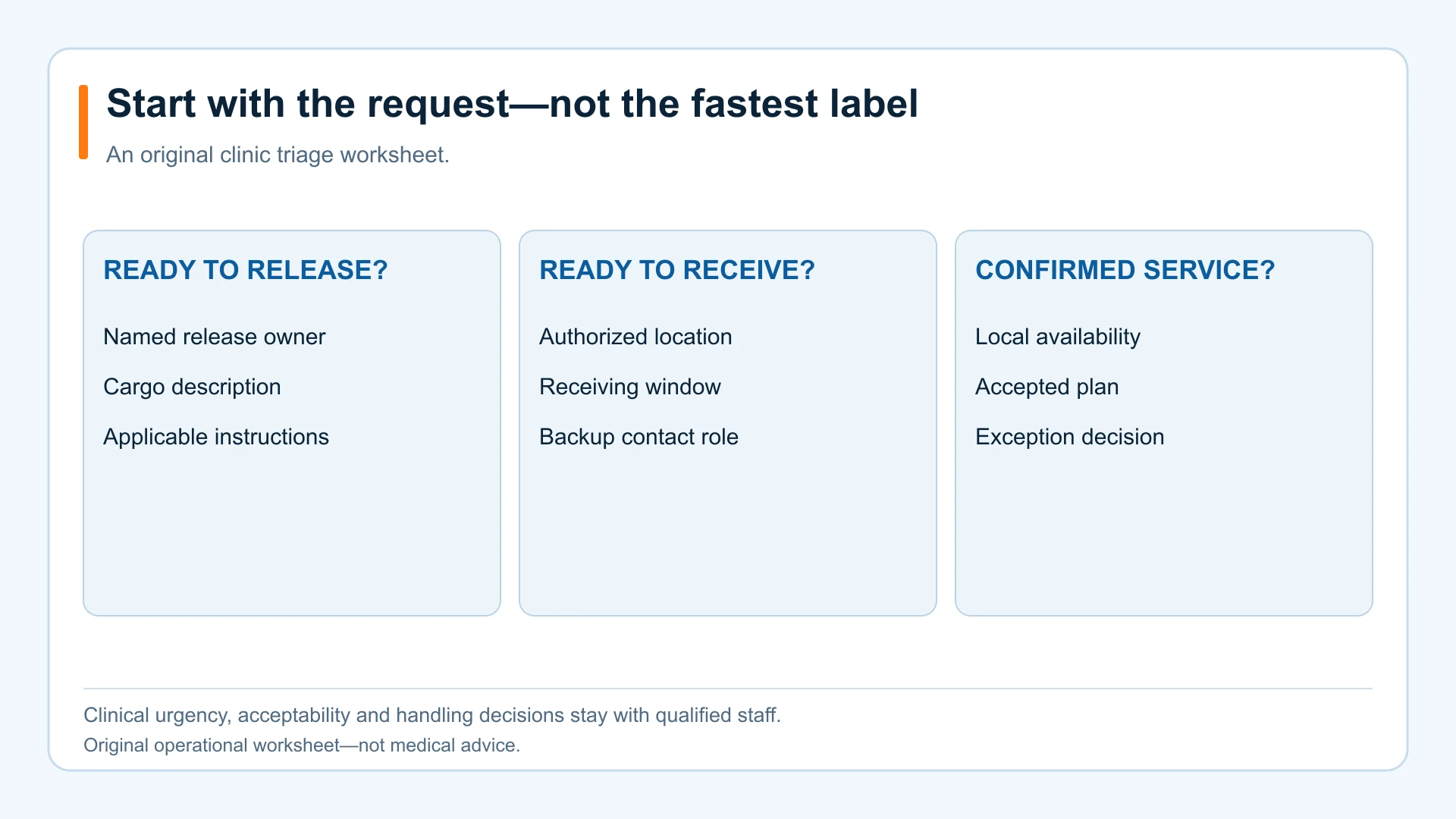
A single point-to-point request may fit an on-demand arrangement. Repeated collections may deserve a scheduled discussion. Several consistent local stops may support a fixed-route review. The intake board helps the clinic recognize those patterns without forcing every request into the same service. Frequency alone is not enough: readiness, destination access and accepted cargo scope also matter.
Use STAT delivery information for a time-sensitive local order and scheduled delivery information when recurring work needs a maintained plan. Confirm availability and the accepted timing for the actual request. A service name does not replace a provider’s explicit acceptance of your locations, requirements and instructions.
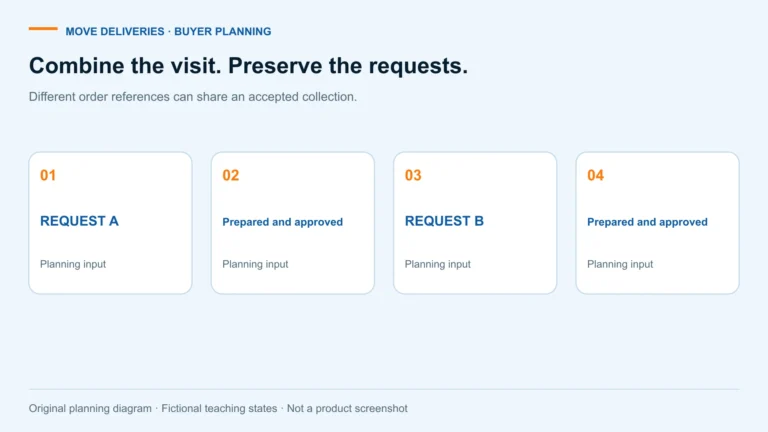
Do not quietly combine unrelated requests to make the board look simpler. A clinic shipment to a laboratory and a supplier return can have different owners, destination permissions and evidence requirements. If the provider proposes combining transport, review whether each request’s conditions still work. Keep their records distinguishable even when an agreed route includes both stops.
A fictional clinic day: three requests, three decisions
Consider a fictional outpatient clinic with three delivery requests. A laboratory collection is planned, a medical supplier needs a boxed return and a second department wants to add another transport unit to an already accepted order. These are teaching examples, not a description of a MOVE customer’s workflow. The coordinator places each request on the board before deciding what to communicate externally.
The laboratory request has a named release owner and receiving instructions, but readiness has not been confirmed. The next action belongs to the clinic’s authorized release role. The supplier return lacks a current destination acceptance reference. That action belongs to the supplier’s responsible contact. The additional unit changes the accepted scope, so the coordinator must obtain provider acceptance rather than simply hand it to the arriving driver.
None of the three decisions is solved by calling everything urgent. The board shows why each request is waiting and who can move it forward. It also gives the backup coordinator a clear handover: the laboratory request needs readiness confirmation; the return needs destination authorization; the added unit needs revised transport acceptance.
Make the pickup area match the instruction
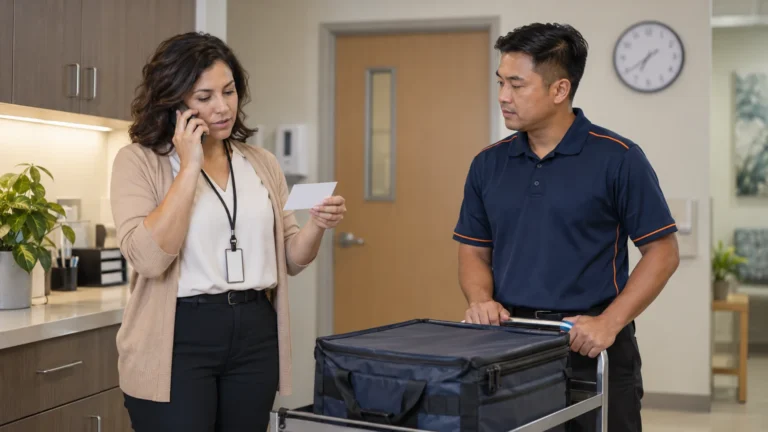
Check whether the person at the release point can identify the accepted shipment and locate the current instruction. Keep transport-unit counts clear without asking the driver to interpret clinical contents. A waiting area containing several similar totes needs an approved identification process so staff release the correct units, not whichever container is nearest the door.
A planned arrival should not depend on the driver wandering through a patient area to find someone who remembers the request. Explain the approved entrance, where to ask for the releasing role and what to do if that person is unavailable. Test the instruction with staff who were not involved in writing it. Their questions often reveal the assumptions familiar team members no longer notice.
If the clinic uses a lockbox or other unattended release arrangement, confirm its authorization, access process and evidence requirements with the responsible parties. Do not publish security details in general notes or assume the existence of a box authorizes every shipment to be left there. Technical handling and release decisions remain subject to the applicable professional instructions.
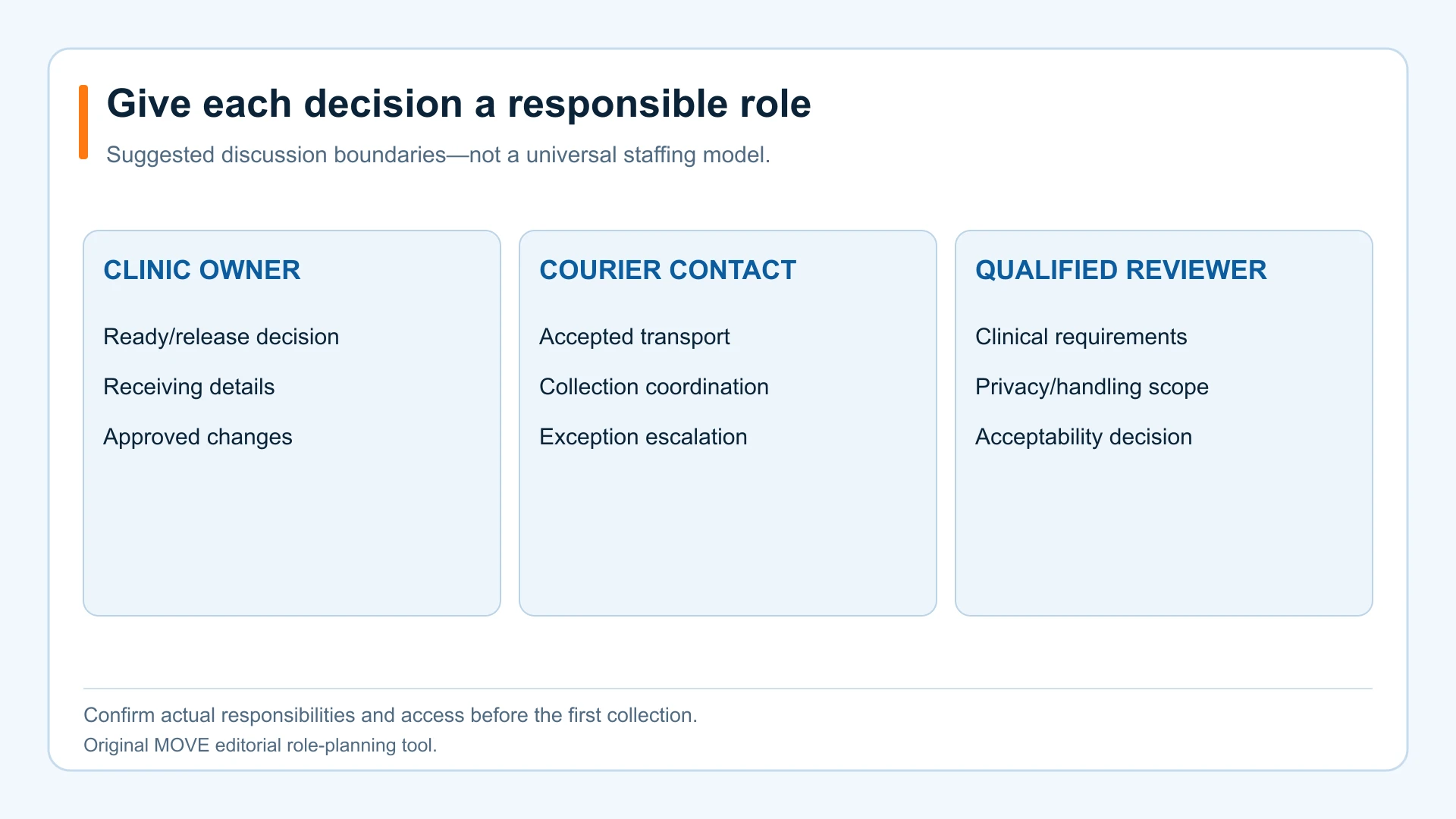
Treat changes as new decisions, not casual additions
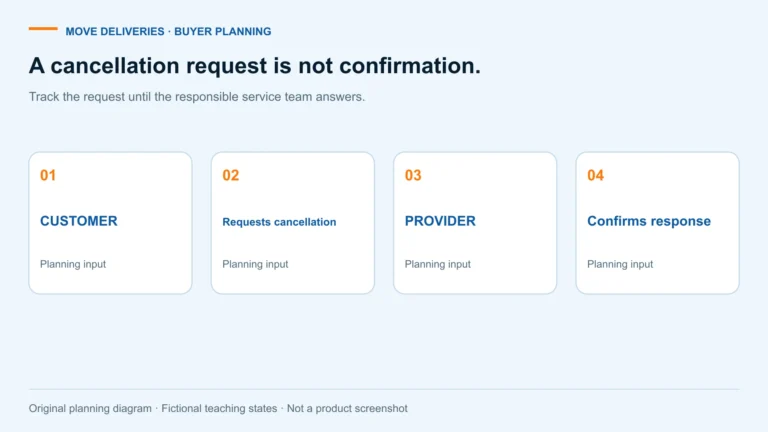
A changed destination, receiving role, package count or release time can affect an accepted order. Give the coordinator a short process for recording what changed, which previous instruction it replaces and who may approve the change. Then confirm whether the provider accepts the revised transport. A message sent is not the same fact as new work accepted.
Specify how staff should report a change discovered when the courier is already present. The driver can report the discrepancy through the agreed process; the appropriate decision owners resolve it. Avoid pressuring the driver to accept an unreviewed unit or choose between conflicting destination instructions. A clear escalation path protects the clinic’s plan as well as the courier’s ability to follow it.
Keep a visible current state after the decision. If the shipment is held, redirected through an accepted process or withdrawn, the old pickup instruction should not continue circulating without context. Retain the history needed for accountability, while making the active instruction obvious to the next authorized person who handles the request.
Close the receiving loop without creating a second clinical record
Before transport, confirm the receiving location’s actual availability and the role authorized to accept the shipment. A street address does not tell you whether the department is staffed or whether the requested entrance can receive the particular delivery. When the destination is another healthcare organization, use its maintained instructions rather than relying on a previous driver’s recollection.
After the handoff, connect the transport record to the clinic’s internal request through the appropriate references. Record whether the agreed evidence is available and whether a follow-up remains open. Do not translate a courier completion event into an unsupported statement that the laboratory accepted the specimens or that a device was clinically suitable for use.
For more on what transport evidence can answer, read our proof-of-delivery guide. The aim is to answer operational questions with an appropriate record, not to copy sensitive information into several new places because the systems can store it.
Build a daily routine the backup can run
At the start of the coordination period, identify accepted orders awaiting release, requests missing decisions and any receiving constraints that have changed. At a suitable handover point, check unresolved items with their named owners. At the end of the shift, leave the current state and next action clear for the next coordinator. Your organization chooses the cadence appropriate to its work.
Keep the review short and factual. “Three requests are waiting” is less useful than identifying which fact is missing from each one. A request waiting for qualified instructions should not consume repeated courier status calls. A request already accepted but affected by changed access should not sit unnoticed behind an incomplete internal return request.
Record recurring friction for a separate improvement conversation. If staff repeatedly cannot find the releasing role, revise the role and backup arrangement. If several requests consistently emerge after a planned collection, examine the clinic’s release pattern before asking for a new recurring schedule. The process should learn from the board rather than require the coordinator to solve the same problem every day.
Questions to settle before launch
Ask the clinic’s departments which delivery decisions they can make and which require another owner. Ask the receiving organization for current access and acceptance instructions. Ask the courier how accepted work, changes and exceptions are confirmed for your arrangement. Put the answers in the maintained process, with a review owner and version date.
Then rehearse four cases: a complete request, a missing technical instruction, a changed unit count and an unavailable release owner. Use fictional references and no patient information during the rehearsal. The purpose is to reveal gaps in authority and communication, not to create an impressive demonstration that avoids every situation likely to occur in practice.
A useful test ends with a next action and a person able to take it. If the team only agrees that someone should “follow up,” the workflow is not finished. Name the role, approved channel and decision required. Confirm that the backup can run the same case without relying on a private conversation the main coordinator remembers.
Same-day clinic delivery: common questions
Does same-day mean a courier can take every clinic shipment?
No. The provider must confirm the actual locations, cargo scope, handling requirements, access and timing it can accept. Qualified personnel determine technical requirements. Same-day describes a proposed service timeframe, not blanket acceptance of every item or an automatic guarantee that every destination can receive it.
Should the front desk decide which specimen is most urgent?
The front desk should route the question to the responsible clinical or laboratory role. Operational coordination can document an approved priority and discuss transport feasibility, but it should not replace clinical decision-making. Make the escalation contact available before staff face the question during a busy shift.
Can recurring pickups remove all daily coordination?
A maintained schedule can reduce repeated planning, but staff still need to confirm release readiness, current access and material changes. The goal is fewer avoidable questions, not a process that ignores changed conditions. Review recurring service when the clinic’s actual request pattern no longer matches the plan.
Let your team focus on the clinic, not unfinished delivery decisions
Bring your release locations, receiving requirements and recurring request patterns to a conversation with MOVE. Our hospital and clinic solutions connect those needs to a local transport discussion. Use Quick Quote for a single order, or Start an Account to discuss ongoing support. A clearer plan starts with the facts your team already owns.