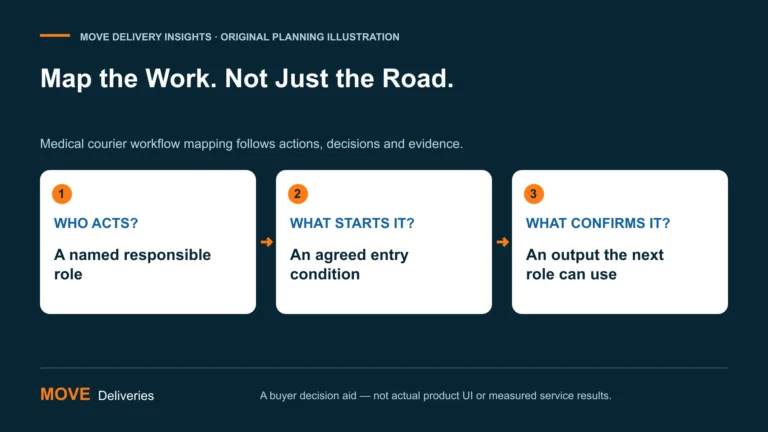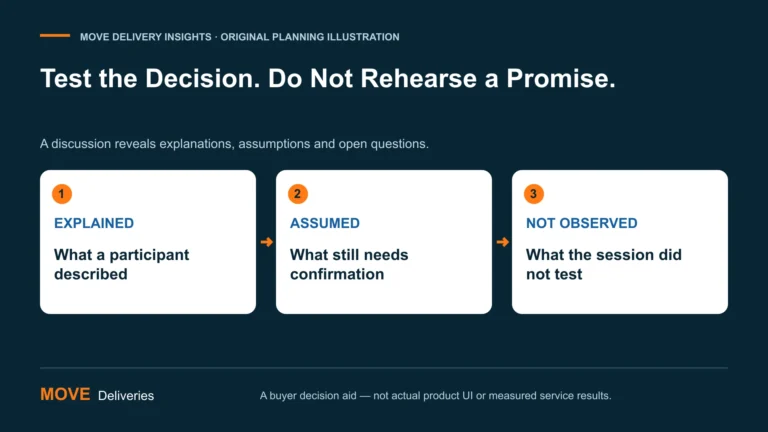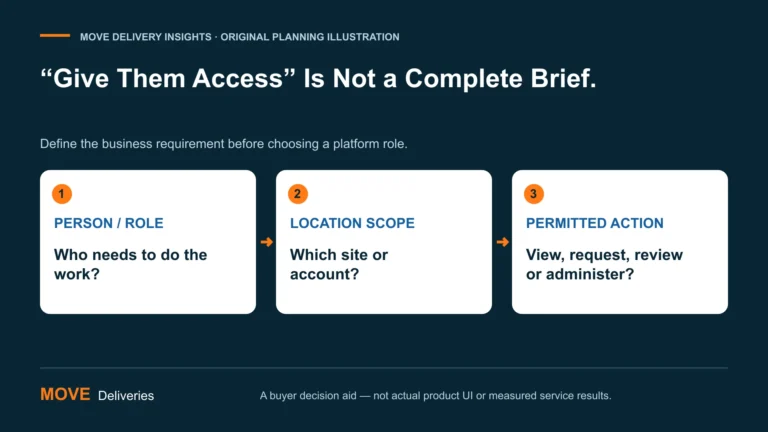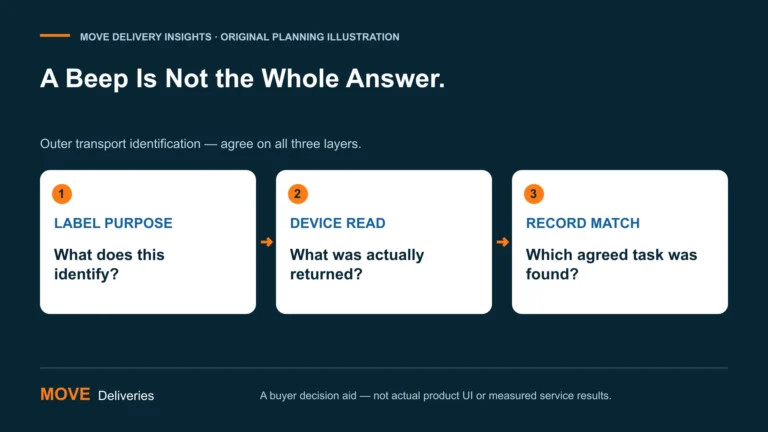
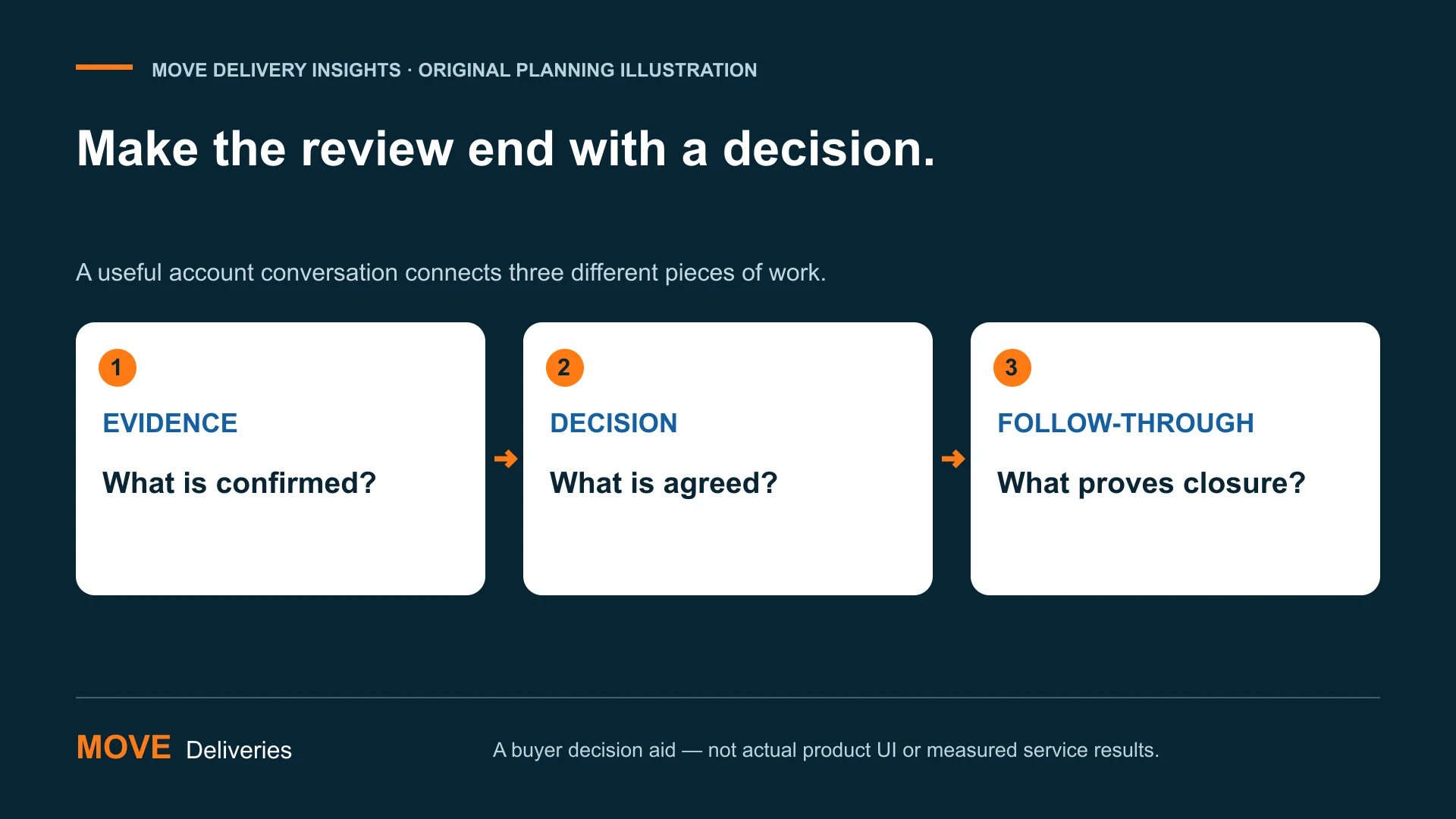
A medical courier service review should leave your team knowing what stays the same, what needs clarification and who will do the next piece of work. It is not simply a presentation of delivery numbers. For a pharmacy, laboratory, hospital or medical supplier, the useful output is an agreed decision that someone can follow after the meeting ends. If everyone leaves with a different interpretation, a polished slide deck has not solved the coordination problem.
Picture a regular account call. Someone says a receiving location has become harder to reach. Another person says the delivery report looks normal. The conversation moves on, but nobody checks whether they are discussing the same department, service arrangement or reporting period. At the next call, the concern returns. The missing element was not another chart. It was a specific question, an accountable person and an agreed way to establish the facts.
This guide offers an original seven-decision agenda and a compact follow-through record for that conversation. It is an administrative buyer tool, not legal advice, a clinical review or a statement that MOVE provides a particular review package. Agree the meeting arrangements and supported information with your provider. Keep urgent delivery questions in the agreed operational contact process rather than waiting for the next account meeting.
In this guide
- A service review is not a second dispatch desk.
- Bring a small evidence pack. Not a mountain of screenshots.
- 7 decisions for a useful medical courier service review
- Use a decision record a covering colleague can understand.
- R-14: a fictional review that keeps uncertainty visible.
- Borrow sound review habits. Do not borrow authority you do not have.
- The real test happens between meetings.
- Questions healthcare buyers ask before the next account call
- Bring the question. Leave with a next step.
A service review is not a second dispatch desk.
Separate three conversations that are easy to mix together. Live operational coordination deals with a current request. A specific incident review investigates what happened in a defined event. A regular service review considers whether the ongoing arrangement still fits the buyer’s needs and whether previously agreed work has been completed. The same people may contribute to all three, but each conversation needs a different starting point and a different record of its outcome.
Do not use the calendar meeting as a reason to defer a time-sensitive issue. If a delivery status, receiving instruction or accepted service needs clarification now, use the contact path already agreed for that situation. Bring the broader learning to the later review once the immediate question has been handled. An agenda can help organize administrative work; it cannot substitute for the response process supporting a current delivery.
Before inviting participants, write the meeting purpose in one sentence. For example: review the recurring arrangement for the named locations and decide which coordination questions need action before the next review. That is narrower than discussing everything about the account. It gives a participant a way to judge whether an item belongs on this agenda, needs a different authorized decision-maker or should be handled through an existing operational process.
Bring a small evidence pack. Not a mountain of screenshots.
Start with the agreed service scope and the previous decision record. Add the specific reports or administrative references needed for the questions on the agenda. Identify the period, locations and request types covered by each item. If a report excludes a type of work, make that exclusion visible. A central account view and a location’s experience may describe different populations without either being an accurate summary of the other.
Keep observations, explanations and proposals separate. A contact reporting a confusing arrival message is an observation worth clarifying. A statement that a software rule caused it is an explanation that may still need evidence. A request to change the rule is a proposal. Putting those three statements into one sentence can make an untested explanation look like an agreed fact and a proposed change look already authorized.
Use the minimum appropriate information for the discussion and the organization’s approved channels. A general account agenda does not need patient names, medication details or copies of private clinical records. Where an authorized reviewer must inspect a relevant operational record, identify the approved reference and access process. Our medical courier reporting guide addresses report definitions; this guide focuses on the decisions a meeting makes from that evidence.
7 decisions for a useful medical courier service review
First, confirm what is being reviewed. Name the locations, service types and period rather than referring vaguely to the account. Ask whether any material operational change has already been confirmed through the appropriate process. A new department, different receiving contact or revised routine may affect how people interpret the evidence. Record an unresolved scope question explicitly instead of silently treating an informal update as the current accepted arrangement.
Second, decide which evidence is sufficient for the question. A summary percentage may be useful context without answering a location-specific concern. Ask what underlying reference supports the interpretation and what remains outside the available information. Missing evidence is not a zero result and is not permission to invent a trend. The meeting can assign a clarification task without deciding that the service has improved or deteriorated before that task is complete.
Third, identify what is working and should be preserved. A review devoted only to complaints can overlook a receiving instruction, contact arrangement or coordination practice that staff rely on. Describe the relevant behavior and the conditions under which it helps. Do not turn a positive anecdote into a universal performance claim. The useful decision may be to retain the current approach while confirming that its instructions remain available to the people who need them.
Fourth, choose which unresolved questions need action. A long list of observations is not yet a prioritized work plan. Consider the actual consequence for the agreed transport arrangement, the evidence available and who can resolve the uncertainty. Keep clinical and regulatory determinations with the responsible qualified personnel. An account review should not guess at those answers simply because resolving every item would make the action list look complete.
Fifth, distinguish a clarification from a proposed service change. Confirming the current receiving point is different from asking the provider to use a new one. The latter may need a supported change process and fresh service confirmation. Record who is authorized to consider the proposal and what response is needed. A meeting note saying the team discussed an idea does not itself make the idea an accepted instruction or a new provider commitment.
Sixth, agree who owns each next action and what will demonstrate completion. Name a responsible role and an agreed checkpoint rather than assigning the task to everyone. If two organizations must contribute, identify the coordinating owner and the separate confirmation required from the other party. A person sending an email has completed a communication step; that does not automatically establish that the requested clarification or change has been accepted and implemented.
Seventh, decide what belongs in the next review. Carry unresolved work forward with its current state, not a fresh start that erases the earlier question. Record which evidence should return and which parties need to participate. Choose a review cadence proportionate to the arrangement rather than claiming that every account needs the same interval. A material issue can require attention through the appropriate process before the next routine meeting occurs.
Use a decision record a covering colleague can understand.
The original worksheet below is designed to sit beside the agenda, not replace the organization’s approved records. Give each item a reference, a bounded question and a clear state. Useful working states include clarification needed, proposal awaiting response, action agreed and closure evidence reviewed. These are labels for this buyer tool, not claims about MOVE platform fields or an instruction to build an unofficial duplicate delivery system.
Make the decision statement specific enough that another colleague could explain it without having attended. For example, confirm the currently accepted receiving point for the named service is more useful than improve communication. Keep the original question visible next to the decision. Otherwise, a later reader may be unable to tell whether the action addressed the issue raised or simply produced another document.
Define closure evidence before marking the item complete. Depending on the action, that might be an appropriate confirmation from the responsible party or a check that the current instruction can be retrieved through the supported process. The evidence should answer the actual question. Attendance at the meeting, a sent message or a green status label does not establish that an operational uncertainty has been resolved.
For a continuing issue, record why it remains open and the next agreed step. Do not repeatedly move the checkpoint without preserving the explanation. Equally, do not mark an item closed because a deadline has arrived. The purpose is an understandable account of agreed work, not a perfect-looking list. Confirm where the current record belongs and how the relevant authorized participants will receive it.
| Field | What the reviewer should be able to explain |
|---|---|
| Question and scope | Which location, service and administrative issue are being discussed? |
| Evidence and limits | Which approved reference supports the observation, and what remains unknown? |
| Decision and state | Was a clarification requested, a proposal referred or an action actually agreed? |
| Owner and checkpoint | Who coordinates the next step, and when will the parties check its state? |
| Closure and communication | What evidence resolves the question, and who needs the confirmed outcome? |
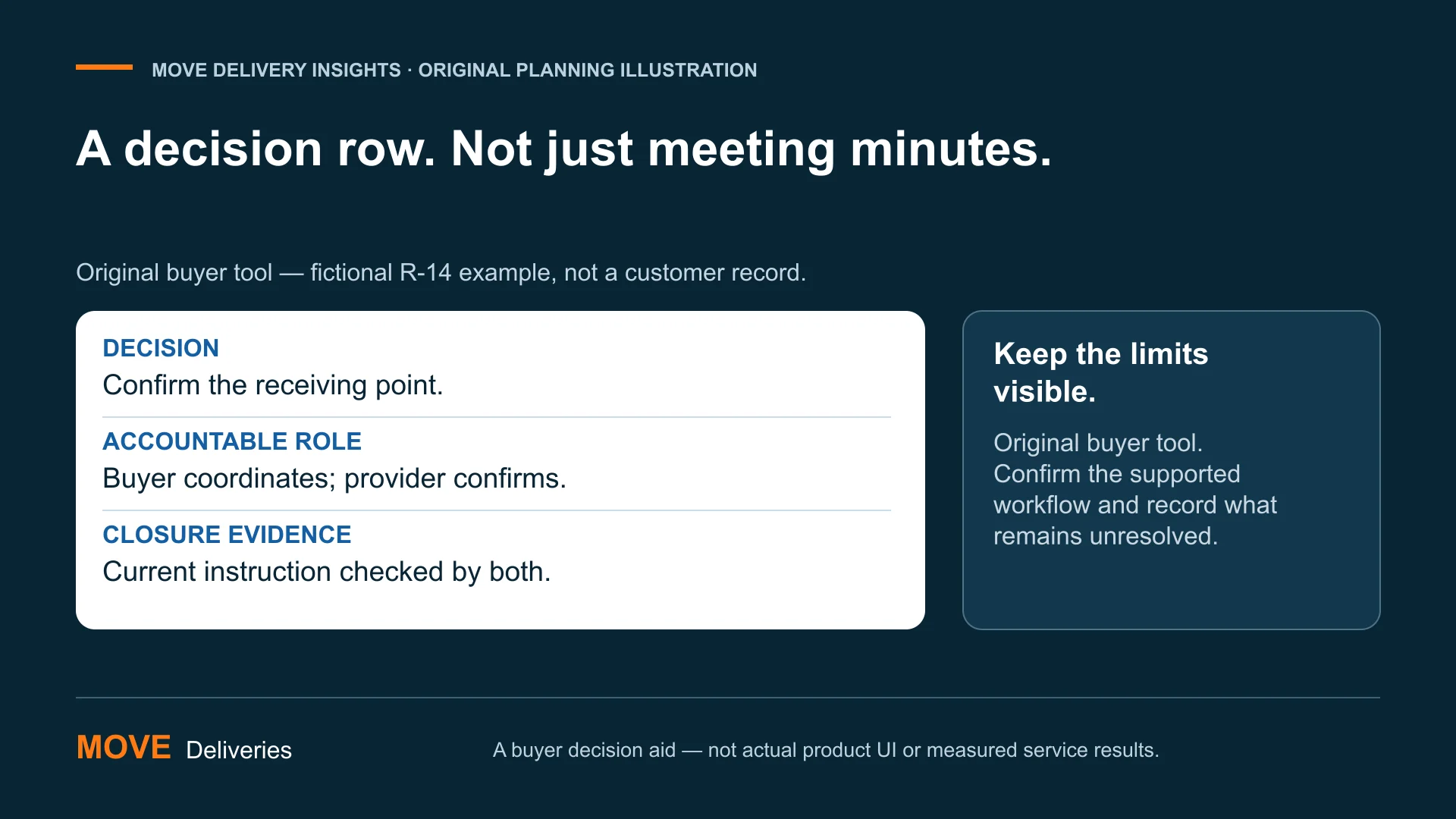
R-14: a fictional review that keeps uncertainty visible.
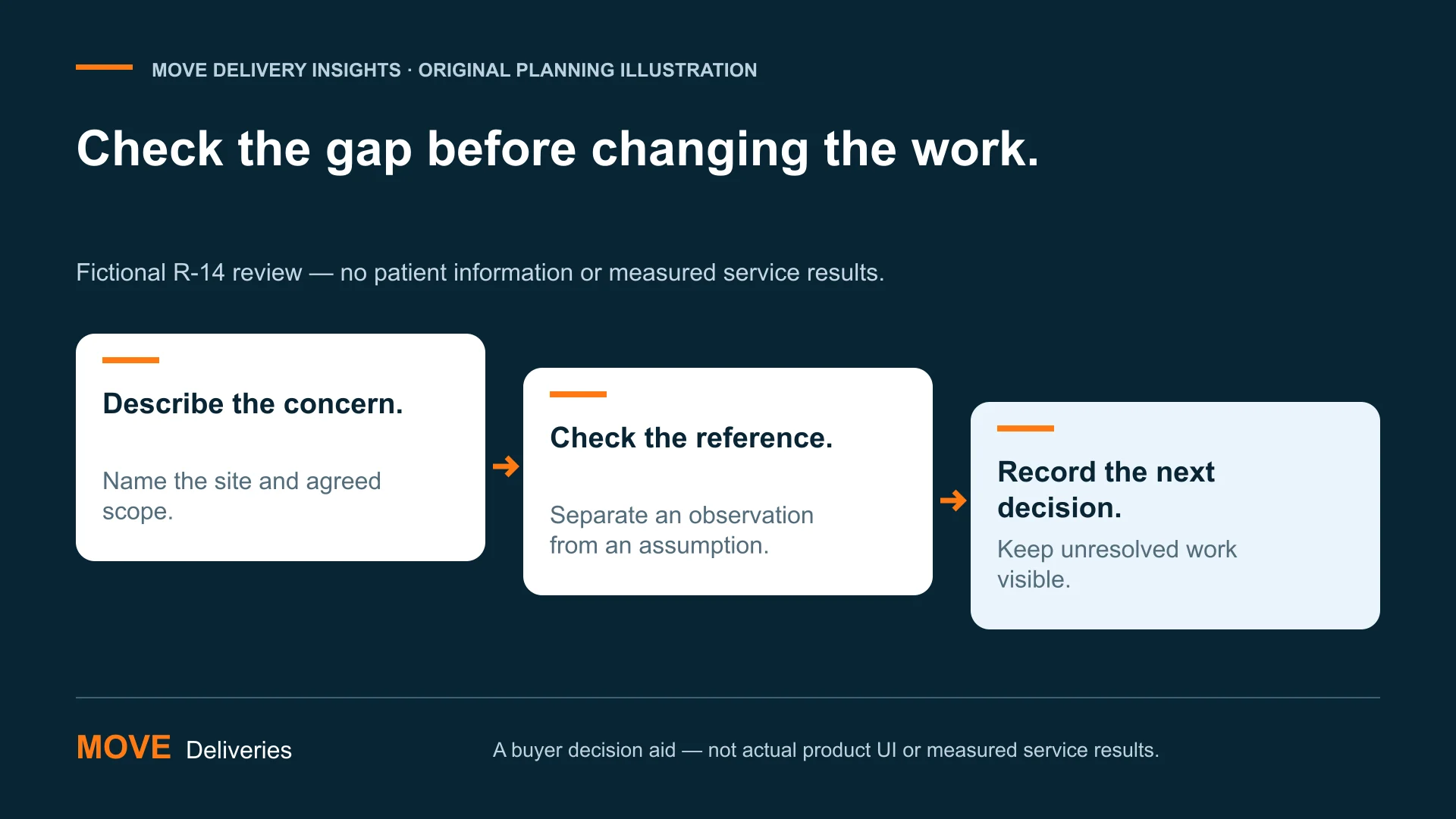
Imagine a generic medical supplier reviewing a recurring local arrangement with a provider. A receiving contact reports that arrival messages sometimes seem to reach the wrong internal team. The meeting reference is R-14. No real facility, shipment or patient is represented. The participants first confirm which location and type of message the concern describes; they do not assume that every update or every department is affected.
The account coordinator brings a summary report, but the report does not identify the recipient choice behind the reported example. The group records that limitation. It assigns the buyer coordinator to establish the appropriate current location contact and asks the provider to confirm the supported notification arrangement through the approved process. The record remains at clarification needed. No participant claims to have proved a software fault from the information available.
At the next agreed checkpoint, the coordinator has identified an outdated internal expectation. That finding does not automatically establish that a new recipient should be added to the service. The group records the clarified requirement and asks the authorized parties to confirm the appropriate next step. It distinguishes the buyer’s internal communication update from any provider-side configuration request rather than treating them as one completed change.
The fictional item closes only when the agreed clarification is supported by the relevant confirmation and the affected participants know which instruction is current. There is no invented reduction in calls, delivery-time saving or satisfaction score. The example demonstrates a recordkeeping distinction: describing a concern, establishing its scope and confirming the outcome are separate actions. Actual account capabilities and response arrangements must be confirmed for the service in question.
Borrow sound review habits. Do not borrow authority you do not have.
The UK Government Commercial Agency’s contract management principles emphasize clear responsibilities, proportionate governance and outcome-focused performance management. Their setting is UK public-sector contracting. They are useful management background here, not a statement of US healthcare courier law or a requirement imposed on a MOVE customer. Our agenda and worksheet are original planning tools, not government forms.
AHRQ’s TeamSTEPPS debrief guidance discusses reviewing events, learning and clarifying future plans without assigning individual blame. Its context is healthcare teamwork. We use that limited communication principle as background; an account meeting is not a clinical debrief, and this article does not claim an effect on patient safety. Clinical decisions and the organization’s required review processes remain outside this administrative tool.
Be equally careful with your own conclusions. A meeting can establish that a question has been referred to an accountable role. It cannot establish service quality, regulatory compliance or a clinical outcome simply because participants reached consensus. Keep confirmed facts, reported experience and proposed work distinguishable in the record. When the available information does not support the requested conclusion, write what needs to be established instead of replacing the gap with confident wording.
The real test happens between meetings.
Send the appropriate decision summary through the agreed channel and invite correction of misunderstandings. Identify the current version and where participants should find it. Do not distribute unnecessary private operational material with every agenda. If an action requires a different authorization or specialist review, preserve that dependency in the record. A routine account meeting should make the next step clearer, not quietly expand who is allowed to make the decision.
At the next checkpoint, begin with the prior actions rather than immediately opening a fresh presentation. Ask whether the evidence actually supports closure and whether affected teams received the confirmed outcome. If an action was unsuccessful, decide what needs clarification through the supported process. Repeating the same instruction more loudly is not evidence that the underlying obstacle has changed. A brief, accurate open-item record can be more useful than an elaborate but stale slide deck.
Keep this process proportionate. A small, stable arrangement may need a simpler discussion than a changing multi-location account. Agree the approach with the relevant parties instead of treating this article as a promise about meeting frequency or dedicated resources. For background on the information your team may use, review proof of delivery and confirm which records and access support your actual service.
Questions healthcare buyers ask before the next account call
Is this the same as selecting a new courier? No. Vendor evaluation examines a prospective provider against the buyer’s requirements. A routine account review concerns the ongoing arrangement and agreed follow-through. If the conversation becomes a new procurement exercise, give that work its own scope. Keep the current service instructions and operational responsibilities clear while the organization decides how to handle the separate evaluation.
Should every review start with a performance score? Not necessarily. Begin with the purpose and the evidence needed for the questions being considered. A properly defined measure can help, but a score without a known population, period and interpretation can distract from the actual decision. Do not invent a minimum target, an industry benchmark or a MOVE result merely to give the meeting a numerical opening.
Can we approve a service change in the meeting? Only through the authority and process applicable to the real arrangement. Capture the proposal and the response required from the authorized parties. Do not rely on this guide to interpret contractual rights or clinical requirements. When those matters arise, refer them to the responsible qualified advisers and retain the administrative question without pretending the review itself supplies the answer.
What if nobody can confirm an answer? Keep the item open with a defined question, responsible coordinating role and next checkpoint. Unknown does not mean failed, and agreed to investigate does not mean resolved. A medical courier service review earns its value by making those distinctions visible. A colleague reading the summary later should be able to see what the parties actually know and what still needs work.
Bring the question. Leave with a next step.
Before the next call, choose one unresolved coordination question and identify the reference that can help explain it. Use the seven decisions to keep the conversation within its purpose. Finish with a clear state, an accountable role and evidence of the next step. The goal is not another meeting template for its own sake. It is an arrangement that the buyer and provider can describe consistently after the conversation ends.
MOVE coordinates local same-day medical delivery through its proprietary platform. To discuss a defined local transport need, request a Quick Quote. For recurring coordination, Start An Account and discuss the supported service and communication your team needs. Review How It Works before that conversation, and confirm availability and scope rather than assuming a review tool creates a service commitment.