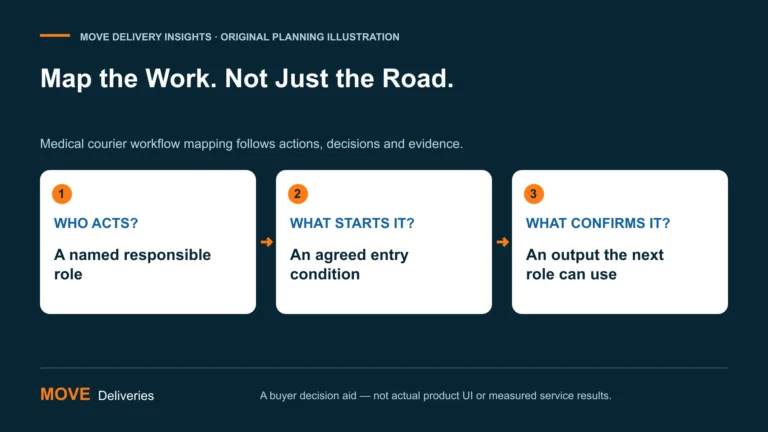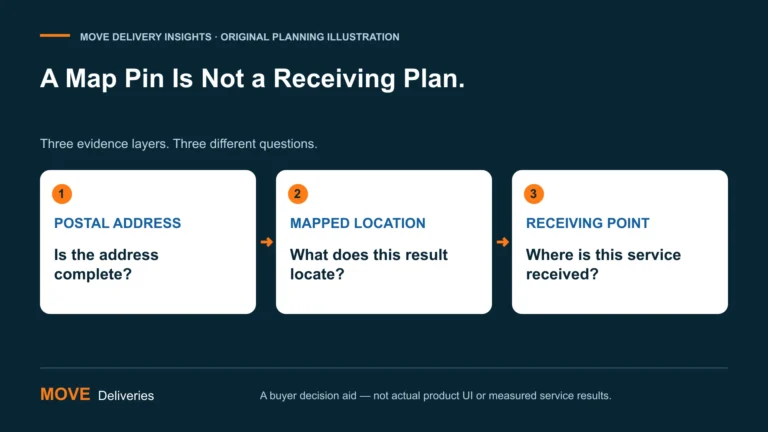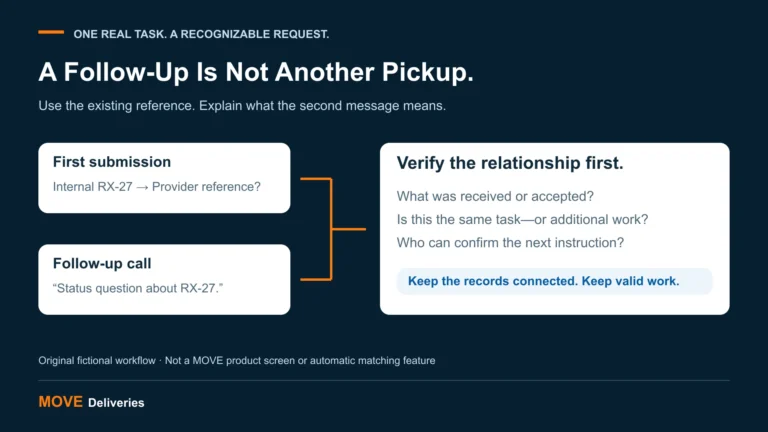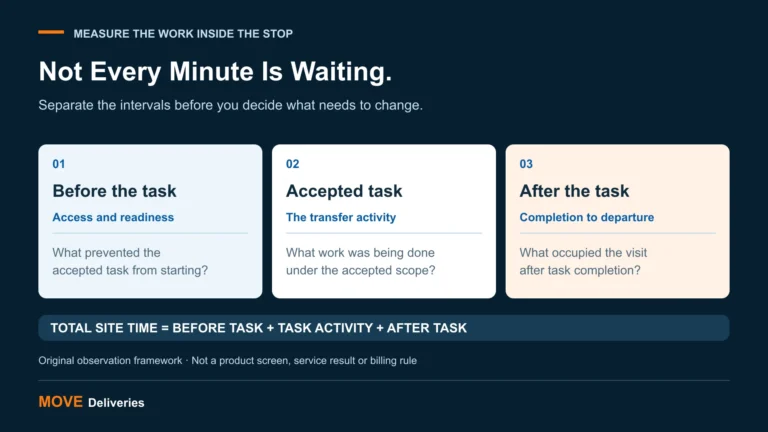
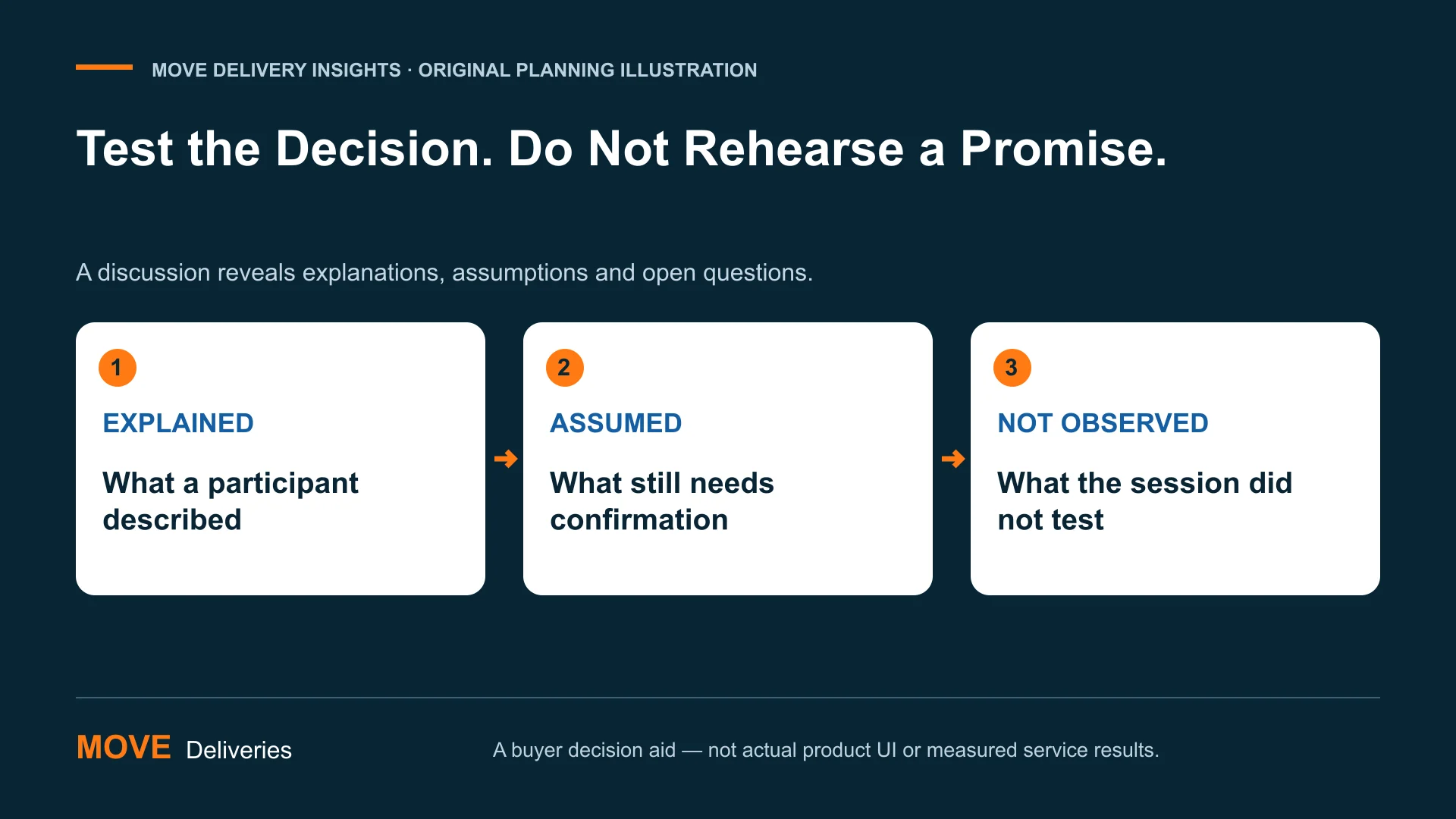
A medical courier tabletop exercise gives healthcare buyers a controlled way to discuss a difficult delivery decision before it arises in real work. Instead of asking everyone whether the plan looks good, present a fictional change and observe how the participants identify the responsible decision role. The useful outcome is not a perfect performance. It is a clearer account of what people know, what they assume and what still needs evidence.
This guide provides seven planning steps, an original facilitator packet and a buyer observation card. It addresses discussion-based operational planning for local pharmacy, laboratory, clinic and medical-supply delivery coordination. It is not an emergency response plan, clinical simulation, accreditation requirement or proof of a provider’s recovery capability. Keep the exercise separate from live dispatch, patients and actual transport changes.
Choose one bounded question. For example: can the team explain how it would establish the current accepted instruction when a fictional receiving contact cannot be reached? Participants can discuss the supported coordination path without moving a real package or inventing a substitute destination. The exercise should reveal the next question that needs confirmation—not manufacture confidence by rehearsing the answer everyone already expects.
In this guide
- A discussion tests an explanation. Not the whole operation.
- 7 steps for a focused medical courier tabletop exercise
- Build a short facilitator packet people can actually use.
- A fictional session that leaves room for an honest answer.
- Use an observation card that does not manufacture a pass.
- Close the learning loop with evidence.
- Tabletop planning: buyer questions
- Leave with a better question—and an owner for the answer.
A discussion tests an explanation. Not the whole operation.
FEMA’s HSEEP resources connect exercise objectives, design, conduct, evaluation and improvement planning. That general structure is useful background for organizing a buyer discussion. Our courier facilitator packet is an original adaptation, not an official FEMA template or an assertion that a particular exercise requirement applies to your organization. Decide the purpose and appropriate participants with your responsible team.
NIST’s SP 800-84, published in 2006 for IT plans and capabilities, distinguishes discussion-based tabletop exercises from other forms of testing. We use that historical distinction only to clarify evidence limits. Explaining a communication procedure does not demonstrate a working production channel, and naming an alternative does not demonstrate that capacity is available.
State what the session will not do. It will not place a courier request, reroute a shipment, contact an actual patient, release a package, test unauthorized system access or decide clinical acceptability. If participants need those capabilities evaluated, assign a separate authorized activity with the appropriate people and safeguards. A clear boundary lets the discussion uncover uncertainty without accidentally creating real operational work.
Also decide what counts as an observation. “The participant identified the account coordination role” is observable in a discussion. “The provider can recover service within a fixed time” is not established by that statement. An observer should capture the answer and the evidence missing from it. Leaving an item unresolved is more honest and useful than recording an imagined operational success.
7 steps for a focused medical courier tabletop exercise
First, select one decision objective. Describe what participants should be able to explain with the information supplied. Avoid broad objectives such as “prove continuity” or “test all delivery exceptions.” A narrower objective might address who can authorize a changed receiving instruction or how an uncertain request state is clarified. The objective should be understandable to the observer without requiring them to infer the planner’s intentions.
Second, choose the right roles. Include the people who can explain the releasing, receiving, account and provider-coordination responsibilities relevant to the question. A participant can represent a role in a fictional discussion without receiving authority over a live task. Identify a facilitator to present information and an observer to record responses. If a necessary role is absent, record that limit rather than allowing someone else to invent its decision.
Third, prepare the starting facts and permitted information. Use a fictional request reference, generic locations and a simple accepted-service description appropriate to the discussion. Do not use patient names, real prescriptions, specimen details, credentials or private access instructions. Tell participants what is known, what is unknown and where they would normally obtain clarification. A scenario should not depend on a hidden fact that the facilitator reveals only to make a participant look wrong.
Fourth, define a small change to present during the discussion. The change should challenge the chosen decision, not expand into every possible disruption. A fictional receiving contact becoming unavailable can test who establishes the current instruction. Adding simultaneous weather, software and vehicle failures changes the question and makes observation less clear. Introduce another issue only if it serves a separate documented objective.
Fifth, write neutral facilitator prompts. Ask what the participant would do next, which role is responsible and what confirmation is needed before proceeding. Do not supply the preferred answer in the question. When someone says “dispatch will handle it,” ask which supported contact path they mean and what response would establish the next instruction. The purpose is to understand the decision, not to reward the fastest or most confident speaker.
Sixth, capture answers separately from assumptions and missing evidence. The observer can record that a participant named a role, located an approved instruction or identified an unresolved question. If a system action is described but not demonstrated, label it described. If a provider capability is assumed, assign a confirmation question. Do not collapse all of those states into a single passing checkbox that hides the actual learning.
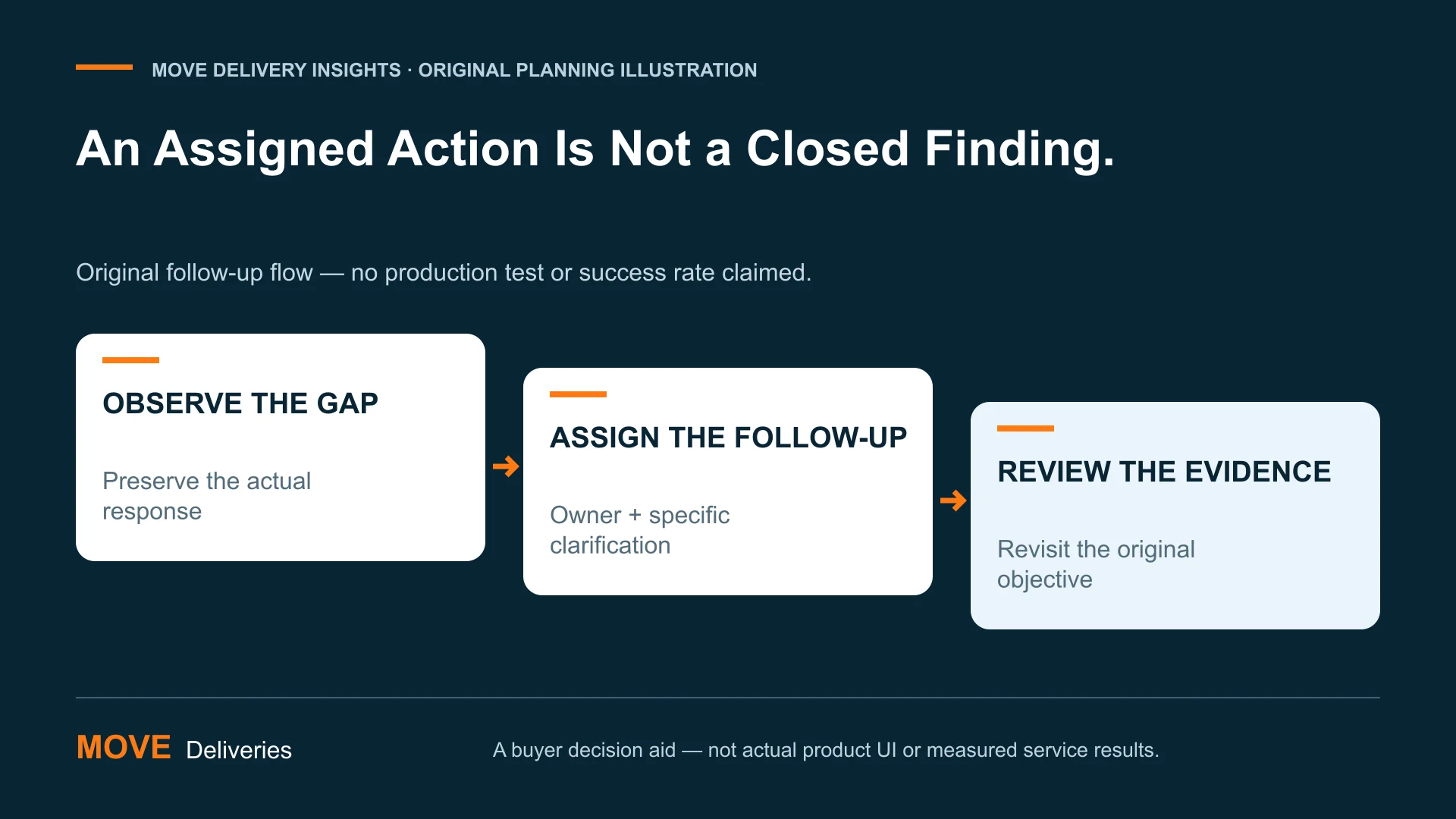
Seventh, agree on follow-up and a retest condition. Name the responsible role, the specific clarification or evidence needed and how the group will know the issue has been addressed. A planned meeting is not the same as a completed correction. Keep findings open until the agreed evidence is reviewed. Retest the original decision after relevant changes, rather than repeating the session merely to obtain a better-looking completion record.
Build a short facilitator packet people can actually use.
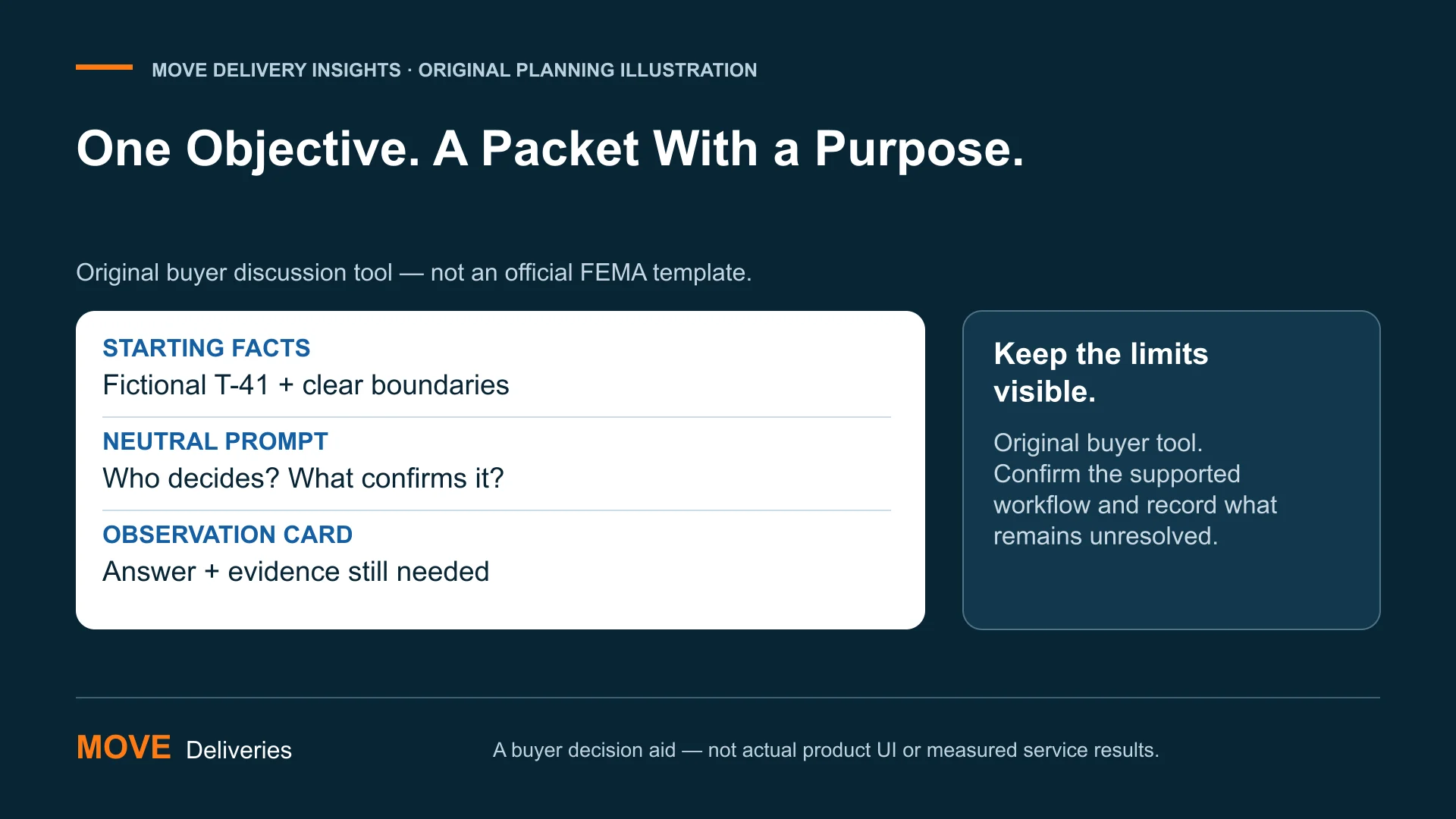
The original packet has four parts: the decision objective, a one-page fictional situation, the prompts and the observation card. Keep participant instructions separate from the facilitator’s sequence. Participants should understand the scenario and its boundaries, while the facilitator knows when to introduce the planned change. Neither document should contain real operational secrets or instructions that could be mistaken for an active dispatch request.
Prepare a visible opening statement explaining that the session is a discussion only. Tell people how to identify a real issue that needs separate escalation. If an actual operational problem arises during the meeting, pause the exercise and let the appropriate team handle it through its real process. Do not keep speaking in fictional terms when someone needs to distinguish genuine work from the scenario.
Decide how disagreement will be recorded. Two participants may reasonably describe different versions of the current procedure. The facilitator should preserve that discrepancy and identify who can clarify it, not choose whichever answer keeps the session moving. A disagreement can be a valuable finding about ownership or documentation. It does not automatically demonstrate that either participant is careless or that a provider’s service has failed.
Use a timebox appropriate to the group, but do not confuse a session agenda with a recovery-time objective. For a small fictional discussion, the facilitator might reserve separate periods for the starting facts, the change, observations and follow-up. Those are meeting-planning choices, not industry benchmarks or promised response times. If the decision remains unresolved when the session ends, record it as unresolved.
| Packet item | Original example | Evidence boundary |
|---|---|---|
| Objective | Explain who establishes a current accepted instruction | Discussion of authority, not live authorization |
| Starting facts | Fictional reference T-41 and generic receiving role | No patient or active dispatch data |
| Scenario change | The fictional receiving contact cannot be reached | No claim about a real facility |
| Prompt | What is known, who decides, what confirmation is needed? | Do not lead participants to a scripted answer |
| Observation | Named role, described path or unresolved question | Explained is not operationally demonstrated |
| Follow-up | Responsible owner and evidence required for closure | An assigned task is not a completed correction |
A fictional session that leaves room for an honest answer.
In the fictional starting situation, T-41 has an accepted local transport instruction and a named receiving role. The exercise does not invent clinical contents or give participants authority to change the service. The facilitator asks the buyer representative to explain where the current instruction is recorded and whom they would contact to clarify it. The observer records the named source and any uncertainty about its currency.
The facilitator then states that the fictional receiving contact cannot be reached. The question is not “which alternative door should the courier use?” It is “who can establish the next accepted instruction, and what information would they need?” This keeps the session focused on decision ownership. A participant should be able to say that more confirmation is required rather than inventing an unapproved destination to keep the story moving.
Suppose the buyer representative identifies the responsible account role, but the group cannot agree on the provider contact path for that situation. Record the first observation and the unresolved second question separately. The group has learned something useful: its internal ownership explanation is clearer than its shared coordination path. It has not demonstrated that a real call would connect or that a delivery could be completed under those conditions.
The follow-up owner asks the provider to clarify the supported path for the relevant service. Once that answer is documented and reviewed by the appropriate participants, the group can revisit the original prompt. If an authorized operational test is needed, plan it separately. Do not convert a later explanatory email into evidence that a production communication or recovery capability was exercised when no such test occurred.
Now change one element for a future discussion: the person covering the account role is new. The same facilitator packet can help examine whether the substitute knows where to find the confirmed instruction. That is a distinct observation about role coverage, not a reason to repeat the earlier session word for word. Record the changed objective and preserve the previous findings so the exercise history remains interpretable.
Use an observation card that does not manufacture a pass.
Create one observation row per decision objective or meaningful prompt. Record the fictional information provided, the role responding, the actual answer and the evidence still needed. Give the observer space to distinguish an unsupported assumption from a known limitation. A short narrative is often more informative than a numerical rating whose meaning has not been defined. Do not turn attendance into a capability score.
If you choose local evaluation labels, define them before the discussion. For example, “explained in session,” “requires clarification” and “not observed” describe different evidence states without pretending to measure production performance. These are original planning labels, not a standard grading system. A group should not label an untested technical capability “explained and therefore verified” simply because the speaker is knowledgeable.
Keep the observation focused on the process rather than unnecessary personal criticism. The purpose is to identify a missing contact path, ambiguous approval role or unclear instruction source. Name the role responsible for follow-up and retain participant details only as appropriate under the organization’s normal records process. A useful report can be accountable without becoming an uncontrolled collection of sensitive staff comments.
Separate limitations of the session from limitations of the operation. If the receiving role was absent, the exercise cannot establish how that role would respond. That is not evidence of actual receiving failure. If a participant described an unsupported assumption, the team needs clarification before relying on it. Both findings matter, but they support different conclusions and should lead to different follow-up questions.
Close the learning loop with evidence.
FEMA’s improvement-planning resources connect exercise findings with tracked improvement activity. For this original buyer tool, keep a simple ledger: finding, responsible role, agreed next action, required evidence and review condition. The ledger should show whether the clarification was requested, received and reviewed. It should not mark an action complete merely because a task was assigned.
Match the follow-up to the finding. An ambiguous role may require an approved ownership clarification. A missing contact path may require a supported provider instruction. An untested system claim may require an authorized demonstration. Those actions are not interchangeable. Sending everyone a revised meeting note cannot by itself establish a capability that was never observed or confirm a service arrangement that the provider has not accepted.
When reviewing closure, return to the original objective. Ask whether the new evidence answers the actual decision question, which participants need the update and whether the instruction source remains understandable to a substitute. Keep unresolved dependencies visible. If the service, locations or responsibilities change materially, decide whether the earlier exercise still applies rather than treating an old completion date as permanent assurance.
Report the result in proportion to what happened. It is reasonable to say the group discussed a fictional scenario and clarified two responsibilities if that is what the record shows. It is not reasonable to claim a percentage improvement, guaranteed recovery time or validated emergency response from that discussion alone. A restrained report can still be persuasive because readers can see precisely what was learned and what remains open.
Tabletop planning: buyer questions
Is a tabletop exercise the same as a courier service test? No. A tabletop is a facilitated discussion. A service or technical test would need a separately defined authorized scope, appropriate participants and observable operational evidence. The discussion may identify what needs testing, but it does not establish that those tests have passed. Keep that distinction in the title and conclusions of your report.
Should the courier provider attend? Invite the roles needed for the objective through an agreed process. A buyer can first identify internal questions, but should not invent provider answers when a supported contact is absent. Mark those questions for confirmation. Attendance also does not imply acceptance of new service terms, capacity commitments or operating instructions; confirm any proposed arrangement separately.
How often should the team repeat the session? Choose review triggers appropriate to the operation and the responsible team’s requirements. A changed location, new decision role or revised supported workflow may justify another discussion. This article does not prescribe a regulatory frequency or claim that a certain number of exercises proves readiness. Focus on whether the evidence still answers the relevant decision.
Can we use a real incident as background? The responsible organization can decide how to learn from its records, but this public packet is designed for fictional, non-sensitive information. Avoid reproducing patient details or private incident material in a general workshop. Any actual incident review, clinical assessment or legal obligation belongs in its authorized process with the appropriate qualified participants.
Leave with a better question—and an owner for the answer.
Choose one unresolved delivery decision and write down the facts a participant would need to address it. Use the facilitator packet to distinguish what can be discussed from what must be confirmed or tested separately. That short preparation can make a provider conversation more concrete. The value is an understandable next action with an accountable role, not another meeting described as a success without supporting evidence.
MOVE coordinates local same-day medical delivery through its proprietary platform. Review How It Works and delivery notifications to frame your questions about service coordination and relevant updates. Confirm the workflow available for your operation. This article is not a claim of emergency capacity or a promise that MOVE conducts a particular exercise program.
For a defined local delivery need, request a Quick Quote. For recurring work, Start An Account and discuss the decision roles and coordination process your team needs. A useful medical courier tabletop exercise ends with clearer evidence—not a stronger promise than the operation can support.