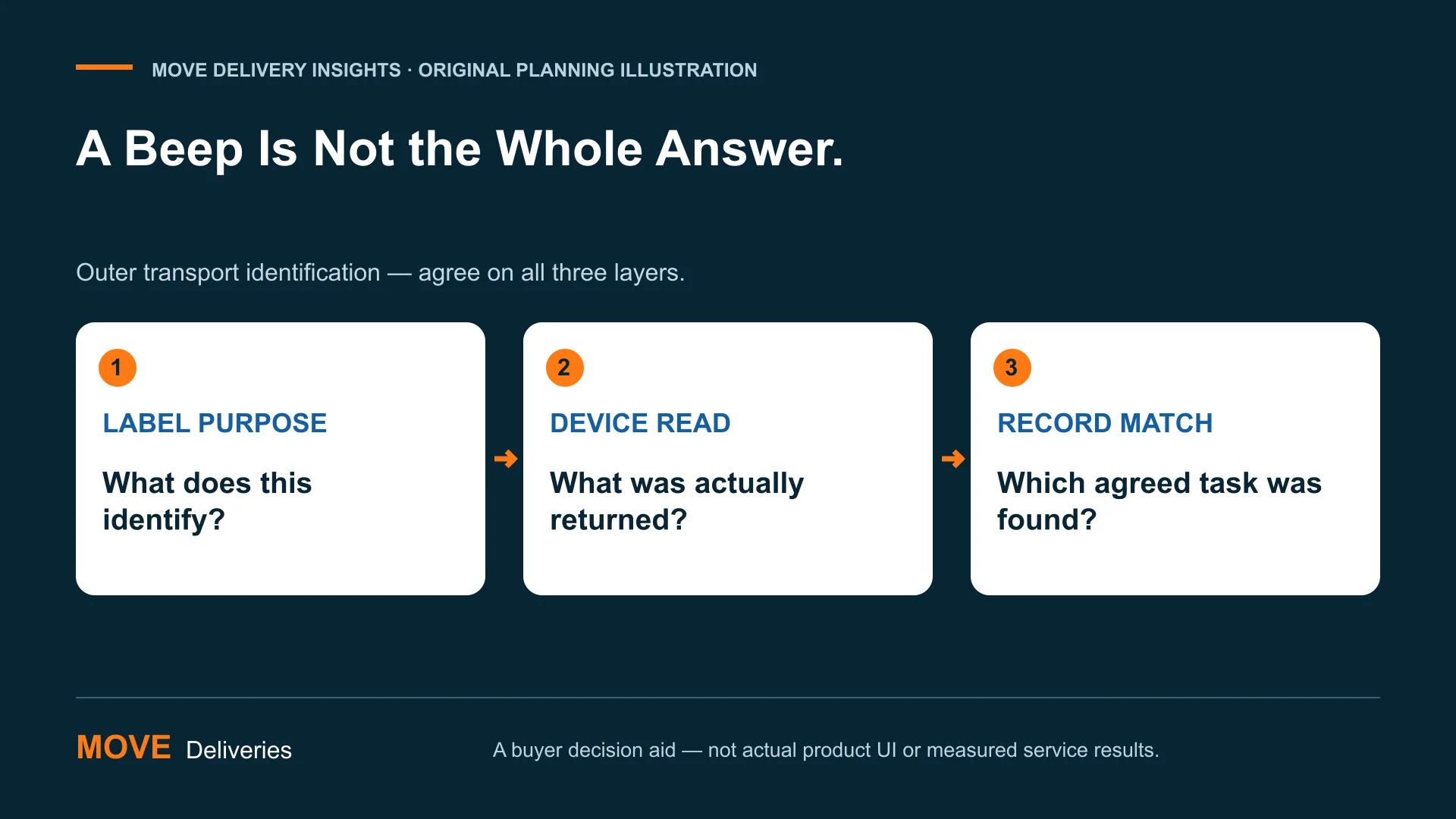
Courier barcode label readability is about more than getting a scanner to beep. A transport team also needs to know which identifier the label represents and what the receiving system does with it. A clear symbol on the wrong transport unit is not a successful identification process. Before a healthcare buyer relies on scanning, agree on the label, the record relationship and the response when something cannot be read.
This guide is for pharmacy, laboratory, clinic and medical-supply teams discussing outer transport identification with a courier provider. It contains seven review checks, an original observation card and a fictional test log. It is not an instruction to alter medication labels, specimen identification, regulated packaging or product barcodes. Those remain with the responsible qualified personnel and applicable procedures.
The examples do not assert that MOVE scans a particular barcode type, assigns a GS1 identifier or provides a verification service. Ask what is supported for your account and transport workflow. Use dummy transport references in an authorized test rather than experimenting on real clinical material. The objective is an evidence-backed coordination process, not a collection of reassuring scanner demonstrations.
In this guide
- The label, the read and the match are different questions.
- 7 courier barcode label readability checks
- An original outer-label observation card
- A small fictional log that keeps failures visible.
- Ask for the workflow evidence, not another feature badge.
- Barcode readability: buyer questions
- Make the next demonstration answer a real question.
The label, the read and the match are different questions.
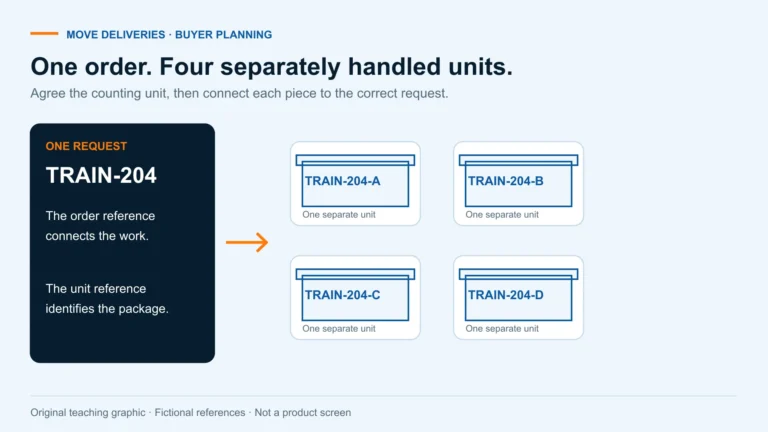
Start by naming the thing being identified. A product identifier, an individual transport unit and a courier request reference are not automatically interchangeable. Several units may relate to one delivery request, while one reusable tote may be used for different work over time. The buyer and provider should explain the intended relationship before anyone chooses a symbol. Otherwise a perfectly readable label can be interpreted as the wrong kind of record.
Next distinguish a read from an operational match. A device may return characters without establishing that the system found the correct active task. Ask what the operator sees after the read and how an unexpected or absent match is handled. Do not assume that an audible response means the package, destination, current request and permitted next action have all been verified. The application’s documented behavior matters.
Finally distinguish a practical scan test from formal symbol verification. GS1 publishes a 2D barcode verification process guideline addressing a defined assessment process. A buyer’s small scan demonstration is not that report and should not be labeled a standards-compliance result. If formal verification is needed, ask the responsible label or packaging specialist what specification, equipment and evidence apply.
These distinctions give each participant a clearer question. The label owner confirms what the identifier means. The device or software team explains the supported reading and matching behavior. The releasing and receiving teams confirm their operational instructions. A courier buyer can coordinate those answers without claiming authority to redesign regulated labels or certify a barcode’s print quality.
7 courier barcode label readability checks
First, agree on the supported identifier and label owner. Record whether the discussion concerns an outer transport-unit reference, a provider request reference or something else. Ask who creates the identifier, who may replace the outer transport label and how reuse is controlled. A sample that works in one system does not prove another party can interpret it. Do not select a barcode type merely because a phone application recognizes the pattern.
Second, review the actual printed sample rather than only the design file. The GS1 US printing and placement guidance discusses clear printing, appropriate contrast, unprinted space around a symbol and placement on a suitable surface. Its product-barcode guidance offers useful questions, but does not by itself approve a courier label. Ask the label specialist which requirements apply to your chosen symbol and scanning environment.
Third, ask whether the finished package changes what can be read. A label that looked clear on a flat sheet may be obscured by a closure, folded surface or another label once the transport unit is prepared. Observe the package in its authorized finished condition without opening sealed contents. Record what is visible and let the responsible preparer decide whether a correction is appropriate under the applicable procedure.
Fourth, confirm that staff can distinguish the intended transport identifier from other visible markings. Ask which label should be used at each agreed event and how the operator recognizes it. A box may carry several legitimate references for different purposes. Removing or covering them indiscriminately is not a solution. Clarify the workflow and the responsible label owner rather than asking drivers to guess which mark matters.
Fifth, test the supported read-and-match path with fictional references. Record the prepared sample, device or application used, expected record and observed result. Include a case that returns an unexpected or unknown identifier. A useful demonstration shows how uncertainty is communicated, not only how the ideal sample succeeds. Keep the test within the provider’s approved environment; do not generate production tasks merely to obtain a screenshot.
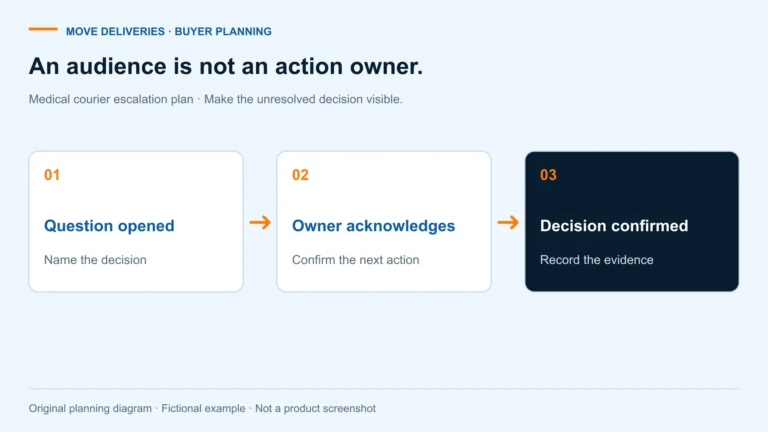
Sixth, agree on what happens when the label cannot be read or the expected record is not found. Identify the authorized coordination contact and the information needed to investigate. Avoid an improvised manual-entry shortcut unless that is part of the approved workflow. Someone should be able to explain how the unresolved item remains connected to its task while the responsible parties determine the next action.
Seventh, retain the result and its limits. A readable sample from one printer, device and packaging configuration does not establish universal performance. Record which combinations were actually observed, what remains untested and which change triggers another review. A new label template, printer setting or packaging arrangement may warrant a fresh discussion. Keep claims proportional to the evidence rather than converting a short demonstration into a reliability guarantee.
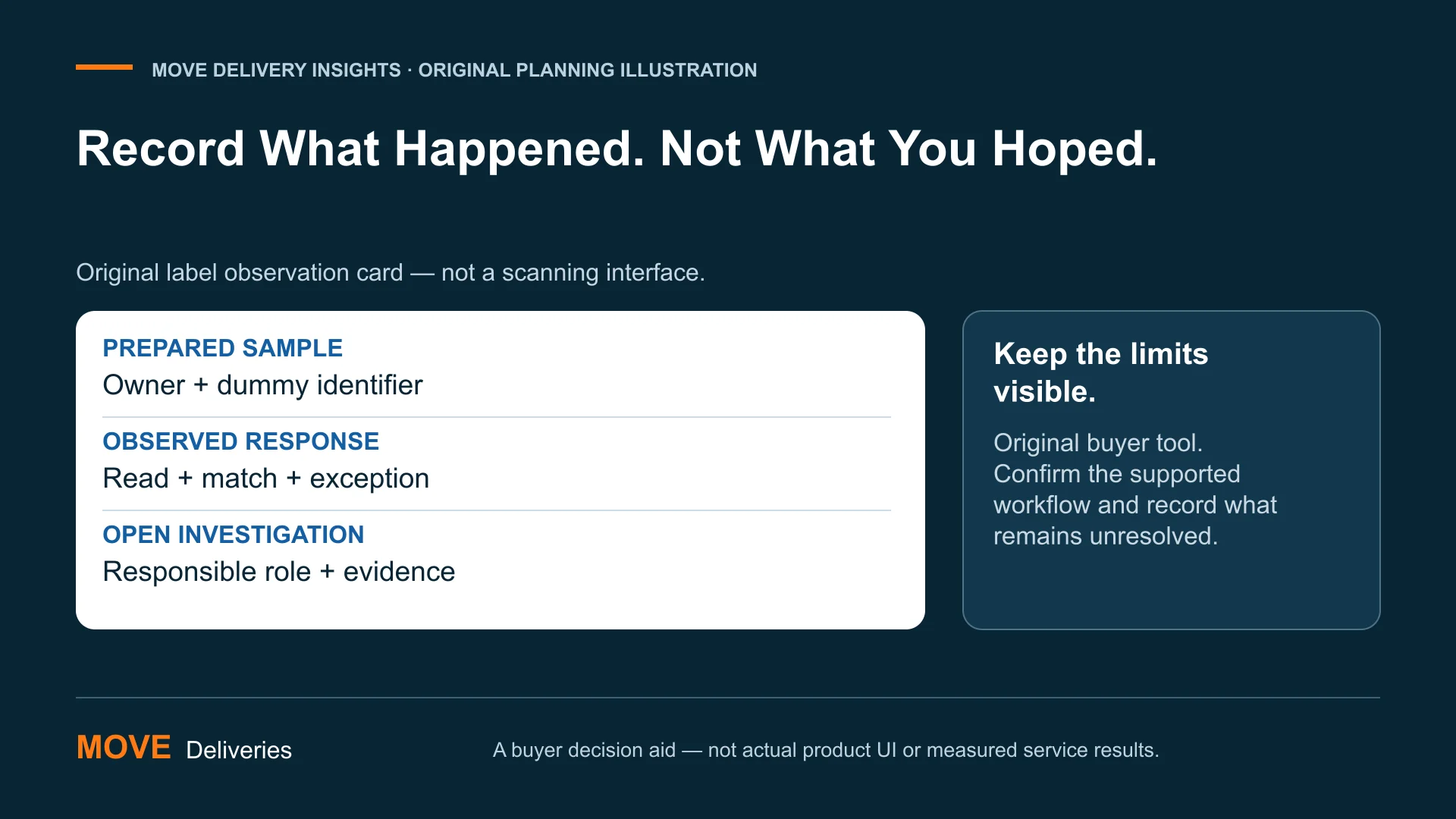
An original outer-label observation card
Use this card before a scanning workflow becomes part of a purchasing decision. It separates the label’s intended identity from its physical condition and the system’s response. Fill it with authorized dummy information during the review. Do not add patient names, medication details or specimen data just to make a demonstration look realistic. A fictional transport reference is enough to ask the operational questions.
The card should identify the person responsible for interpreting a failed result. A procurement employee can observe that no expected record appeared, but may not be able to diagnose whether the cause was the label, device configuration, application mapping or an intentionally unknown test reference. Record the observation accurately and assign the investigation. A plausible explanation is not the same as a demonstrated correction.
Keep original samples or approved photographs only under your organization’s information-handling process. If retaining a sample would expose unnecessary information, use a controlled test specimen of the label itself or record the non-sensitive observations instead. The value is a traceable decision about the workflow, not an expanding archive of package photographs that nobody is authorized to manage.
| Review field | Record the observation | Decision boundary |
|---|---|---|
| Identification purpose | What unit or task the reference identifies | Do not substitute a clinical or product identifier |
| Label ownership | Responsible creator and correction role | Do not relabel without authorization |
| Prepared condition | Surface, placement and visible obstruction | Do not open sealed contents to inspect |
| Supported test path | Approved device/application and dummy reference | Do not assume every scanner is equivalent |
| Observed response | Returned reference, record match or unresolved state | A beep alone is not task confirmation |
| Exception path | Responsible contact and supported next action | No invented manual-entry workaround |
| Limits and recheck | Combinations tested and change trigger | No unmeasured reliability claim |
A small fictional log that keeps failures visible.
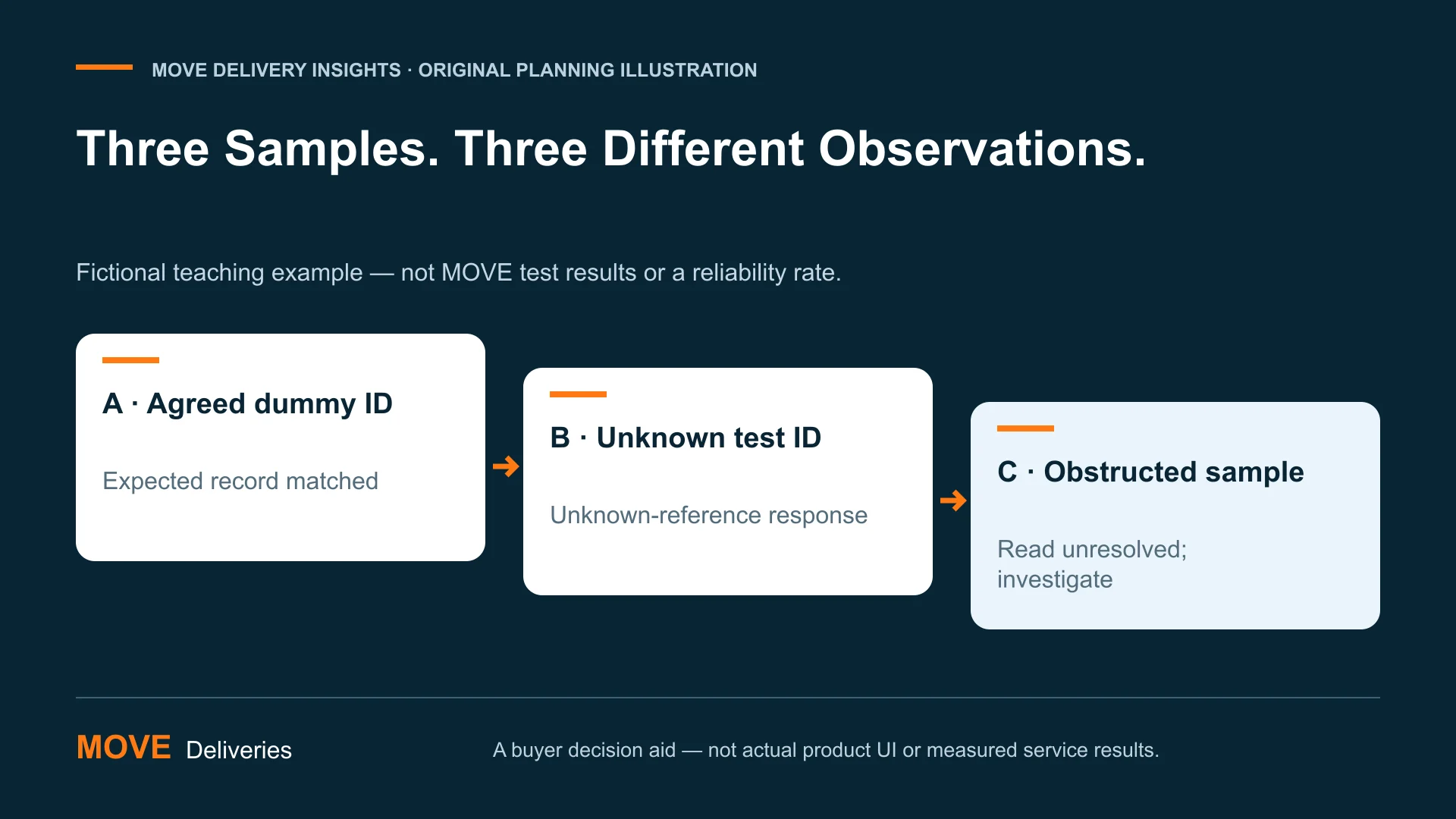
Consider a fictional buyer reviewing three outer transport-label samples with its provider. Sample A is the agreed dummy reference on a prepared package. Sample B uses an intentionally unknown test reference. Sample C has a visible obstruction introduced on a separate demonstration label, not on a live shipment. Before testing, the parties describe the expected response for each case. None of the examples includes clinical content.
For Sample A, the observer records whether the system returned the expected reference and found the intended test record. For Sample B, the important observation is how the unknown reference was presented and who would investigate. For Sample C, the observer records what could be read and the supported response to uncertainty. The team does not treat “someone eventually figured it out” as equivalent to the documented workflow operating as expected.
Suppose A matches the test record, B is shown as unknown and C cannot be read. The useful report has three different observations, not one overall pass rate. A worked as expected in that setup. B demonstrated an unknown-reference response if that response was actually observed. C leaves a readability issue requiring investigation by the appropriate owner. These fictional outcomes are teaching examples, not MOVE performance results.
Now imagine the provider explains how C would be resolved but does not demonstrate the supported recovery path. Record the explanation as an explanation. Leave the recovery evidence open until an authorized follow-up is completed. This distinction makes the report more useful to a buyer than a slide declaring the entire scanning workflow “verified.” It also preserves the difference between a process discussion and a technical measurement.
Ask for the workflow evidence, not another feature badge.
A purchasing conversation should establish the actual scope of the offered service. Ask whether scanning is supported for the intended transport-unit identifier and which agreed milestones use it. Ask how those records relate to available delivery status and completion documentation. Do not infer a complete chain of custody, product authentication or clinical verification merely because a proposal mentions barcode technology. Those claims require their own evidence and responsible review.
Request a clear distinction between a standard capability, an account-specific configuration and a proposed future integration. A provider may be able to discuss one without committing to the others. Ask what the implementation would require from your label owner, software team and receiving locations. A modest supported workflow is more useful than an impressive feature list whose necessary inputs are missing from the buyer’s operation.
Discuss how exceptions reach the people who need to know. An unresolved record match may require a coordination conversation rather than a new label. Explore delivery notifications and confirm what applies to your service. Do not assume every internal scanning event is automatically sent to every location or patient. Message recipients and operational decisions are separate requirements.
Also ask what a completed record means. Proof of delivery can help the team review the agreed completion evidence, but it does not retrospectively validate every identifier or label encountered during a trip. Agree on the record your team will use and the questions it can answer. Keep the underlying evidence available through the supported account process.
Barcode readability: buyer questions
Can we print the barcode larger to fix an unreadable label? Do not improvise a design change. Ask the responsible label specialist to review the symbol, artwork, print process and intended use. Changing proportions or editing a supplied image can create a different problem. A courier coordination guide is not a substitute for the applicable labeling specification or the organization’s authorization to change it.
Does a successful phone scan prove the courier workflow will work? No. It demonstrates what that phone and application returned under those conditions. The supported operational device, application, identifier relationship and exception process still need review. Keep the test configuration in the record so a later reader does not mistake a convenient consumer demonstration for an accepted service capability.
Should staff write a new transport number when a label is damaged? Follow the approved process and contact the responsible owner. A replacement reference can break the connection with an existing task if it is introduced without coordination. Do not remove required markings, break a seal or replace clinical identification based on this article. Record the unresolved operational question and ask for an authorized next action.
Can a barcode tell us that the contents are correct? Reading an identifier is not a general inspection of contents. What an application checks depends on its documented workflow and the evidence supplied to it. Keep transport coordination separate from clinical or product-release decisions. Buyers should ask what the offered process actually verifies and avoid treating the presence of a barcode as proof of everything they hope it means.
Make the next demonstration answer a real question.
Choose the unresolved question before requesting a demonstration: the identity of an outer transport unit, the relationship to a request, the response to an unknown reference or the label owner’s correction process. Bring authorized dummy examples and the observation card. A narrowly framed review is easier to evaluate than a general request to “show us your barcode technology.” It also exposes what the parties still need to agree.
MOVE coordinates local same-day medical delivery through its proprietary platform. Review How It Works and our medical-supplier delivery information. Discuss the records and supported identification workflow appropriate to your service; this article is not a claim that a specific scanner, barcode type or verification capability is available.
For a defined local delivery requirement, request a Quick Quote. For a recurring arrangement, Start An Account and clarify the operational references your staff will use. The goal is not a louder beep. It is an identifier and response that the authorized people can understand.