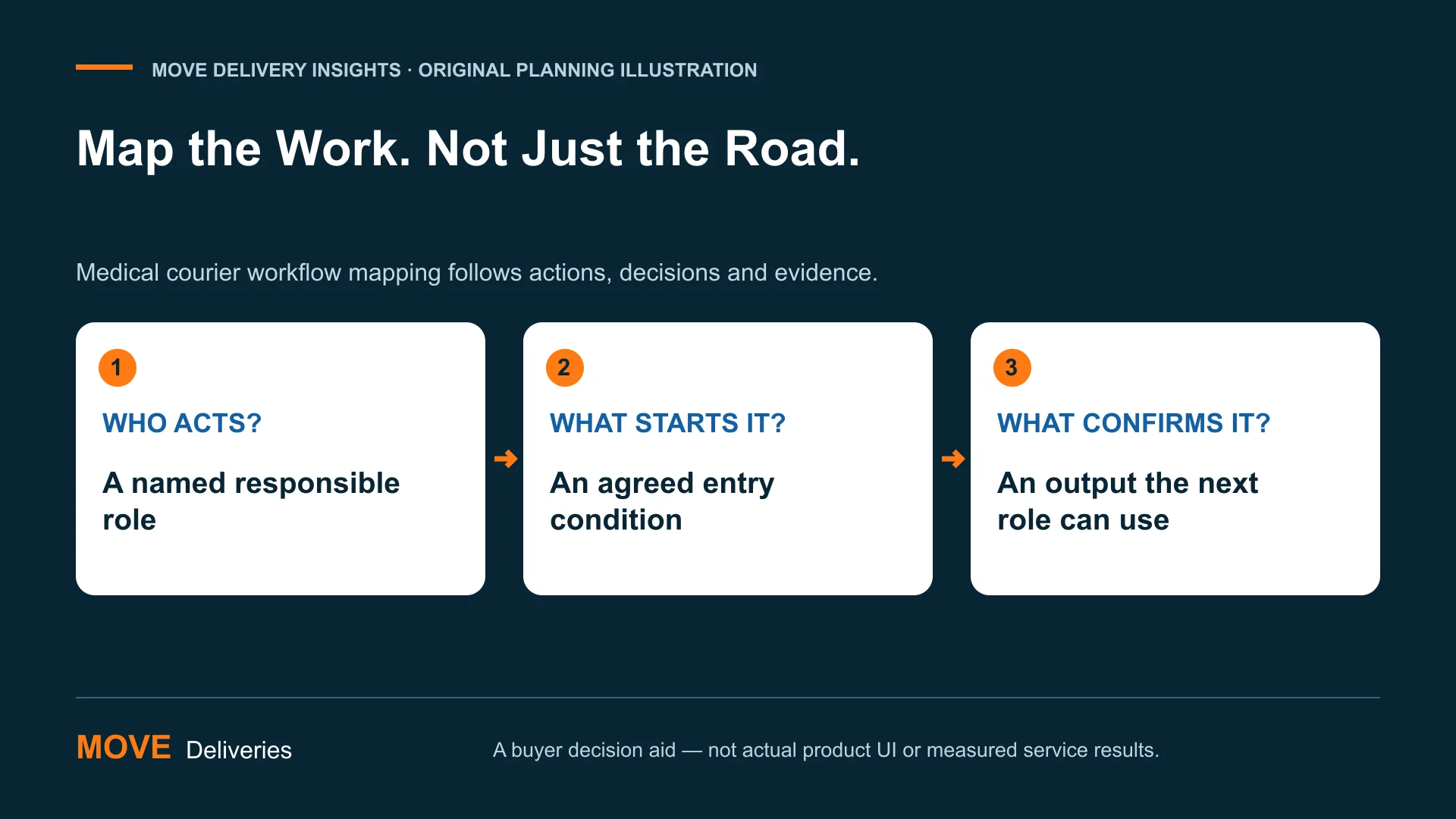
Medical courier workflow mapping shows how a delivery request moves between people, decisions and records—not just where a vehicle travels. A useful map identifies the role responsible for each action, the information that starts it and the evidence that lets the next role proceed. For a pharmacy, laboratory, hospital or medical supplier, that can make an automation conversation much more concrete.
Picture a request that looks complete on one screen. The releasing team is still waiting for an internal approval. The receiving team expects a separate confirmation. Nobody has drawn those dependencies, so each department believes the delay belongs somewhere else. Adding another notification would not necessarily answer the missing question: what event actually makes this work ready for the next person?
This guide gives healthcare buyers an original four-role mapping worksheet and seven practical decisions before changing a local delivery workflow. It is an administrative planning aid, not a clinical procedure, regulatory assessment or promise that a platform supports every proposed automation. Start with one ordinary request and the people who actually handle it. A clear small map is more useful than an impressive diagram nobody can explain.
In this guide
- A workflow map follows responsibility. A route map follows geography.
- 7 decisions for useful medical courier workflow mapping
- The four-role worksheet: make each arrow explain itself.
- A fictional request reveals why another alert may not solve the problem.
- Keep current facts, reported habits and proposed changes apart.
- Turn a gap into an automation brief—not a feature assumption.
- Give the map an owner and a reason to change.
- Workflow mapping questions healthcare buyers ask
- Before adding another notification, clarify the next decision.
A workflow map follows responsibility. A route map follows geography.
A route map helps discuss locations and travel sequence. A workflow map asks a different question: who needs to do what before the request can advance? An arrow between a pharmacy and a clinic does not explain who authorizes release, who communicates a changed receiving instruction or who checks the completion record. You may need both maps, but they should not be treated as interchangeable evidence.
AHRQ’s Workflow Assessment for Health IT Toolkit highlights the relationship between technology and clinical or administrative work. Its stated setting is ambulatory health IT. Our delivery worksheet is an original administrative adaptation of the broader workflow-assessment idea, not an AHRQ courier protocol. The responsible organization retains its own clinical, privacy and operating requirements.
ASQ’s flowchart guidance describes mapping activities, inputs, outputs and decisions, and checking the current process with people involved. That is useful methodological background. The role-and-evidence worksheet below is our own buyer tool, not a reproduced ASQ template or certification standard. Its purpose is to expose questions that a delivery arrangement needs answered.
Do not begin by drawing the ideal future screen. Begin by identifying a concrete request type within the service you are considering. A recurring local collection, an additional same-day request and a changed destination can involve different decisions. Mixing them into one diagram often creates arrows that nobody can interpret. Keep exceptions visible, but do not let every possible exception overwhelm the first map.
7 decisions for useful medical courier workflow mapping
First, choose the unit of work. State whether one map follows a single request, a collection containing several requests or a recurring service instruction. Those are different objects. Write the reference that connects the administrative steps without reproducing patient details. If the unit changes halfway through the map, a completion event may appear to close more work than it actually covers.
Second, state the start and finish from the buyer’s perspective. The start might be an authorized department asking its coordinator to arrange transport. The finish might be that coordinator locating the relevant delivery record and closing its own transport task. Neither boundary establishes clinical acceptance or completion of every downstream department activity. Decide the endpoint explicitly so the map does not quietly assign work to the courier that belongs elsewhere.
Third, assign a role to each action. Use roles such as requesting coordinator, releasing contact, provider coordination and receiving contact rather than an employee’s name in every box. Record where a covering colleague would find the current instruction. A shared inbox is a channel, not automatically an accountable role. If two teams each expect the other to act, draw the unresolved ownership instead of hiding it behind a combined label.
Fourth, write an entry condition and an output for each action. “Coordinate pickup” is too broad to evaluate alone. What information must be available before that action starts, and what confirmed instruction results? Distinguish a request sent from a request accepted under the agreed service. A button click, message timestamp or visible map position may support a specific observation without proving the next team’s action occurred.
Fifth, mark the waiting states. A task can be waiting for preparation, clarification, provider acceptance or a receiving decision. Those states call for different questions. Do not turn every pause into a driver delay or an instruction to travel faster. Put the waiting reason beside the responsible coordination role so a reviewer can see which dependency needs attention and which facts are still unknown.
Sixth, label evidence honestly. A procedure explains intended work; an interview describes someone’s account; an observed request shows what happened in that particular instance. Keep those evidence types separate. Where they disagree, record a question with an owner. One example can reveal a gap worth investigating, but it cannot establish how frequently the gap occurs across all sites or services.
Seventh, isolate the proposed change. Copy the relevant part of the current map into a separate future-state sketch and mark the exact action you want to change. Ask what the new trigger requires, who handles an unsuccessful outcome and how people will know which instruction is current. A proposed automation is a requirement to discuss and test, not a feature commitment simply because someone drew it.
The four-role worksheet: make each arrow explain itself.
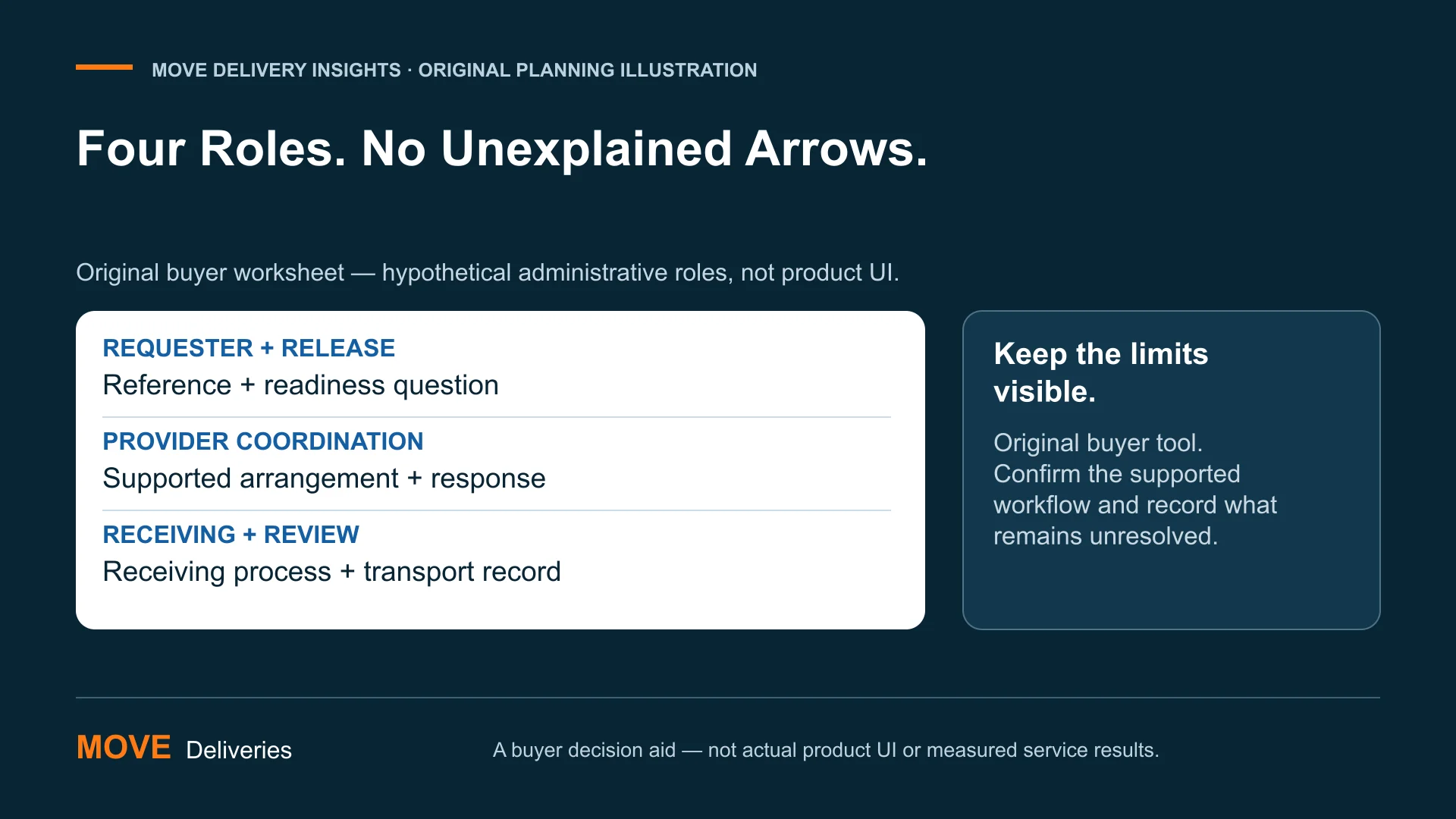
Give the map four administrative lanes: requester, releasing team, provider coordination and receiving team. These are working categories, not a universal organizational chart. Your operation may combine roles or require another authorized participant. An arrow crossing a lane boundary should state what information or confirmation passes across it. “Then dispatch” is not enough if nobody can explain what dispatch receives or what response the requester expects.
Use the worksheet alongside the drawing. Each row captures one action, its entry condition, its output and an unresolved question. Add an evidence reference in your controlled working copy, rather than putting private records directly on a workshop slide. The row should help a colleague find the source without exposing information that does not belong in the discussion. Use fictional references in general training examples.
The entries below are hypothetical prompts for an ordinary local transport discussion. They are not MOVE account configuration instructions, actual product statuses or clinical release rules. Confirm which responsibilities and records apply to the real service. If a role cannot confirm an answer, leave that part open. A blank with an accountable question is more informative than a green cell based on an assumption.
Keep the evidence field specific enough to be useful. Instead of writing “email,” identify the approved instruction reference and the question it answers. Instead of writing “portal,” describe the record the authorized person expects to retrieve. Do not assume every participant can see the same fields. Ask the provider to confirm the supported view and the appropriate access for the intended task.
| # | Action and checks |
|---|---|
| 1 | Requester: arrange transport. Entry: internal request authorized. Output: agreed reference and scope. Resolve: who clarifies incomplete information? |
| 2 | Releasing team: prepare for collection. Entry: approved internal preparation complete. Output: readiness communicated through the agreed process. Resolve: what is the agreed readiness signal? |
| 3 | Provider coordination: confirm arrangement. Entry: sufficient service details supplied. Output: accepted transport instruction, as applicable. Resolve: how is an uncertain request state clarified? |
| 4 | Receiving team: follow the receiving process. Entry: relevant arrival information available. Output: appropriate receiving or exception record. Resolve: who confirms changed receiving instructions? |
| 5 | Requester: review transport completion. Entry: relevant delivery record available. Output: buyer transport task reviewed. Resolve: what remains outside transport completion? |
A fictional request reveals why another alert may not solve the problem.
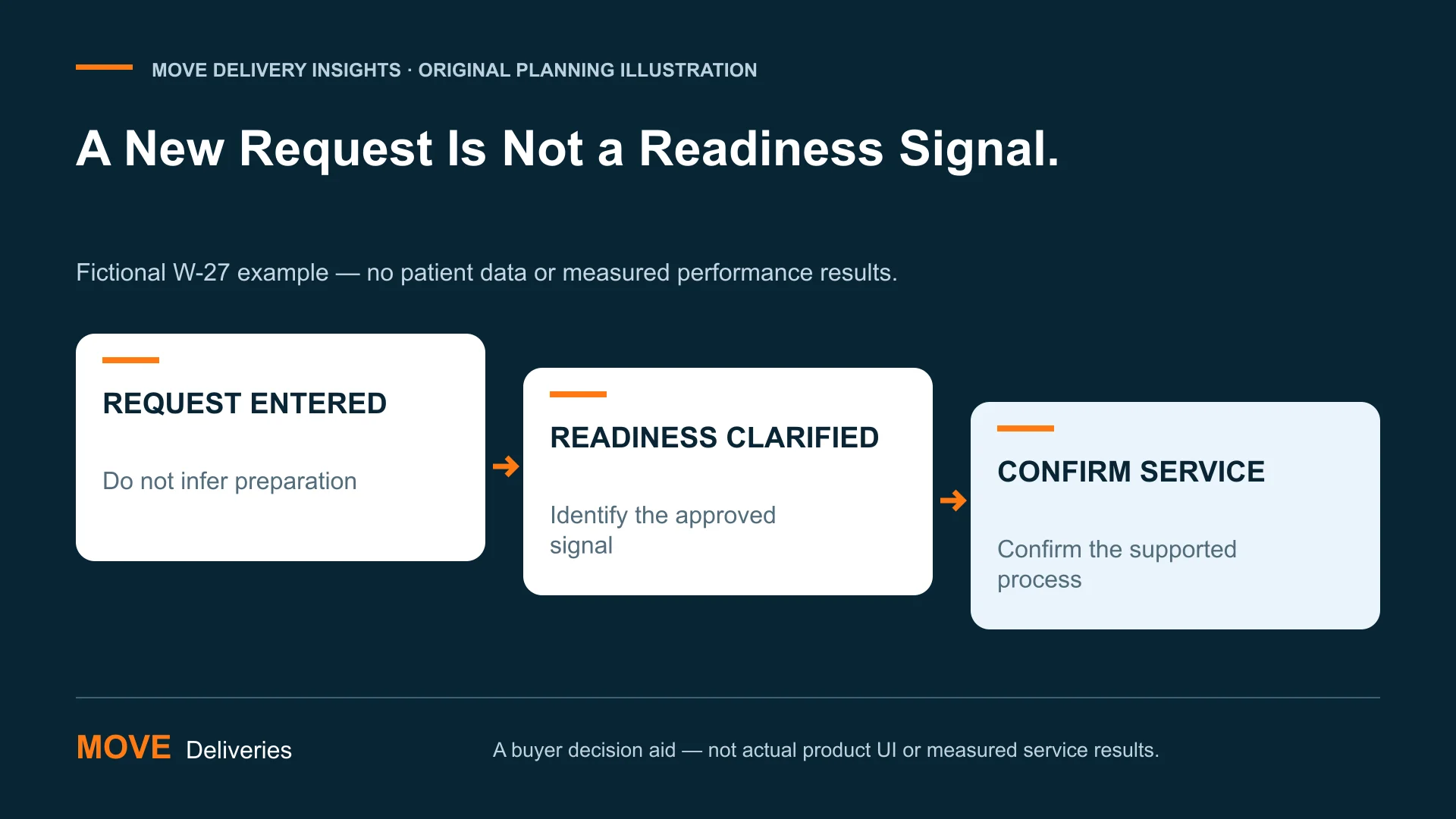
Consider fictional request W-27 between two generic local facilities. The buyer’s current-state sketch says: request entered, pickup arranged, transport completed, record reviewed. During the mapping discussion, the releasing role explains that it waits for an internal approval before communicating readiness. The requester thought entering W-27 already meant the package was ready. No patient, clinical item or real facility is represented in this example.
Add the missing readiness action to the releasing lane. Give it an entry condition established by the organization’s approved internal process, then identify the agreed communication path for transport coordination. Do not invent the organization’s release criteria. The useful discovery is an administrative mismatch: the requester and releasing team attach different meanings to the same point in the sequence. That mismatch needs clarification before a software trigger is selected.
Suppose someone proposes sending an automatic pickup reminder as soon as a request is entered. On the map, place that proposed event beside the readiness dependency. Ask whether the reminder merely requests preparation or asserts that preparation is complete. Those messages have different meanings. If the wording implies readiness without evidence, a faster notification could spread the ambiguity rather than remove it. This is a hypothetical design concern, not a measured outcome.
The group decides to ask the service provider which supported workflow can distinguish a new request from a confirmed preparation update. Record that as a requirement question, not a promise that the platform offers a particular field, trigger or integration. If the supported process is different from the proposed sketch, revise the sketch. Technology should be evaluated against the actual coordination need rather than the name of an imagined feature.
Finally, connect the receiving lane. The receiving team may need an arrival update, while the requester needs the eventual transport record. Draw separate outputs if they support different actions. Do not close the receiving team’s internal work simply because a delivery record is available. The finished example has no invented savings percentage: its result is a clarified dependency and a specific question for the provider.
Keep current facts, reported habits and proposed changes apart.
A practical map needs a small legend. For this original tool, use “observed,” “reported,” “documented” and “proposed” to identify the basis for an entry. These are working labels, not a formal audit rating. An observed instance can coexist with a different documented procedure. Preserve the difference and ask the responsible role to explain it rather than selecting whichever version makes the diagram look cleaner.
Record the scope of observation. A weekday collection at one site does not represent an evening receiving process at another site. Note the service type and relevant operating conditions without collecting unnecessary sensitive information. If a step was inferred rather than seen, label it inferred and seek confirmation. That prevents a convincing diagram from acquiring more authority than the evidence behind it.
Avoid adding timing figures simply to make the map feel analytical. If timing would help a later review, define the start event, end event, clock basis and missing-data treatment first. A conversation about typical delays is not a measured distribution. Keep estimates distinct from actual event records. The current mapping exercise can identify what needs measuring without producing a chart from numbers that nobody collected.
Treat disagreement as a finding about the description, not an automatic verdict on a person or provider. A receiving coordinator may be describing a temporary arrangement while the requester is using an older instruction. Identify the authoritative clarification path and preserve the question until it is resolved. The map should help participants establish the current supported workflow, not become another unofficial version competing with it.
Turn a gap into an automation brief—not a feature assumption.
Choose one map gap and write the desired outcome in operational terms. “The requester can distinguish an unconfirmed request from an accepted arrangement” is clearer than “we need a dashboard.” The first statement explains the decision. The second chooses a presentation before the supported workflow is understood. A provider can respond more usefully when the brief identifies what a person needs to know and what they would do next.
For each proposed automation, identify the input, expected action, recipient and unsuccessful-result owner. Ask what happens if information is missing, repeated or later corrected. Keep technical integration testing in its own approved scope. The map is a requirements conversation; it does not authorize access, transmit production data or establish that an automated connection is available. Any technical demonstration should use the provider’s supported process and appropriate test information.
Include a human fallback question without assuming a specific service response. Who can clarify an uncertain state through the agreed contact path, and how will that clarification reach the roles affected? Confirm availability and boundaries with the provider. A box labeled “manual fallback” is not an operational plan until the responsible parties understand what it means for their actual arrangement.
Review MOVE’s technology overview and delivery notifications to frame the conversation. MOVE coordinates local same-day medical delivery through its proprietary platform. Discuss the visibility and coordination your workflow needs, then confirm the supported service configuration. This guide does not claim a workflow builder, automated approval engine or particular integration capability.
Give the map an owner and a reason to change.
A useful diagram can become misleading when a site, role or instruction changes. Put an owner, a version reference and its stated scope on the working map. Identify where the current approved copy is maintained. A review date is helpful context, but it does not prove the diagram remains accurate. A material change may require review sooner than a routine calendar reminder.
Keep proposed edits separate until the responsible roles have reviewed them. If a receiving point changes, the effect may reach the requester’s instructions and the provider’s service arrangement. Updating one box in an internal document does not communicate or authorize all those changes. Use the agreed coordination process, then record the confirmed outcome and which map version reflects it.
At review, ask whether a covering colleague can follow one representative request using the map and its referenced instructions. Capture questions that require clarification. This is a usability check on the administrative description, not an operational stress test or a clinical competency assessment. Do not create live transport work merely to demonstrate the diagram without a separate authorized plan.
Keep the original purpose visible. The map supports an understandable local delivery conversation and clearer requirements. It should not grow into a duplicate system of record containing private shipment histories. Link to approved records through appropriate access instead. When a reader needs detailed clinical, packaging or regulatory direction, refer them to the responsible organization’s qualified personnel and applicable procedures rather than expanding this administrative map beyond its scope.
Workflow mapping questions healthcare buyers ask
Is this the same as route optimization? No. Workflow mapping describes administrative actions and dependencies across roles. Route planning addresses the geographic transport sequence and its operating constraints. A complete service discussion may require both. Do not use a shorter line on a map to infer that preparation, acceptance or receiving coordination has become simpler.
Does every delivery need its own diagram? Not necessarily. Start with a defined representative request type and state the boundaries. Separate materially different workflows when combining them would obscure who decides or what evidence is required. A site may use one main map with clearly identified variations, provided participants can understand which version applies to their work.
Can a process map prove service quality? Not by itself. It can explain the intended or observed sequence within its stated scope. Performance evaluation needs appropriate operational records and defined measures. A diagram does not establish clinical suitability, compliance, capacity or a guaranteed delivery time. Keep the conclusions proportional to the evidence you actually reviewed.
Who should join the review? Include the roles whose actions and decisions appear in the chosen scope. The people who prepare, coordinate and receive work can explain practical dependencies that a system-only description misses. Obtain provider confirmation for provider responsibilities. Do not assign commitments to an absent party simply because its lane appears on your worksheet.
Before adding another notification, clarify the next decision.
Take one ordinary local delivery request and draw its path across the four roles. Under each action, write what starts it and what confirms its output. Bring the unresolved questions—not sensitive shipment details—to your provider conversation. The value of medical courier workflow mapping is an understandable requirement with an owner, not a more elaborate picture of work nobody has confirmed.
Review How It Works for the service conversation from request through delivery documentation. For a defined local transport need, request a Quick Quote. For recurring coordination, Start An Account and discuss the roles, request types and information your team needs. Confirm local availability and the agreed scope before relying on a proposed arrangement.