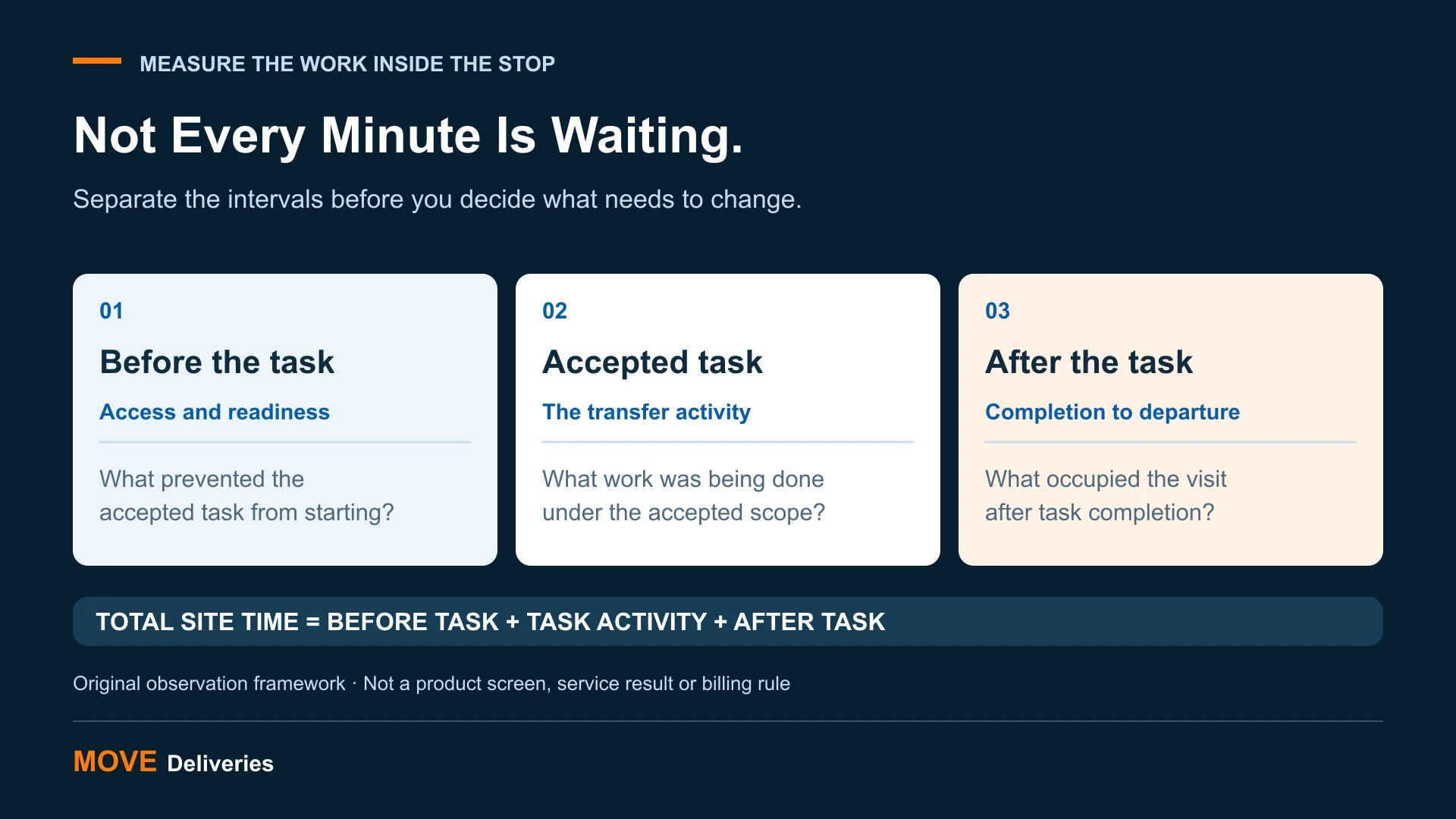
Medical courier wait time is easier to improve when your team can explain what occupied the visit. Was the package still being prepared? Was the courier waiting for access? Or was necessary loading, checking or receiving work taking place? One arrival-to-departure number cannot answer all three questions. Before changing a route, ask a more useful question: which part of the stop needs a different plan?
For pharmacy, laboratory, clinic and medical-supply buyers, this is a practical observation exercise—not a contest to make every stop faster. A short visit is not automatically a good delivery. Required checks, careful handling and an authorized receipt still matter. The purpose is to find avoidable uncertainty while protecting the work that should happen at the location.
This guide includes an original stop-observation card, a seven-check measurement plan and a fictional five-visit example. It does not publish MOVE performance, establish a universal waiting allowance or determine a billable charge. Use the method with the responsible site team and provider, then agree what your own evidence supports. Clinical limits, product handling and safe work methods remain with the people qualified to set them.
In this guide
- Define the time you are measuring
- Use seven observation checks
- Copy the buyer observation card
- Compare five fictional visits
- Test one change without hiding required work
- Answer common buyer questions
- Plan the next conversation
A long stop is a question. Not a diagnosis.
For this worksheet, total site time means the interval from the agreed arrival event to the agreed departure event at one location. Within that interval, separate time before the transfer task can begin from time spent doing the accepted task and any time afterward. These are working definitions for an observation exercise, not a legal definition of detention or a statement of a provider’s pricing rules.
Imagine a courier arriving at a hospital campus at 10:00, reaching the designated receiving point at 10:06, starting the accepted transfer at 10:10, completing it at 10:17 and leaving at 10:19. The visit occupied nineteen minutes under a campus-arrival definition. Calling all nineteen minutes “waiting” would hide seven minutes of actual transfer work and the different questions raised by access, readiness and departure.
There is a useful caution in the U.S. Department of Transportation Office of Inspector General’s January 2018 truck-detention report: available electronic data did not readily distinguish detention from legitimate loading and unloading. That finding concerns the trucking study, not current medical-courier performance. Its relevance here is the measurement problem. Do not label a whole facility visit as avoidable delay merely because a location timestamp exists.
This is different from predicting an arrival estimate or calculating how much work a dedicated arrangement can accept. The question here is retrospective and local: what happened during the stop, what evidence supports that explanation, and which part could be planned differently? A good observation card makes a specific conversation possible without turning an incomplete timestamp into a conclusion about a person.
7 checks before you measure medical courier wait time
1. Pick one stop type and one decision.
Start with a repeatable question, such as whether a pharmacy’s release process is ready when its accepted pickup begins. Do not combine outpatient prescription collections, bulky-equipment unloading and a hospital dock visit into one unexplained average. The tasks differ. State which location, service pattern and accepted work belong in the first observation set, and what decision the results will inform.
For example, a clinic might want to decide whether its current receiving contact needs a clearer arrival message. That is narrower than proving the courier is “too slow.” Record the decision before collecting data so the team knows what information is necessary. Include ordinary visits as well as difficult ones. A folder containing only complaints cannot describe the experience of all visits.
2. Agree on observable start and finish events.
Choose events that two reviewers can identify consistently. “Arrived” might mean entering the campus, parking in the permitted area or checking in at the named desk. Those are not interchangeable. Write down the event, the evidence source and the clock basis. If the only available record shows a status entry rather than the physical event, label it as a recorded status time.
The same care applies to completion. Signing a delivery record, finishing unloading and leaving a site may happen at different moments. A later record entry does not establish that the physical transfer ended later. Keep the event time and the entry time separate when both are available. If an event was not observed, mark it unknown instead of reconstructing it from a convenient neighboring timestamp.
Keep the calendar date with each event when a visit can cross midnight. As an original test example, 2026-11-13T23:58:00-08:00 followed by 2026-11-14T00:12:00-08:00 describes fourteen elapsed minutes. Subtracting only the displayed clock values would lose that relationship. The Internet timestamp format in RFC 3339 combines a date, time and UTC offset. A complete format helps interpretation; it does not prove that the clock was correct or the physical event was observed.
Before using a worksheet or export, ask the responsible technical contact to run three simple record-quality checks. These invented inputs test the arithmetic and treatment of uncertainty, not delivery performance. If the two events use different offsets, compare their actual instants rather than their clock labels. If a date or offset is unclear, preserve that uncertainty and seek clarification instead of automatically adding a day or taking an absolute value to force a positive duration.
- Cross-midnight example: the two fully specified timestamps above should produce 14 minutes.
- Reversed-event example: on the same date and offset, a 10:04 start and 10:01 finish should be flagged for review—not converted into three minutes of waiting.
- Missing-finish example: without a supported finish event, retain an unknown duration rather than recording zero.
3. Separate access, readiness and the actual task.
An access interval may involve finding the agreed entrance, completing check-in or obtaining permission to approach the receiving point. A readiness interval may involve waiting for the releasing or receiving team to be available. The transfer task may involve the accepted counting, loading, verification or receipt work. Describe the activity rather than assigning responsibility from the category name alone.
Some activities overlap, so a measurement plan needs a consistent rule. If a courier checks in while staff finish staging the package, do not add both full intervals and claim that sum is elapsed time. Use non-overlapping phases for the total and optional notes for concurrent activity. When the sequence is unclear, preserve the raw observations and keep the uncertain portion unclassified.
4. Record what was ready—not just who was present.
A staff member at the desk does not necessarily mean the shipment was ready for the accepted transfer. Conversely, a package on a cart does not establish that release authorization, documentation or the receiving contact was available. Use a short readiness note tied to the agreed task. Keep patient names, diagnoses and unnecessary document contents out of an operational observation sheet.
A useful note might say “designated releasing contact unavailable at check-in; backup contacted at 10:12.” That describes an observable condition without guessing why the person was absent. “Pharmacy caused a delay” is less useful because it skips both the evidence and the decision. Ask the site contact to review disputed facts before converting an observation into a recurring cause category.
5. Keep the observation method safe and consistent.
Decide who records events and when it is appropriate to do so. Do not ask a driver to enter updates while driving, interrupt a required check or take an unsafe shortcut to create a cleaner time series. Where an observer is appropriate, explain the purpose and use the facility’s approved process. Where records are reviewed later, acknowledge the limits of the records rather than presenting them as continuous observation.
AHRQ’s Workflow Assessment for Health IT Toolkit considers clinical and administrative workflow in ambulatory care. It supports examining how work happens before redesigning it. This courier observation card is our own operational adaptation, not an AHRQ-validated instrument or a clinical study. Keep the observation burden small enough that the measurement does not become the next interruption.
6. Compare like with like and keep missing data visible.
A complete observation has the required event definitions and evidence. Count how many visits meet that standard before comparing durations. If ten visits were selected but only six have usable start and finish records, report both numbers. Do not quietly treat missing events as zero minutes or remove the four incomplete visits from the explanation. Missing evidence is a separate finding the team may need to address.
Separate planned conditions when they materially change the task: a different receiving entrance, an equipment delivery requiring agreed assistance or a changed appointment. This is not permission to discard awkward visits until the average looks good. Show the inclusion rule, the exclusions and their reasons. A small descriptive exercise can guide a local test; it cannot establish a universal benchmark for other facilities or services.
7. Distinguish an operational finding from a billing decision.
A measured interval does not automatically establish an extra charge, a service failure or an entitlement to compensation. Those questions depend on the accepted scope, applicable terms and the evidence needed for that specific decision. Discuss how waiting is defined and documented before booking. If a charge is disputed, use the agreed review process rather than changing the observation categories to reach a preferred invoice result.
Keep the improvement conversation concrete: which recurring condition is within the team’s control, who can approve a change, and what evidence will show whether the change helped? A different release message might be useful. A blanket instruction to hurry through unloading might be unsafe and miss the cause entirely. The aim is a more workable stop, not an attractive number detached from the actual delivery.
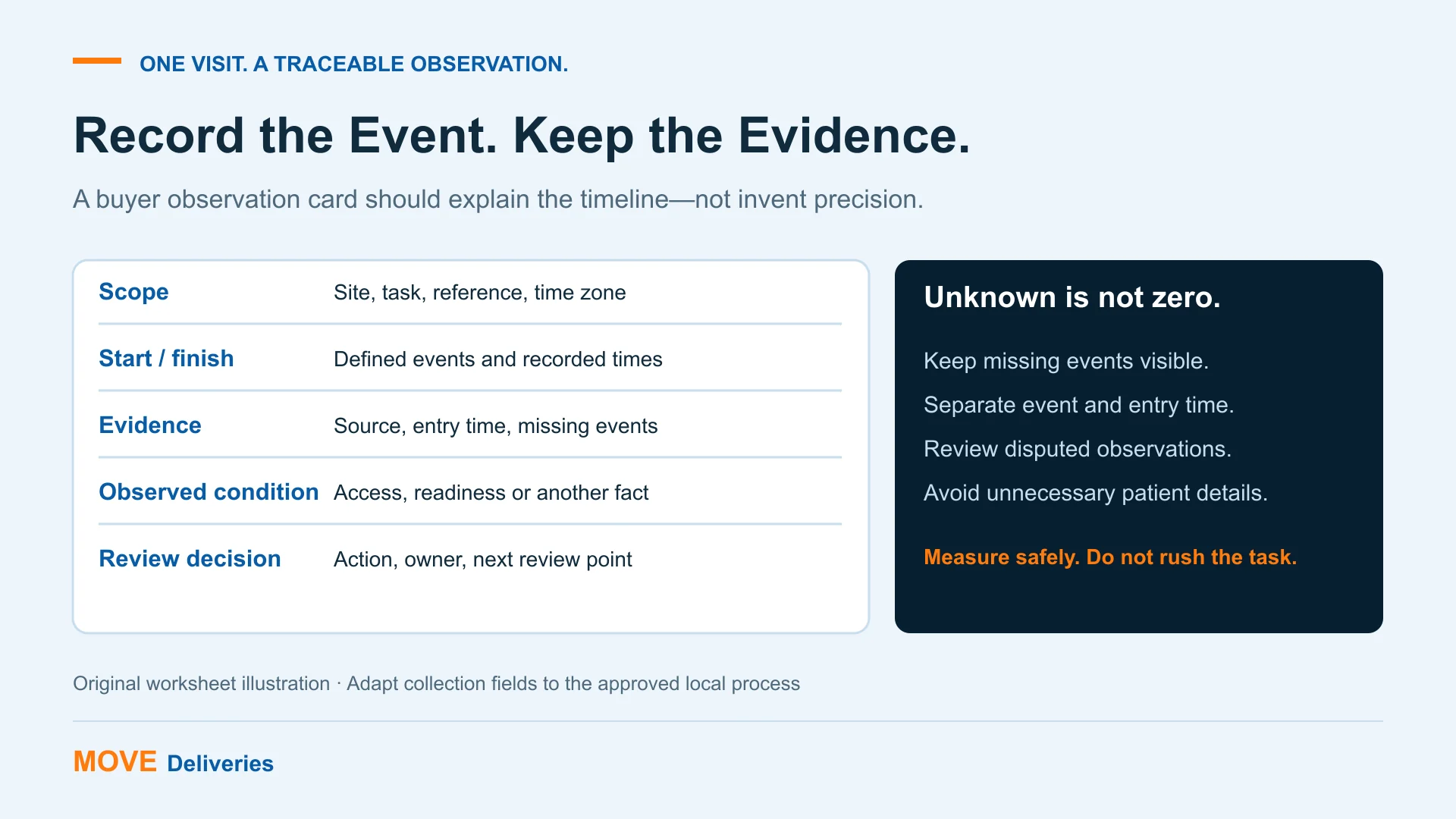
A stop-observation card your team can use
Start with a blank card for one defined visit. ASQ’s check-sheet guidance recommends defining the observed event, choosing the collection period and testing the form before broader use. Apply that discipline here without copying its example. Let one site contact and one provider contact test whether they understand the fields in the same way before using the card for a larger review.
| Field | Record | Question it answers |
|---|---|---|
| Scope | Site reference, visit type, accepted task and local time zone | Which visits are comparable? |
| Arrival event | Defined location event, time and evidence source | When does this observation begin? |
| Task start | Time accepted transfer activity begins, or unknown | What happened before the task? |
| Task finish | Time accepted activity ends, or unknown | How long did that activity occupy? |
| Departure event | Defined departure event, time and source | What happened after the task? |
| Condition note | Observed access, readiness or other condition; no patient narrative | What should reviewers investigate? |
| Evidence quality | Observed, contemporaneously recorded, reconstructed or missing | How much confidence does the timeline support? |
| Review decision | Agreed action, responsible contact and review point | What happens next? |
Add a visit reference that authorized reviewers can connect to the correct order without putting unnecessary sensitive information in the worksheet. Store the card through an approved internal process with access appropriate to the review. If an existing delivery record already contains a necessary event, reference it rather than manually creating another inconsistent version. Ask whether the available records support the analysis you want before commissioning a new report.
The card should make uncertainty easy to write down. A receiving staff member may remember a sequence but not the exact minute. A status update may be entered after the event. An observer may arrive partway through the visit. Those are different evidence conditions. Keep the distinction visible and avoid assigning artificial precision. “Time not observed” is more useful than an invented timestamp that later drives a staffing or supplier decision.
Five visits. Similar totals. Different questions.
The following fictional dataset illustrates the method. All five visits are assumed to have complete, consistent records and the same basic transfer task. The three intervals do not overlap: before task start, accepted task activity, and after task finish until departure. The figures are invented teaching values, not MOVE results, industry averages, recommended limits or evidence that any specific party caused a delay.
| Fictional visit | Before task | Task activity | After task | Total site time |
|---|---|---|---|---|
| A | 12 min | 6 min | 2 min | 20 min |
| B | 3 min | 14 min | 2 min | 19 min |
| C | 10 min | 6 min | 3 min | 19 min |
| D | 2 min | 7 min | 2 min | 11 min |
| E | 11 min | 6 min | 2 min | 19 min |
Visits A, C and E invite a question about what happened before the transfer task began. Visit B has a similar total but a much longer task interval. Its notes may describe a different accepted activity, an additional verification step or a recording inconsistency. The duration alone cannot choose among those explanations. Review the supporting notes before classifying the visit or assuming it is comparable with the other four.
The total for these five invented visits is eighty-eight minutes: thirty-eight before the task, thirty-nine in the task and eleven afterward. Dividing eighty-eight by five gives a mean of 17.6 minutes per visit. That arithmetic does not tell the buyer which interval to change. The breakdown is the useful part because it directs different follow-up questions while keeping the same observed total intact.
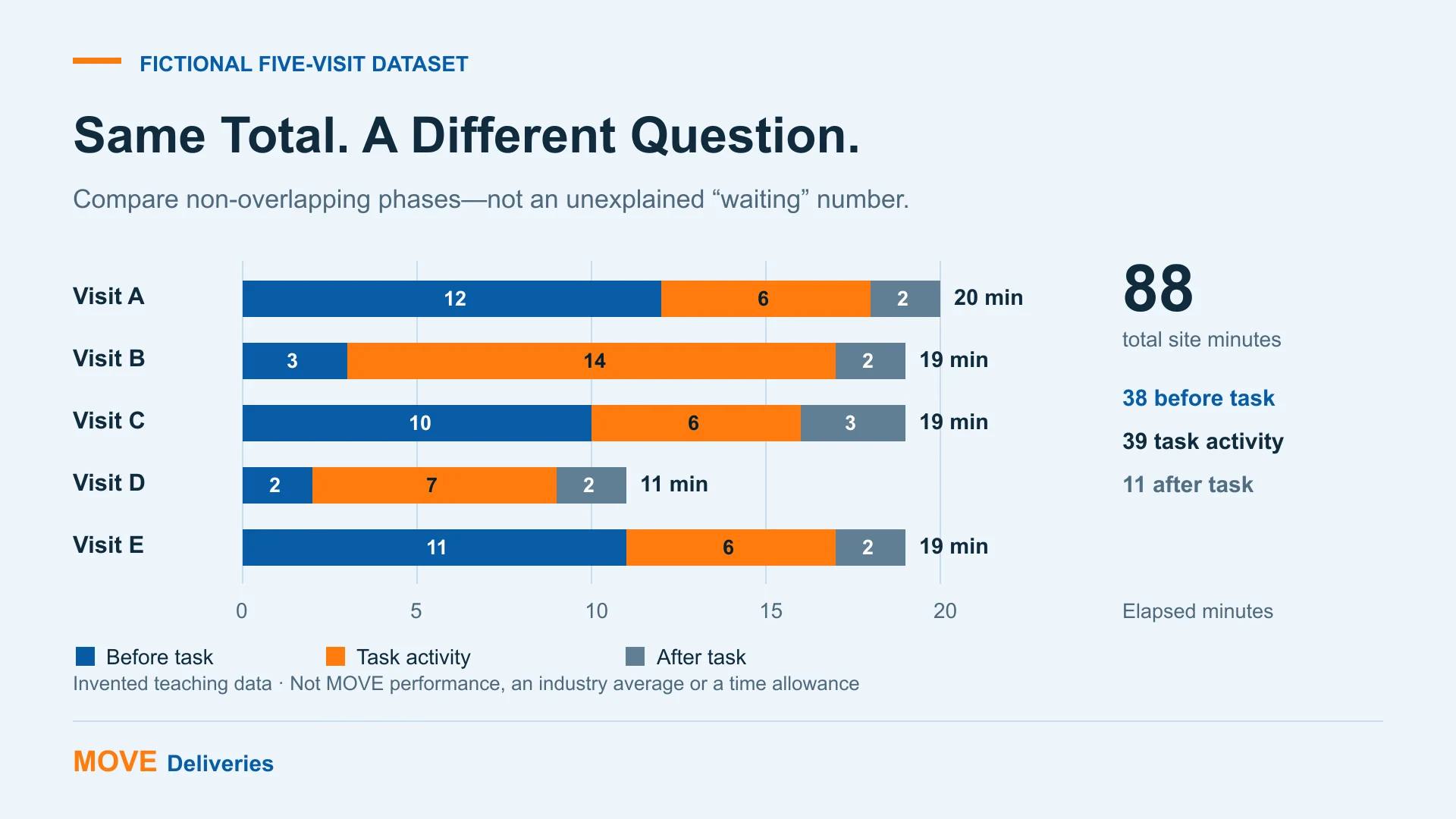
Do not turn visit D into a promised target for every future collection. It is one invented case, not proof of a safe or representative minimum. In a real review, ask whether the tasks and conditions matched, whether records were complete, and whether an unusually short visit omitted work that should have happened. Faster is only useful when the accepted service and required safeguards remain intact.
Change one condition. Then observe again.
Suppose a real review, unlike the fictional example, identifies repeated uncertainty over which releasing contact is ready to meet the courier. One small test could define a primary contact, a backup and an approved readiness message for that site. Agree who sends the message, what it means and how a changed condition is communicated. Do not call a package ready until the site’s own release requirements are satisfied.
Use the same event definitions during the test and retain the task interval as well as the total. If pre-task time changes but transfer work grows, the whole picture matters. Also record unsuccessful attempts, missing events and feedback from the people performing the work. A prettier chart is not a successful test if it shifts unrecorded work onto another department or creates new confusion at the next destination.
At the review point, make a bounded decision: retain the change, revise it, or stop it and investigate further. Explain what was observed and what remains uncertain. Do not infer a permanent percentage reduction from a handful of visits or treat a local observation as a medical outcome. If the finding suggests a broader route or receiving change, have the responsible teams review that separate decision before expanding it.
Medical courier wait time: buyer questions
Is every minute at a pickup or delivery location waiting?
No. A visit may include necessary check-in, agreed transfer activity and completion steps as well as intervals when work cannot begin. Start with clearly defined events and separate the activities your records can actually support. Total site time is a useful boundary, but labeling all of it as avoidable waiting can obscure the task and lead to the wrong operational decision.
Does a map arrival time prove the courier checked in?
Not by itself. A location or status record must be interpreted according to the event it captures. Entering a campus, reaching the designated entrance, checking in and completing a delivery are different events. Use live tracking for the visibility available to your service, and agree what separate evidence supports check-in and completion. Do not assume a map position proves acceptance.
What is a normal or billable waiting period?
This guide does not set one. A normal observation depends on the actual task and site conditions; a billable interval depends on the accepted terms and required evidence. Discuss both before service starts. When comparing proposals, keep the same event definitions and work scope so that an allowance under one proposal is not mistaken for an equivalent allowance under another.
Can MOVE automatically produce every field on this card?
Do not assume every suggested observation exists as an automatic platform field. MOVE uses a proprietary platform for delivery visibility and records, but your team should confirm which events, permissions and reporting options apply to its service. The worksheet is a conversation tool, not a product specification. If a necessary event is unavailable, agree on an appropriate review method rather than inventing the missing data.
Bring the stop details. Build a clearer delivery plan.
A useful courier conversation starts with the work at both ends of the trip. Bring the releasing location, receiving point, ready time, accepted task and the recurring condition your team wants to understand. Include what your records show and where they are incomplete. That gives a provider something concrete to review without treating a general complaint or a map estimate as the entire service requirement.
For recurring collections, explore Scheduled Delivery. For a multi-stop pattern, review Fixed-Route Delivery. Hospital and clinic teams can also review our healthcare-facility delivery information. MOVE confirms local same-day service against the actual addresses, timing and work requested; a planning worksheet does not reserve availability.
Ready to discuss the details? Request a Quick Quote, or Start An Account for an ongoing delivery conversation. Keep the focus on the decision your team needs to make. Clearer observations can make that conversation more useful without promising that every delay, charge or operational constraint will disappear.