
Medical courier dock appointments connect two plans that are easy to confuse: the courier’s trip and the facility’s permission to receive it. A vehicle can reach the right hospital address while the receiving slot, entrance or authorized staff member is still unresolved. For a healthcare buyer, the useful question is not simply, “When will the courier arrive?” It is, “What has the receiving site actually confirmed, and does the accepted delivery plan fit that confirmation?”
This guide is for pharmacy, laboratory, hospital and medical-supplier teams sending local deliveries to facilities that require a dock or receiving appointment. It is not a reason to add a booking process to every clinic. Use these seven checks where a site requires one, with the facility’s own instructions and the courier provider’s accepted scope. The goal is fewer assumptions, clearer decisions and a receiving record your team can understand.
In this guide
- Understand the four appointment and delivery states
- Use the seven receiving checks
- Copy the appointment decision card
- Review a changed-appointment example
- Test the process at one receiving destination
- Get answers to common booking questions
- Discuss a local delivery plan with MOVE
A confirmed slot is not a completed delivery
A receiving appointment is an agreed opportunity to present a delivery under the facility’s stated conditions. It is different from a courier’s estimated arrival, a purchase order, a package-ready time or a completed receipt. Some destinations use a staffed receiving desk rather than a dock. Others require a booking reference before arrival. Ask the destination which arrangement applies instead of assuming that the word “hospital” identifies a single receiving process.
Keep four states separate: appointment requested, appointment confirmed, transport accepted and receipt recorded. Your buyer worksheet should show the evidence for each state and who owns the next action. An unanswered booking request is not a confirmed slot. A confirmed slot does not establish that a provider has accepted the vehicle, timing or transfer task. An arrival message does not establish that the authorized receiving function accepted the shipment.
Begin with a simple map of the actual process, from requesting the slot through recording the receipt. ASQ’s flowchart guidance describes a way to make steps, decisions and responsibilities visible and check them with the people performing the work. Apply that general method to your receiving process; it is not a courier-specific standard or a substitute for facility instructions.
7 checks for medical courier dock appointments
1. Name the person who owns the booking
Ask who submits the appointment request and who receives the facility’s response. It may be the supplier, the customer’s purchasing team, a receiving coordinator or another authorized contact. Do not leave the task between organizations with the expectation that someone else will arrange it. Record a responsible role, a working contact method and a backup role. An organization name alone is not enough when a confirmation is missing.
Separate ownership of the appointment from ownership of the courier request. The appointment owner can confirm the destination’s slot; the courier coordination contact can discuss the transport plan. Neither should make commitments for the other without authority. If your team expects the provider to help arrange a slot, discuss that responsibility explicitly and obtain acceptance. Do not infer it from a tracking feature or from the fact that dispatch knows the destination address.
Make the backup meaningful. A generic department inbox may be useful, but the team still needs a way to resolve a time-sensitive question during the relevant shift. Ask the receiving site how its confirmation and change process works. Put the answer in the appointment record rather than in an individual’s memory. This allows a colleague to continue the conversation without restarting the booking or creating a second request.
2. Confirm the slot, reference and arrival rule
Record the confirmed date, local time zone, receiving window and reference the facility actually uses. Ask whether the window describes check-in, the start of receiving or another event. If there is a reference number, preserve it accurately. If confirmation is provided through a message instead, retain the appropriate confirmation record in your approved workflow. A planner’s preferred time and a facility’s confirmed time should be visibly different fields.
Ask what the destination expects if arrival is earlier or later than the agreed window. Do not assume that arriving early gains priority or that a short delay will be accepted. Equally, do not impose a rule copied from a different facility. The useful answer names the approved contact, the next decision and the applicable receiving instruction. Pass that instruction to the courier coordination contact before the trip, not after a missed slot.
Read the confirmation back in plain language: which shipment, which receiving function, which window and which reference. An accurate reference paired with the wrong destination department can still create confusion. Where a booking covers only a defined shipment or vehicle arrangement, identify that limit. Additional pieces, a different task or a changed vehicle may require a new discussion rather than silently inheriting the original confirmation.
3. Identify the receiving entrance, not just the building
A street address can identify a campus without identifying the approved receiving point. Confirm the entrance, receiving department and check-in contact that apply to this delivery. Use the facility’s current instructions, including how an arriving courier should ask for assistance. Keep operational directions concise enough to use. A long paragraph containing old gates, unrelated departments and several contradictory phone numbers is not a helpful site profile.
Have the site confirm any relevant vehicle-access limitations before the provider accepts the plan. The appropriate parties should review the vehicle, space and transfer task; a booking reference is not proof that every vehicle or task fits. Do not ask a courier to improvise an entry, parking arrangement or transfer method. Access questions should be resolved through the facility and provider, with their instructions controlling the work.
If the appointment directs the vehicle to central receiving but the customer expects delivery to a separate department, clarify where the courier’s accepted responsibility ends. A receiving dock, internal distribution route and department-level delivery are different tasks. Our hospital receiving-instructions checklist helps frame the destination conversation. The appointment worksheet adds the separate booking confirmation and change decision, rather than replacing those instructions.
4. Check that readiness and the accepted trip fit the slot
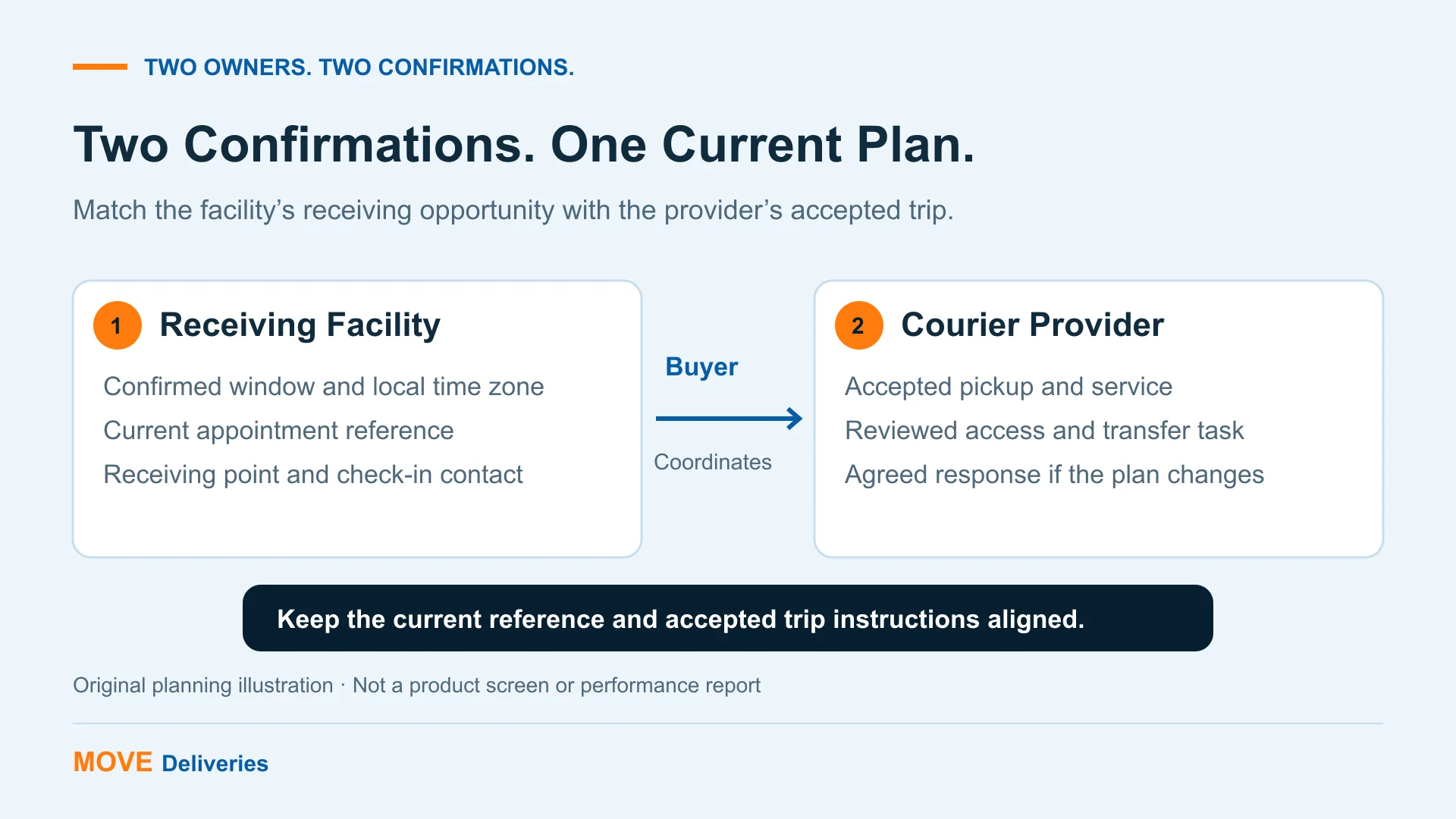
Work backward from the confirmed receiving event without treating a drive-time estimate as the entire delivery plan. The shipment needs to be ready for the agreed pickup, the provider needs to accept the service, and the destination needs to be able to receive it. Discuss the sequence with the courier team using the actual ready time and appointment information. Do not promise a slot can be met merely because two addresses appear close together.
When preparation changes, revisit the fit rather than keeping an obsolete appointment in the instructions. The right decision might be a revised pickup, a different confirmed receiving window or another accepted arrangement. It depends on the parties’ actual requirements and available service. The buyer’s role is to make the changed assumption visible and obtain the necessary confirmations, not to select a faster service label and assume the constraint has disappeared.
For a recurring need, review the appointment process alongside scheduled delivery. A repeating courier routine does not automatically reserve a destination’s recurring dock slot. Ask whether the facility requires a fresh reference, a standing arrangement or a separate confirmation for each delivery. Record its answer. MOVE coordinates local same-day medical delivery through its proprietary platform; discuss the supported booking responsibilities without assuming an automatic dock-reservation integration.
5. Agree on the decision when arrival does not fit
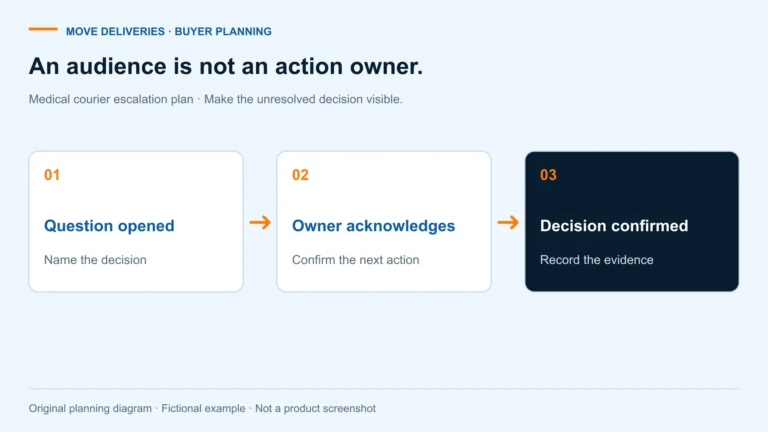
An exception plan should say who decides, not simply instruct everyone to “call if delayed.” Name the appointment owner, the facility’s receiving contact and the courier coordination contact. Explain which question each person resolves. Receiving can confirm whether a revised opportunity exists. The provider can confirm what transport arrangement it can accept. The customer’s authorized role can approve a changed plan within its responsibilities. Keep those decisions distinct.
Agree how waiting, an unavailable receiver or a revised appointment will be reviewed, including any applicable commercial terms. Do not introduce an arbitrary waiting limit in a generic guide. Use the accepted arrangement and facility instructions. If the original plan no longer works, seek an authorized decision before changing the destination, leaving the shipment or assuming another department will receive it. A fallback is only useful when the parties have actually accepted it.
Keep the update factual: the current appointment reference, the observed issue, the information needed and the role responsible for the answer. Avoid promising a new receiving time before it is confirmed. Live tracking can support a progress conversation, but a map position cannot grant access to a dock or approve a receiving change. The appointment decision still belongs to the appropriate people.
6. Define the receipt record separately
Ask what operational evidence will show that the agreed delivery was received, and who needs that record. An appointment confirmation proves a booking state, not delivery completion. Check-in proves that an arrival was presented, not necessarily that the receiving function accepted the shipment. Keep those records available for their own purposes without treating them as interchangeable. Your team should be able to identify the event a timestamp describes.
Discuss the appropriate proof-of-delivery workflow before service begins. Confirm the accepted receiving location, the applicable completion evidence and how the customer will access it. A courier receipt should not be assigned extra meanings such as installation, inventory reconciliation or clinical acceptance unless those are separately defined responsibilities. The appointment closes one planning question; the receipt closes the agreed transport question.
Use appropriate operational identifiers in the appointment record. A facility reference, shipment reference and authorized business contact may be sufficient for ordinary coordination. Do not add a patient’s diagnosis or unrelated medical history merely to make the worksheet look complete. Sensitive information and any specialized shipment requirements belong in the organization’s approved workflow, with qualified personnel determining the relevant requirements. This article is an operational planning aid, not compliance or clinical advice.
7. Keep one current confirmation after a change
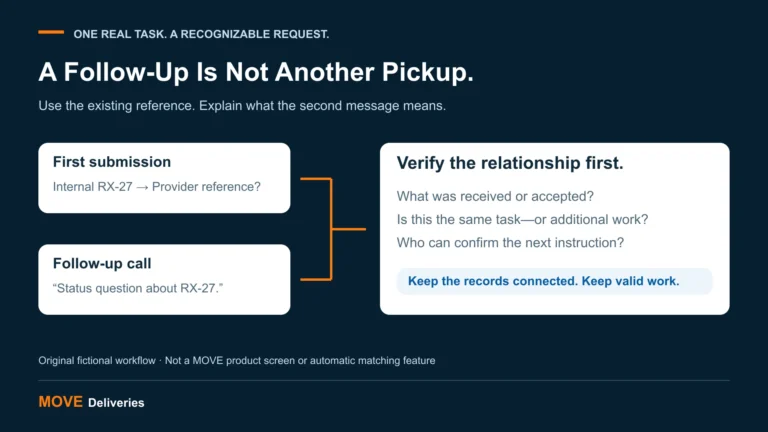
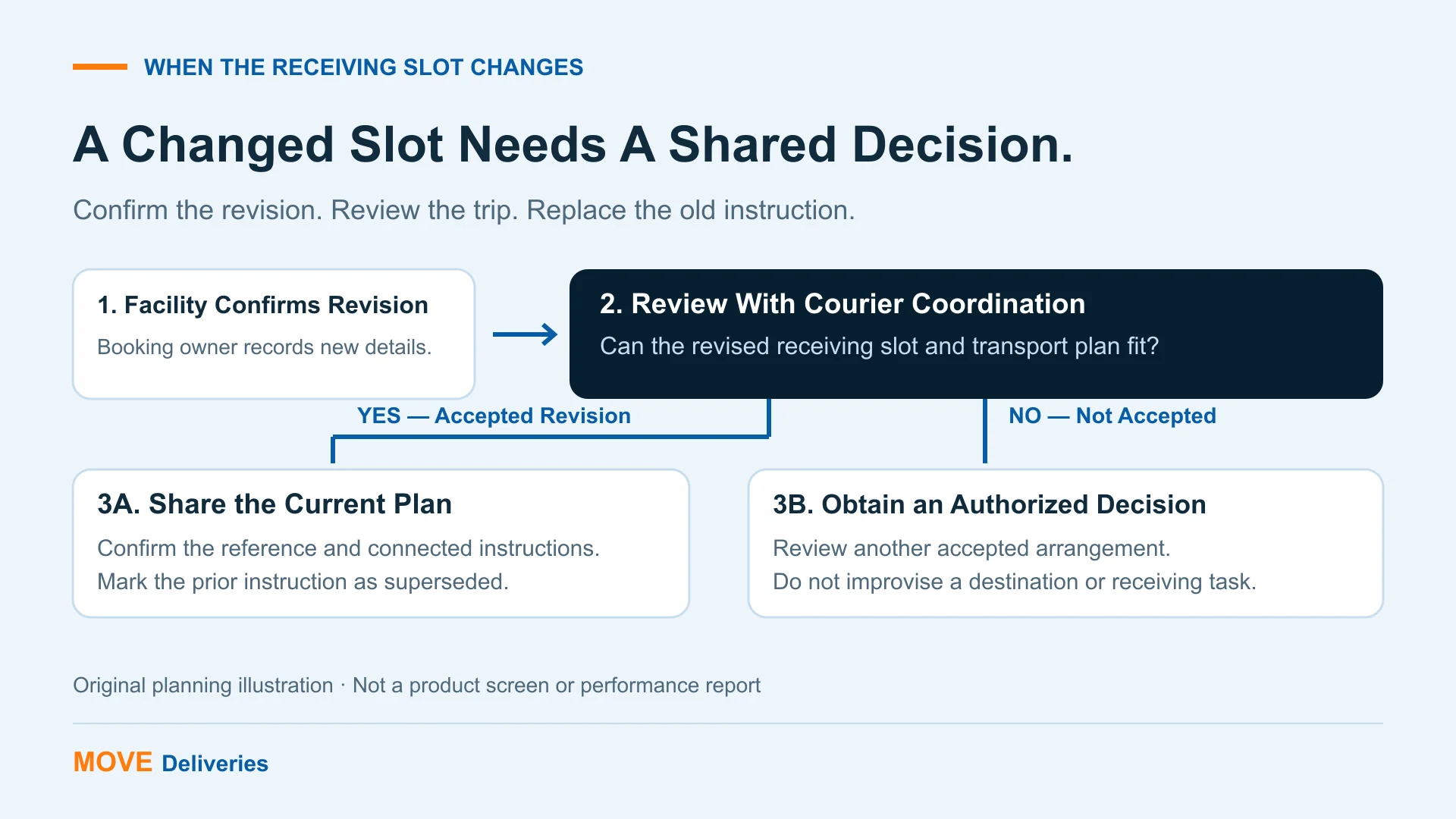
When a booking changes, record the new confirmed information, who confirmed it and what prior instruction it replaces. Identify which contacts need the update. Sending another message is not the same as confirming that the receiving site and courier coordination contact share the revised plan. Use the agreed communication process to resolve conflicting references before departure or through the appropriate exception decision if the trip is already underway.
A revised dock window may affect pickup timing, receiving staff and the customer’s expected completion. Do not change only the appointment field while leaving the old pickup instruction active. Review the connected assumptions with the relevant parties. A practical record can show the current booking and retain the earlier state as history, clearly marked as superseded. The reader should never have to guess which of two confirmation messages applies.
Pay particular attention to a shift change between booking and arrival. The receiving role on the next shift needs the applicable instructions and a working contact path. That does not mean every employee needs every shipment detail. Identify who needs the operational update and confirm how it reaches them. Where several suppliers use the same facility, keep references distinct so one customer’s revised slot does not accidentally overwrite another customer’s appointment.
Use this receiving appointment decision card
The following card is an original buyer tool, not a MOVE product screen or a facility booking form. Copy its fields into your approved planning system and adapt them to the destination’s process. Complete it with the booking owner, receiving contact and courier coordination contact. Leave an unresolved item visibly unresolved. A blank confirmation field is more honest and useful than a guessed reference that everyone later treats as accepted.
| Decision | Record before the trip | If unresolved |
|---|---|---|
| Booking ownership | Responsible role, contact path and backup | Assign an authorized owner |
| Confirmed slot | Date, local time zone, receiving event, window and reference | Keep status as requested, not confirmed |
| Receiving point | Current entrance, department and check-in instruction | Ask the facility for the applicable direction |
| Transport acceptance | Agreed ready time, service and task accepted by the provider | Review the fit with the courier team |
| Arrival exception | Decision contacts and accepted waiting or revision process | Obtain an authorized decision |
| Receipt evidence | Agreed completion record and access for the customer | Clarify what will count as receipt |
| Current version | Latest confirmation, confirmer and superseded instruction | Resolve conflicting references |
Use the card as a conversation aid, not a second uncontrolled source of instructions. If your organization already has an appointment system, reference the approved record rather than copying information into several spreadsheets that can diverge. Agree which record controls and who can update it. The worksheet’s value is making decisions explicit; creating a parallel booking process without ownership would add the very uncertainty you are trying to remove.
A changed appointment: an illustrative buyer example
In this invented example, a medical supplier proposes a 10:00–10:30 receiving check-in window for boxed supplies. The purchasing coordinator records the date and local time zone but has not received facility confirmation. The status stays “requested.” Asking a courier to review the proposed trip does not turn that request into an appointment or establish transport acceptance.
The facility confirms that check-in window under fictional reference AP-204. The buyer shares the current receiving entrance, package-ready time and accepted transfer task with courier coordination. After review, the provider confirms the transport arrangement under fictional reference TR-61. The worksheet now connects two different pieces of evidence: AP-204 for the receiving appointment and TR-61 for the accepted trip. Neither reference is a receipt record.
Before pickup, the facility replaces the window with 13:00–13:30 and issues AP-205. The appointment owner marks AP-204 as superseded while preserving its history. The changed receiving confirmation is then sent for a separate review of the transport plan. Updating the appointment field alone does not update the courier’s accepted pickup instruction. Until the necessary parties confirm the revised arrangement, the record should show the unresolved transport decision rather than implying the new window is automatically covered.
If a revised plan is accepted, the responsible contacts confirm which instructions now apply and brief the people who need them. If it is not accepted, they decide another arrangement without presenting either window as a promise. Following the actual delivery, they review the receipt evidence separately. The references and windows above are fictional teaching inputs—not customer records, facility rules, MOVE software fields or guaranteed service times. Use the exercise to see whether your team can identify the current appointment, the accepted transport plan and the next decision without guessing.
Test the appointment process before expanding it
Start with a small, approved test of the receiving process at one applicable destination. Ask a precise question, such as whether the current appointment reference and receiving contact are available to the right roles before the trip. The Institute for Healthcare Improvement’s guidance on testing changes explains learning through planned small tests, observations and revisions. That general improvement method does not authorize changing a facility’s receiving or shipment requirements.
Before the test, define what you will observe and what result would prompt a revision. You might review whether a booking remained unconfirmed, whether a current reference was missing from the trip instructions or whether a changed window reached the correct contacts. These are proposed observation categories, not performance results. Record the actual evidence and its limits. One smooth trip does not establish that the process will work across every shift or destination.
A simple prepared observation sheet can make the review consistent. ASQ describes a check sheet as a structured tool for collecting and examining data. Choose categories that match the booking question, and include unknown or not-applicable outcomes where needed. Do not combine an unavailable booking reference, a vehicle-access concern and a completed late receipt into one generic “dock problem” category that cannot guide a useful correction.
Review the findings with the people who book, coordinate and receive the work. Identify whether the correction belongs in the confirmation process, site instructions, accepted transport plan or communication path. Preserve original observations rather than rewriting them to make the pilot look successful. If you later report results, define the population and the event measured. This guide supplies no industry benchmark, no predicted savings and no guaranteed improvement percentage.
Questions buyers ask about receiving appointments
Does every medical delivery need a dock appointment?
No. Confirm the destination’s actual receiving process. A clinic reception, laboratory intake desk and hospital central receiving function may use different arrangements. Apply a booking workflow only where it is required or expressly agreed. The aim is to satisfy the relevant facility instruction, not to create unnecessary administrative work around a straightforward local delivery.
Does an ETA replace a confirmed receiving window?
No. An estimate helps the team discuss expected progress. A confirmed receiving window records the destination’s agreed opportunity and conditions. If the estimate no longer fits, use the approved decision process. Do not treat a tracking update as permission to enter, wait indefinitely or leave a shipment with someone who has not been authorized to receive it.
Who should change a receiving appointment?
The role authorized under the facility and customer’s booking process should request or confirm a change. Coordinate the transport implications with the provider separately. Record the revised reference, the confirmer and the prior instruction it replaces. Ask the appropriate contacts to resolve any contradiction rather than letting the driver or an uninformed colleague choose between two competing versions.
Can a supplier book a slot before requesting a courier?
The permitted sequence depends on the parties’ processes. A supplier may coordinate the receiving opportunity before discussing transport, but should not imply that the slot commits a courier provider. Share the confirmed constraints and request review of the proposed service. Equally, a courier request should not be described as facility approval when the destination has not confirmed its receiving arrangement.
Bring the receiving details into your delivery conversation
Before asking for local medical delivery, gather the ready time, confirmed receiving requirement, current entrance instructions and the role that owns appointment changes. Share the relevant operational details through the agreed channel and ask which service the courier team can accept. Clear inputs allow a specific conversation about your workflow instead of a broad promise built on an address and an assumed open dock.
MOVE helps coordinate local same-day medical delivery through its proprietary platform. For an individual need, start with Quick Quote. For an ongoing workflow, Start An Account and discuss the applicable receiving process with the team. Confirm booking responsibilities, accepted service and completion evidence before work begins. A practical plan should make the next decision clear, not leave your staff to discover it at the dock.