Start with the decision, not another status message
A medical courier escalation plan defines when an unresolved delivery issue needs a named owner, what information that person needs, how responsibility is acknowledged and what counts as closure. It is a coordination tool for healthcare buyers—not a new delivery order, an automatic reroute or a promise of a particular response time.
Picture a clinic that is waiting for a routine supply carton. The expected update has not arrived, the receiving desk has a limited opening window, and three people have started asking different questions. One person wants the courier’s location. Another wants to know whether the carton can still be accepted. A third is considering changing the destination. More messages do not necessarily bring the team closer to a decision.
The useful question is simpler: what is still unresolved, who can resolve it, and by when does the next agreed action need to happen? This guide gives your team seven decisions to make before an exception becomes a round of unanswered calls. It includes an original escalation card, a responsibility worksheet and a fictional receiving-window drill. It concerns local same-day delivery coordination. Clinical decisions, cargo-specific handling limits and emergency response remain with the responsible qualified personnel and established procedures.
In this article
- Start with the decision, not another status message
- 1. Separate a status question from an unresolved decision
- 2. Agree on triggers before choosing a countdown
- 3. Name one coordinator and a usable backup path
- 4. Send a message that makes the next action clear
- 5. Confirm understanding, not just message receipt
- 6. Keep escalation separate from permission to change the delivery
- 7. Define closure without erasing the event
- Use a medical courier escalation plan decision card
- Practice with a fictional receiving-window drill
- Turn the card into a clearer service conversation
1. Separate a status question from an unresolved decision
Begin by writing the question in one sentence. “Where is the vehicle?” asks for information. “Can the clinic still receive this shipment within the agreed window?” may require a decision from the clinic as well as information from the provider. “Should the destination change?” adds authorization and transport acceptance. Treating those questions as interchangeable sends requests to people who may know the status but cannot approve the next action.
Use an operational reference for the delivery and identify the event you are discussing. Pickup confirmation, movement toward the destination and receiving confirmation are different events. If one record says the shipment was collected, that does not answer whether someone at the destination is ready to receive it. MOVE’s live tracking page explains visibility; your escalation discussion should identify the decision that visibility needs to support.
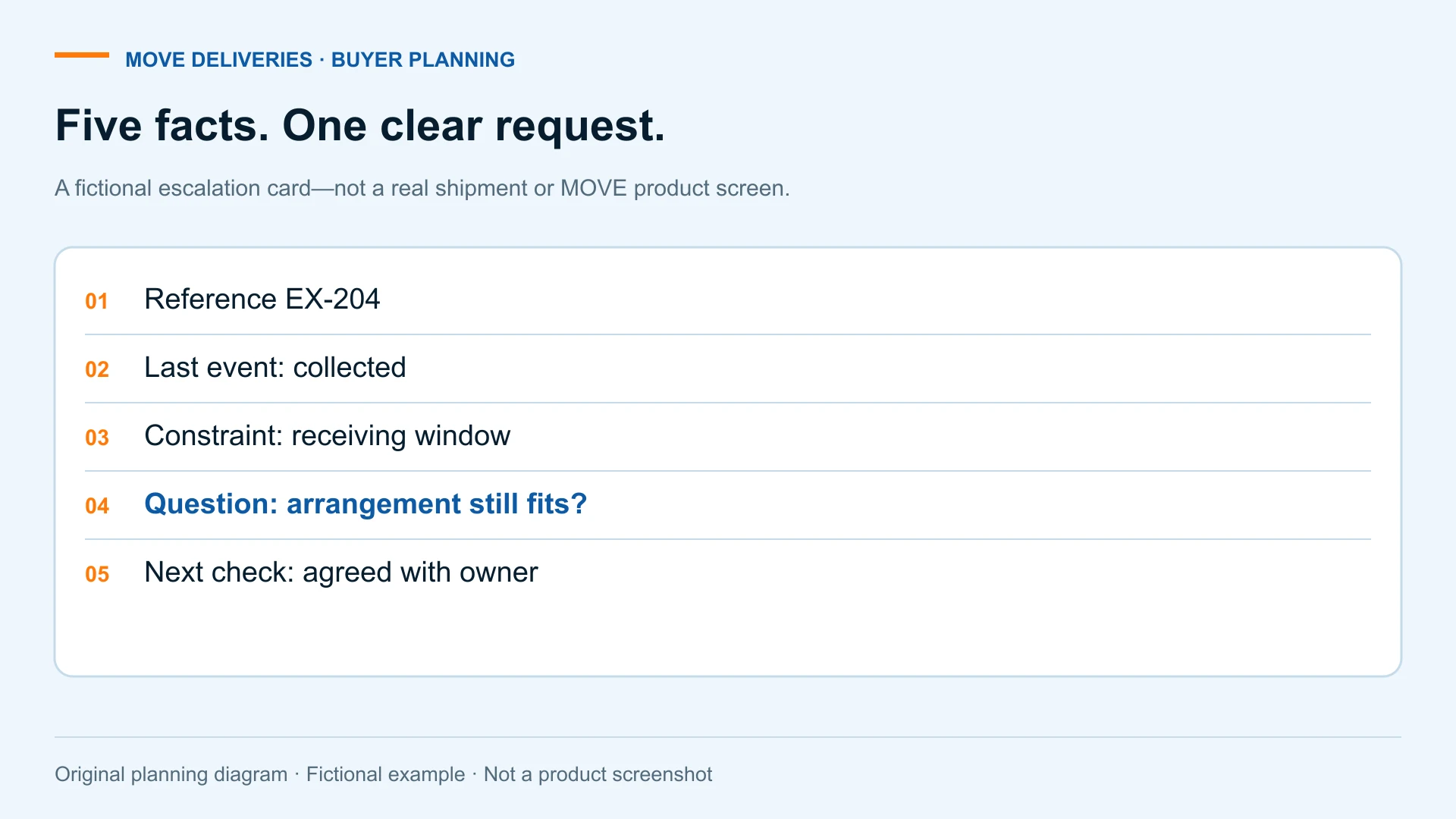
A useful entry might say: “For fictional delivery EX-204, the receiving desk needs confirmation of the planned arrival before it closes its routine receiving window.” That statement names an unresolved decision without inventing a cause or blaming a person. It also prevents your team from opening separate conversations about the same work. Keep the delivery identity, the current question and the responsible coordinator together.
2. Agree on triggers before choosing a countdown
A trigger should describe an observable condition, not a vague feeling that the order is taking too long. Examples for discussion include an agreed update that has not been received, conflicting receiving instructions, an expected acknowledgment that remains missing or a receiving window that may no longer fit the current plan. Each condition points to a different next check. A missing message does not establish that a driver is late, and a map position does not establish that a package was received.
Add the relevant time reference and the reason it matters. Your staff need to know whether the trigger relates to a promised callback, an agreed collection arrangement or the destination’s actual acceptance window. Do not import a universal five-minute or fifteen-minute escalation rule from an example. Choose intervals with the provider and the releasing or receiving team for the service being discussed. Record the agreement rather than relying on someone’s memory of a sales conversation.
ASQ describes a process decision program chart as a planning tool for identifying possible problems and considering responses before they occur. The original worksheet in this guide applies that general planning idea to delivery communication. It is not an ASQ-issued courier procedure. Identify a realistic trigger, a practical response and the person who must confirm that response before it becomes an instruction.
3. Name one coordinator and a usable backup path
An escalation can involve several people without having several competing owners. Name the role that coordinates the open question on the customer side. That role should collect the current facts, contact the agreed provider support channel and bring in the location decision-maker when needed. It does not need unlimited authority. Its value is that the team knows who is maintaining the current question and the next checkpoint.
Write the backup path in terms that staff can actually use during the relevant operating hours. A job title, a monitored business contact route and an agreed fallback are more useful than “call whoever is available.” Check whether the backup can acknowledge the issue, authorize a receiving change or only locate the appropriate decision-maker. Do not assume an account contact can speak for every hospital department, pharmacy or laboratory location.
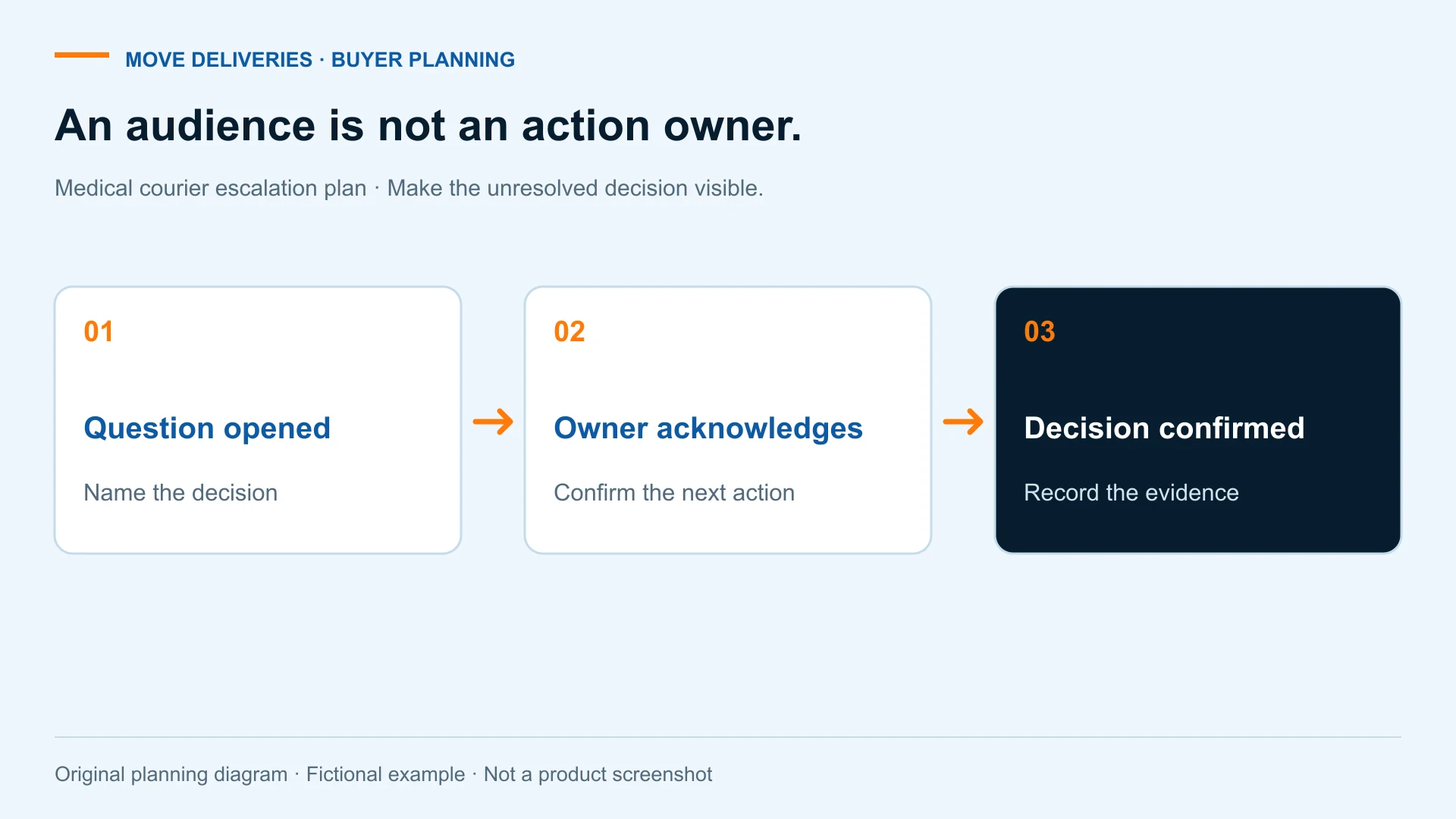
Keep the business audience distinct from the action owner. MOVE can notify location contacts or the customer’s primary account contact or contacts, as discussed on the delivery notifications page. Receiving an update does not itself assign responsibility or approval authority. Before relying on the arrangement, ask which contact is expected to respond, which channel is monitored and how responsibility moves when that person is unavailable.
4. Send a message that makes the next action clear
An effective escalation message should be short enough to act on and specific enough to verify. Include the delivery reference, the last confirmed event with its time, the unresolved question, the relevant receiving or release constraint and the action you are requesting. Distinguish a confirmed fact from a report that still needs checking. “No receiving confirmation appears in our current record” is more precise than “the delivery has failed.”
For example, a fictional coordinator could write: “EX-204: collection was confirmed at 1:20 p.m. The clinic’s routine receiving window ends at 3:00 p.m. We need to know whether the current receiving arrangement still fits. Please identify who is checking the transport status and confirm the next update checkpoint.” Those times are invented for a communication drill. They are not MOVE service commitments or instructions for a real shipment.
Use the approved channel for the actual account and keep the message focused on the transport question. A routine escalation card does not need a diagnosis, medication history or laboratory result. Where sensitive details are genuinely required, follow the organization’s approved information-sharing process. Do not send a real shipment escalation through the website’s public quote form simply because it is easy to find; agree on the operational support path before the first delivery.
5. Confirm understanding, not just message receipt
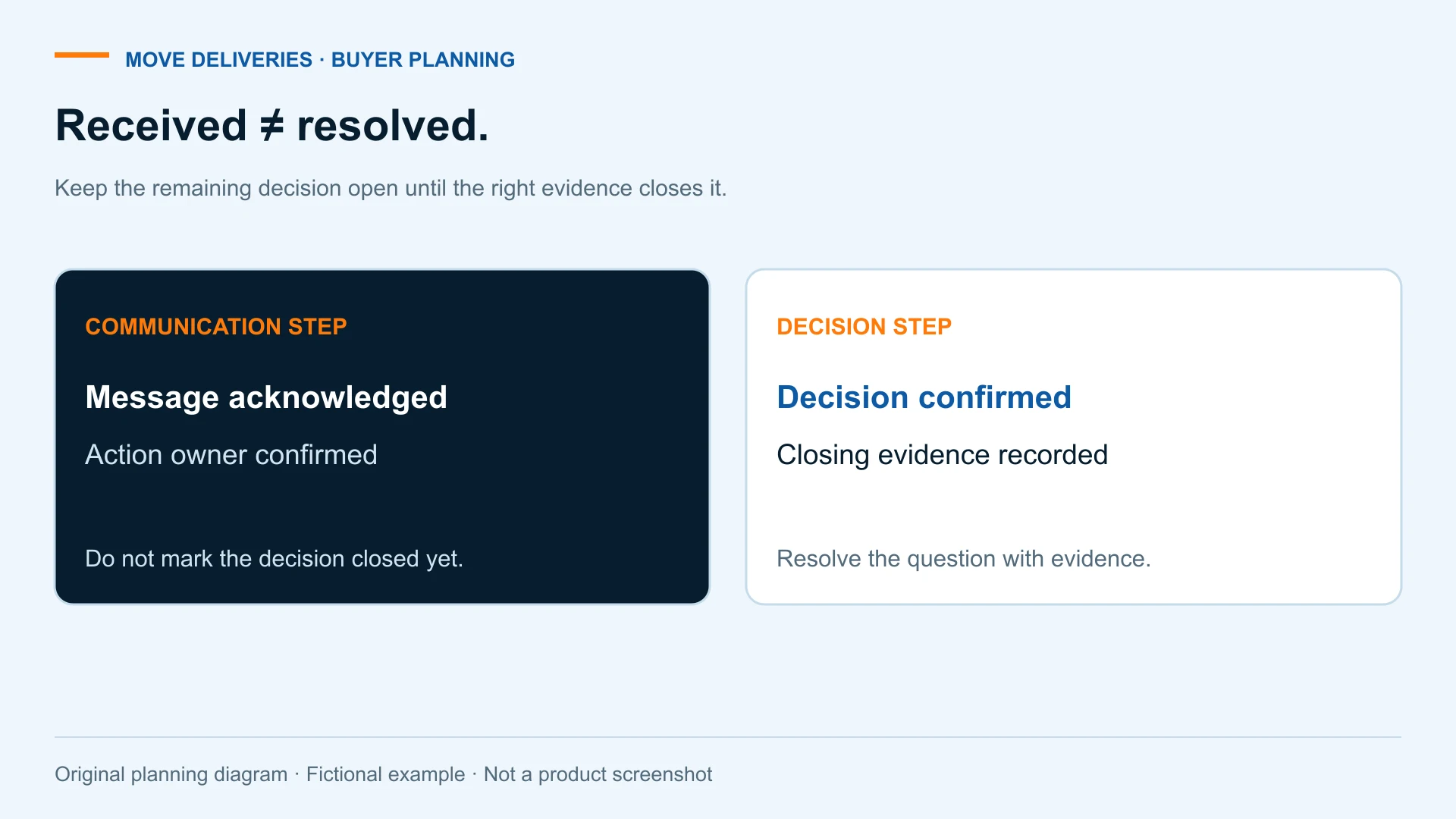
A sent email, a notification icon and an acknowledged task are not the same thing. Decide what acknowledgment means for the escalation. The receiving person should be able to state the question they are taking, the next action they will perform and when the coordinator should expect the next check. A brief “received” can be useful, but it may not establish that the person understood the time constraint or accepted ownership of a particular action.
AHRQ’s check-back communication tool describes confirming exchanged information through a response and verification. For this original operational exercise, use a similarly clear exchange: the coordinator asks for a receiving-window decision; the recipient repeats the question and their next check; the coordinator confirms that the interpretation is correct. This is an adaptation of a communication principle, not a claim that MOVE has a particular training credential or clinical program.
If the requested acknowledgment is not received through the agreed channel, use the agreed backup path. Do not turn silence into assumed acceptance, and do not create a new shipment request merely to attract attention to the first one. Keep one coordinator on the unresolved question so the provider and location team do not receive contradictory instructions from several callers. Record the actual acknowledgment time when it occurs.
6. Keep escalation separate from permission to change the delivery
An escalation asks for attention to a problem. It does not authorize a different destination, an unattended drop-off, a return movement or a revised handling method. Those actions can change the work the provider accepted and the receiving arrangement the customer approved. A person who can report an exception may not be the person who can approve a new plan. Make that distinction explicit on the decision card.
When an alternative is proposed, identify the customer role that can approve it and the provider role or process that confirms whether the transport change can be accepted. Ask what remains valid while that review is pending. Avoid telling one party that a change is confirmed while the other party is still assessing it. A requested change, an authorized change and an accepted transport arrangement should not collapse into one ambiguous “updated” label.
This matters when a destination is closing or the original receiving contact cannot be reached. The next step is not automatically “leave it with reception” or “deliver to the nearest branch.” Bring the responsible parties into the decision using the approved support path. The hospital receiving instructions checklist is a useful companion because it explains why a building address alone is not a complete acceptance plan.
7. Define closure without erasing the event
Closure should answer the question that opened the escalation. If the issue was uncertainty about who could receive the shipment, closure needs the confirmed receiving arrangement and the relevant acceptance decision—not merely a later tracking update. If the issue was an inconsistent record, closure needs a reviewed explanation of the evidence. Choose the closing condition before staff begin treating a reassuring message as proof that every concern is resolved.
Record who confirmed the decision, what was agreed and what remains open. A transport decision can be resolved while an administrative follow-up is still pending. Keep those states separate. MOVE’s proof of delivery page explains completion records; an escalation note should not claim that a delivery is complete without the relevant receiving evidence. Likewise, a completed transport record does not prove that a clinical or inventory decision has been made.
Once the immediate question is resolved, decide whether a separate service review is useful. Repeated missing acknowledgments, unclear role boundaries or conflicting contacts can be planning signals. Review the pattern with dates, event definitions and the current procedure. Preserve the original sequence rather than rewriting the history to match the final outcome. Correcting the ongoing issue and improving the process afterward are two different pieces of work.
| Open question | Action owner | Acknowledgment | Closing evidence |
|---|---|---|---|
| Missing agreed update | Named coordinator + provider support | Question and next checkpoint repeated | Confirmed status and next action recorded |
| Receiving window may not fit | Location decision-maker + provider | Which arrangement is under review | Approved receiving decision and transport acceptance |
| Conflicting instructions | Authorized customer role | Current instruction version identified | One accepted instruction and retired conflicting version |
| Decision still unresolved | Agreed backup contact | Remaining question and owner confirmed | Resolution evidence, or explicit open follow-up |
Use a medical courier escalation plan decision card
The worksheet below is an original buyer tool. Complete it with the provider and the affected locations before using it for a real delivery. ASQ’s flowchart guidance supports making process steps, decisions and participating roles visible. Here, the card is intended to expose the ownership gap between an issue being reported and a decision being confirmed. It is not a provider-approved service instruction until the responsible parties agree on the arrangement.
For each row, write the actual channel and decision owner in your internal version. Do not replace a missing agreement with “standard response” or “normal escalation.” If the team cannot identify the owner or the closing evidence, the card has found useful preparation work. Resolve that gap before testing the contact chain. Store the current version where the responsible staff can locate it and retire outdated business contact details.
The most important line may be the last one: what remains unresolved after the first response? A person can acknowledge a message but still need another team to decide whether a receiving window can change. Keeping that remaining question visible avoids a common operational mistake—marking the whole issue closed when only the first communication step was completed.
Practice with a fictional receiving-window drill
Use a harmless exercise before depending on the card. In this fictional scenario, a routine clinic supply shipment has been collected, the original receiving window ends at 3:00 p.m., and the coordinator lacks a current answer about arrival. The coordinator opens one question: “Does the existing receiving arrangement still fit?” They do not declare a service failure or assume that a different drop-off point is available.
The first contact acknowledges the request and repeats the question. A location decision-maker checks receiving availability while the provider checks the transport status through the agreed channel. The coordinator records both answers separately. If an alternative arrangement is proposed, the appropriate customer approval and provider acceptance are obtained before the coordinator describes that arrangement as confirmed. If no decision is available by the agreed checkpoint, the designated backup path is used.
End the exercise by asking where communication could have stopped without ownership. Was the first contact able to act or only forward the message? Did the backup know which question was still open? Did anyone interpret a status update as permission to change the destination? Measure the exercise against those questions, not an invented speed target. No real patient information, shipment or clinical deadline is needed to discover a gap in the contact chain.
Turn the card into a clearer service conversation
Before choosing a local courier arrangement, ask how exception questions are raised for the proposed service and how customer-side decisions connect with provider-side coordination. Bring the release pattern, receiving windows, current business contacts and examples of unresolved decisions. The purpose is to agree on a workable process—not to obtain a broad assurance that someone will “handle everything” without identifying the roles involved.
MOVE supports local same-day medical delivery and uses its proprietary platform to connect delivery visibility and records with the agreed service. Discuss the actual support and notification arrangement for your account rather than assuming a specific feature, response interval or staffing model applies to every order. A useful plan makes your team’s responsibilities as clear as the provider’s responsibilities, especially when the work spans several healthcare locations.
If you are planning a new service, use Quick Quote to begin the service discussion or Start An Account for ongoing delivery needs. These are prospective service paths, not substitutes for an agreed operational escalation channel. Give the team a clear delivery question, and agree on the contact and decision process before you need to rely on it.