What medical courier pilot evaluation should establish
Medical courier pilot evaluation is a structured review of a limited, agreed transport arrangement before deciding whether to expand it. The review identifies what was tested, what evidence was collected, which requirements were met and which conditions remain untested. A pilot is not a universal service guarantee or a substitute for procurement, clinical or compliance review.
A healthcare buyer can feel confident after several uneventful deliveries. That experience matters, but it can be overinterpreted. Perhaps every request used the same entrance, the same release owner and an ordinary daytime receiving window. The pilot may not have tested a different department, a larger packaged item or a changed instruction. Expanding without recognizing those boundaries asks the evidence to support more than it actually shows.
This guide gives seven decisions, an original go-or-revise worksheet and a fictional review meeting. It focuses on local delivery operations. Qualified personnel retain responsibility for clinical requirements, regulated materials and applicable organizational approvals. Do not use a small transport trial to claim medical certification, security assurance or legal compliance.
A good pilot begins with a specific learning question. Can the agreed release and receiving process work for these sites and this packaged scope? Can the customer team use the available status and completion records? Can unresolved operational questions reach the right owner? These questions produce more useful evidence than a broad request to “try the courier and see how it goes.”
In this article
- What medical courier pilot evaluation should establish
- 1. Define the decision before the first collection
- 2. Choose representative conditions and name exclusions
- 3. Agree the observations and success criteria
- 4. Preserve a baseline and a dated pilot record
- 5. Review exceptions without hiding inconvenient evidence
- 6. Distinguish observed success from untested capability
- 7. Choose expand, revise, continue or stop
- Use an original pilot decision worksheet
- A fictional review: expand the scope that was actually tested
- Create a one-page pilot decision memo
- Prepare a review meeting that produces a usable next step
1. Define the decision before the first collection
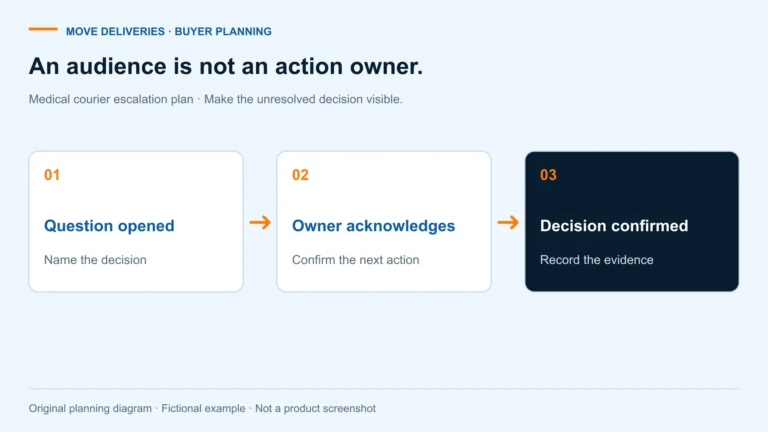
State the expansion decision you expect to make. It might concern adding similar requests at the tested sites, reviewing another receiving point or continuing a limited routine. Describe the service scope, review date and roles responsible for the decision. A pilot without a defined decision can continue indefinitely while staff disagree about whether it has succeeded.
Identify what approval is outside the pilot. Procurement may still need commercial review. Qualified personnel may need to review material-specific requirements. Your technology team may need evidence for an integration or security question. The transport pilot can produce operational observations without replacing those separate reviews. Keep their status visible in the decision record.
Use the delivery process page to frame the service conversation. Then document the narrower arrangement actually accepted for the test. Do not assume that a public service description establishes every pilot location, transport window or available feature.
2. Choose representative conditions and name exclusions
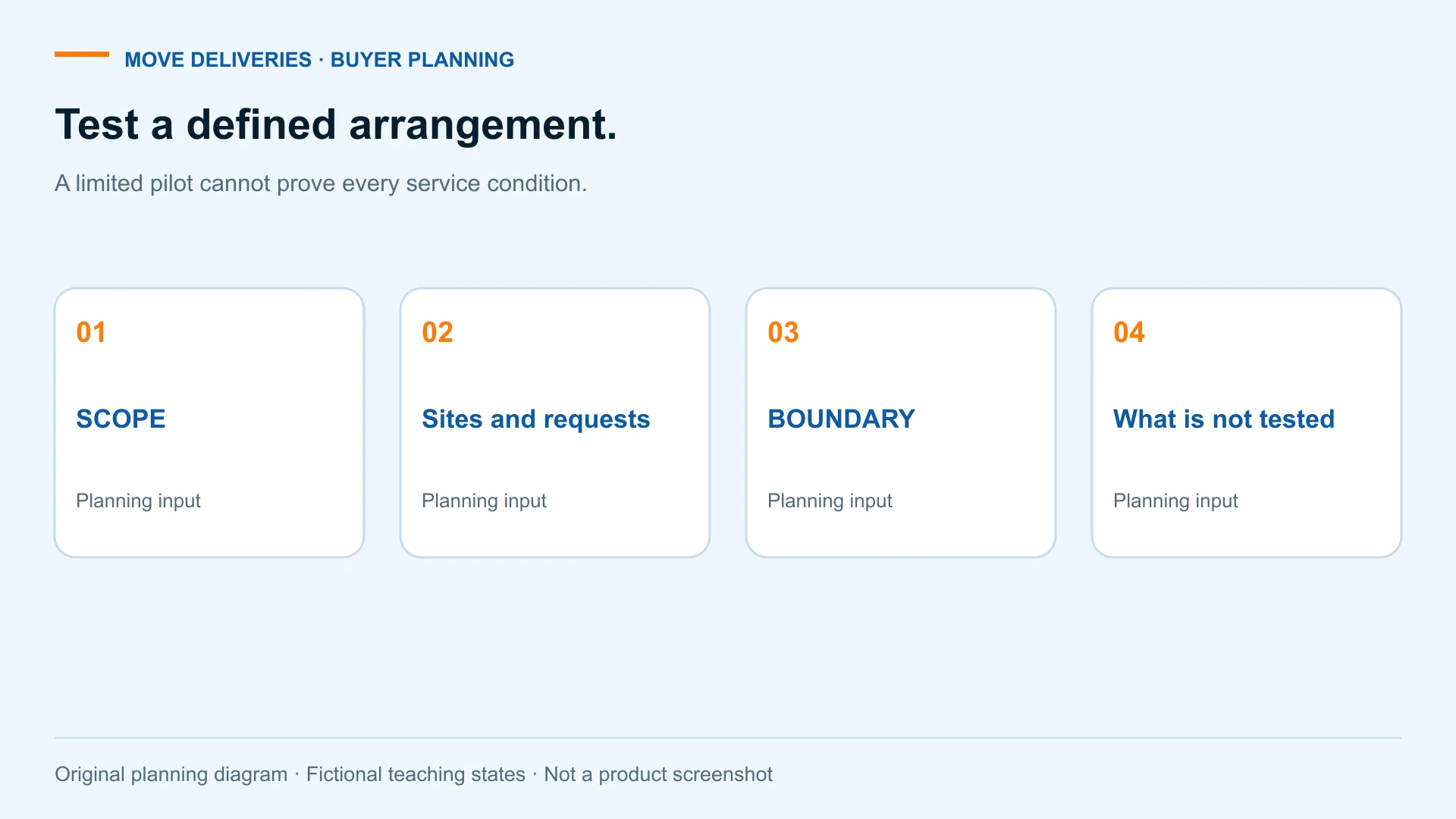
Select conditions relevant to the question you want answered. Describe the sites, approved releasing and receiving points, ordinary packaged scope and actual service periods. Explain why they are included. The selection need not mimic every possible operation, but it should not quietly exclude the very condition that motivated the service discussion.
List what the pilot does not test. Examples might include another site, unusual packaged dimensions, different receiving staff or a proposed order integration. These are scope statements, not accusations that the provider cannot support the excluded work. They simply prevent an unevaluated condition from appearing approved by association.
Do not invent a universal number of deliveries that makes a pilot statistically representative. The appropriate test design depends on the decision and the organization’s analysis needs. A small operational trial can reveal process gaps without establishing a reliable failure rate or national performance estimate. Where statistical conclusions are needed, involve qualified analytical personnel.
3. Agree the observations and success criteria
Define what evidence will support each requirement before the trial begins. For release, identify the readiness and collection records. For receiving, identify the agreed completion evidence. For communication, identify which operational question should reach which role. Choose criteria that the parties understand and that can actually be observed under the accepted arrangement.
Keep criteria specific without manufacturing a guarantee. A requirement can identify the agreed service window or proof record without inventing an industry-wide target. Record the accepted terms and how they will be reviewed. If a condition is not measurable with available evidence, mark that limitation and decide whether another observation or review is needed.
Avoid measuring only the most convenient outcome. A completed delivery may still have required repeated clarification because the customer supplied an ambiguous entrance. Conversely, an unprepared package may explain why an expected collection could not proceed. The pilot review should distinguish service execution from readiness and receiving conditions instead of assigning every difference to the courier.
4. Preserve a baseline and a dated pilot record
Record the situation that prompted the test using available evidence. Perhaps staff are seeking clearer delivery records or a less fragmented collection routine. Describe the problem without inventing historic failure counts. If the baseline is incomplete, say so. A pilot cannot demonstrate a quantified improvement against a number that was never measured.
Maintain the accepted request references, instruction versions and observations during the test. Keep the record factual: what was requested, what was confirmed, what occurred and which question remained open. Separate direct evidence from a participant’s interpretation. This makes the final review more useful when people remember the same event differently.
The nonprofit ASQ plan-do-check-act framework supports planning a change, testing, reviewing evidence and deciding the next action. Applied here, it informs a bounded courier trial rather than a claim that the pilot proves statistical effectiveness or an ASQ certification. The worksheet and scenarios in this article are MOVE editorial planning tools.
5. Review exceptions without hiding inconvenient evidence
Include requests with unresolved or changed conditions in the review. Describe the operational stage and the evidence available. Was the package ready under the agreed instructions? Did receiving availability change? Was a proposed revision accepted? The review should identify the actual difference rather than excluding every difficult request from the pilot summary.
An exception can reveal a useful process gap without establishing a universal service failure. Record the gap, its responsible owner and the proposed correction. If the cause is not supported, keep it unresolved. Do not convert a participant’s impression into an official explanation because the meeting needs a tidy conclusion.
Where the accepted arrangement changed during the pilot, preserve both versions. A revised receiving point or additional packaged unit can make later requests different from earlier ones. Those differences may be relevant to the expansion decision. The corrective-action guide describes reviewing a specific exception; the pilot decision asks what the resulting evidence supports next.
6. Distinguish observed success from untested capability
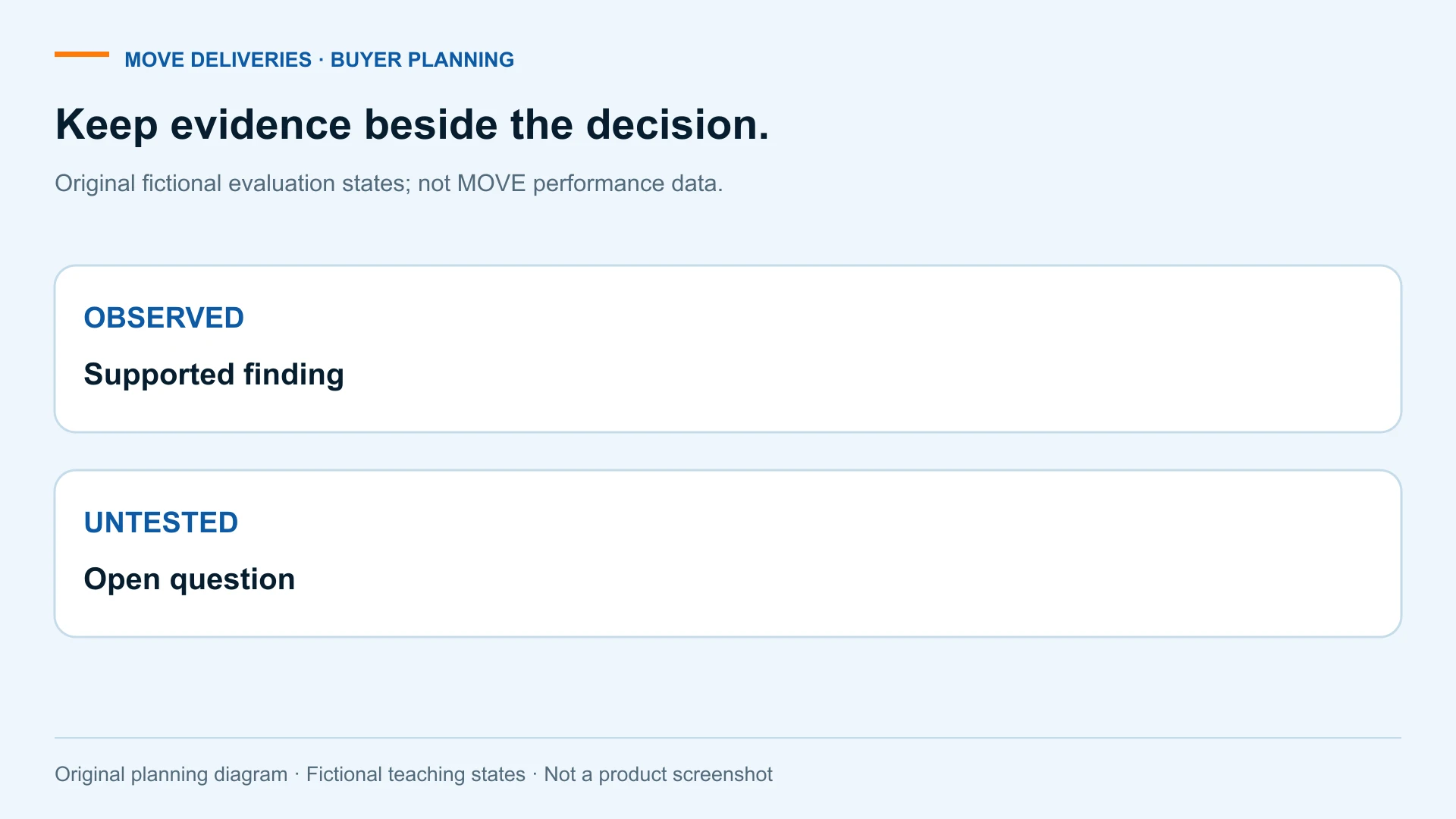
At the review, place the tested conditions beside each finding. If the available completion records were useful for ordinary daytime deliveries, that is a supported observation about those requests. It does not automatically establish the same experience at a different department or under a new integration. Keep the language proportional to the evidence.
Separate a demonstrated workflow from a proposed feature. MOVE coordinates local same-day medical delivery through its proprietary platform, but this article does not claim a trial activates every notification, integration or record option. Review the supported configuration for the actual pilot. The proof of delivery page and tracking page provide context, not substitute evidence for an untested configuration.
Ask which unresolved conditions matter to the next phase. Some may need clarification before similar requests continue. Others may belong to a separate future test. Record the distinction. An expansion decision becomes more trustworthy when it openly identifies both supported findings and remaining questions instead of presenting the trial as a blanket endorsement.
7. Choose expand, revise, continue or stop
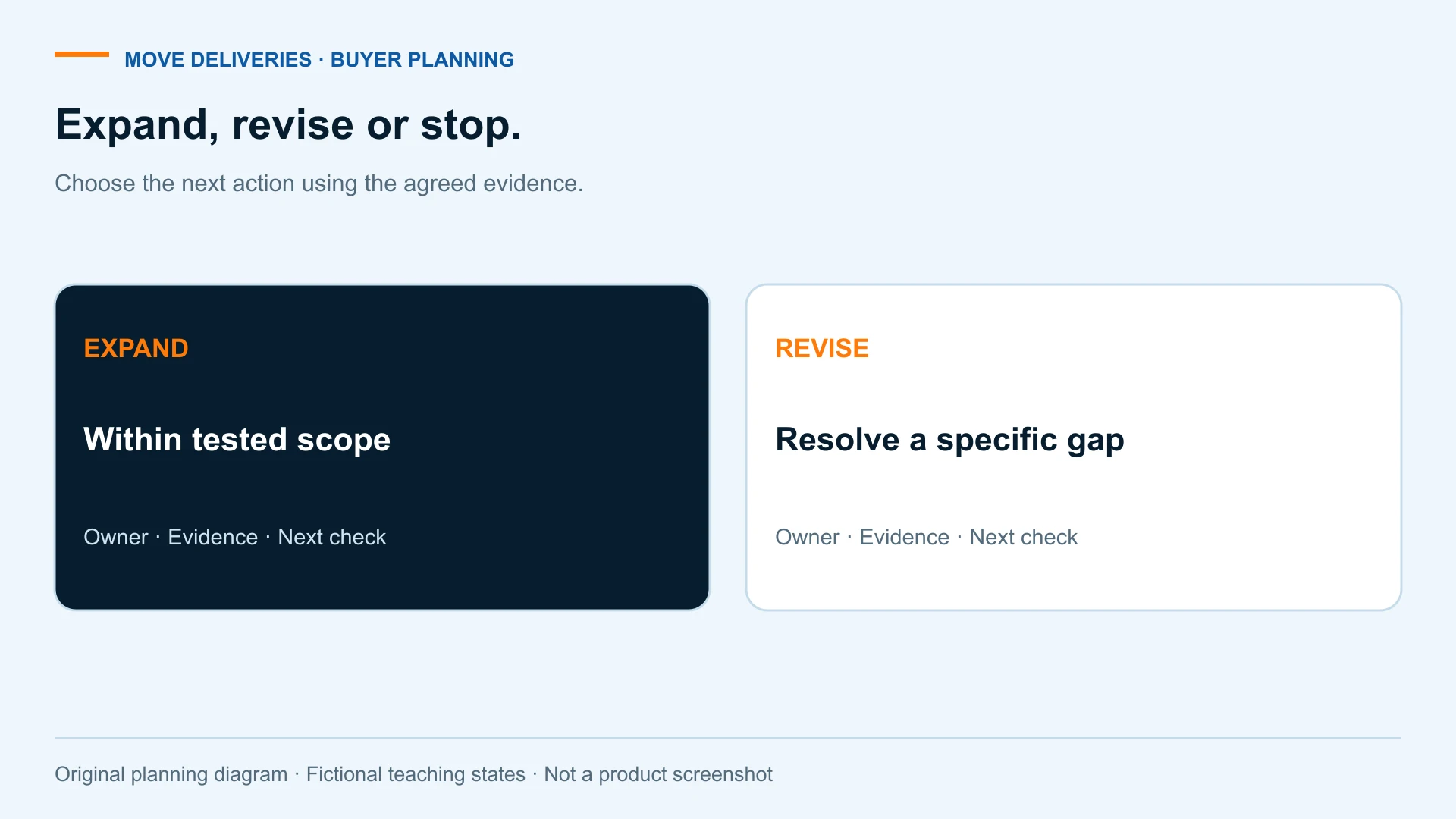
Make the next decision explicit. Expanding within the reviewed scope differs from adding new sites or materially different packages. Revising a specific instruction differs from extending the trial because evidence is missing. Stopping a proposal differs from cancelling individual accepted requests already in progress. Each action needs its own responsible owner and agreed implementation.
State the reason and the evidence that supports it. If the team continues the pilot, identify the unresolved question, what observation will answer it and the next review date. Do not use “more testing” as an indefinite placeholder. If the proposal stops, preserve the decision record and separately resolve any remaining accepted work through the appropriate process.
Confirm commercial and operational changes before communicating the next phase to staff. A positive review does not itself reserve additional capacity or establish a new price. The scheduled delivery option may fit recurring work, but the actual arrangement still needs acceptance. Evidence can support a decision without acting as a booking.
| Fictional requirement | Evidence state | Finding | Next action |
|---|---|---|---|
| Ordinary release process | Reviewed observations | Supported within tested scope | Discuss continuation |
| Completion record use | Customer review pending | Not yet concluded | Resolve record question |
| Additional department | Not tested | No conclusion | Separate scope review |
Use an original pilot decision worksheet
Create one row for each requirement or learning question. Recommended columns are tested condition, agreed criterion, evidence reference, supported finding, limitation, proposed next action and decision owner. Keep the pilot’s overall scope at the top. This allows someone outside the review meeting to understand why the team chose its next step.
The fictional worksheet below includes a release process that was observed, a completion-record review that remains open and an additional site that was not tested. These states are deliberately different. “Not tested” is neither a failure nor a successful result. “Evidence awaiting review” is not proof that a requirement was met.
Avoid using an overall score to erase a critical unanswered question. A pilot can have several encouraging observations while one important expansion requirement remains unresolved. Record that requirement directly. If the organization uses a formal scoring method, define its meaning and limitations separately; this article supplies no invented pass percentage or universal procurement threshold.
A fictional review: expand the scope that was actually tested
A supplier and clinic agree a limited trial of prepared cartons under one ordinary receiving arrangement. The customer team records readiness answers, accepted request references and available completion records. During review, the evidence supports continuing similar requests at those two points. The team also wants to add a different department with a different entrance.
The worksheet records the first finding as observed under the tested conditions. It records the new department as untested. The team can discuss continuing the established arrangement while separately reviewing the additional department’s readiness, receiving and service requirements. That is more precise than declaring the entire organization approved after the trial.
One completion record remains under customer review because the team has not agreed which field answers its receiving question. The review assigns that gap to the relevant customer and service roles. It does not fabricate a failure count or mark the requirement complete to make the pilot summary look cleaner. A concrete record question can be resolved and checked without recasting every delivery as a problem.
In a different outcome, the trial may show that the proposed preparation routine is not ready for expansion. The team can revise that routine and define a narrower next test. The lesson is not to keep testing until the result looks positive. It is to let the evidence support the next action and preserve the limits of the conclusion.
Create a one-page pilot decision memo
Write the decision memo so an approver who did not attend the trial can understand it. Start with the original learning question and the accepted scope. List the evidence period and references. Separate supported findings, unresolved observations and excluded conditions. Then state the proposed next action and the roles whose approval or service acceptance is still required.
Include a limitations paragraph that names the actual boundaries, not a generic disclaimer. For example, the test may have used one receiving point and ordinary packaged cartons, while an additional department remains unreviewed. Those limits explain why the team can discuss continuing one arrangement without declaring every possible shipment approved. Keep the description factual and avoid invented customer testimonials or performance rates.
If the next action is a revised trial, attach the specific question that the revision must answer. Identify what changes, what stays the same and how the new evidence will be reviewed. Preserve the earlier memo rather than overwriting it with the new plan. A reader should be able to follow the decision sequence and understand why the team changed direction.
For expansion, connect the memo to the separate commercial and operational acceptance. A positive pilot finding is an input to that conversation, not a reservation or signed service amendment. Staff should receive the new confirmed instructions only after the required process is complete. This keeps an encouraging review from becoming an accidental promise about work that has not yet been accepted.
Prepare a review meeting that produces a usable next step
Send the scope and evidence summary to the responsible participants before the meeting through the approved channel. Ask them to identify factual differences or missing records. Keep the discussion centered on the defined learning question, not a general debate about every service feature. If another review is required, name its owner instead of leaving it as an unnamed condition of approval.
How long should a pilot run? There is no universal duration in this guide. Choose the actual decision and relevant conditions. Can a smooth pilot guarantee every future delivery? No. Can a pilot replace a security or compliance assessment? No. Should you change the success criteria after seeing the result? Preserve the original criteria and explain any proposed revision rather than rewriting the test retrospectively.
For a defined local trial, request a Quick Quote. For a recurring arrangement, Start An Account and bring the decision worksheet. A useful pilot does more than reassure the buyer. It establishes a clear, evidence-backed next step—and names the questions the evidence has not answered yet.