Define the transport question without making a clinical decision
Medical supply stockout delivery planning is the review of transport feasibility after a healthcare organization identifies a supply gap and responsible personnel approve a source and packaged shipment. The courier question is whether that specific local work can be accepted under the actual release, receiving and handling requirements. It is not a decision about product substitution, clinical use or the quantity needed for patient care.
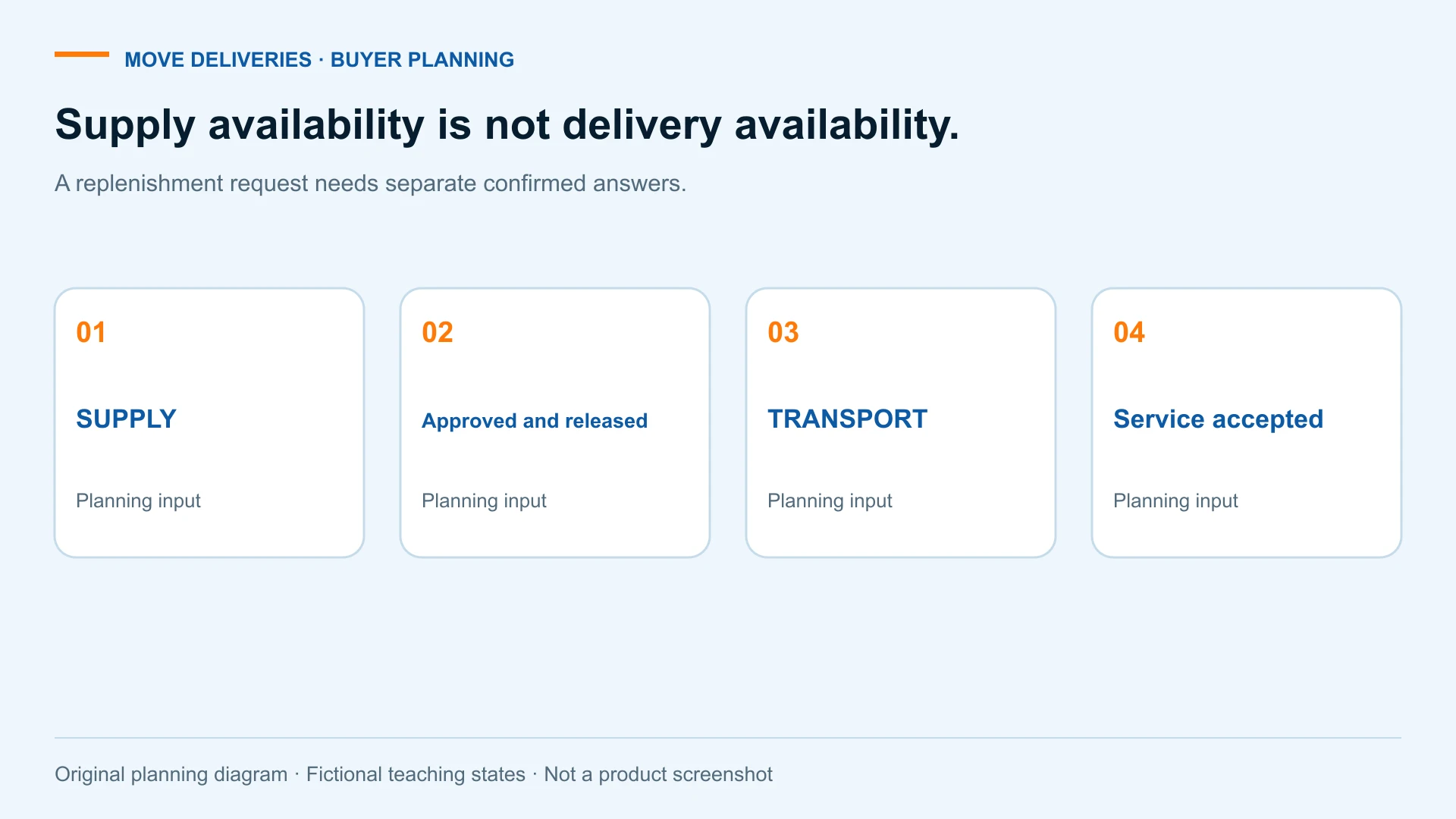
When a clinic runs short of an item, the pressure to give an immediate arrival answer can be intense. Yet a nearby supplier’s apparent stock, a proposed transfer from another location and an accepted courier request are three different things. A fast conversation built on an unverified shelf count can create an arrival promise before anybody has confirmed that the approved units are available for release.
This guide offers seven transport checks, a feasibility worksheet and a fictional supply-transfer example. It is aimed at operations and procurement staff working with their organization’s responsible healthcare personnel. For emergencies or patient-care decisions, follow the organization’s approved clinical and emergency procedures. A website article or public courier inquiry is not an emergency response channel.
The FDA’s medical device shortage list provides public context about categories of device shortages. It does not establish availability at a particular supplier or the suitability of an alternative item. Check current authoritative product information with the appropriate personnel; this article makes no claim about a particular device currently being in shortage.
In this article
- Define the transport question without making a clinical decision
- 1. Obtain an approved supply decision first
- 2. Verify source availability and authorization to release
- 3. Describe the packaged shipment accurately
- 4. Confirm destination readiness independently
- 5. Review the service before communicating an arrival promise
- 6. Assign an owner to every unresolved transport condition
- 7. Review transport completion and inventory resolution separately
- Use a transport feasibility worksheet
- A fictional replenishment request with one missing fact
- Test whether the worksheet can reveal a missing agreement
- Prepare the next request before the pressure returns
1. Obtain an approved supply decision first
Ask the responsible customer role what supply movement has actually been approved. The decision should identify the source, destination and authorized packaged scope through the organization’s accepted process. A courier coordinator should not choose a substitute product, make a clinical priority decision or infer authorization from someone saying that a unit is needed urgently.
Separate the product question from the transport question in your internal worksheet. If procurement or qualified personnel have not resolved suitability, the transport proposal remains incomplete. Keep that gap visible and assign the appropriate decision owner. Do not mark the shipment ready simply because a potential source was found.
Share only appropriate operational facts with the provider. The public Quick Quote path can support a defined local transport inquiry; it is not a place for unnecessary patient details or an unresolved clinical decision. Use the approved channel for sensitive information and material-specific requirements.
2. Verify source availability and authorization to release
Confirm that the source has the approved units and can release the actual packaged work. “We should have it” is a useful lead, not a readiness confirmation. Ask the person who owns the source’s release process when the packaged units will be available and who is authorized to provide them to the courier.
A transfer from another care location may require internal approvals distinct from a purchase at a supplier. This guide does not establish those rules. Responsible customer personnel determine whether the transfer can occur. The service discussion should receive the resulting approved scope, not an assumption that a nearby location can spare the units.
Record the source contact’s answer, the relevant date and the operational time. If the count or readiness changes, update the proposal through the supported process. A driver dispatched under earlier assumptions should not arrive to discover that the units were reserved for another purpose. Do not imply that a courier can procure supplies or resolve a shortage simply by arriving quickly.
3. Describe the packaged shipment accurately
Provide the package count, packaged dimensions and any loading or handling information required for the service review. The product name alone may not describe the transport unit. Several small supply boxes and a large equipment package can lead to different vehicle and loading discussions even when both requests are called replenishment.
Qualified personnel and the responsible organizations establish applicable packaging, suitability and material-specific requirements. Do not use urgency as a reason to skip that review or copy generic handling instructions from another shipment. Where a requirement is not yet resolved, state the open question and involve the appropriate role.
The loading planning guide can help organize operational details such as space, people and tools. It does not certify a vehicle for every item or authorize transporting regulated materials. The provider must review the actual packaged scope before acceptance.

4. Confirm destination readiness independently
Verify the designated receiving point and the person or role available to accept the approved supplies. A clinic that needs an item may still have an unstaffed receiving desk or a different delivery entrance. General opening hours do not establish the specific receiving arrangement. Ask the responsible destination owner about the actual date and request.
Describe any receiving requirement that affects the service discussion, including the relevant local time zone. A clinical need may establish a customer priority, but the courier provider must separately confirm what transport arrangement can be supported. Do not translate urgency into an arrival guarantee on behalf of another team.
If the destination answer changes, keep the proposed revision visible and obtain the required response. A message sent to the receiving team does not by itself establish that transport instructions changed. Our receiving-window guide explains this side of preparation without prescribing clinical timing or universal acceptance rules.
5. Review the service before communicating an arrival promise
Present the approved source, destination, package-ready information, receiving need and packaged scope to the provider. Ask what local service can be accepted. Do not assume that distance alone establishes availability or that a driver visible in a coverage region is assigned to this request. Specific pickup and delivery requirements determine the service conversation.
Keep requested, under review and accepted arrangements distinct. If the provider offers a proposed option, confirm the applicable instructions and commercial scope through the agreed process. Discuss the relevant STAT delivery option without inventing a universal response time, rate or capacity promise.
Communicate only the arrival information actually available under the accepted service. An estimate helps preparation but is not the same as a guaranteed receiving event. If an answer remains open, say what is being reviewed and when the responsible person will check again. That is more trustworthy than reassuring staff with an exact time that nobody has accepted.
6. Assign an owner to every unresolved transport condition
A supply gap can produce several parallel conversations: procurement checks a source, a clinic confirms receiving and a coordinator asks about courier availability. Connect these answers in one maintained record. Assign each unresolved condition to the role that can resolve it. A generic “urgent” label does not identify the next decision.
Use a concise operational statement such as source readiness awaiting confirmation or provider scope under review. Preserve the difference between information missing and a proposed option rejected. Those states require different follow-up. Do not ask a driver to infer an alternative source or destination from an unresolved customer discussion.
AHRQ’s check-back guidance supports verifying exchanged information. Applied narrowly here, the parties can restate the accepted source, destination and next action. That is a communication technique, not a claim of platform automation, shortage resolution or clinical effectiveness.
7. Review transport completion and inventory resolution separately
After receiving, verify the available delivery evidence for the accepted request. Record any count or receiving difference through the approved process. A completed transport event can establish that the agreed packaged work was received; it does not establish that the clinic’s inventory is now sufficient or that the approved product meets every ongoing need.
The responsible supply and healthcare teams should review the underlying gap through their own procedures. Your courier record can support that review by providing the transport reference and agreed event evidence. Do not mark a clinical or inventory issue resolved simply because one delivery is complete. Separate responsibilities make the follow-up clearer.
The proof of delivery page explains the transport evidence context. If the customer needs further replenishment, that is a new planning question with its own readiness and service review. Closing one request does not automatically book the next movement.
| Fictional movement | Source answer | Receiving answer | Provider answer |
|---|---|---|---|
| TRAIN-R1 | Approved units; packaged readiness pending | Confirmed for the proposed request | Under review; not accepted |
| TRAIN-R1 revised | Packaged readiness confirmed | Current arrangement confirmed | Review actual scope before acceptance |
Use a transport feasibility worksheet
Create one row for each approved proposed movement. Recommended fields are supply decision owner, source authorization, packaged scope, release readiness, designated receiver, provider review, accepted service reference and remaining decision. Mark unconfirmed answers explicitly. The worksheet is a customer planning tool, not a description of mandatory fields in MOVE’s proprietary platform.
The fictional example below begins with an approved supply proposal but no accepted transport. The source has not yet confirmed packaged readiness and the receiving team has supplied an answer. The provider is reviewing availability. The row cannot become a confirmed delivery merely because two of the three operational questions have answers.
After the missing facts are resolved and service is accepted, date the instruction record and tell affected staff which plan applies. If a fact changes again, review that change through the responsible roles. Keep the prior version available for context instead of editing it into an apparently continuous agreement. The evidence trail should show what was known at each decision.

A fictional replenishment request with one missing fact
A clinic identifies a gap in an approved supply item. Its responsible personnel authorize a proposed movement from a supplier. The supplier confirms that units exist but has not yet confirmed when the packaged shipment can be released. The clinic’s receiving role is available. A coordinator asks the provider for a service review while clearly stating the unresolved source readiness.
The provider cannot treat the supplier’s stock answer as a release-ready time. The worksheet assigns that question to the supplier owner. Once the answer arrives, the provider reviews the actual scope and receiving requirement. Only then can the coordinator communicate the accepted arrangement. If the service cannot meet the proposed need, responsible customer personnel review the next option rather than telling the driver to improvise.
In a second version, a nearby care site offers a possible transfer. That offer does not establish authorization or product suitability. The customer’s responsible personnel review those questions before transport is requested. The courier worksheet must not become an informal substitute for the organization’s supply approval process.
The exercise ends with two separate reviews: evidence of the accepted transport and the responsible team’s assessment of the remaining supply issue. No invented inventory threshold, shortage statistic or claimed patient outcome is needed. The value is in exposing the missing fact before a specific arrival promise is made.
Test whether the worksheet can reveal a missing agreement
Use a fictional replenishment proposal and deliberately leave one answer unresolved. Begin with source readiness. Ask whether the team would communicate a confirmed arrival despite not knowing when the packaged units can be released. If so, revise the instruction that distinguishes supply availability from transport readiness. The purpose is to expose a planning assumption, not create a real urgent request.
Repeat the exercise with receiving availability unresolved, then with provider acceptance unresolved. Each version should keep a different owner and next question visible. A completed customer worksheet cannot substitute for the provider’s response, and an accepted vehicle arrangement cannot substitute for the organization’s approval of the supplies. These boundaries should remain readable even when staff are under time pressure.
Finally, introduce a changed package count after the proposal was reviewed. Ask which supported process handles the revision and who confirms the response. Do not presume that the earlier acceptance covers added units or a larger packaged item. The exercise should produce a specific instruction about communicating scope changes, not a blanket direction to move whatever is available.
Keep training references clearly fictional and use operational facts only. Do not include real patient histories, create unnecessary live bookings or ask staff to simulate a clinical emergency through a courier form. Have the responsible customer and service roles review the resulting transport checklist. A planning exercise is useful when it clarifies the next question, not when it manufactures a reassuring claim of readiness.
Prepare the next request before the pressure returns
After the event, identify one transport-planning improvement. Was the source’s release owner difficult to reach? Did package dimensions arrive late? Was the receiving point unclear? Improve the contact or preparation record relevant to that problem. Do not infer that every future shortage will have the same source, package or service requirement.
Should a courier choose substitute supplies? No; the responsible organization decides suitability. Can a nearby source guarantee a faster arrival? No; readiness, receiving and accepted transport still need review. Does a public shortage list establish local stock? No. Does transport completion establish that the supply issue is solved? Not by itself.
For medical supplier delivery, MOVE coordinates local same-day transport through its proprietary platform. Use a Quick Quote for a defined local request, or Start An Account for ongoing work. Bring the approved packaged scope and the worksheet’s unresolved answers. Urgency deserves clarity, not assumptions disguised as a plan.