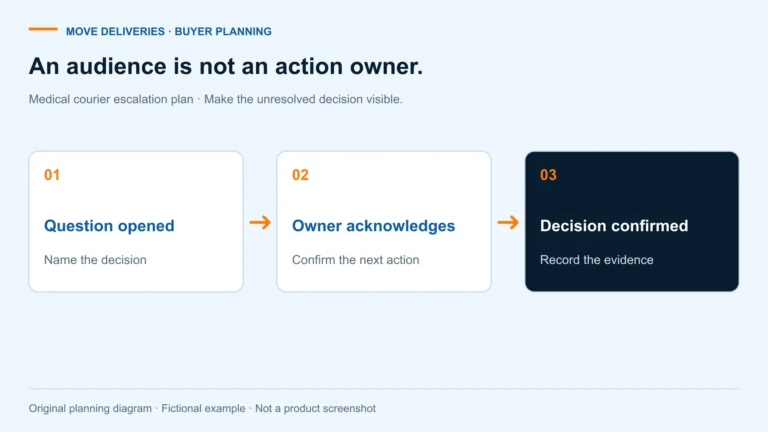

Courier driver training should help a person perform the actual accepted task, recognize its limits and use the right escalation path when conditions change. A certificate can document a course or achievement, but its title alone cannot explain whether a driver can follow your current site instruction, identify a transport unit correctly or handle an ambiguous receiving situation.
Healthcare buyers need a more useful question than whether training exists. Ask what work the learning covers, how performance is assessed and what happens when the assignment changes. This guide offers an original evidence-review worksheet for that conversation. It does not establish a universal courier credential, regulatory training syllabus or actual assessment result for MOVE drivers.
The distinction matters because readiness is specific. A driver can understand a general handoff process yet be unfamiliar with a changed service entrance. A knowledgeable person can lack access to the current instruction. A completed course may address an earlier task. Review the connection between the learning and the work without treating every operational gap as a failure of individual effort.
1. Start With the Accepted Task and Its Boundaries
Identify the responsibility you want the evidence to support. Examples might include finding the agreed handoff point, matching a closed transport unit to an order reference, retrieving the current instruction or recognizing that a requested change requires authorization. Define the behavior plainly enough that an observer can tell whether it occurred.
Also identify what the courier is not authorized or qualified to decide. Transport coordination does not automatically include clinical acceptability, product preparation or legal interpretation. Training evidence should show an appropriate boundary and escalation path rather than encourage a driver to improvise expertise the assignment does not include.
Keep the customer and provider responsibilities distinct. A site may need to maintain a current access instruction while the provider ensures the courier can obtain and understand it. If the instruction is unavailable or obsolete, repeating a general training session may not address the underlying condition. Review the workflow before assigning more coursework.
MOVE’s company overview introduces the service approach. In a procurement conversation, ask for evidence relevant to the actual proposed work and the arrangement being accepted. This editorial article does not claim that a particular internal training program or accreditation has been demonstrated.
2. Separate Attendance, Knowledge and Observed Performance
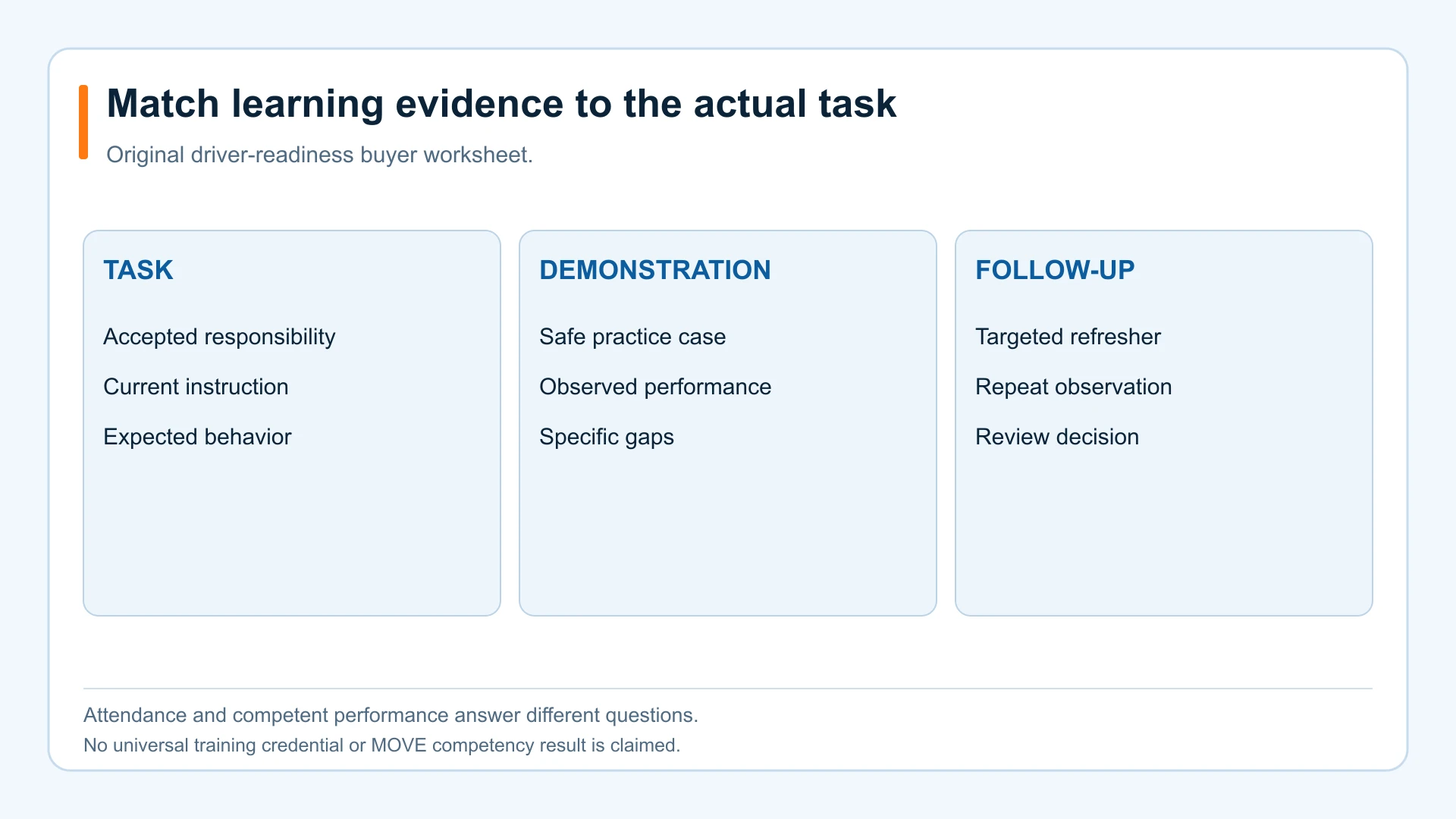
An attendance record says a person took part in an activity. A knowledge check can show how they answered defined questions. An observed practice can show what they did under stated conditions. These evidence types answer different questions. Do not convert one into the others simply because all three are described as completed training.
Read the evidence in its actual scope. Which learning objective was assessed? Which instruction version was used? Who reviewed the result? What remained uncertain? A broad completion label may be sufficient for one administrative purpose but insufficient for a specific readiness question. Explain the gap rather than dismissing the entire record.
The CDC Quality Training Standards provide a general educational reference: learning objectives, assessment and follow-up support should connect. They are benchmarks for training developed or funded by CDC, not a universal medical-courier credential. Our buyer worksheet is original and does not imply CDC approval of a provider’s training.
When a credential is required by your applicable arrangement, qualified reviewers determine whether the credential, issuer, validity and scope meet that requirement. That review can coexist with task-specific observation. Neither an operational demonstration nor a certificate should be presented as proof of every legal, clinical and transport requirement.
3. Use a Task-to-Evidence Review Ledger
A ledger lets buyers ask focused questions without requesting an unrestricted personnel file. Identify the actual task, appropriate evidence and responsible review role. Use approved summaries or demonstrations where suitable, and limit access to private training and personnel information according to the real arrangement.
| Task question | Relevant evidence to discuss | Important limitation |
|---|---|---|
| Can the courier locate the agreed handoff? | Controlled walkthrough using the current site instruction | One location does not establish readiness at every site |
| Can the unit be matched to the assignment? | Safe practice with dummy identifiers and closed practice units | Practice does not prove every live custody event |
| Can an ambiguous change be escalated? | Scenario response identifying authorized decision roles | Knowing the contact does not authorize clinical decisions |
| Can current instructions be retrieved? | Observed access using the actual approved workflow | A document sent by email is not evidence of usable access |
| What happens when the task changes? | Defined review trigger and relevant refresher evidence | No universal refresher interval is supplied here |
| How are gaps handled? | Specific follow-up and repeated relevant observation | A meeting alone does not verify that a gap was resolved |
Keep the ledger proportional to the proposed scope. A buyer commissioning one local recurring assignment does not need to design an entire provider curriculum. Ask for enough evidence to understand the relevant task and boundaries. Material product, safety and regulatory questions should go to the appropriately qualified people rather than be flattened into a general score.
Record unresolved questions explicitly. If the evidence is from a different site or older instruction, note that limitation. Do not label the driver untrained solely because a particular document has not been supplied, and do not label the assignment ready merely because a general certificate has been supplied.
4. Design a Safe and Relevant Demonstration
Use a controlled practice case when it is appropriate and authorized. Dummy references, empty units and approved test environments can help assess an operational sequence without exposing patient information or creating unintended live work. Qualified reviewers decide whether a task requires another approach or additional safeguards.
Define the expected behavior before the exercise. An instruction-retrieval check might expect the person to find the approved version without help from its author. An escalation scenario might expect them to identify a missing authorization and contact the relevant decision role. Do not redefine the pass condition after seeing the result just to produce a favorable record.
Make the task recognizable without manufacturing a dangerous situation. Do not use real duplicate orders, unsuitable equipment or sensitive cargo merely to test initiative. A good exercise allows an appropriate stop or escalation response. It should not reward a person for completing an assignment that responsible reviewers have not accepted.
Observe the process and record its limits. If a coach gives a prompt, distinguish assisted performance from an unassisted demonstration. If the case uses an empty tote, do not describe the result as validation of product packaging or clinical transport conditions. Accurate limitations make the evidence more useful, not less impressive.
5. Ask Whether a Gap Is About Learning, Access or Work Design
If someone cannot find a receiving instruction, first determine whether the current instruction exists and is available through the approved path. If it does not, a refresher on looking harder will not solve the missing information. Address the source and access conditions with the responsible owners, then assess the relevant behavior again.
If the instruction is available but ambiguous, clarify it before testing recall. Different experienced people may interpret a broad phrase differently. A demonstration can expose that ambiguity. Treat it as useful evidence about the work rather than using the exercise to choose one person to blame for a poorly defined expectation.
If the behavior requires knowledge or practice that is genuinely missing, use targeted learning tied to the observed gap. Explain the expected task and boundary, provide suitable practice and reassess the relevant behavior. Avoid assigning the same general course repeatedly when the unresolved condition is much more specific.
Keep this review separate from disciplinary and employment decisions. Those decisions have their own responsible processes. The public worksheet is a procurement and operational-readiness tool, not a personnel evaluation standard or a determination of worker status.
6. Revisit Evidence When the Work Changes
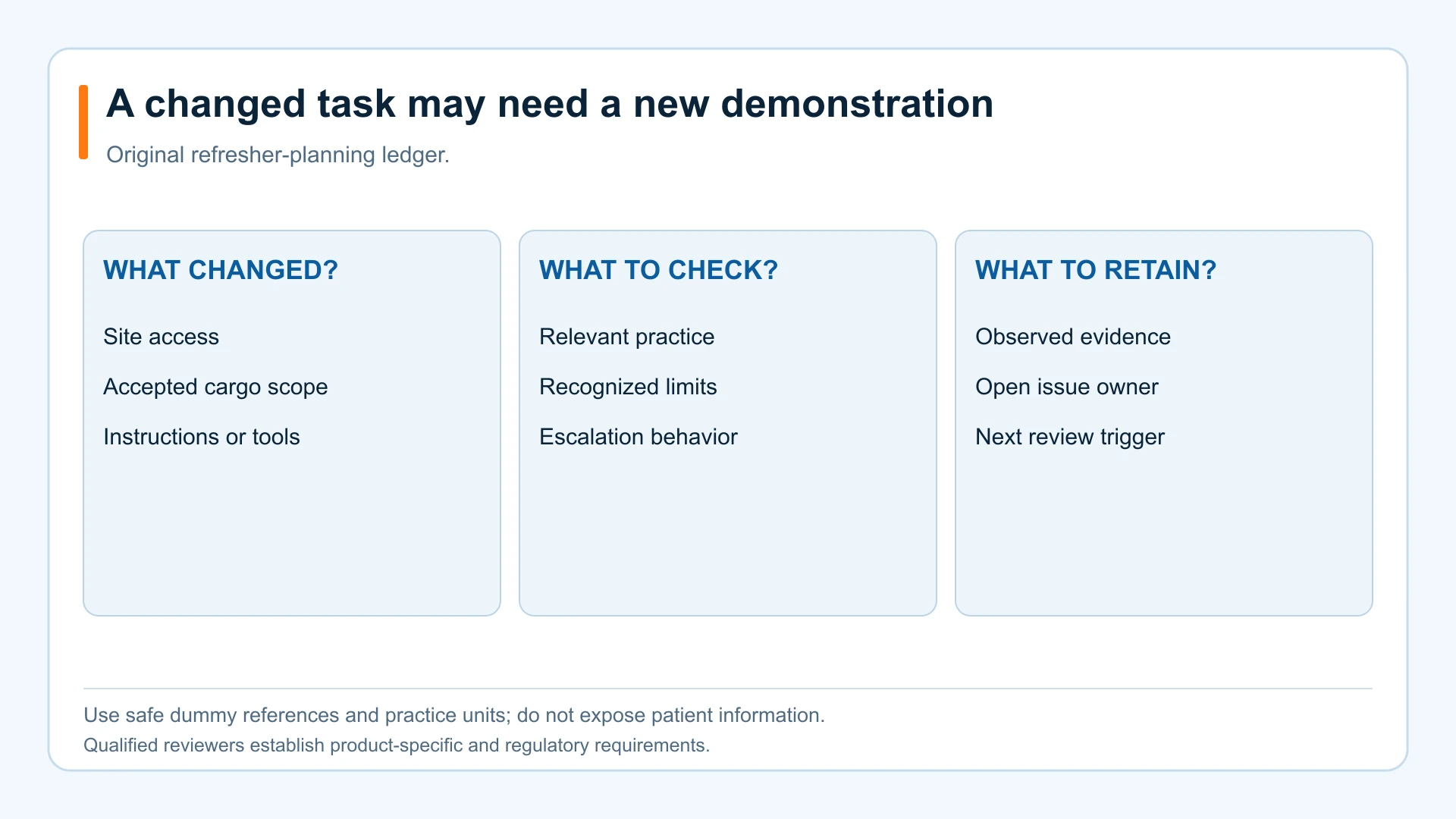
A changed site entrance, receiving role, cargo scope or accepted tool can change what a courier needs to understand. Define who identifies the change and decides whether existing evidence remains relevant. A calendar-based refresher may serve one purpose, but it should not be the only way a material new task receives attention.
Use current instructions in the follow-up. A demonstration against an obsolete version can produce a technically correct result that is operationally useless. Connect the record to the version actually accepted for the assignment, and make clear which conditions were included in the observation.
Include relevant backup arrangements in the discussion. A familiar courier knowing a site well does not demonstrate that a replacement has the same instruction access or task understanding. Ask how the actual provider reviews readiness for the accepted backup arrangement without assuming a particular staffing model or promising driver availability.
MOVE’s scheduled delivery information helps frame recurring work. Confirm the actual site instructions, change process and evidence available for your proposed service. A repeat schedule does not eliminate the need to review material changes.
7. Examine a Fictional Instruction-Change Scenario
Imagine a clinic moves its receiving point from a main desk to a staff service alcove. The accepted instruction has been updated, but a practice participant follows an old printout. The observation shows a version mismatch. It does not establish that the person ignored the current instruction or that every driver would make the same choice.
The responsible team checks how the old copy remained in circulation and how the current version is accessed. After revising the approved distribution path, a controlled practice asks a different authorized participant to retrieve and explain the current receiving point. The coach records prompts, observed behavior and remaining questions.
A passed narrow check supports a conclusion about that instruction path under the tested conditions. It does not establish permanent error-free delivery or certify clinical handling. Keep the accepted instruction owner and a future-change trigger visible after the exercise closes. The scenario contains no real MOVE personnel record or customer result.
8. Report Readiness Without Inflating the Claim
Summaries should state the reviewed task, scope, evidence period and unresolved limitations. Completed observations divided by selected observations is not automatically a fleet-wide competency rate. If you use a percentage, identify the population and exclusions. Do not present a small practice group as representative of every driver and assignment.
Keep feedback useful to the people responsible for the work. A finding can lead to clearer instruction, targeted practice or a better escalation path. Report the supported change rather than a promised reduction in delays, claims or patient harm. Those broader outcomes require their own evidence.
Ask how relevant questions can be revisited during ordinary service review. A buyer does not need unrestricted access to personnel records to discuss whether a changed handoff has been understood. Agreed evidence summaries and controlled demonstrations can support a focused conversation while respecting actual access boundaries.
Before accepting a summary, ask what decision it is intended to support. Approval for one site’s access routine, completion of a course and acceptance of a new cargo task are different decisions. Naming the decision prevents a useful but narrow record from being reused later as evidence for work it never assessed.
Courier Driver Training: Common Questions
Does a certificate prove readiness for our site?
Not by its title alone. Review the credential’s actual scope with qualified personnel, then discuss evidence connected to your accepted task and current site instruction. Attendance, knowledge and observed performance answer different questions.
Should every problem lead to another training course?
No. Missing access, obsolete instructions and unclear responsibilities may require a workflow change. Identify the supported condition first. Learning is useful when it addresses an actual knowledge or skill gap, not when it conceals an unresolved system problem.
How often should refresher training happen?
This guide supplies no universal interval. Responsible reviewers determine applicable requirements and useful change triggers. Material changes in scope, instructions or tools can justify reviewing whether existing evidence remains relevant.
How can we discuss readiness with MOVE?
Start an account conversation about your actual handoffs and review needs. For a defined individual assignment, Quick Quote. Confirm accepted scope and available evidence rather than inferring capability from a generic credential.