
Courier distracted driving is not only a question about what a driver chooses to do with a phone. Buyers and dispatch teams should also examine whether the delivery workflow pressures that person to read, answer or update an assignment while moving. Useful communication gives staff clarity without making an immediate in-motion response the hidden price of keeping the order current.
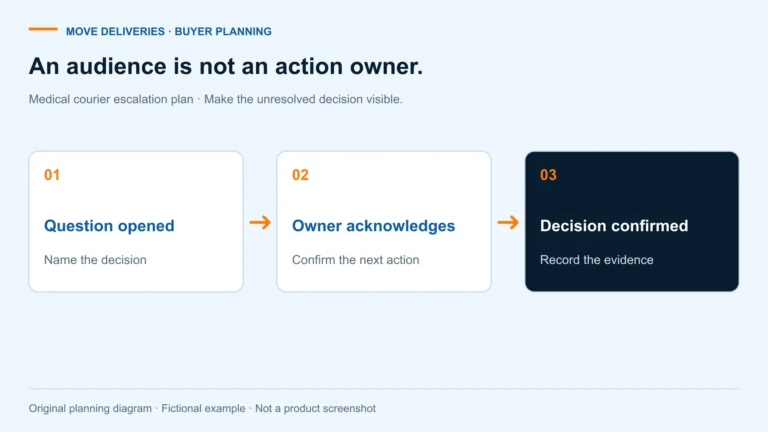
A clinic wants to know whether a collection has been accepted. A pharmacy wants to change the receiving instruction. A dispatcher wants confirmation that a new assignment was seen. Each request can be legitimate, but the communication path matters. Design the decision and acknowledgment process around safe stops rather than encouraging repeated calls until the courier answers.
This guide offers an original buyer and dispatch review worksheet. It does not supply jurisdiction-specific law, a certified safety program or an actual MOVE crash rate. Qualified safety and legal reviewers determine applicable policies and requirements. The proposed questions help teams examine operational pressure without blaming an individual for a workflow they have not reviewed.
1. Read National Crash Data in Its Actual Scope
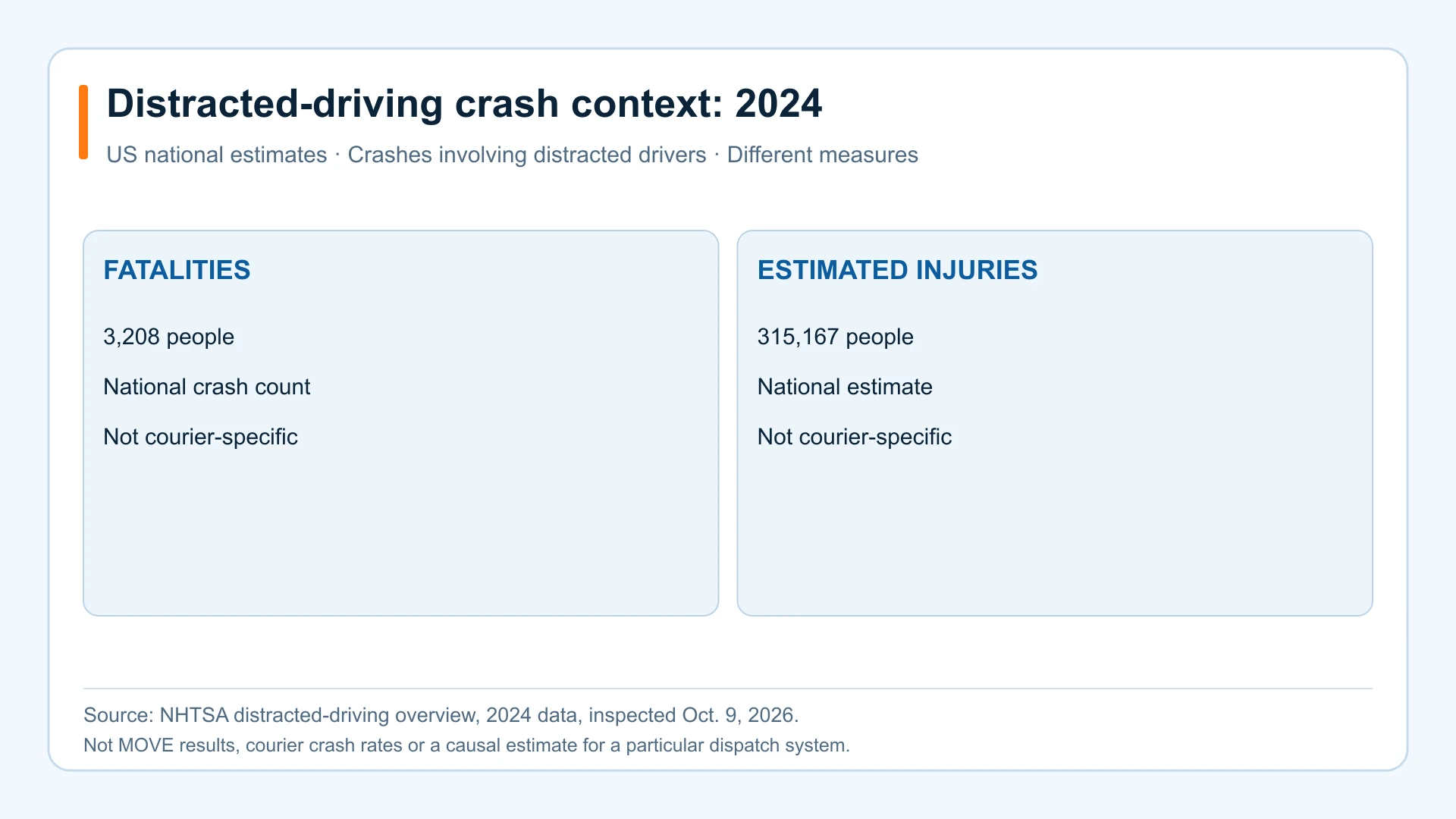
NHTSA’s distracted-driving overview reports 3,208 fatalities and 315,167 injured people in 2024. These national figures concern crashes involving distracted drivers. They are not medical-courier-specific data, MOVE results or a rate for any particular dispatch system. A fatality count and an injury estimate are different measures; placing them together does not create a comparable performance score.
| Measure | 2024 figure | Interpretation boundary |
|---|---|---|
| People killed | 3,208 | National crashes involving distracted drivers, not courier-specific |
| People injured | 315,167 | National injury estimate, not a provider’s performance result |
Use the data as context for asking serious workflow questions, not as a way to manufacture a courier risk estimate. The figures cannot tell a healthcare buyer how many crashes an app feature would prevent, whether one provider is safer than another or how a particular route should operate. Those claims would require additional appropriate evidence.
When sharing the graphic, retain its year, source and scope labels. Avoid a headline implying that all distracted-driving deaths involve couriers or phones alone. The original data card deliberately uses named measures instead of bars that could suggest a meaningful comparison between fatalities and injuries.
2. Find Where the Workflow Creates Response Pressure
Map which roles can contact the courier and for what purpose. Separate a new assignment, a changed instruction, a customer question and a general progress check. If every role uses a different direct channel, the driver may receive conflicting messages even when each sender believes their request is reasonable. The problem begins before a phone is picked up.
Ask whether the process expects an immediate response and what happens when one is not received. A reminder cascade can quietly become pressure to interrupt driving. Review the actual response expectation, not just a policy statement that everyone should be safe. Staff need an approved alternative when a reply is not yet available.
Identify which questions can be answered by an authorized coordinator or existing event record rather than by contacting the person driving. A known accepted order state may resolve a front-desk question without another call. Confirm actual information availability; do not promise that any particular platform displays every event or eliminates the need for human coordination.
MOVE’s live-tracking overview describes operational visibility. Ask how that visibility relates to your accepted service and communication needs. A visible status should be understood in its scope, not treated as a guarantee of arrival or evidence that the driver can safely answer now.
3. Review More Than Handheld Texting
The CDC/NIOSH workplace overview distinguishes visual, manual and cognitive distraction, including attention diverted even with hands on the wheel. Its guidance supports avoiding phone use while driving and using a safe stopping location for communication. Hands-free does not mean distraction-free. Our dispatch worksheet is an original operational proposal, not a certified implementation of that guidance.
With qualified reviewers, ask whether a process requires reading a notification, searching for an instruction, entering a status or discussing a complicated change during travel. Review the task as a whole. Removing one tap from an interface does not prove that the remaining interaction demands no attention.
Include navigation changes in the review. A revised receiving point can require more than hearing a new street name. It may require checking authorization, understanding access and confirming acceptance of a changed task. Do not equate a short message with a trivial decision. Arrange a process that allows the relevant review when safely stopped.
Keep the policy discussion with the responsible provider and employer roles. A healthcare buyer can ask how communication expectations are managed without inventing its own driving instruction for another organization’s workforce. Applicable safety and legal requirements require qualified review in their actual jurisdiction and arrangement.
4. Write a Communication Review Ledger
For each message type, identify its purpose, authorized sender, decision owner and alternative when the courier cannot respond safely. The ledger should expose unresolved expectations rather than normalizing them. Avoid a default response-time target copied from ordinary office customer service; the task environment is different.
| Message type | Question before sending | Alternative to forced in-motion interaction |
|---|---|---|
| Progress question | Can an authorized coordinator use the latest confirmed record? | Explain known status and uncertainty without repeated driver calls |
| New assignment | Has the provider accepted it and defined acknowledgment? | Use the agreed review path around a safe stop |
| Instruction change | Who authorized the revision and accepts its transport implications? | Coordinator review and clear current instruction |
| Missing response | What does the absence of a reply actually establish? | Follow the approved escalation path; do not infer refusal |
| Urgent concern | Which responsible process applies to the specific concern? | Use the appropriate qualified or emergency process, not improvised phone pressure |
For urgent concerns, distinguish clinical urgency, an operational question and an actual emergency. This article does not establish an emergency procedure or authorize delayed handling of an emergency. Responsible organizations must define the applicable qualified response path. A routine progress call should not borrow emergency language merely to produce an immediate answer.
Keep the ledger accessible to relevant coordination roles. A process known only to a safety manager cannot guide a new dispatcher or backup site contact. Give those roles a usable instruction for uncertainty, including whom they may contact and what they should tell the requesting team.
5. Separate Preparation, Movement and Safe-Stop Review
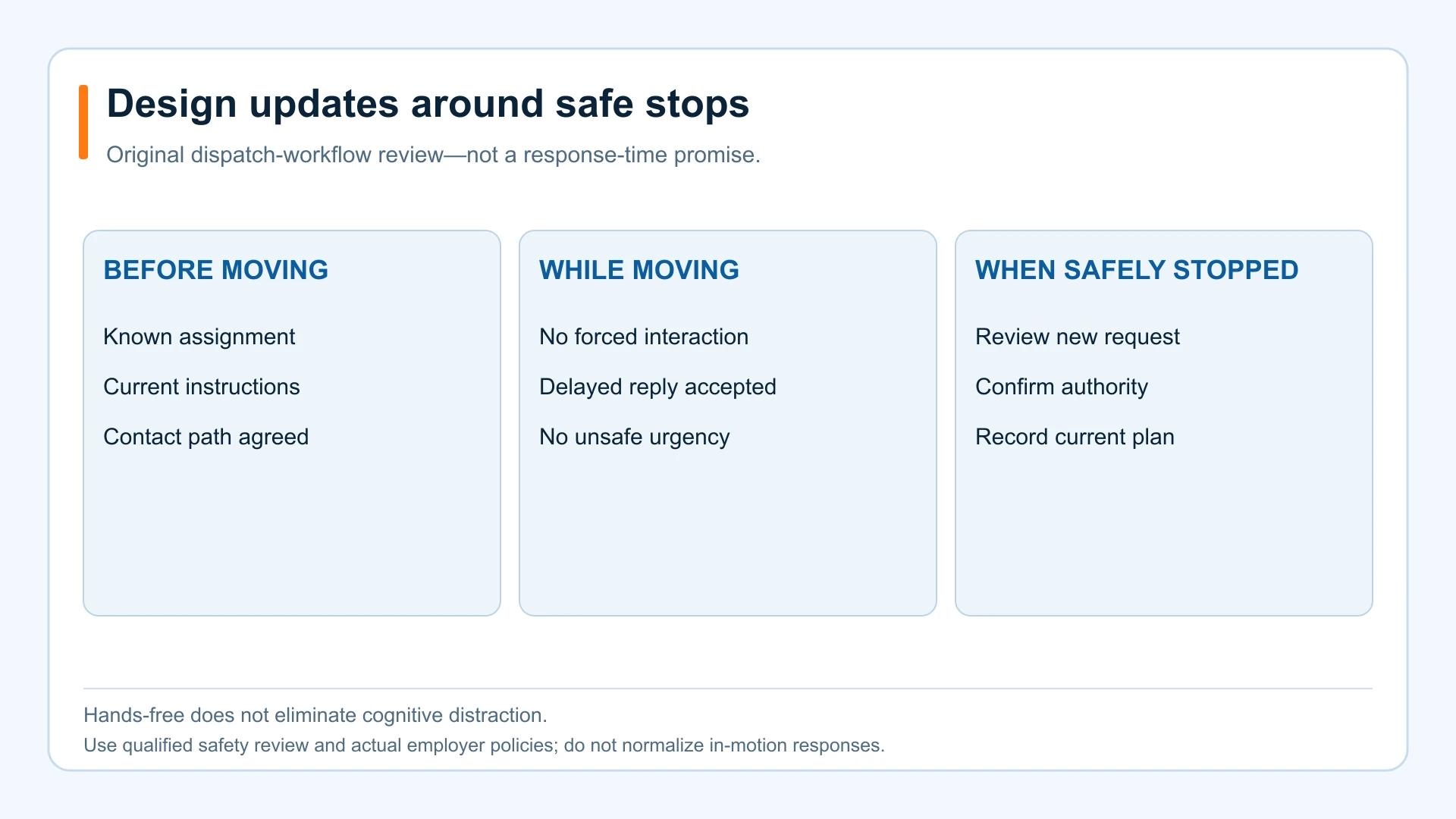
Before movement, confirm that the accepted assignment and current instructions are available through the approved workflow. This is a discussion boundary, not a universal pre-driving checklist. The responsible provider determines the actual procedure. The buyer should supply accurate site information early enough for that procedure to be useful.
During movement, the communication design should not require the driver to perform an immediate non-driving interaction. The responsible policy needs to address acknowledgment expectations, repeated requests and the information coordinators can give instead. Avoid incentives or informal comments that contradict the stated safety expectation.
At a safe stop, relevant requests can follow the agreed review and decision path. A stopped vehicle is not itself proof that every interaction is appropriate; qualified policies still govern the setting and task. The operational aim is to make room for a considered review instead of compressing an authorization decision into a hurried response.
Confirm which instruction becomes current after a change. If an older message remains visible, the courier and receiving staff should not have to guess which version controls the accepted work. MOVE’s how-it-works page helps frame the handoff sequence, while actual change authority and response arrangements need explicit agreement.
6. Examine a Fictional Receiving-Instruction Change
Imagine a clinic discovers that its receiving entrance is temporarily unavailable after a courier has begun travel. A staff member sends several direct messages and calls repeatedly because the first message is unanswered. That pattern does not establish that the courier ignored the instruction. It establishes that the communication path needs a decision for unavailable immediate acknowledgment.
The coordinator should have an agreed process for verifying the request, consulting the appropriate site and provider roles and defining the current accepted instruction. The driver reviews through the authorized safe-stop path. The receiving team gets an honest update about what is known and what still needs confirmation, rather than a promise that the unacknowledged message already changed the route.
Test the scenario with dummy references and stationary participants, not by sending distracting messages to a driver in motion. Observe whether staff can identify the authority, current instruction and alternative response. The exercise contains no real MOVE event and demonstrates only the tested coordination behavior, not a measurable crash reduction.
7. Review the Process Without Creating a New Unsafe Target
Do not evaluate drivers by the speed of their in-motion replies. A metric can pressure behavior even when its creator intended only to measure communication. Review with qualified safety personnel whether the chosen measure rewards an appropriate process or creates a conflicting demand.
A buyer can review narrower operational questions: whether a coordination contact was available, whether a changed instruction had a named owner and whether staff could explain the last confirmed state. Use actual records, a defined period and clear limitations. Those observations are not crash rates or proof that a workflow is universally safe.
Keep reporting denominators visible. A count of messages reviewed should not become a percentage of all driving activity unless the data actually supports that population. Missing acknowledgment data should remain missing, not be interpreted as evidence of driver distraction, safe behavior or misconduct.
When a review identifies a conflicting expectation, fix the expectation and communicate the change to affected roles. A general reminder to drive safely does not resolve a dispatcher instruction to answer instantly. Verify that the revised process gives staff a practical alternative when a response is not safely available.
8. Include Customer-Facing Contacts in the Review
Reception, purchasing and receiving staff can unintentionally recreate direct-call pressure if they do not know the coordination path. Tell them which contact can clarify an assignment and what information that contact may provide. Keep private driver details out of broadly circulated material when those details are not required for the task.
Explain the distinction between a customer request and an accepted change. That lets staff understand why a new instruction may require provider review rather than an instant driver answer. It also protects clarity: the customer can prepare for the confirmed plan without assuming every sent message has already become effective.
Review the path periodically when the service arrangement changes, using your actual policies and qualified advice. A new account contact, communication channel or receiving function can affect the workflow even if the driving task appears unchanged. Keep the accepted instruction current rather than relying on a remembered informal routine.
Ask a backup coordinator to explain the process using a stationary practice case. Can they tell a customer that a request is awaiting review without inventing an arrival time? Can they find the current accepted instruction and identify who may change it? If they resort to repeatedly calling the driver, the alternative path may still be unclear. Record that finding and refine the instruction before interpreting missing replies as a driver-performance issue.
Courier Distracted Driving: Common Questions
Does hands-free calling remove the concern?
No. Attention can still be diverted. Review the full communication task with qualified safety personnel rather than treating hands-free equipment as proof that an interaction while driving is appropriate.
Does live tracking mean we should never contact the provider?
No. Use the agreed coordination path for questions and changes. Tracking can help describe a confirmed state, but it does not settle every authorization or receiving question. Confirm the actual information available for your service.
Are the national figures MOVE’s results?
No. They are NHTSA’s 2024 national crash-context figures. They cannot establish MOVE performance, courier-specific risk or a crash-reduction benefit from any software feature.
What should we ask before starting service?
Discuss communication contacts, change authority and honest updates when immediate acknowledgment is unavailable. Start an account conversation, or Quick Quote for a specific delivery. Actual availability and operational arrangements require confirmation.