
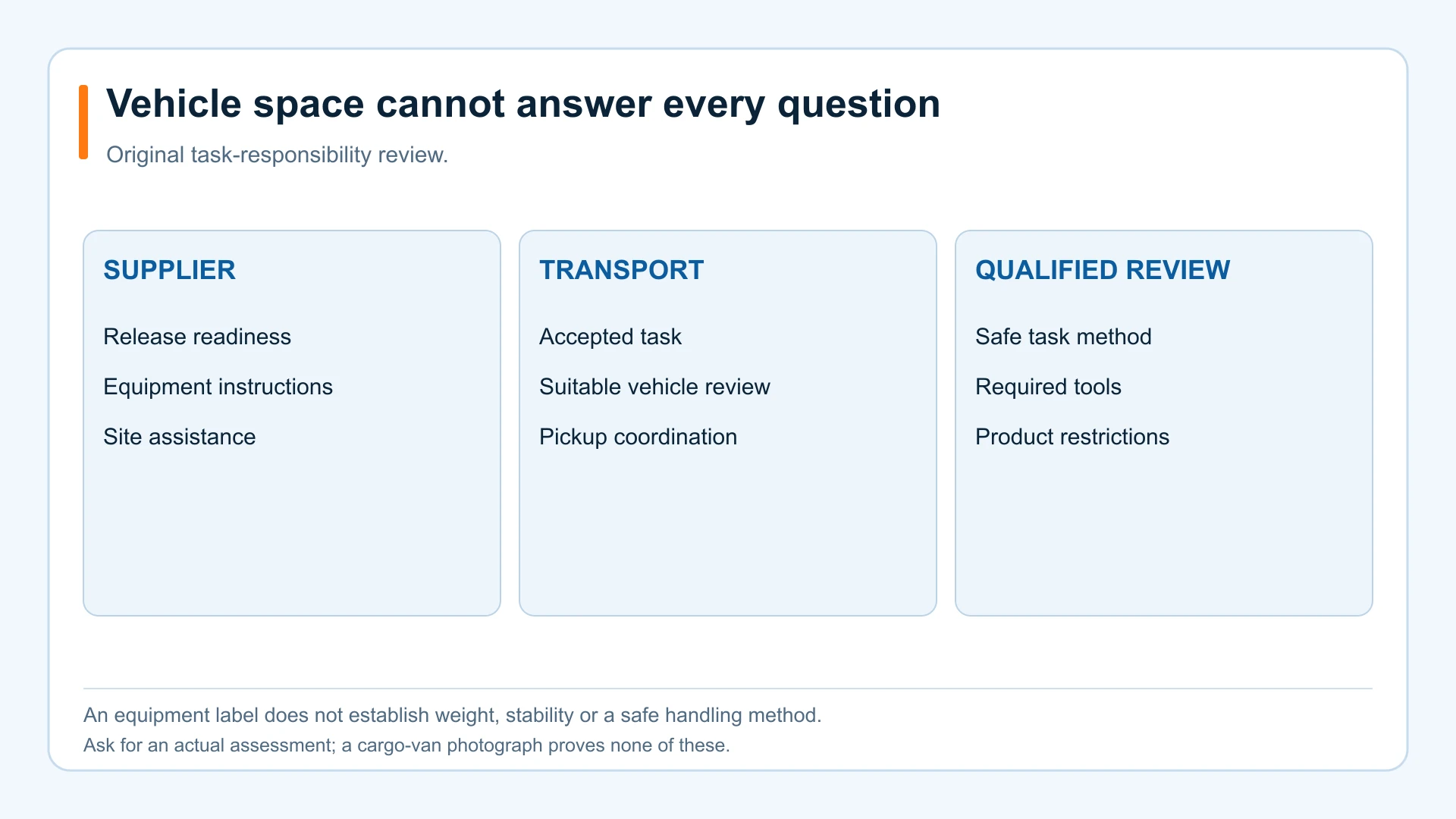
Medical equipment loading is a set of responsibilities, not a detail that a cargo-van reservation automatically resolves. Before a wheelchair, cart or boxed device leaves a supplier, confirm who prepares it, who reviews the transfer task, which people and tools are available and what the transport provider has actually accepted. A clear task description prevents your team from discovering missing assistance at the vehicle door.
A vehicle can have room for an item without the proposed loading method being suitable. The same equipment can create different tasks at a level warehouse bay, a narrow service entrance and a customer location with restricted access. Start with the actual object and environment. Do not substitute an equipment category, a photograph or a broad delivery label for an assessment of the work.
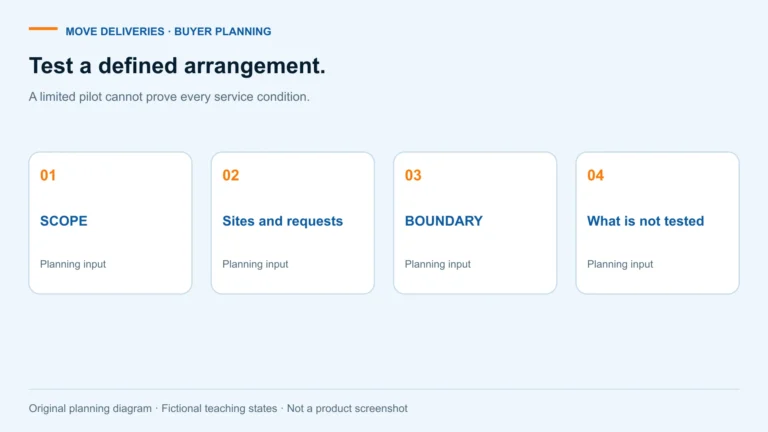
This guide is an original scope-planning tool for medical suppliers. It is not a lifting technique, a securement procedure, an ergonomic assessment or hazardous-material advice. Qualified personnel determine safe methods and product requirements. No universal weight threshold, staffing ratio, ramp specification or loading capability is asserted for MOVE or any other provider.
1. Describe the Transport-Ready Object
An order description such as wheelchair is incomplete if the provider must decide which accepted vehicle and assistance arrangement fits. Describe the actual transport-ready configuration: packaged or unpackaged, folded or assembled, with or without associated boxes, and ready for release or still awaiting preparation. Use verified measurements and product information where the responsible reviewers need them; do not estimate from an online photograph.
Identify what belongs together and what can move separately under the approved plan. A device, accessories and documentation may be associated with one commercial order but arrive as several physical units. Record that relationship in a way release and receiving staff can understand. Avoid unnecessary patient details in a broad transport worksheet.
Distinguish item count from task complexity. Several small sealed cartons and one awkwardly configured device can create different transfer requirements even when their total weight is similar. Conversely, a large-looking package may have handling instructions that the courier cannot infer visually. Keep product-specific restrictions with the qualified reviewer and approved instruction.
Confirm the condition in which the supplier will release the equipment. The transport provider should not discover that assembly, disassembly, packaging or product inspection was assumed to be part of collection. If any of those activities are requested, define them separately and obtain the appropriate acceptance. Transport does not automatically include technical servicing.
2. Split the Work Into Observable Tasks
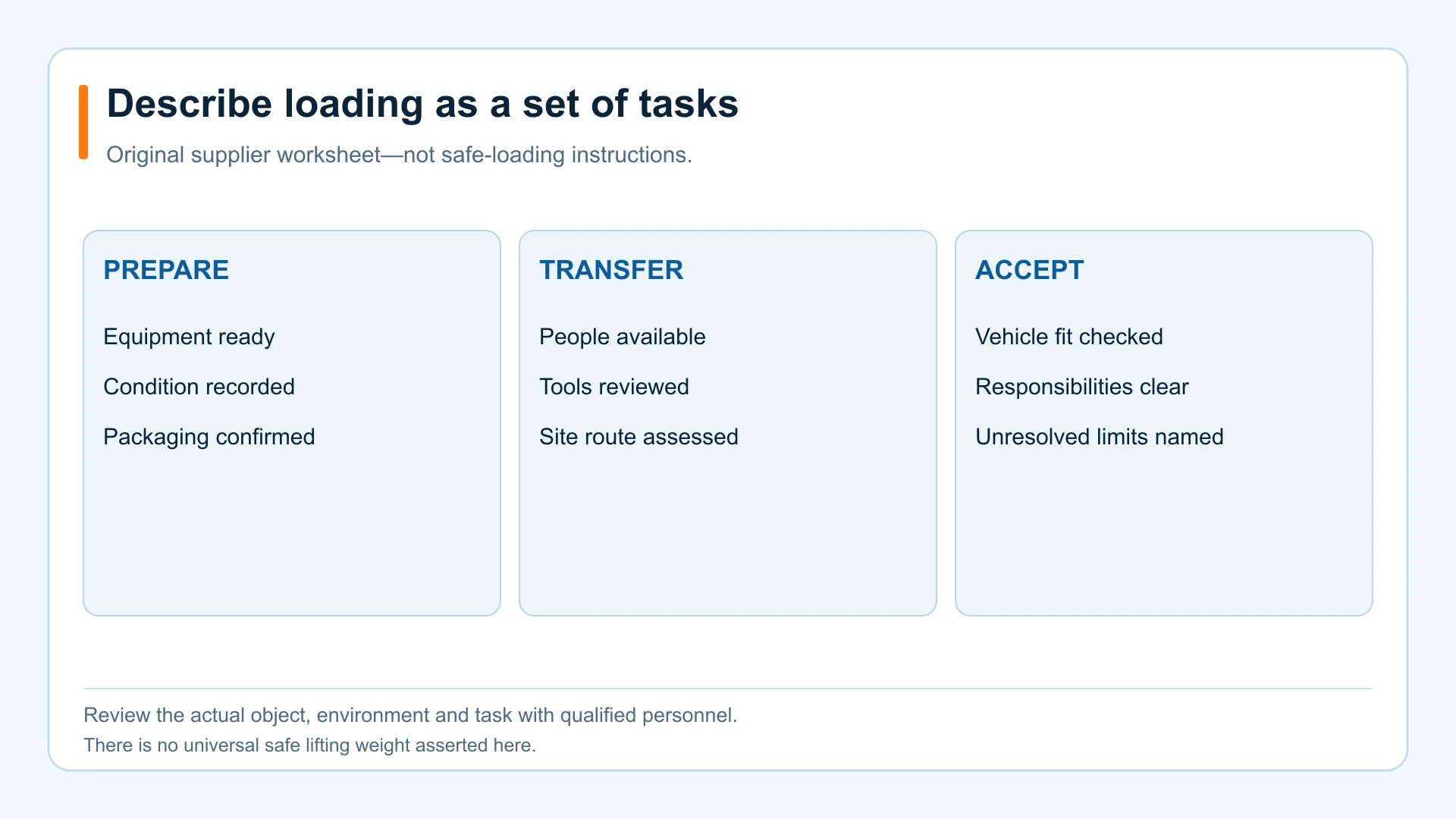
Write the sequence from staging location to accepted receiving point. That sequence may include preparing units, moving them within the facility, crossing an entrance, transferring them into the vehicle, arranging the accepted load and completing the receiving handoff. The purpose is to identify responsibilities and review needs, not to prescribe how those movements should be performed.
For each task, ask who performs it, who authorizes the method and which conditions must exist before it begins. A supplier employee standing nearby is not necessarily assigned or trained to assist. A courier arriving alone is not evidence that the task was accepted as a single-person movement. Confirm the arrangement before depending on either assumption.
The OSHA ergonomics overview identifies lifting, pushing, pulling, awkward postures and repetitive work as relevant risk factors, and emphasizes assessing work and involving workers. This is narrow background for asking task-specific questions. It does not supply a universal safe lifting weight or certify a proposed equipment transfer.
Consult MOVE’s medical-supplier delivery information to frame the service conversation. Then discuss the actual loading scope, locations and required assistance. The proposed task remains subject to provider acceptance and qualified review, regardless of which service name appears on the request.
3. Review the Site Route, Not Just the Parking Space
The parking location is only one part of access. Confirm the accepted entrance, staging area and path between them. A narrow doorway, changing floor level or restricted receiving point can alter the task. Facilities contacts should review their site conditions rather than asking the driver to discover and solve them during a time-sensitive collection.
Identify temporary conditions separately from permanent instructions. Renovation, a closed service entrance or a relocated loading area may invalidate an otherwise familiar plan. Name the person responsible for keeping that information current and the path for communicating changes. A note from last month’s successful delivery is not proof that today’s access remains suitable.
Describe available site assistance and tools accurately. An available cart should not be described as suitable for every object; an installed ramp should not be assumed appropriate for a particular task without review. Record what exists, then let qualified personnel assess suitability. The planning worksheet should expose the question rather than quietly converting an inventory item into a safety conclusion.
Review the receiving side before confirming the outbound transfer. If the destination cannot support the accepted handoff, a smooth collection does not complete a usable delivery plan. Clarify where transport responsibility ends and which receiving role is available. Do not assume home installation, patient instruction or equipment setup is part of courier delivery.
4. Use a Responsibility Ledger Before Booking
A concise ledger turns a broad request for loading help into questions that responsible people can answer. Keep factual observations, requested assistance and accepted responsibilities distinct. An empty cell should remain a named unresolved item, not become an implicit responsibility assigned to whoever arrives first.
| Task boundary | What to confirm | Who should review |
|---|---|---|
| Release readiness | Actual transport-ready configuration and associated units | Supplier’s authorized release role |
| Site movement | Accepted route, current access and available assistance | Facilities and qualified task reviewers |
| Vehicle transfer | People, tools and method accepted for the actual task | Transport provider and qualified personnel |
| Transport scope | Actual vehicle configuration and product restrictions | Provider and appropriate product reviewer |
| Receiving handoff | Agreed receiving point and available receiving function | Destination’s authorized contact |
| Exception | Who decides when a material condition differs? | Named customer and provider decision owners |
Keep the review version connected to the accepted assignment. If the cargo mix, access or assistance changes, the earlier assessment may not describe the new work. Ask the responsible people whether the revised task can be accepted. Do not treat the original quote as authorization for every later addition.
Also define how staff recognize an unresolved boundary. For example, a promised assistance role may be absent at release. The instruction should name the escalation contact and make clear that urgency does not require an improvised transfer. Product acceptability and safe task decisions stay with the appropriate reviewers.
5. Keep Vehicle Fit and Loading Acceptance Separate
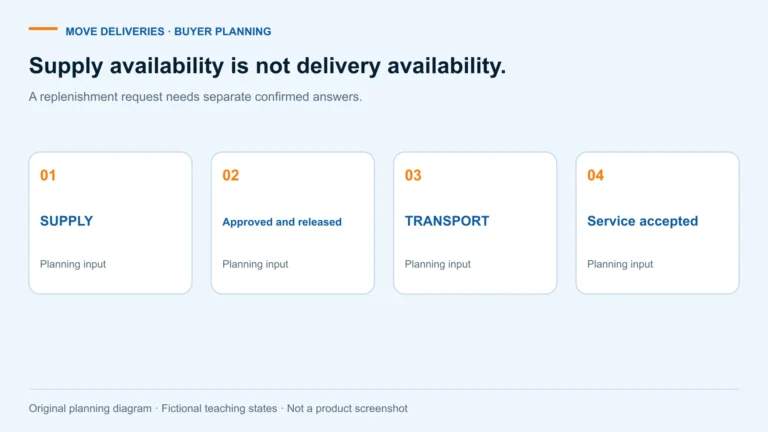
Usable vehicle configuration depends on the actual load and arrangement, not just a vehicle model name. A supplier should disclose the complete accepted cargo mix and associated return units. The provider should review whether the assignment fits its actual vehicle and task conditions. This guide does not calculate capacity or prescribe restraint and securement methods.
Review the loading boundary alongside the unloading boundary. Equipment that can be transferred at a supplier’s facility may require a different accepted arrangement at the destination. Confirm both before booking. Otherwise the assignment can reach the receiving location while leaving a fundamental question about who can perform the remaining task.
Do not infer specialized capability from general fleet language. Oxygen cylinders, hazardous cargo, regulated products and temperature-sensitive items can create distinct requirements. Bring those questions to qualified personnel and the provider before requesting transport. A generic cargo-van image does not establish acceptance of those categories.
For recurring work, compare the proposed assignment with the actual reserved scope. Our dedicated courier coverage overview provides a starting point, but dedicated time does not automatically establish equipment fit, available helpers or a safe method. Those conditions remain separate questions.
6. Examine a Fictional Task Change
Imagine a supplier initially requests transport of a folded wheelchair and two closed accessory cartons from a level service bay. Before collection, the release team adds an assembled display cart and moves staging to a different entrance. The original scope may no longer describe either the cargo or the site route. That is a reason to reopen the review, not merely to update the package count.
The supplier confirms the new transport-ready configuration and current staging conditions. The provider reviews the revised vehicle and assistance needs. Qualified personnel assess the actual task method. The receiving contact verifies whether the destination can accept the revised units under the agreed handoff. Each party answers its own responsibility rather than relying on the driver to make every decision.
If a material question remains unresolved, record it and obtain an accepted next step. Do not label the task ready solely because the pickup time is approaching. This example contains no real customer event, loading recommendation or MOVE capability claim. It illustrates how an apparently small order change can cross several decision boundaries.
7. Review the Accepted Task After the First Handoff
Use the first accepted assignment to review whether the planning description matched the observed work. Did the agreed assistance exist? Was the staging location current? Did the receiving role understand the endpoint of transport responsibility? Keep observations factual and share relevant gaps through the approved review process.
A completed handoff does not demonstrate that every loading method was safe or every future load will fit. Do not turn one outcome into a general certification. Qualified reviewers should assess concerns that arose, and operational teams should update confirmed instructions when the actual arrangement changes.
For recurring assignments, maintain a task-change trigger rather than relying only on an annual calendar review. Changed equipment configuration, site access, available tools or assistance can justify another review. The responsible people decide its scope. A current instruction should explain the accepted arrangement clearly enough for a backup role to use it.
Connect the transport unit with its documented handoff using the actual agreed evidence. MOVE’s electronic proof-of-delivery information describes completion visibility. It does not certify loading safety, product function or patient readiness to use the equipment.
Resolve Unknown Details Before Turning Them Into Instructions
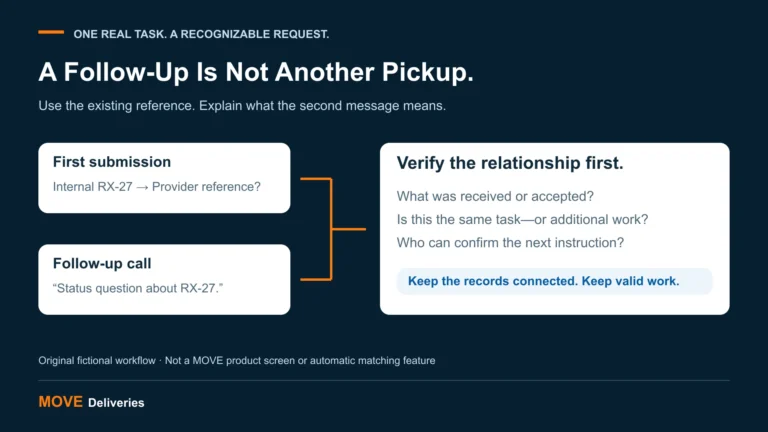
A release coordinator may not know an item’s transport-ready dimensions or whether a device can be moved in the proposed configuration. Keep that uncertainty visible and identify the person who can provide verified information. Do not convert a guessed measurement into a confident instruction merely because a request form requires a value. The provider needs to distinguish confirmed inputs from questions awaiting product or site review.
The same discipline applies to assistance. If a supplier says someone can probably help, ask which authorized role will actually be available and what that role has agreed to do. Record an unresolved staffing question as unresolved. An expectation that happens to work once is not a durable recurring arrangement.
Finally, keep a declined task separate from a delayed task. If the proposed arrangement cannot be accepted, changing the pickup time alone does not resolve the missing people, tools or assessed method. Ask the responsible parties what material condition needs to change before another review. That keeps scheduling from concealing a task-scope problem and lets staff give the receiving team an honest update.
Medical Equipment Loading: Common Questions
Does ordering a cargo van include loading assistance?
Do not assume that. Describe the required tasks and confirm the people, tools and assistance the provider accepts. Vehicle availability and acceptance of a particular loading arrangement are separate decisions.
Can we use a single weight limit for every equipment item?
This guide supplies none. The actual object, environment, movement and available tools require qualified task review. Product information and site conditions matter; a broad category cannot settle suitability.
Does courier delivery include installation or patient instruction?
Only an expressly accepted and appropriately qualified arrangement can answer that. Do not infer technical servicing or clinical responsibilities from a delivery label. Confirm the receiving endpoint before the equipment leaves the supplier.
What information should we give MOVE?
Share the actual transport-ready units, pickup and receiving locations, relevant access constraints and requested assistance through the appropriate channel. Quick Quote for one assignment or start an account conversation for recurring work. Actual task acceptance must be confirmed.