
A medical courier vendor transition changes more than a contact name. It changes who accepts new work, who finishes existing orders, where instructions are maintained and how your team accesses delivery records afterward. A successful handover makes those responsibilities explicit before the first collection under the new arrangement, rather than leaving staff to improvise at the loading desk.
The practical risk is an ambiguous boundary. One clinic assumes the old provider is still collecting. Another submits the same request to both providers. A supplier finds that its returnable totes are split between depots. Accounts payable cannot tell which provider’s agreed terms apply to a late invoice. These are transition problems, even if both providers perform their own accepted assignments correctly.
This original guide gives healthcare buyers a controlled handover plan. It is not a legal termination notice, a clinical protocol or a promise that MOVE can import another platform’s history. Confirm your actual contracts, access permissions and product requirements with the responsible reviewers. The focus here is responsibility for work at the transition boundary, not a generic checklist for opening a new care site.
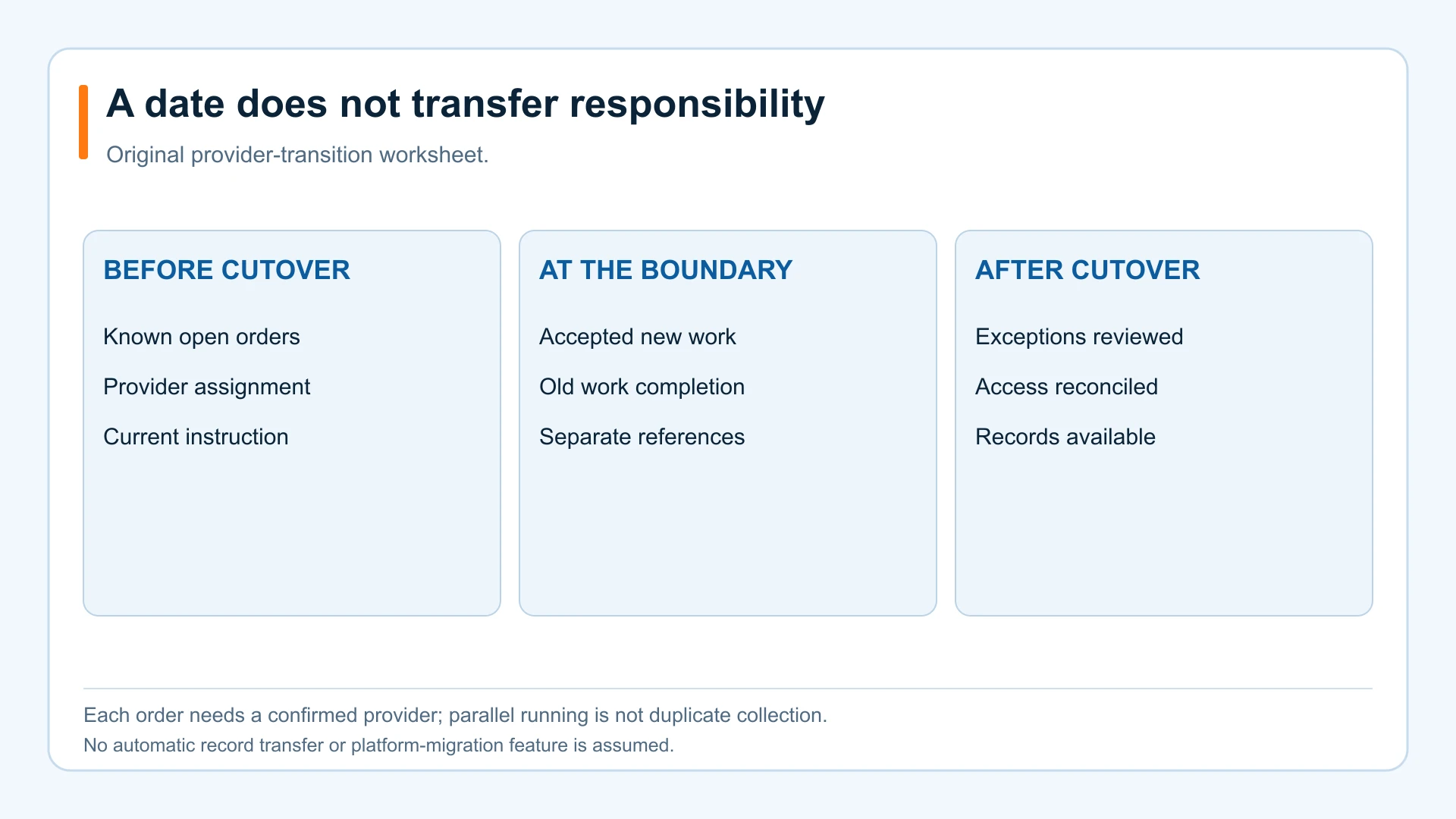
1. Define the Boundary by Work, Not Just by Date
A cutover date is useful, but it does not explain every open order. A request may be submitted before that date, collected afterward and completed later still. A recurring schedule may span the boundary. Write down how those cases will be assigned, accepted and completed. Give each actual order one clearly identified provider rather than relying on a broad announcement that service has changed.
Separate the last date for new requests to the old provider from the last completion or return activity under that arrangement. They may differ. Confirm which team will review unfinished work and which contact remains available to resolve it. Do not revoke essential access simply because the calendar reached the advertised launch date.
Describe the new provider’s accepted geography, service days, cargo scope and receiving constraints in writing. A marketing coverage map is not acceptance of your specific route. The new arrangement should be reviewed against the actual workload, including exceptions and return movements, before the organization retires its former request path.
MOVE’s request-to-delivery process provides a useful sequence for this discussion. Ask how requests become accepted assignments, how the courier receives current instructions and how completion is documented. Do not assume a preferred launch date supplies those operational answers.
2. Inventory What Must Survive the Change
Begin with an authorized inventory of recurring assignments, open orders, service instructions, unresolved exceptions, returnable equipment and commercial questions. This is an inventory of responsibilities, not an invitation to copy every patient-related record into a transition folder. Identify the necessary evidence and the approved system where it remains accessible.
For recurring work, review each accepted location and receiving function rather than assuming the new provider will discover the same handoff conditions. Shared site names can hide different entrances, departments and operating hours. Keep site-specific details controlled and current. If an instruction cannot be confirmed, assign it to a named site contact before testing the handover.
For open orders, record the current provider, last confirmed event, remaining activity and responsible reviewer. A generic status such as active is insufficient if no one can explain whether collection has happened. Preserve uncertainty honestly. The transition team needs to know what is unresolved, not a cosmetically complete spreadsheet.
For physical units, distinguish customer-owned containers, provider-owned containers and equipment with other ownership arrangements. Confirm where they are believed to be, what evidence supports that location and how any accepted return will occur. Do not treat a courier’s final outbound delivery as proof that every reusable unit has been returned.
3. Build a Handover Ledger With Accountable Decisions
The ledger should make responsibility visible to operational staff as well as project managers. Use approved references, explicit stages and a decision owner for each unresolved item. It should explain what staff should do now, not simply track whether a meeting has occurred. Keep internal project completion separate from evidence that actual work has been accepted.
| Item | Boundary question | Evidence before closeout |
|---|---|---|
| Recurring assignment | Which provider accepts the next occurrence? | Confirmed scope and active request path |
| Open delivery | Who owns the remaining accepted work? | Known latest event and completion responsibility |
| Site instruction | Which approved version will the courier use? | Responsible site review and current provider acknowledgement |
| Reusable unit | Who owns it and where must it return? | Unit identity, known location and accepted return movement |
| Historical record | Who needs authorized access after cutover? | Reviewed access or approved export, with limitations |
| Commercial question | Which terms govern the unresolved work? | Named reviewer and documented disposition |
Version the ledger when the boundary changes. A revised launch time can affect request ownership, staffing and receiving instructions. Explain what changed and who needs the new version. Leaving two apparently current transition sheets in circulation is an avoidable way to recreate the ambiguity the project was meant to remove.
Give the team a clear stop condition. If an order cannot be assigned confidently, or the new provider has not accepted a material requirement, escalate rather than guessing. The responsible healthcare team decides clinical implications; the transport provider decides whether it can accept the task. A project manager’s deadline cannot substitute for either decision.
4. Use Parallel Running Without Duplicate Collections
Parallel running can mean different things. It may mean comparing dummy order records, testing a limited accepted route or keeping the old arrangement available while new sites are commissioned. Define the intended method. It should not mean sending a real collection request to two providers and hoping the first arrival resolves responsibility.
Use safe practice cases where appropriate. A dummy reference and an empty practice unit can test the request path, site access and event visibility without using live clinical cargo. Qualified staff decide which checks require a different controlled approach. The editorial guide does not establish a universal test count or authorize a real shipment for training.
For a limited live scope that has been properly accepted, identify the provider for each order and tell relevant release and receiving staff how to verify that assignment. Keep the test boundary distinct from the full recurring arrangement. A successful isolated collection does not automatically validate every location, cargo type, service period and exception path.
Review what the test actually demonstrated. Did the correct request reach the intended provider? Were current site instructions available? Did the receiving function understand the handoff? Were records accessible to authorized reviewers? Record unknowns and differences without upgrading a narrow success into a broad continuity guarantee.
5. Review Information Access Separately From Physical Service
A new provider taking over future work does not establish a right to copy the former provider’s entire account history. Determine which records your organization needs, who is authorized to obtain them, the format available and the limitations of an approved export. Retention and privacy decisions belong to your qualified reviewers and applicable agreements.
Ask whether exported references can be related to your own accepted order identities. A folder of files may be technically downloadable yet difficult to interpret later. Review sample records with authorized staff, preserve their context and note what the export does not include. Do not treat a filename as proof that all supporting information was transferred.
The NIST Cybersecurity Framework is a general risk-management reference for discussing information access and responsibilities. It is not a certification of a courier platform or a prescribed migration procedure. Our proposed handover ledger is an original buyer tool; actual technical and access controls need provider-specific evidence.
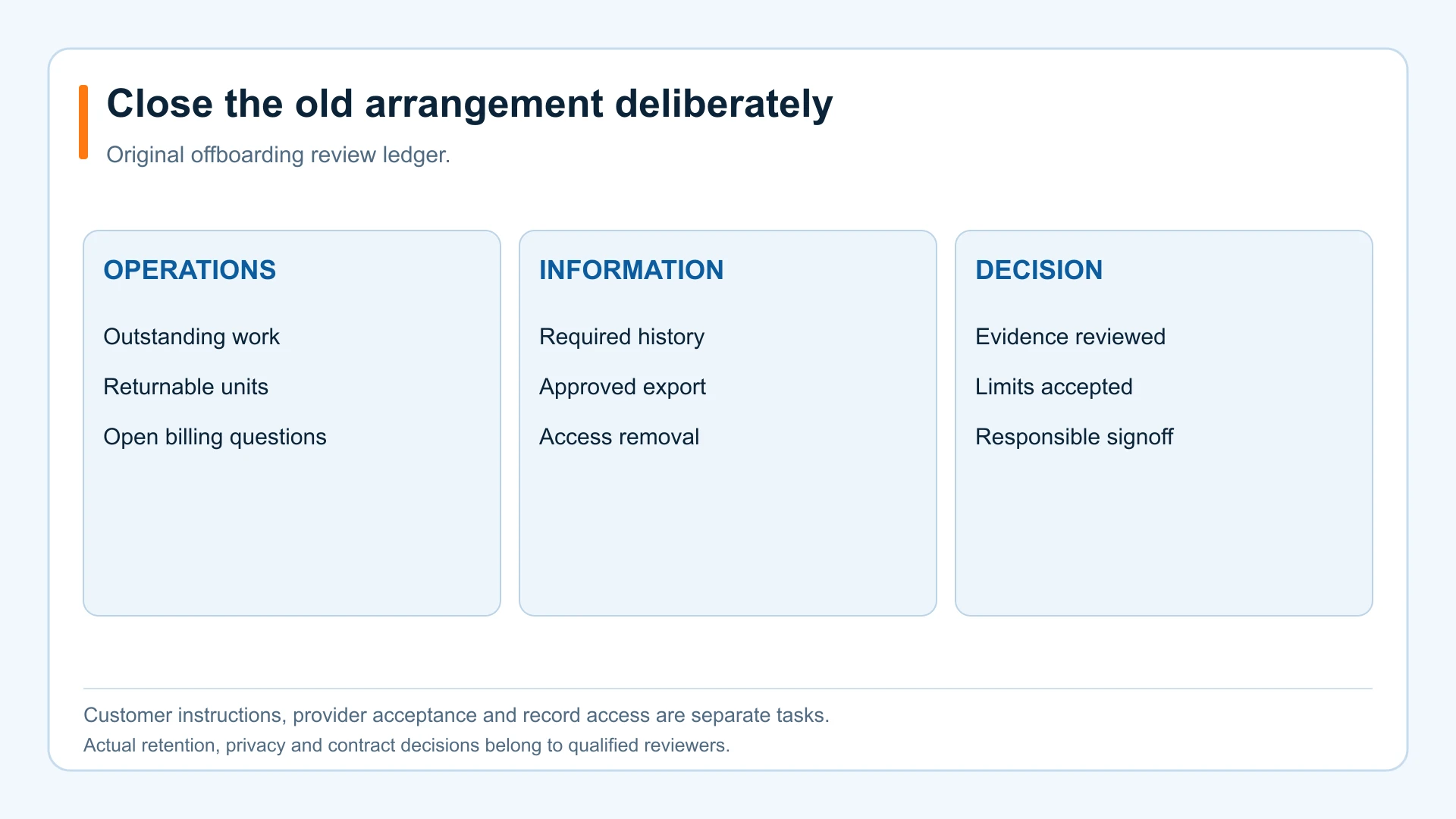
Remove old access deliberately after required work and review needs have been resolved or addressed through an approved alternative. Review individual accounts, shared access and support paths as separate questions. Keep operational offboarding and information offboarding connected, but do not assume closing one automatically completes the other.
6. Give Staff One Current Instruction
Front-desk and receiving teams need a usable instruction, not the full project presentation. Explain the active request path, provider verification method, accepted cutover boundary and contact for ambiguity. Keep private access details in the approved channel rather than a broad public announcement. Make the instruction available to relevant backup and evening staff too.
Tell people what has not changed as well as what has. A department may keep the same internal release authority even though the courier contact changes. A familiar collection time may remain a requested time until the new provider accepts it. These distinctions reduce the risk that staff infer a new responsibility from a new logo or email address.
Use a short scenario to check understanding. Ask a staff member what they would do if two couriers arrived claiming the same order, if the familiar driver arrived after cutover or if the new provider could not find the request. Their answer reveals whether the instruction identifies a responsible decision path rather than encouraging improvised workarounds.
Do not turn staff education into an accusation that people resisted change. An unclear instruction can make experienced staff rely on the old routine because it is the only routine they understand. Improve the instruction and confirm its availability before interpreting a transition problem as a performance failure.
7. Close Out the Old Arrangement on Evidence
At closeout, review open work, exceptions, container returns, approved record access and commercial questions. Some items may be completed; others may remain under a documented arrangement with a named owner. Distinguish those states. A green project dashboard should not imply that unresolved deliveries or record questions have disappeared.
Then review the first period of the new arrangement against the actual accepted scope. Group findings by site, instruction and decision path where useful, without exposing private information. Separate the effect of the transition from unrelated service conditions. A single observation is not evidence of a provider-wide defect or a permanent improvement.
If you summarize results, state which assignments were reviewed, the period, known missing records and unresolved exceptions. Do not label a limited pilot representative of all future work. Use the findings to clarify the ongoing arrangement, not to manufacture a success story or claim that a transition can never interrupt care.
Test a Shift-Change Boundary Before It Becomes Real Work
Consider a fictional clinic whose daytime team submits requests before leaving while an evening team handles release. The planned provider cutover occurs between those shifts. A request accepted by the old provider can therefore remain that provider’s work even when an unfamiliar courier arrives during the new service period. The date alone does not tell the evening team who should receive the unit.
Use an empty practice container and dummy references to examine the instruction. Can the evening reviewer identify the accepted provider? Can the old provider’s completion reference remain connected to the original request? Can a newly created order be distinguished from the unfinished assignment? If the answer relies on recognizing a driver’s face, the boundary needs a more durable verification method.
Record the gap and revise the current instruction with the responsible parties. Then repeat the narrow practice check without expanding its conclusion. Passing this exercise demonstrates only the tested shift-change scenario, not all clinical, technical or commercial requirements of the transition. Keep the actual launch decision with the authorized reviewers.
Medical Courier Vendor Transition: Common Questions
Should both providers receive the same live order during testing?
Not as an informal race. A real order needs a known accepted provider. Define parallel testing so that identity, responsibility and collection remain unambiguous. Use safe dummy cases when appropriate and obtain qualified approval for any live operational test.
Can a new courier automatically import our old delivery records?
Do not assume that capability or authority. Confirm approved access, export availability, record context and the actual technical arrangement. MOVE’s proprietary-platform overview describes delivery visibility, not a promise to import another provider’s system.
When should the old provider’s access be removed?
Use your approved offboarding decision after reviewing outstanding work, required historical access and an appropriate alternative where needed. This guide sets no retention period or universal deadline. Your qualified reviewers determine the actual requirements.
How do we start discussing a transition with MOVE?
Start an account conversation with your locations, current workload and unresolved handover questions. For a specific local assignment, Quick Quote. Confirm actual availability and acceptance before changing the active service instruction.