
Courier invoice reconciliation connects an invoice line to the work your team agreed to buy, the activity that actually occurred and the price basis that applies. The purpose is not to assume every difference is an error. It is to make each charge understandable before an unexplained total becomes a recurring argument between operations, procurement and accounts payable.
A pharmacy may recognize the delivery reference but not the waiting-time entry. A medical supplier may recognize the route but not know whether a return collection was included. A clinic may see two lines for one order and assume duplication, even though one line reverses a prior charge. These are different questions. A useful review separates identity, scope, evidence and arithmetic instead of treating them as one billing problem.
This guide provides an original review worksheet for healthcare buyers. It does not supply MOVE prices, payment advice, a promised savings percentage or a finding about any provider. Use your actual agreement and authorized records. Your contract, finance, privacy and legal reviewers decide the requirements that apply to your organization.
1. Start With the Agreed Billing Unit
Before matching numbers, establish what the number represents. An order, completed destination, route, service block and transport unit are not interchangeable billing units. A shipment containing three cartons can still be one accepted order, while a route can contain several separately recorded stops. The agreement should explain how those operational descriptions relate to the unit used for billing.
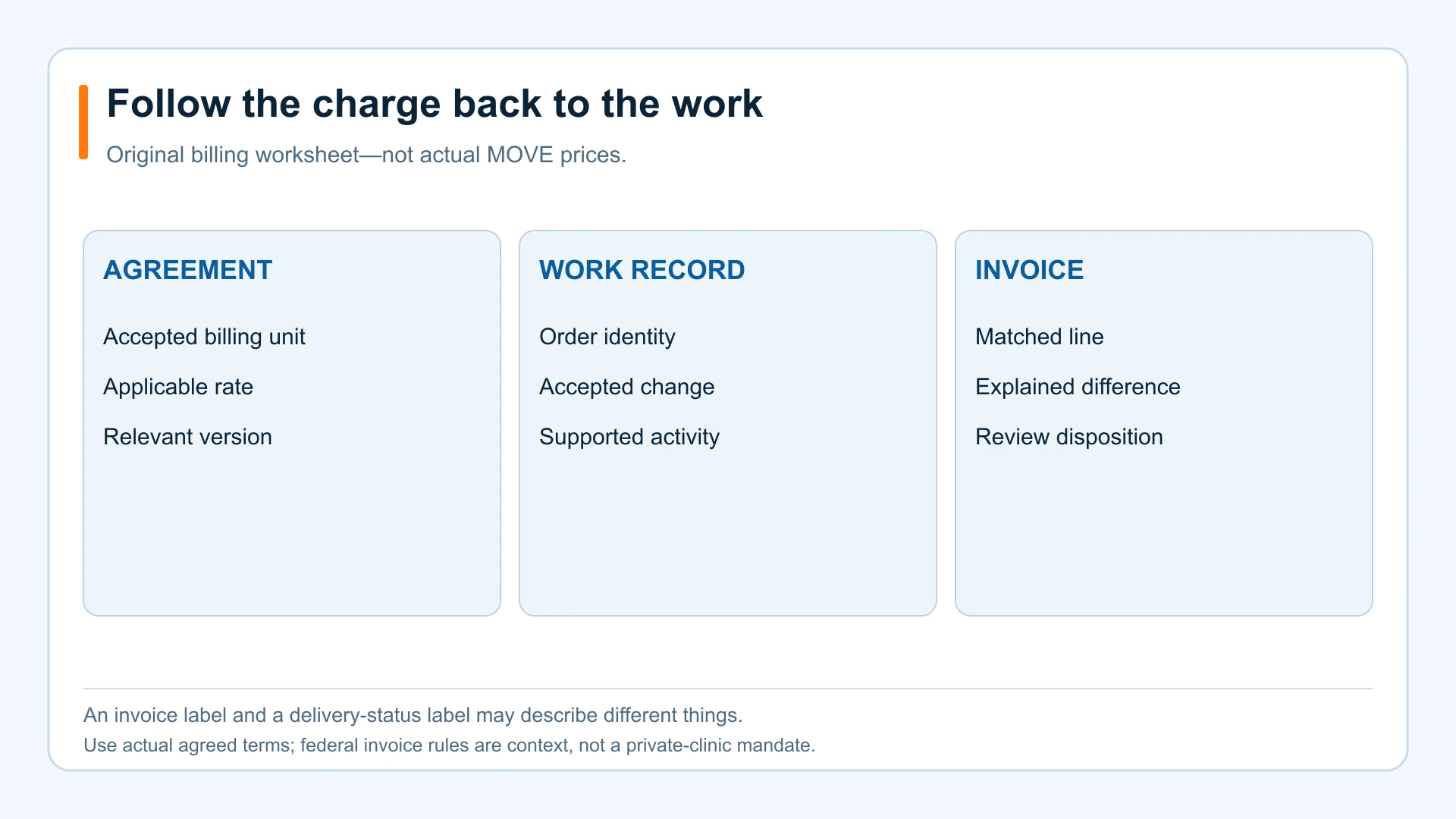
Create a short reference sheet with the applicable service period, billing unit, accepted price version and the scope included in that unit. Do not fill missing terms with a rule remembered from another provider. An earlier proposal, an unsigned spreadsheet and the active agreement may contain different assumptions. Flag the difference and ask the responsible commercial contact which document governs the work under review.
Keep service evidence separate from invoice evidence. A delivery marked complete can establish a recorded completion event without proving that every condition for a particular charge has been satisfied. Conversely, a failed delivery does not automatically establish that no agreed work was performed. Cancellation, waiting and attempted-service terms require their own review against the actual arrangement.
The federal invoice documentation provision in FAR 32.905 offers a narrowly scoped reference: government invoices identify authorized work, quantities, units and prices, with supporting performance documentation. Those rules govern their stated federal context. They are not a universal payment procedure for private healthcare organizations. The worksheet below is our own operational tool, not a reproduction of that regulation.
2. Gather Four Sources Without Copying Unnecessary Data
A reviewer needs the accepted commercial terms, the relevant order record, evidence of the billable activity and the invoice. That does not mean every reviewer needs every piece of delivery information. Identify which authorized system holds the evidence and link to the necessary reference rather than exporting patient-facing instructions into an unrestricted finance workbook.
Use a stable delivery identifier that both teams recognize. If a provider invoice uses a different identifier from the purchasing system, keep a controlled mapping. Do not match solely on a date and street address when multiple orders can share those values. A confident but incorrect match can make a correct charge appear wrong and leave the real unmatched order hidden.
Capture the version and period of the agreement alongside the invoice period. A price change during the month creates a boundary question: which work falls under the old basis and which under the accepted new basis? Review that boundary explicitly. Do not apply the latest rate retrospectively merely because it is easier to find.
Order changes need a decision trail too. Ask who requested the changed work, whether the request was authorized, whether the provider accepted it and how the revised scope was recorded. Our delivery process overview helps frame the operational sequence, but the applicable billing answer remains in the agreed commercial terms and actual work evidence.
3. Review Each Line in a Consistent Order
Begin with identity, then scope, quantity, rate and extension. That sequence prevents a reviewer from correcting arithmetic on a line that belongs to a different order. It also makes discussion with the provider more precise: the question becomes a specific missing reference or inconsistent unit rather than a general complaint that the bill is too high.
| Review field | Question to resolve | Useful evidence |
|---|---|---|
| Identity | Which accepted order or service block does this line reference? | Stable reference and controlled identifier mapping |
| Scope | Is the described work included, additional or unresolved? | Applicable agreement version and accepted change |
| Quantity | Does the quantity use the agreed billing unit? | Relevant activity record, not an unrelated package count |
| Rate | Which accepted rate applies to this work and period? | Confirmed commercial term with effective date |
| Extension | Does the calculation follow that quantity and rate? | Transparent calculation and rounding convention |
| Disposition | What decision was made, by whom and on what evidence? | Matched line, open question or accepted correction |
Keep the original invoice intact. A review workbook should identify differences, not silently overwrite the source document until it appears to match. When a correction is accepted, retain the connection between the original line and the revised document. The next reviewer should be able to explain what changed without relying on the memory of the person who first handled it.
Separate an invoice date from a service date and a record-entry date. A late entry may describe earlier work; a later invoice may cover the prior service period. The distinction matters when comparing monthly totals or evaluating a rate change. Label the date used for every grouping instead of treating all dates as the same event.
4. Distinguish Duplicate Charges From Different Kinds of Work
Two lines sharing one order reference are a review signal, not proof of duplication. One may be a reversal, a correction or separately accepted work. Check descriptions, document relationships and the applicable terms before classifying the difference. Ask for the supporting explanation in a form that the next invoice reviewer can also understand.
Waiting-time questions deserve particular care. Define which event starts the relevant interval, which event ends it, whether an included allowance exists and what evidence supports the interval. Do not substitute GPS arrival at a campus for arrival at the agreed handoff point unless the actual terms use that event. An invoice label alone cannot settle the meaning of the clock.
A return movement can create another ambiguity. Was the empty container collection included in the original assignment, added afterward or separately scheduled? The answer needs the accepted work definition. Physical proximity to the original route does not establish that the return was free, and an invoice line does not establish that a separate return was authorized.
Also separate an unsuccessful attempt from an incomplete record. If the invoice references an attempted handoff, ask what occurred, which instruction applied and which event was documented. If the record is missing, mark the evidence gap. Avoid turning uncertainty into a confident accusation or approving a line solely because the exception has become inconvenient to investigate.
5. Give Every Difference a Review Disposition
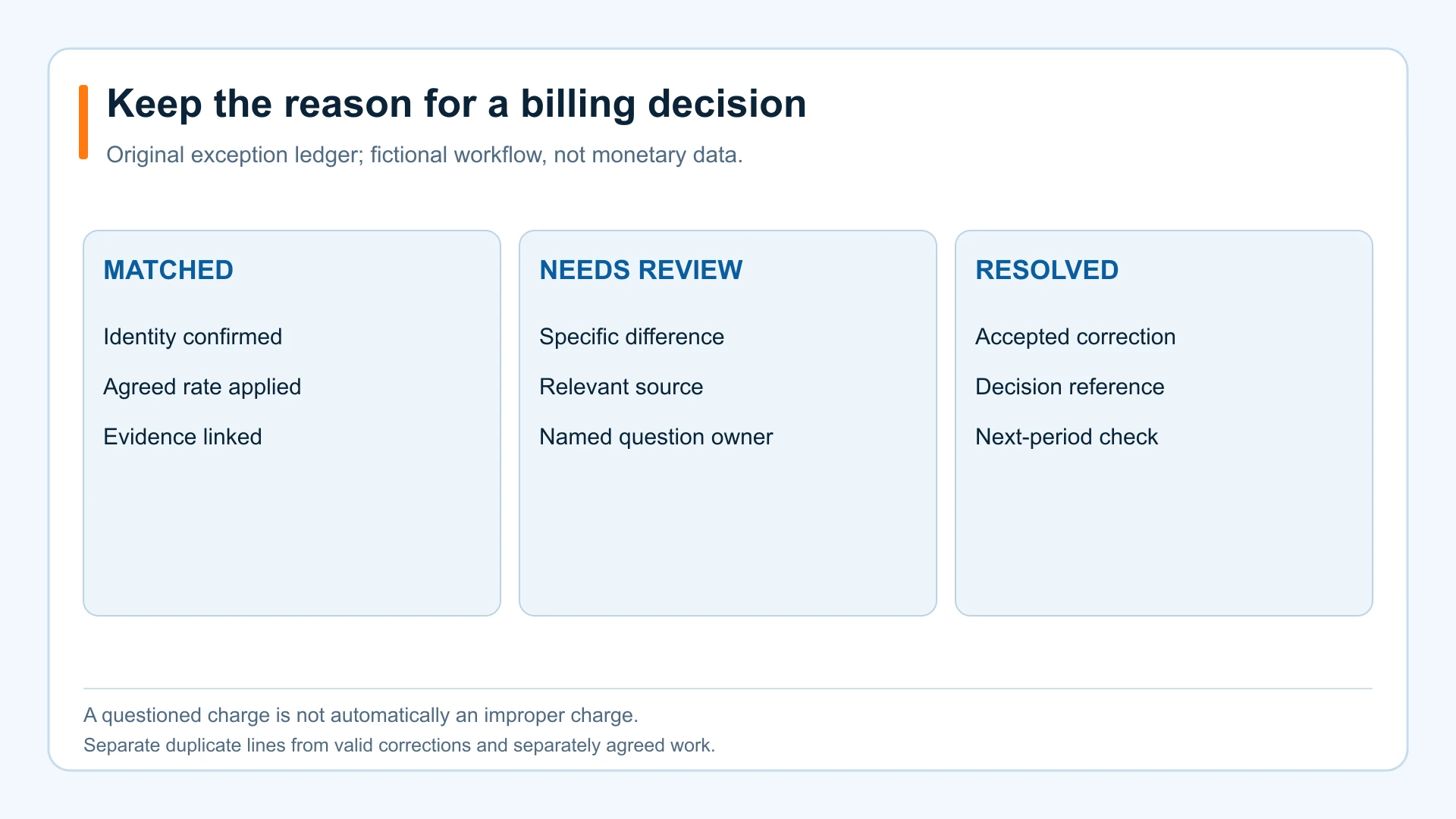
A useful ledger distinguishes matched, awaiting information, under commercial review and resolved items. Those labels should describe actual progress, not a predetermined payment decision. Record the specific question, the evidence requested, a responsible owner and the next review point. An unresolved line should not vanish when someone creates a fresh spreadsheet for the next month.
When the provider explains a charge, assess whether the explanation connects to the accepted terms and recorded work. A clear explanation may resolve the question without changing the invoice. In another case, an accepted credit or revised line may be needed. Keep both possibilities open until the appropriate finance and commercial reviewers make the decision.
Do not infer a right to withhold payment, an interest obligation or a dispute deadline from this guide. Those are arrangement-specific matters for the responsible reviewers. The editorial worksheet improves the evidence available for their decisions; it does not replace their authority or your organization’s purchasing and payment procedures.
6. Walk Through a Fictional Review Without Inventing Rates
Imagine a supplier receives an invoice line described as an additional return collection. Its operations record shows a completed outbound delivery and an empty tote arriving back at the depot the next day. The buyer initially assumes the return was included. The provider initially assumes it was an accepted additional movement. Neither assumption, by itself, resolves the invoice.
The reviewer first matches the return to the correct transport unit and order. Next, the reviewer locates the applicable scope and any change request. If the records show an authorized additional collection accepted by the provider, the reviewer checks the agreed billing basis. If the authorization is absent or ambiguous, the item remains a named commercial question rather than a silently approved or deleted line.
The resulting decision could be confirmation of the original charge, an accepted correction or a clearer instruction for future returns. Record the reason, not just the outcome. The example contains no actual MOVE prices, customer events or savings. Its value is the sequence of questions, which can be used without inventing a market-rate comparison.
7. Use the Findings to Improve the Next Billing Period
Repeated differences often point to a shared definition that needs repair. If reviewers repeatedly question package quantities, clarify the billing unit. If waiting entries are unclear, align the relevant events and supporting evidence. If authorized changes cannot be found, improve the connection between the operational decision and the commercial record.
Measure review findings carefully. A count of questioned lines is not an error rate; some questions resolve as correct charges. If you report a rate, name the reviewed population, period, classification rules and unresolved items. Avoid publishing a savings number that combines accepted credits, unverified assumptions and amounts that would never have been payable under the agreement.
Consider a small, reproducible sample before changing the entire review process. Include routine lines and known exception types, then check whether two authorized reviewers reach consistent classifications using the same evidence. Disagreements can reveal unclear instructions. The goal is a repeatable explanation of the work, not a spreadsheet that only its creator can interpret.
Share improvements with the teams producing the records. A billing finding may require a clearer change request, more precise accepted scope or a better identifier mapping. Closing the loop lets procurement, operations and finance solve the underlying ambiguity together instead of repeating the same email exchange on every invoice.
Check how accepted corrections enter the next period. A credit document can exist without being connected to the original line in the buyer’s ledger. Record its reference and the affected work, then verify that reviewers do not count the same adjustment both as a revised invoice and as a separate credit. Where an adjustment spans several orders, preserve the approved allocation rather than distributing it arbitrarily to make departmental totals agree.
Courier Invoice Reconciliation: Common Questions
Is proof of delivery enough to approve every charge?
No. A completion record answers a delivery-event question. Billing approval also depends on the accepted scope, relevant unit, applicable rate and supporting evidence for any additional work. MOVE’s proof-of-delivery overview explains completion visibility, not the payment terms of a specific agreement.
Should every questioned charge be recorded as an error?
No. Keep an open question distinct from a confirmed discrepancy. A line can be explained and accepted without alteration. Recording those outcomes separately produces a more honest review report and avoids exaggerating either invoice problems or savings.
Can a spreadsheet replace the source records?
No. Treat it as a controlled index to the evidence and decisions. Preserve the relevant invoice, agreement and authorized work records in their approved systems. Keep access limited to the information each reviewer needs, and use your organization’s actual record policies.
What should we discuss before starting recurring service?
Confirm the billing unit, scope, change process, evidence available and review contacts alongside pickup and receiving requirements. Start an account conversation with MOVE for ongoing work, or Quick Quote for a specific local assignment. Actual availability, terms and prices require confirmation.