
A useful courier driver pay comparison starts by identifying what the number represents. An employee wage, an independent business’s invoice revenue and the money left after vehicle costs are not the same thing. Before comparing opportunities, ask which work is included, which expenses you would carry and how the actual arrangement is documented.
A large earnings figure can attract attention while leaving important questions unanswered. Does it describe one unusually busy period? Does it assume uninterrupted work? Are fuel, vehicle wear, waiting and non-delivery time included? A thoughtful comparison brings those assumptions into view before you decide whether an opportunity fits your circumstances.
This guide uses national BLS employee wage context and an original comparison worksheet. It does not state MOVE pay rates, guarantee assignments or determine employment classification. The fictional arithmetic examples explain comparison methods, not expected earnings. Review the particular opportunity and obtain qualified legal, tax or financial advice where your circumstances require it.
Use public wage data without turning it into a promise
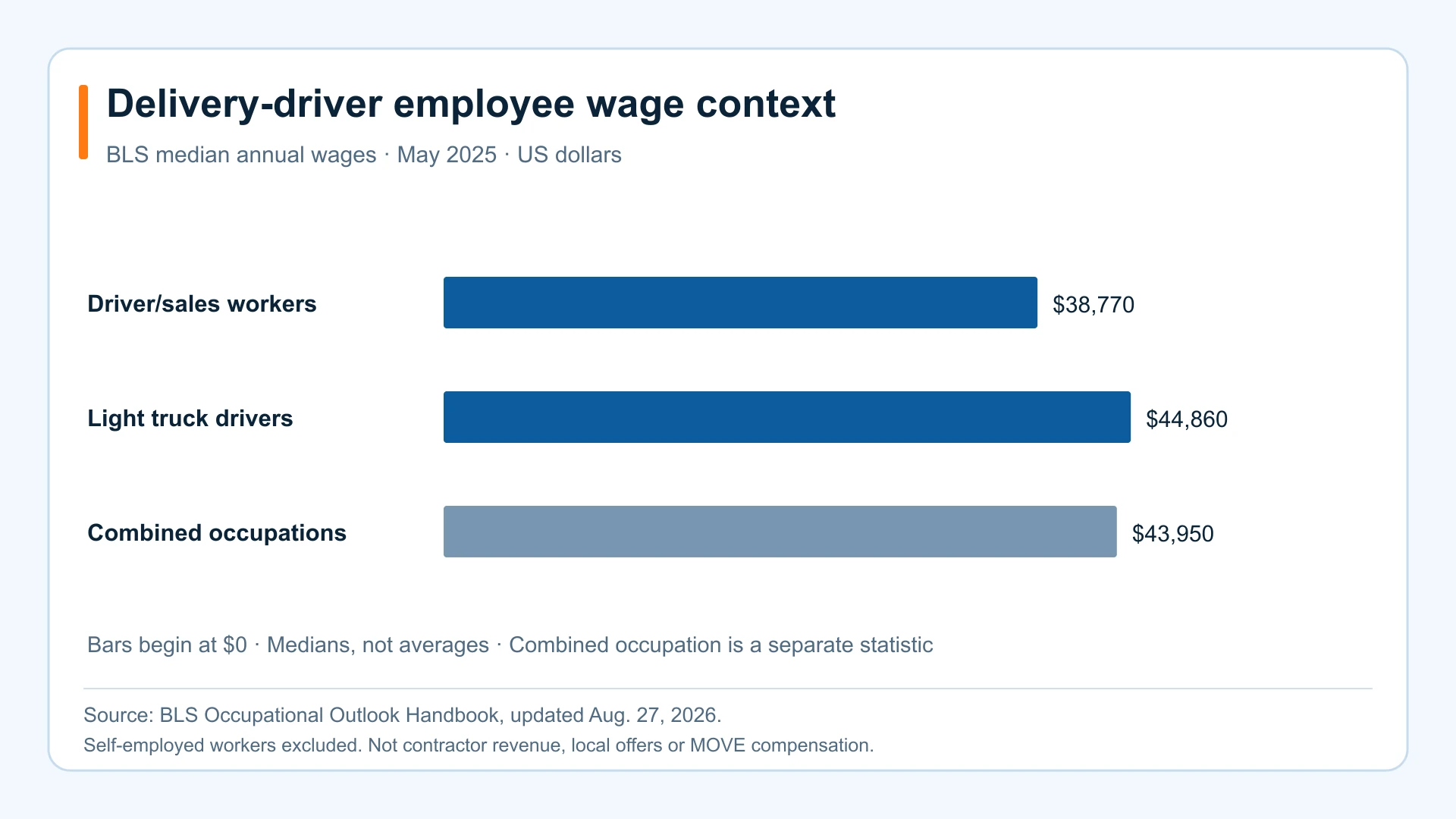
The BLS delivery occupations profile reports May 2025 median annual wages of $38,770 for driver/sales workers and $44,860 for light truck drivers. The combined occupation median is $43,950. These are broad national employee wage statistics, not medical-courier-specific pay or MOVE compensation.
A median describes the middle of the measured wage distribution; it is not an average payment for a delivery. It does not identify the compensation available for a particular local role. BLS wage estimates exclude self-employed workers, so they should not be presented as typical independent-contractor gross revenue or take-home income.
Our chart displays the published annual medians without converting them into per-stop prices or assuming a work schedule. That restraint matters. A reader comparing two opportunities needs the actual agreed pay basis and workload, not a national figure divided into an hourly promise that the source never made.
| Broad occupation | Median annual wage | What this does not establish |
|---|---|---|
| Driver/sales workers | $38,770 | Available assignments, individual schedule, local offer or independent-business profit. |
| Light truck drivers | $44,860 | A rate for one medical delivery, an employer’s specific compensation or a contractor’s net income. |
| Combined occupations | $43,950 | A third group to add to the two component occupations, or the pay every worker receives. |
Identify the pay basis in the actual opportunity
Ask whether compensation is described by time worked, accepted assignment, completed stop, route, another unit or a combination. Then ask what event makes the payment due and how the applicable record is created. A per-stop amount cannot be evaluated meaningfully without knowing what a stop includes and what happens when the handoff cannot be completed.
Discuss waiting, failed attempts, returns, additional stops and changed scope. Do not assume these are paid, unpaid or included. The actual agreement should explain their treatment. Request examples of the record needed to review a payment question, using fictional information rather than another driver’s private earnings.
Also identify the payment period and process. When are completed records reviewed? How does a correction or dispute reach the responsible contact? What happens if a required record is missing? A rate that looks attractive on paper can still be difficult to assess when the payment basis and evidence process remain unclear.
A contractor label does not settle the legal arrangement
Employee and contractor status is not simply a menu choice made because one headline rate looks higher. Classification depends on the actual relationship and applicable law. The IRS classification guidance discusses control and relationship facts for federal employment-tax purposes. Other federal and state tests may differ.
Do not assume owning a vehicle, receiving a particular tax form or signing an agreement automatically resolves every test. Ask for a clear description of the role and seek qualified advice if the arrangement raises questions. This article does not decide whether a particular courier relationship is lawfully classified.
A pay comparison should follow that review rather than try to replace it. You can identify practical questions about schedule, expenses and records without treating those answers as a legal determination. Keep the decision about suitability for your circumstances distinct from an unsupported conclusion about compliance.
Write down who carries each expense
List the expenses relevant to the actual work and identify who is responsible for each one. Vehicle acquisition or financing, insurance appropriate to the use, fuel, maintenance, tires, parking, tolls, communications and required equipment may warrant discussion. These are comparison categories, not a statement that every opportunity assigns them to the driver.
Distinguish an immediate cash payment from a longer-term cost. Buying fuel is visible today; vehicle maintenance and replacement may be less visible until later. Ignoring longer-term vehicle costs can make invoice revenue look like disposable income. Use realistic records for your own circumstances instead of a universal expense percentage copied from an advertisement.
Do not treat every planning expense as a deductible tax expense. Eligibility, substantiation and tax treatment depend on the applicable rules and your circumstances. Keep an operational expense worksheet separate from a tax return, and have a qualified adviser answer tax questions rather than relying on a courier article.
| Comparison item | Question to ask | Evidence or assumption to record |
|---|---|---|
| Pay unit | What work and event does the quoted amount cover? | Written pay basis and examples of included work. |
| Assignment availability | Is any workload guaranteed, or does it depend on accepted opportunities? | Actual agreement and a clear distinction between history and future expectation. |
| Vehicle responsibility | Who supplies, maintains and insures the vehicle for its intended use? | Confirmed responsibility, appropriate advice and your relevant costs. |
| Waiting and exceptions | How are waiting, attempts, changes and returns handled? | Agreed treatment and the record needed for payment review. |
| Time commitment | What preparation, travel, handoff and administrative time belongs in the comparison? | Observed or explicitly estimated time, separated from guaranteed commitments. |
| Payment review | Which records support the amount, and how are questions resolved? | Review channel, period, correction process and accountable contact. |
| Classification and taxes | Which legal and tax questions need qualified assessment? | Advice on the actual arrangement, not a conclusion inferred from one pay figure. |
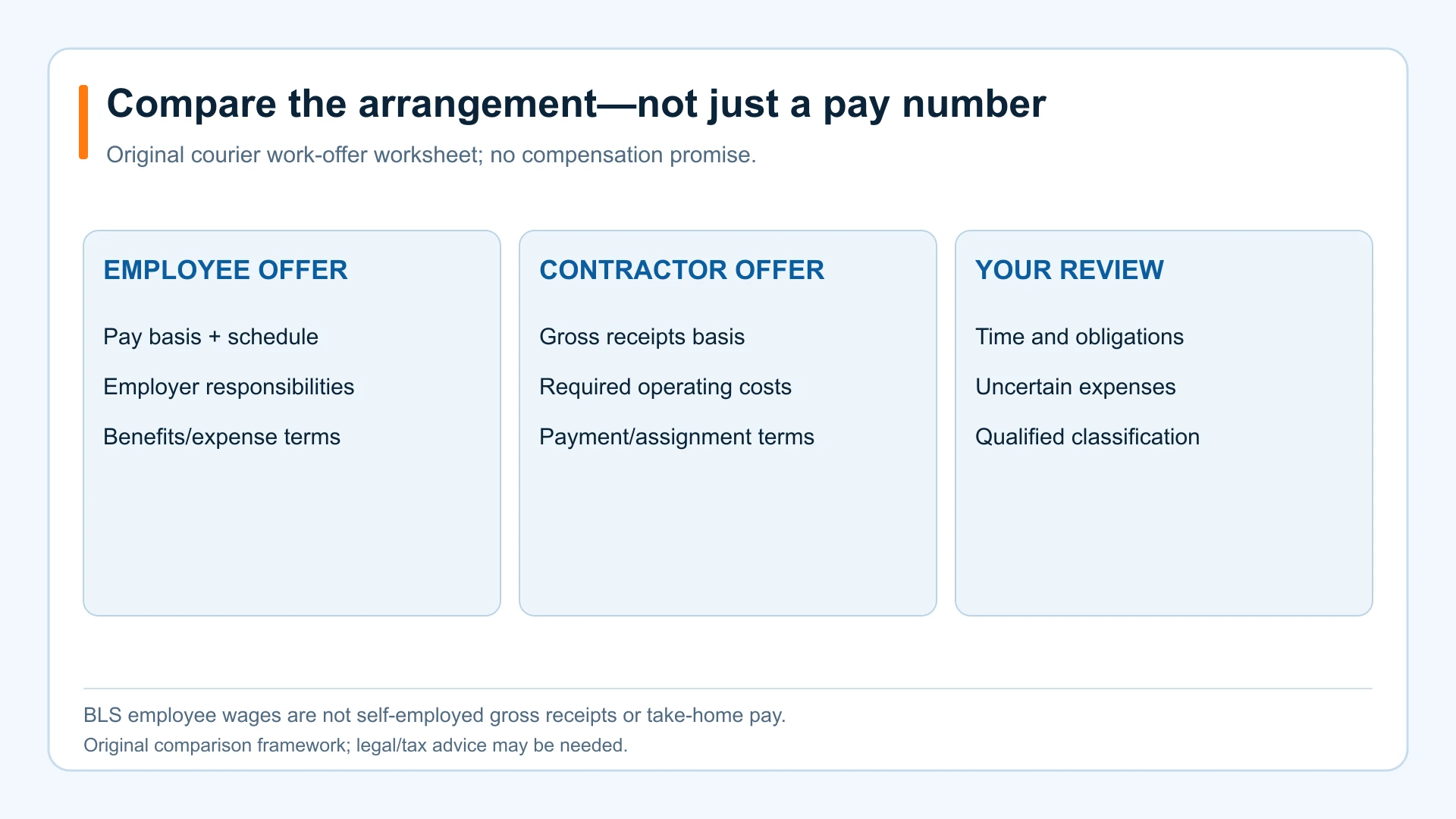
Compare total relevant time, not only the minutes behind the wheel
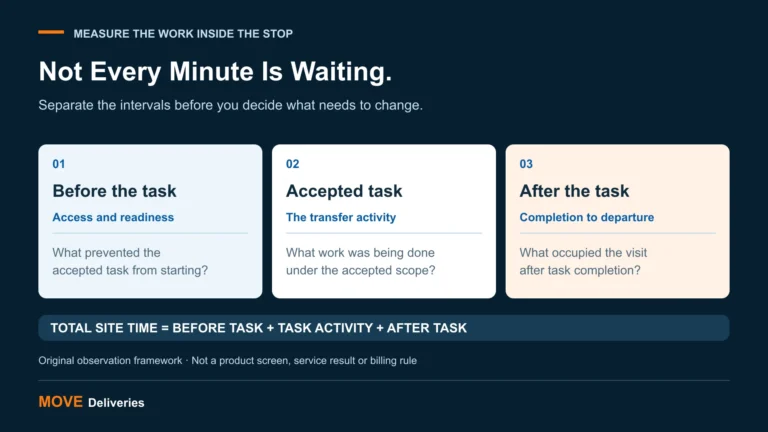
Delivery work can involve preparing for an assignment, reaching the pickup, locating the release point, completing the handoff, following approved instructions and maintaining required records. Which time is compensated and how it is treated depends on the actual arrangement and applicable law. Do not assume that a displayed drive time captures every part of the work.
For planning, record the time categories consistently when comparing opportunities. An estimate based only on travel between two addresses can overlook access, loading and receiving conditions. Those omissions may matter to your own capacity and workday even when the quoted payment unit is not hourly.
Use observations responsibly. One unusually smooth assignment or one difficult day is not a stable forecast. Keep a range where the work varies, identify the source of each estimate and state which conditions could change it. A comparison is useful when it makes assumptions visible, not when it produces one deceptively precise answer.
Fictional arithmetic: revenue is not the amount left after costs
Imagine a fictional independent business recording $500 of assignment revenue during a comparison period. It estimates $120 of relevant operating costs for that same period. Subtracting those assumed costs leaves $380 before taxes and other items not included in the example. These invented amounts are teaching inputs, not actual courier rates, typical margins or expected MOVE earnings.
If the business counted only fuel and ignored other relevant costs, the calculated amount would be higher without the underlying opportunity becoming better. That is why the expense list and period must be explicit. Equally, adding costs unrelated to the work would distort the comparison in the other direction. Use consistent boundaries.
Now suppose the fictional period involves 20 hours of relevant activity. Dividing the $380 planning remainder by 20 gives $19 per hour as an analytical ratio. It is not an employee wage, a legal hourly-pay assessment or a take-home-pay estimate. The ratio can help explain assumptions, but it cannot replace classification, tax or contract review.
Treat workload uncertainty honestly
A headline example may assume every available assignment is accepted and completed without interruption. Your actual circumstances may differ. Ask which volume is guaranteed, which is historical and which is merely possible. Do not build a personal budget around a projection presented as though it were an agreed commitment.
Consider more than one planning case using your own appropriate assumptions. What changes if assignments are fewer than expected, vehicle costs rise or an agreed operating period changes? This is not a prediction of what will happen. It is a way to identify which assumptions your decision depends on most strongly.
Keep the terms clear when an opportunity uses examples from busy periods. A historical example should identify its period and relevant conditions. It should not silently become a promise about every applicant’s experience. Ask for current terms directly and be cautious when the details needed for a meaningful comparison are unavailable.
Include the work’s practical fit
Pay is important, but it is not the only question. Consider whether the work’s location, physical tasks, operating pattern and required responsibilities fit your circumstances. Ask what instructions and support apply to the specific opportunity. A figure alone cannot tell you whether you can perform an accepted task safely and reliably.
For healthcare-related courier work, understand the boundary between transport responsibilities and qualified clinical decisions. Ask how the organization communicates release, receiving and handling instructions and how you report a discrepancy. Do not accept an expectation that you improvise a technical answer outside your role merely to keep an assignment moving.
Clear communication is part of the comparison. You should know whom to contact about an unavailable receiving role, changed scope or payment record. A maintained process is more useful than a vague assurance that someone will always answer. Discuss the actual arrangement without assuming every courier opportunity includes the same support.
Keep the evidence needed to review the opportunity
Save the current agreed terms and maintain records appropriate to the work, using approved methods and respecting confidentiality. Do not retain unnecessary patient information in a personal expense worksheet. Operational references can help connect an assignment and payment without copying sensitive shipment details into unrelated files.
When a payment question arises, identify the assignment reference, agreed pay basis, relevant event and specific discrepancy. A precise question is easier to review than a general claim that a total looks wrong. Use the defined process and preserve the original record rather than changing it to match the amount you expected.
Review material changes to terms before relying on the old comparison. A different operating area, new vehicle responsibility or revised pay unit can alter the decision. Update your assumptions and ask about the change in writing through the appropriate channel. The original worksheet should remain a record of the earlier comparison, not be silently rewritten.
Courier driver pay comparison: common questions
Is a contractor’s revenue comparable with an employee’s wage?
Not directly. They measure different things. Identify expenses, time, taxes, benefits where applicable and the actual working arrangement before drawing conclusions. National wage data cannot supply all of those answers for an individual opportunity.
Does BLS show typical medical courier contractor earnings?
Not in the profile used here. It reports employee wages for broad delivery occupations and excludes self-employed workers from wage estimates. Do not relabel the figures as medical-courier contractor revenue or MOVE compensation.
Can a fictional calculation tell me what I will earn?
No. It demonstrates the method and the effect of assumptions. Your outcome depends on current agreed terms, workload, expenses, circumstances and applicable obligations. Ask about the particular opportunity rather than treating an example as a forecast.
Start with the details of the actual opportunity
If courier work with MOVE interests you, visit Become a Driver and ask about the current opportunity in your location. Review the work, requirements and terms before deciding whether it fits. This guide supports a better-informed conversation; it does not create a job offer, an assignment guarantee or a promise of income.