Medical courier address validation should answer a practical question: can the agreed delivery reach the intended receiving team? A street address can be neatly formatted and still omit the building, suite or entrance that matters. A map marker can look convincing while pointing to the wrong side of a hospital campus. Before changing courier providers or adding software, separate what your records actually confirm from what staff have assumed.
This guide helps pharmacy, laboratory, clinic and medical-supply buyers prepare local delivery destinations. It offers seven checks, an original facility confirmation card and a fictional campus example. The method is an operational planning aid, not a postal certification, a route-navigation instruction or permission to change clinical labels. Your facility and courier coordination contacts must agree on the applicable service and receiving instructions.
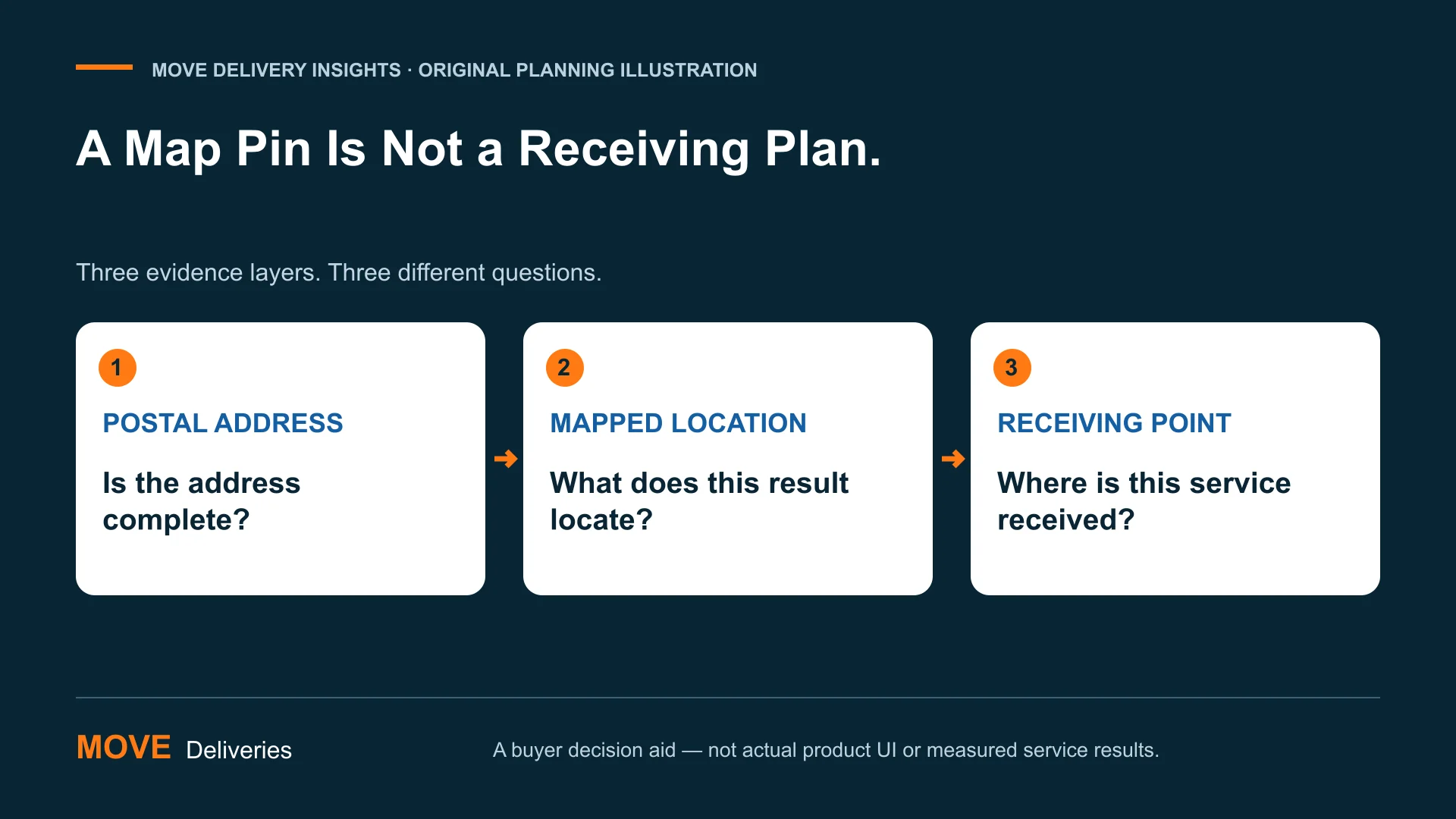
Keep three evidence layers separate: the postal address, the mapped location and the operational receiving point. Each can help, but none proves the other two. A useful record names the source and date of confirmation, the remaining uncertainty and the person authorized to resolve it. Do not turn an attractive map display into a promise that a particular door is open or staffed.
In this guide
- A valid address is not the same as a usable destination.
- 7 medical courier address validation checks
- Copy this original destination confirmation card.
- One fictional campus. Three different answers.
- Make corrections traceable, not invisible.
- Address validation: questions buyers ask
- Bring a destination your team can explain.
A valid address is not the same as a usable destination.
Postal formatting concerns the components of an address. USPS Publication 28 describes delivery-address elements including the street number, directional information and secondary unit. Its address-component guidance helps explain why a missing unit can matter. The publication is about mailing addresses; applying that distinction to a courier destination record is our planning adaptation. It does not establish a hospital’s current courier entrance.
Mapping concerns a geographic estimate. The Census Geocoder documentation explains that its coordinates are approximated from address ranges and that a number in a range does not necessarily identify an existing structure. This illustrates why a geocoding result is not independent proof of a receiving location. Other mapping services have their own methods and limitations; ask which result your workflow uses.
Operational confirmation concerns the specific service point: the facility or department, the appropriate entrance, who can receive and when the agreed task can occur. A switchboard, mailroom and laboratory receiving desk may all share a street address without being interchangeable. Capture the distinction without publishing private access details or unnecessary patient information. The purpose is to direct an authorized delivery conversation, not to build a public directory of sensitive facility instructions.
When reviewing an existing address list, do not replace every entry with the first result from an automated search. Preserve the original value, identify the proposed correction and obtain confirmation from the appropriate source. A normalized abbreviation may be harmless, while a changed building number or omitted suite can alter the intended destination. Those differences deserve different levels of review.
7 medical courier address validation checks
First, identify the facility and the purpose of the stop. Ask which organization, building and receiving function the request is intended to reach. A familiar business name is not enough when multiple branches or similarly named departments exist nearby. Use the organization’s approved location identifier where one is available. The provider can then discuss the same destination without relying on a nickname known only to one employee.
Second, confirm the full street address and required unit information with an authorized facility contact. Distinguish a suite number from an internal department name and a building letter from a street suffix. USPS secondary unit designators provide a postal vocabulary, not a rule that every internal hospital location belongs in the same field. Preserve operational details in the appropriate instructions rather than forcing them into a ZIP Code box.
Third, review the map result as a separate piece of evidence. Ask whether it identifies the correct property and whether the receiving point has been independently confirmed. A location result near the main lobby may be geographically reasonable but operationally unhelpful for the agreed task. Do not instruct a driver to disregard site signs, access restrictions or safe navigation because a saved pin appears elsewhere. Resolve the discrepancy through the supported coordination process.
Fourth, establish which arrival point the facility wants used for this service. A loading area, outpatient entrance and staffed reception desk may follow different procedures. Ask the facility to confirm the appropriate location and who should be contacted on arrival. Document the source rather than guessing from an aerial image. Confirm any vehicle or access constraints with the courier provider before treating the instruction as accepted.
Fifth, confirm receiving availability for the requested day and window. The building can be open while a particular department is not receiving. Record the applicable contact and any known exception that changes the destination discussion. Do not copy yesterday’s successful visit as proof of today’s staffing or schedule. For a recurring arrangement, agree how the buyer will communicate a changed receiving instruction and how that change becomes confirmed.
Sixth, compare the destination across the request, location record and current coordination message. A correct master record does not help if the employee selects a different branch when booking. Use the agreed nonclinical reference to identify the task, then reconcile differences before sending replacement instructions. If transport is already underway, raise the issue with the authorized coordinator rather than silently editing a spreadsheet and assuming the driver sees it.
Seventh, close the confirmation loop and retain its evidence. Record what was confirmed, by which role, through which approved channel and when it applies. Include what remains unresolved. A telephone conversation can be useful, but the next employee needs an understandable current instruction. Confirmation should reach the releasing and receiving people who need to act, not remain in the notes of the person who happened to answer the call.
Copy this original destination confirmation card.
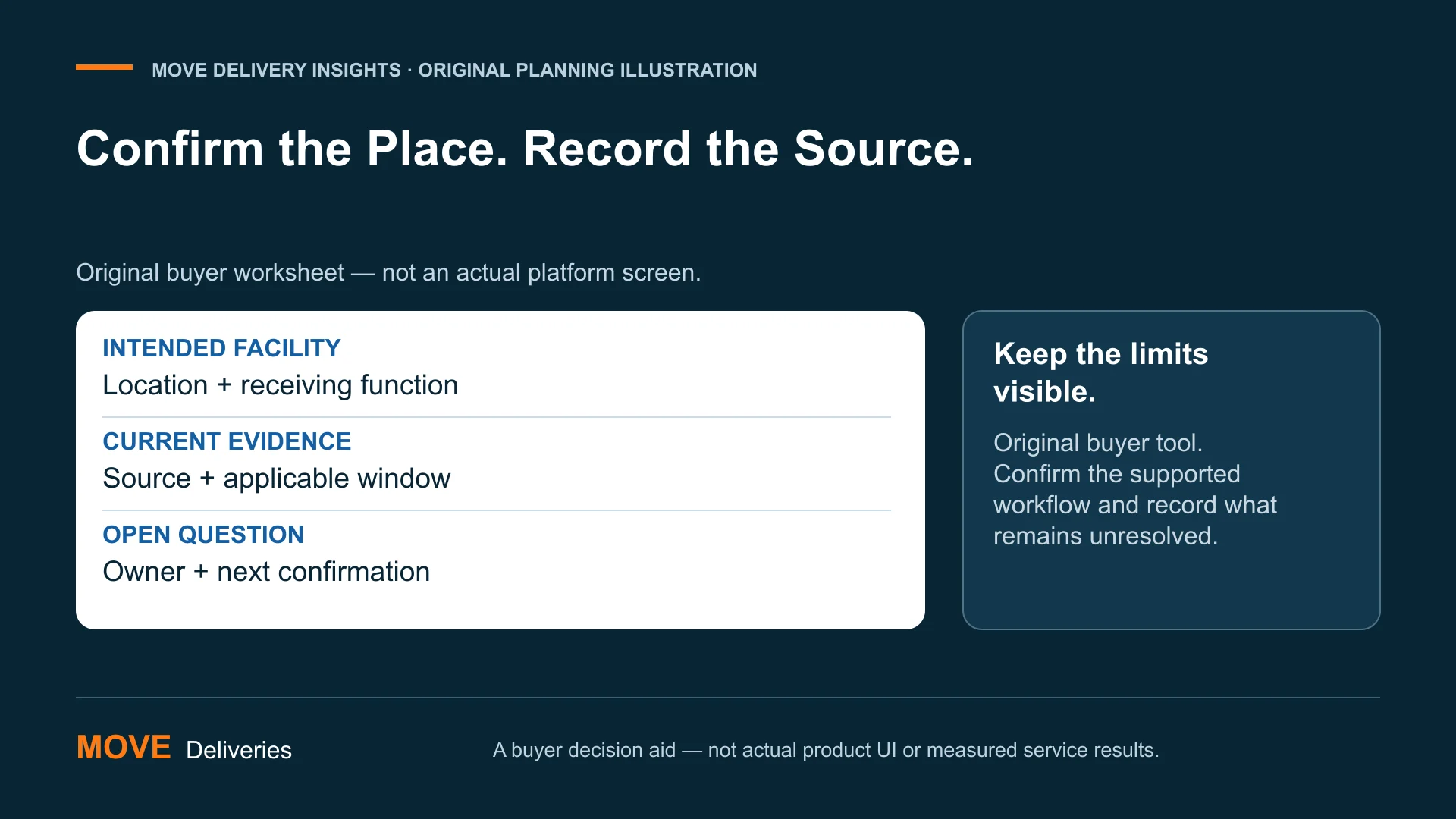
Build the card around decisions rather than a long mandatory questionnaire. Start with the exact destination your team intends to use, then distinguish confirmed information from a proposed value. Keep a blank or unresolved option available. Requiring a guess just to complete the form produces a more polished record without producing better evidence. The person approving the destination should understand what each confirmation actually covers.
Store sensitive access information only in the approved operational system, with access appropriate to the people using it. This public worksheet intentionally avoids gate codes, patient identifiers and clinical details. A buyer can name the responsible role and the controlled instruction source without duplicating those details into every email or exported list. Ask your own organization how location information should be handled and shared.
A confirmation date is useful when paired with a change trigger. A location may require review after a department move, a revised entrance procedure, a failed arrival or an ambiguous branch selection. Pick triggers that fit your operation rather than assuming a generic monthly reminder catches every change. The card supports that review; it does not certify that a facility will remain accessible until the next scheduled check.
| Field | Evidence to record | Do not infer |
|---|---|---|
| Intended facility | Approved location reference and receiving function | A familiar name identifies one branch |
| Postal layer | Complete address, unit and confirmation source | A formatted address proves receiving access |
| Map layer | Result reviewed and any discrepancy noted | A pin identifies the correct door |
| Receiving layer | Facility-approved arrival point and contact role | The main lobby accepts this delivery |
| Availability | Applicable day/window and exception contact | Open building means staffed department |
| Current instruction | Provider review and confirmed next action | Editing a local list updates an active trip |
| Review trigger | Owner, confirmation date and reason for recheck | A past visit proves present conditions |
One fictional campus. Three different answers.
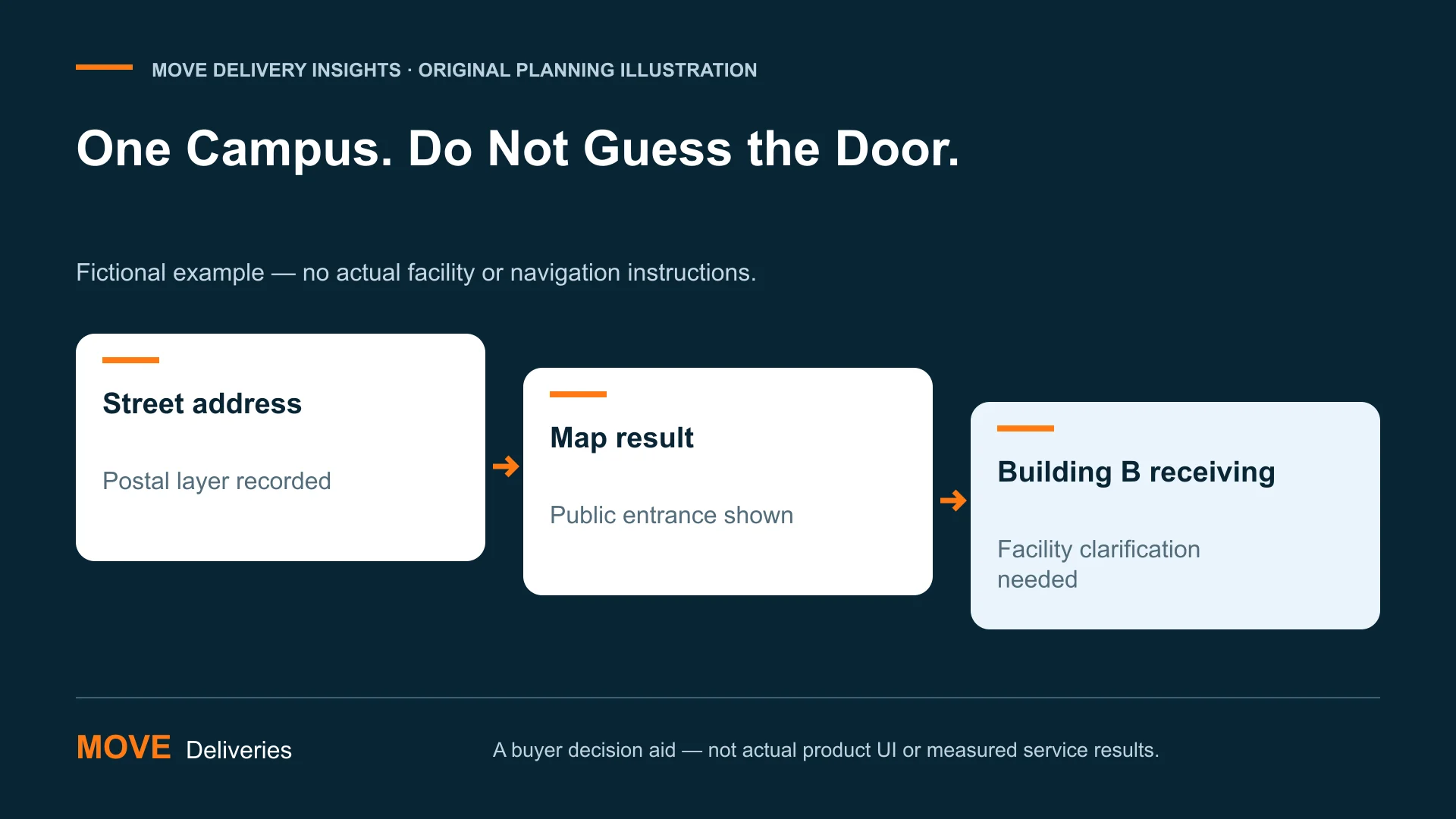
Imagine a fictional supplier arranging a local delivery to West Campus Clinic. The buyer’s location list contains a street address and the label “clinic.” A map search resolves to the campus’s public entrance. A receiving employee explains that this particular service should be coordinated with a department in Building B. None of these facts should be quietly discarded, and none alone answers the full destination question.
The buyer records the postal address as one layer and asks the facility to confirm how Building B and its receiving function should appear in the operational instructions. The mapping discrepancy remains visible. The courier provider reviews the proposed arrival point and service constraints before the buyer treats the plan as accepted. This is a confirmation conversation, not an instruction to navigate through an unapproved entrance.
Now suppose another department uses the same street address but receives elsewhere. The buyer creates a distinct operational location reference rather than giving two incompatible meanings to one nickname. Staff selecting the destination can see which function they are requesting. The address may remain identical while the intended receiving point differs. Keeping those concepts separate helps explain the booking without inventing another street address.
Finally, change the date: Building B’s receiving contact is unavailable for the requested window. The previous confirmation is evidence of the normal arrangement, not authority for a substitute destination. The buyer and provider must establish the applicable next instruction with the facility. The example does not demonstrate a successful real delivery, calculate saved minutes or prove a software feature. It shows where a decision requires more evidence.
Make corrections traceable, not invisible.
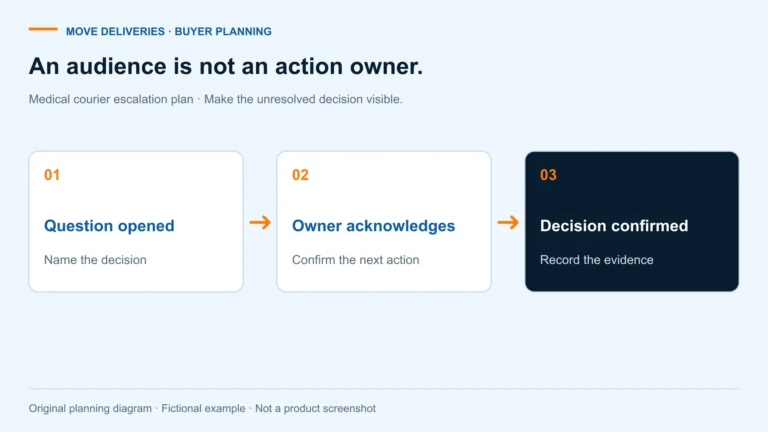
Agree who may propose a location correction and who may approve it. Reception staff may identify a mismatch without being responsible for authorizing a changed transport destination. The buyer’s location owner can collect the clarification, while the provider determines how an accepted request is updated through its supported workflow. Clear responsibilities prevent a useful correction from becoming a contradictory instruction.
Preserve enough history to explain what changed. Record the prior value, proposed value, source of confirmation and effective condition in the appropriate work record. Avoid retaining unnecessary personal information merely to make the history more detailed. If the same error appears in multiple systems, identify the system of record and the downstream copies that need review. Fixing only the spreadsheet visible at the moment can leave the next booking unchanged.
Use an explicit unresolved state when sources disagree. A web listing, a saved account location and a facility contact may provide different information for legitimate reasons. Ask the responsible parties to clarify which applies to the intended service. Do not choose whichever source looks most official and hide the conflict. A courier cannot resolve an organization’s intended recipient by interpreting competing administrative records alone.
After a correction, test the selection process using fictional or otherwise authorized non-sensitive details. Can a different employee choose the intended branch, recognize the receiving function and locate the confirmation source? Can they tell when to ask for help? This is a review of the buyer’s record and workflow, not a production navigation test or permission to submit a real delivery request without need.
Address validation: questions buyers ask
Does a successful address lookup guarantee delivery? No. A lookup can support the address or mapping layer within that tool’s limits, but service availability, receiving conditions and accepted instructions remain separate. Ask what was actually checked and retain that distinction. A general “validated” badge should not be used as shorthand for every operational condition your team needs.
Should we store every doorway as another customer address? Not automatically. First distinguish the organization, postal address, operational location and service-specific instruction. Your account structure may support these in different ways. Ask the provider how its location records and permissions work before importing a long list. The goal is a clear selection, not the largest possible number of near-identical entries.
Can proof of delivery correct a bad address record? A completion record may help investigate where a particular accepted delivery was recorded, but it is not a universal source of current facility instructions. Review MOVE proof of delivery and ask which records are available for your service. Address maintenance still requires an authorized source and an understandable effective instruction.
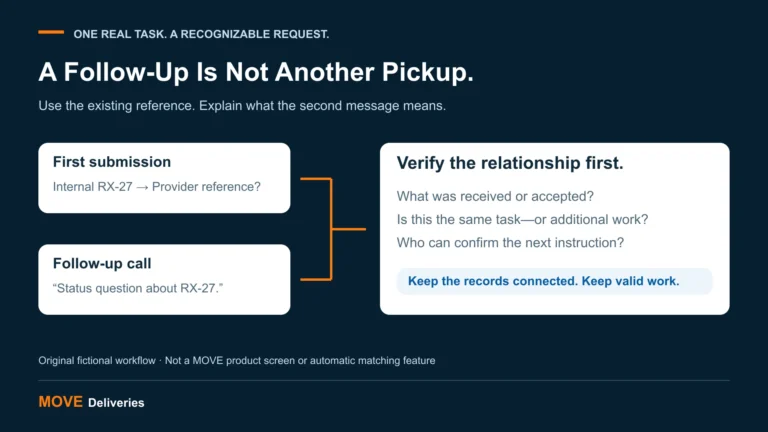
What should an employee do when a destination changes after booking? Contact the authorized coordination team using the existing request reference and explain the proposed change. Confirm what is accepted and who needs the update. Do not assume a new map pin, a local edit or a message sent to one colleague changes an active delivery. The relevant operational parties must agree on the next action.
Bring a destination your team can explain.
Before the next provider conversation, select a small set of actual location-record problems without unnecessary patient details. Include one missing unit, one ambiguous facility nickname and one disagreement between a map result and a receiving instruction. Use the card to identify the missing evidence in each case. A specific unresolved question gives the conversation more substance than a general request for “better address validation.”
MOVE coordinates local same-day medical delivery through its proprietary platform. Explore How It Works and our hospital and clinic delivery information. Discuss the location records, supported request channels and receiving details your workflow needs. This guide does not claim an automated address-verification feature or reserve a service.
For a defined local delivery, request a Quick Quote. For recurring work, Start An Account and review how destination changes will be confirmed. The objective is not another reassuring marker on a screen. It is a destination record that the next authorized person can understand and use.