What a medical delivery shift brief should contain
A medical delivery shift brief is a short customer-side review of open transport requests, current instructions and unresolved decisions when operational staff change. Its purpose is to help the incoming employee understand what still needs attention and who can act. It is not a clinical report, a transfer of patient-care responsibility or a substitute for the organization’s approved healthcare communication procedures.
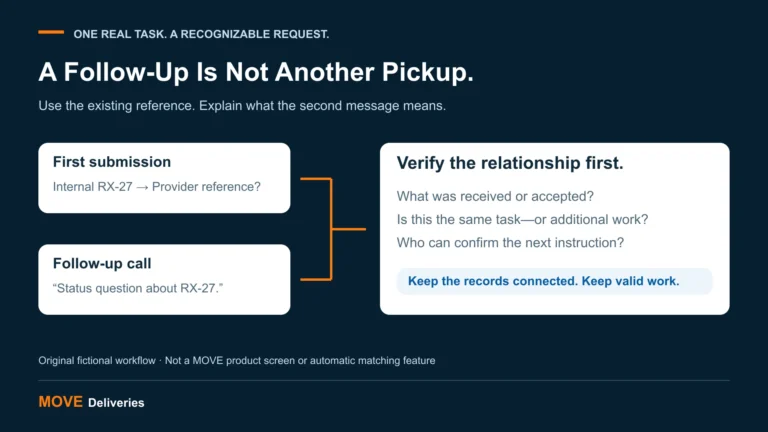
The visible problem is often a status call that nobody on the new shift can answer. The outgoing coordinator knew why a collection remained under review, which destination had changed receiving arrangements and who could approve the next step. That knowledge stayed in a conversation rather than the maintained record. The incoming employee now has a reference number but not the context needed to resolve the question.
This guide offers seven questions, an original open-work board and a fictional check-back exercise. It addresses pharmacies, laboratories, hospitals, clinics and suppliers coordinating local transport. Clinical priorities, preparation requirements and sensitive information remain with responsible personnel and approved channels. The brief should translate established transport decisions into a usable operational view, not decide those requirements for them.
Keep the meeting proportional to the work. A brief with one unresolved request need not become a lengthy presentation. A busy shift change may require a structured board so no open item disappears. The objective is not to repeat every historical event. It is to identify the current state, the next decision and the employee or role available to handle it.
In this article
- What a medical delivery shift brief should contain
- 1. Which requests are still open, and why?
- 2. What is the current instruction version?
- 3. Who can make the next decision?
- 4. What evidence supports the status?
- 5. What should happen if the open condition changes?
- 6. Can the incoming employee restate the next action?
- 7. Close the brief without losing open work
- Use an original open-work board
- A fictional shift change that exposes an unaccepted proposal
- Check the briefing board with three practical tests
- Build the brief around the real service arrangement
1. Which requests are still open, and why?
Start with the actual request references that need ongoing attention. Separate work awaiting service acceptance, work awaiting release, work already collected and work needing a completion review. A general “pending deliveries” list combines different questions. Staff should know whether they are waiting for an agreed pickup, prepared units or evidence of receiving.
For each open request, describe the unresolved issue in one operational sentence. For example, the releasing owner has not confirmed preparation, or the customer coordinator is waiting for a response about a proposed receiving change. Avoid a vague “check with dispatch” instruction that requires the incoming employee to discover what question to ask.
Exclude completed work unless it has a specific open reconciliation question. A long board full of finished deliveries can conceal the few items that matter now. Where a completion record is awaiting review, label that purpose separately. The proof of delivery page explains the evidence context; a map position or notification alone does not answer every receiving question.
2. What is the current instruction version?
Identify the maintained transport record and the instruction version that applies. Staff may have a printed preparation list, a message thread and a platform view describing the same request differently. The brief should direct the incoming employee to the agreed current source and flag differences that still require resolution.
Do not silently merge old and new instructions. If a receiving window was revised, say whether the responsible parties accepted the revision. If a change is only proposed, preserve that state. The incoming shift should not treat a forwarded suggestion as a confirmed transport instruction. An old acknowledgment does not establish agreement with a later revision.
Describe the date and relevant local time zone when a decision depends on timing. Relative wording such as “tomorrow morning” can become ambiguous when copied into another shift or read after midnight. Exact dates make the record more usable without requiring unnecessary patient details. Keep sensitive access instructions within the approved operational channel rather than displaying them on a broadly visible board.
3. Who can make the next decision?
Assign an available owner to each unresolved question. The person who can confirm preparation may differ from the role that can approve a transport change. Receiving staff may verify an entrance or availability without authority to alter the customer’s commercial request. Describe the responsibility, not just a name beneath every row.
Identify a backup when the ordinary coordinator will be unavailable. Confirm the approved contact path and the limits of that role’s authority. A brief that transfers work to an absent person creates the appearance of ownership without a practical next step. Avoid sharing unnecessary personal contact details; use the established operational contact arrangement.
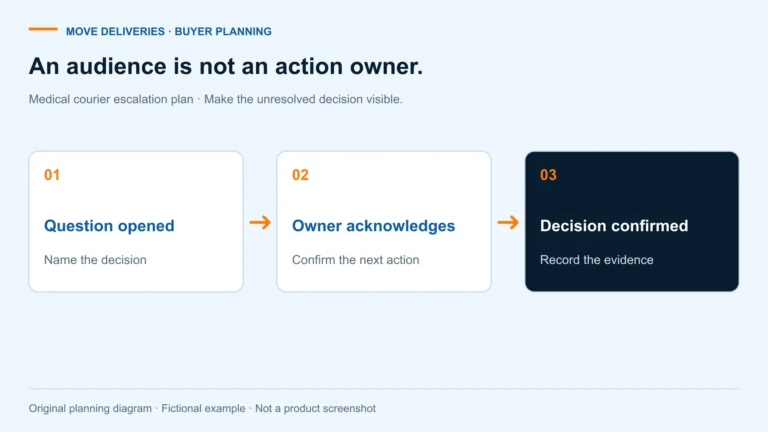
The incoming employee should know when to raise a question and whom to involve, but should not be asked to invent a driver instruction. Changes after collection need the appropriate authorization and service response. Our transport-change guide addresses that separate decision path. The brief keeps the responsible roles visible while the approved process handles the change.
4. What evidence supports the status?
Separate confirmed events from expectations. A releasing employee’s readiness confirmation, an available pickup record and a receiving confirmation answer different questions. State the evidence currently available and any limitation. Do not upgrade an anticipated collection to a completed pickup because the usual time has passed.
When a status is unclear, describe the uncertainty rather than forcing the request into a convenient category. The incoming employee might need to verify whether collection occurred or ask the service team about an unresolved update. That check is different from requesting cancellation or redirection. The operational stage determines what question is appropriate.
MOVE’s proprietary platform supports the delivery conversation through available records and updates. Discuss the specific supported views with the team; this guide does not claim a dedicated shift-brief module, automatic task reassignment or a universal update interval. The live tracking page provides the visibility context. The brief should remain useful when staff need a responsible person to clarify the record.
5. What should happen if the open condition changes?
Describe the next agreed check or decision, not an improvised contingency. If preparation remains unconfirmed, identify the preparation owner and the next review. If receiving availability changes, identify the approved contact who reviews the request. If an expected update does not arrive, follow the established support path. Different conditions require different responses.
Keep possibilities separate from authorizations. Waiting, returning, cancelling and rescheduling may be options to discuss, but the brief should not authorize them by listing them. Record the response actually accepted by the responsible parties. An incoming employee should be able to distinguish “ask about this option” from “this instruction now applies.”
Include the decision time only when it has a real operational basis. Do not invent a universal escalation timer or promise a response interval on behalf of the provider. Use the actual service and receiving requirements. Where timing is still undecided, assign the person who must obtain the answer rather than hiding the gap in an exact-looking schedule.
6. Can the incoming employee restate the next action?
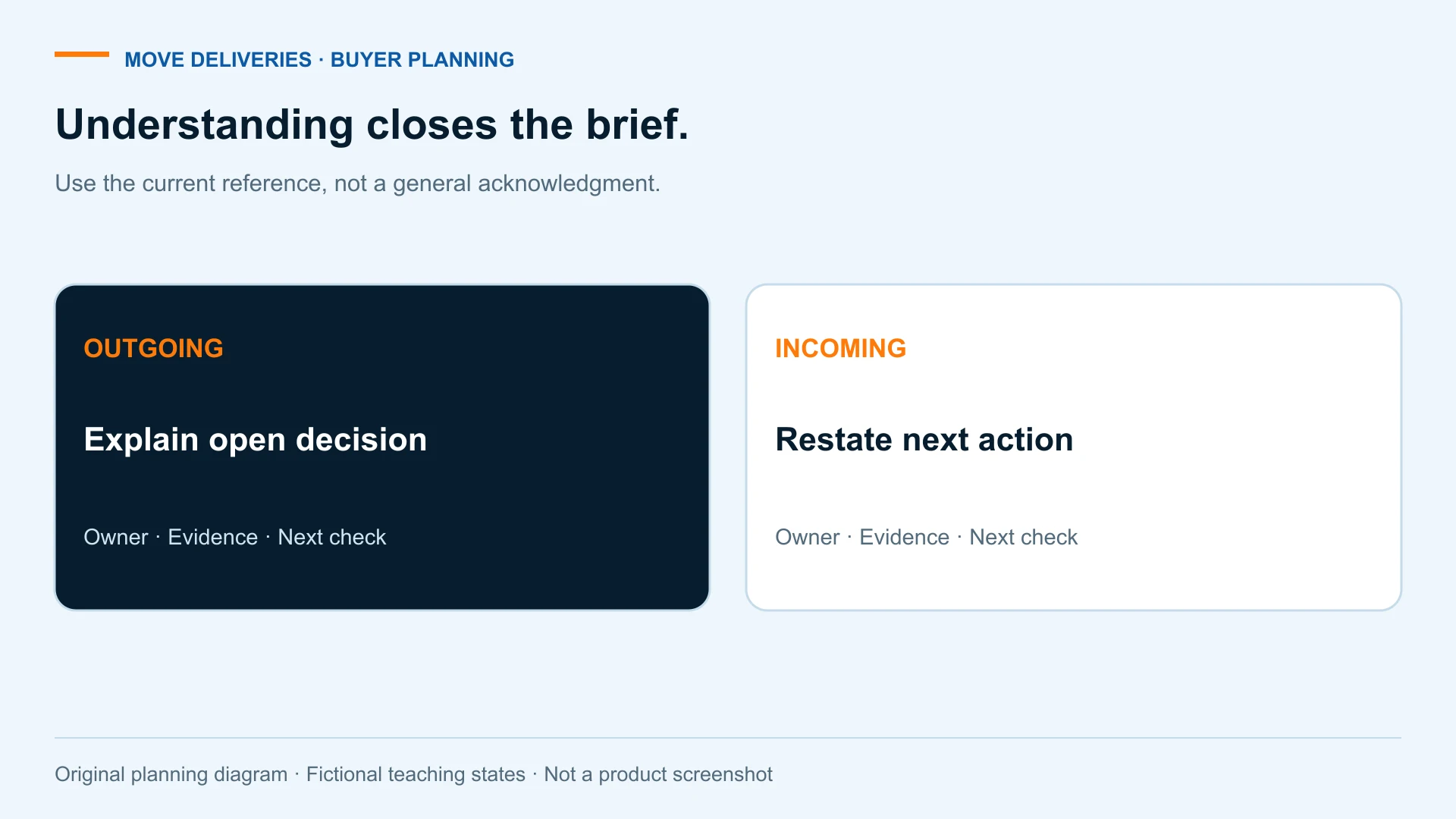
Ask the incoming employee to restate the important unresolved item and the next decision owner. A general “got it” does not establish that a revised receiving arrangement or unaccepted service proposal was understood. Keep the check brief and specific. The goal is shared understanding, not a memory test or a blame exercise.
AHRQ’s team brief guidance emphasizes clear roles, goals and operational constraints. Its check-back tool addresses verifying exchanged information. Here those ideas inform a narrow transport coordination exercise, not a clinical protocol, certification or claim of proven courier outcomes.
If the restatement reveals a difference, correct the maintained record through the responsible owner. Do not let two employees leave with competing versions. Record which instruction needs clarification and whom to contact. Where a clinical question arises, route it to the qualified healthcare role rather than discussing it as a dispatch decision.
7. Close the brief without losing open work
End with a clear statement of which items remain open and who now owns the next check. Preserve the briefing record through your normal internal process. Do not clear the board merely because the outgoing employee has finished the shift. A change in staffing is not evidence that transport work is resolved.
Keep unresolved completion and commercial questions distinct from active collection work. Staff may need to review a delivery record or reconcile an accepted charge without asking the driver to perform another task. The brief should identify that purpose so the incoming team does not accidentally create duplicate transport requests while trying to close administrative questions.
Review the briefing process when a recurring gap appears. Did the record lack an owner, a current instruction or evidence of the transport stage? Improve that specific field or question. A longer checklist is not automatically better. Remove information that does not help the incoming employee make the next appropriate decision, while retaining the evidence required by your organization’s approved procedures.
| Fictional request | Current stage | Open question | Next owner |
|---|---|---|---|
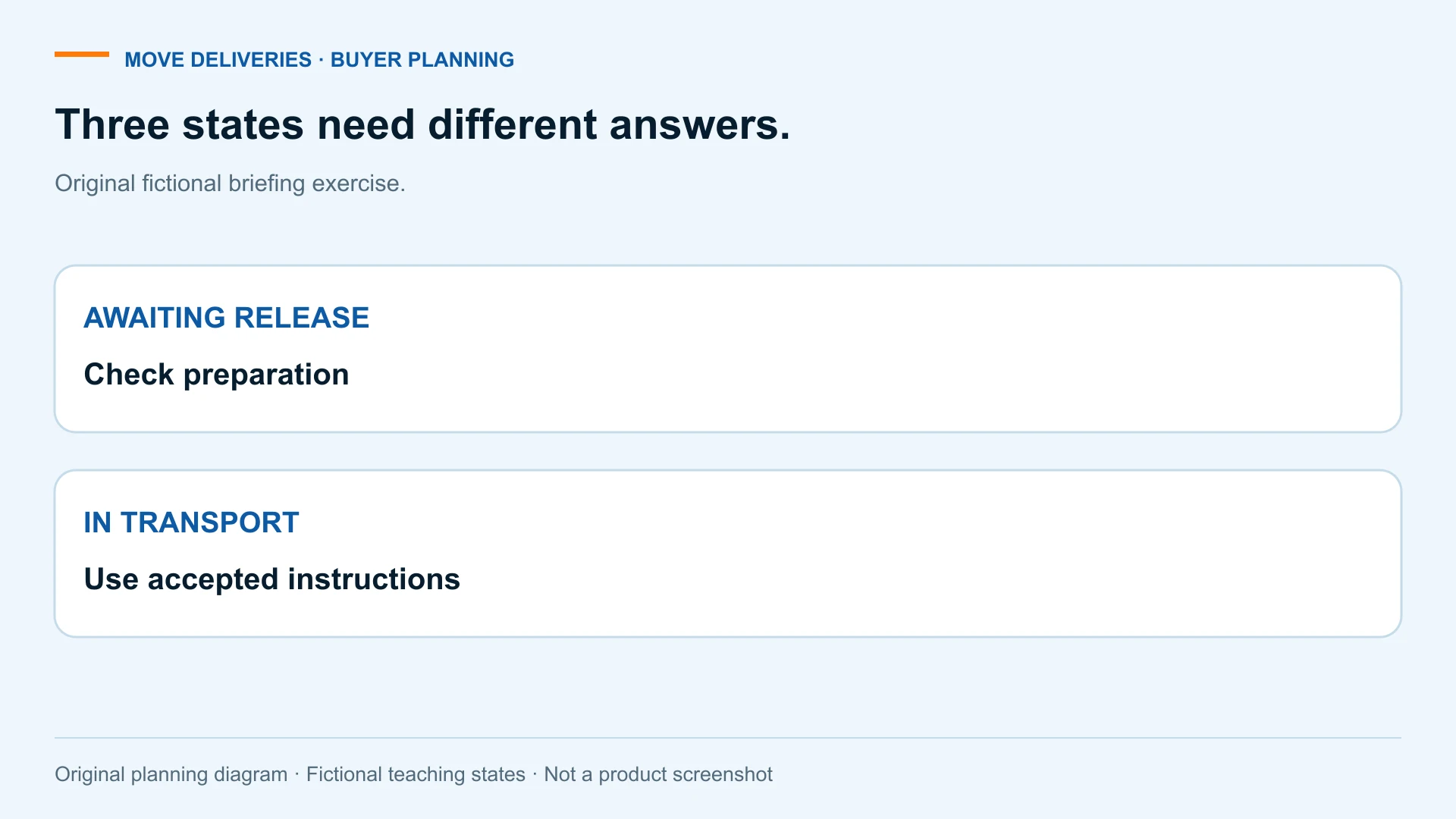
| TRAIN-B1 | Awaiting release | Has preparation been confirmed? | Release owner |
| TRAIN-B2 | In transport | Has the proposed change been accepted? | Authorized customer coordinator |
| TRAIN-B3 | Completion recorded | Has the customer reviewed the record? | Receiving review role |
Use an original open-work board
The fictional board below shows three requests with different operational needs. TRAIN-B1 requires a readiness answer from the release owner. TRAIN-B2 is in transport under accepted instructions. TRAIN-B3 has a completion record awaiting customer review. These are teaching states, not live shipments, product fields or a report of MOVE performance.
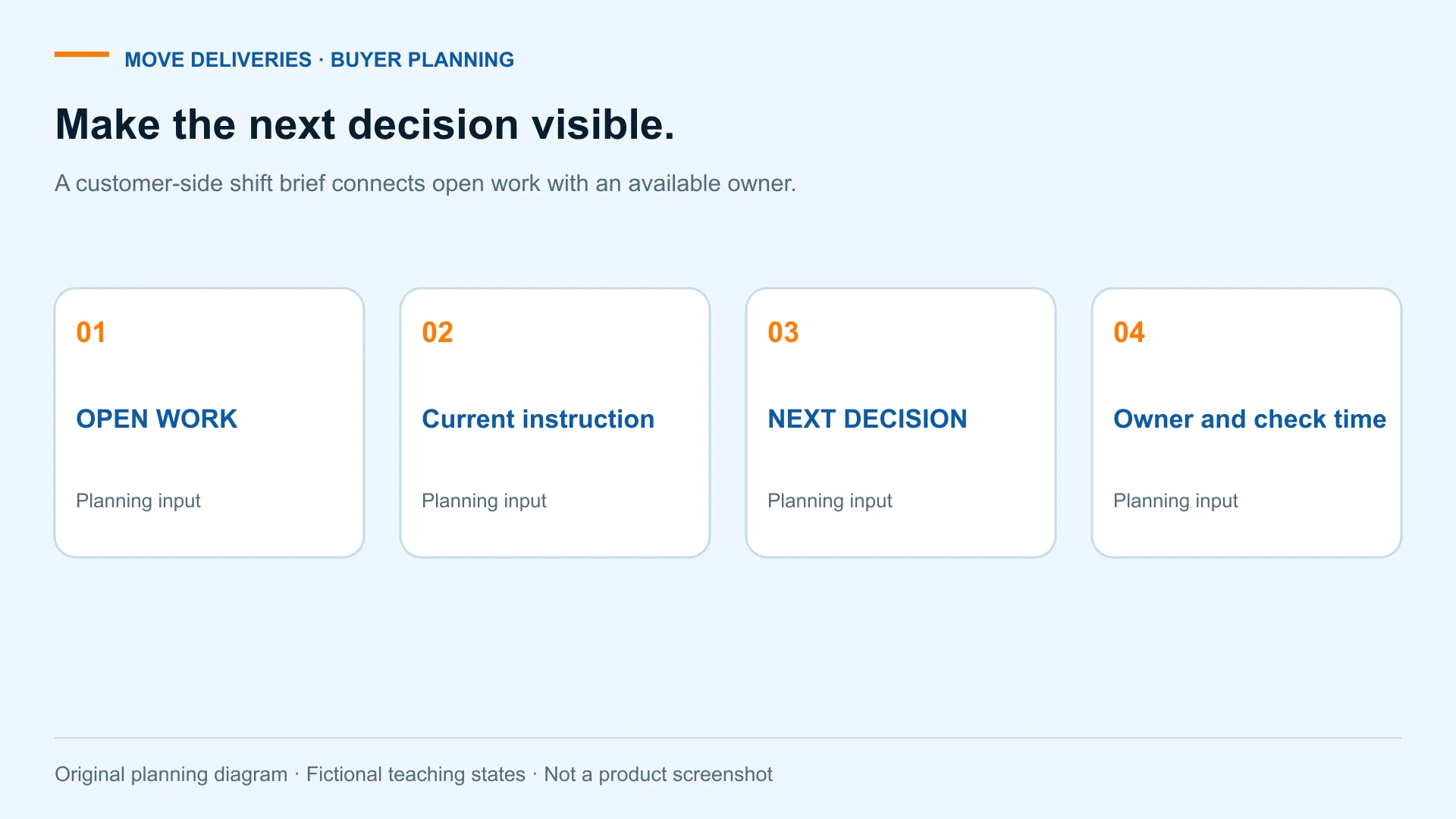
Recommended columns are reference, current stage, instruction version, evidence source, unresolved question, available owner and next check. Avoid adding clinical histories or unnecessary package contents to a generally visible board. A concise transport reference can connect the brief to the approved detailed record without displaying everything in the meeting.
Test the board by asking someone unfamiliar with the outgoing shift to identify the next action for each row. If they must search several threads for the actual question, the board needs better decision wording. If they cannot tell whether the action has been accepted, the instruction state needs clarification. The exercise assesses the record, not the employee’s willingness to guess.
A fictional shift change that exposes an unaccepted proposal
A clinic’s outgoing coordinator notes that a delivery could arrive at a different receiving desk. The provider has not yet responded to the proposal. During the brief, the incoming employee restates it as a confirmed destination change. That difference exposes the risk before anyone issues another instruction. The board is corrected to show a proposed change awaiting the responsible service response.
The incoming employee takes ownership of checking that response through the agreed contact path. The original accepted receiving instruction remains the current instruction until the appropriate process resolves the proposal. The receiving desk receives the relevant update only after the decision is clear. Nobody assumes a message sent during the prior shift established service acceptance.
In another row, a release owner has not confirmed package preparation. The brief does not solve that gap by marking the courier late. It assigns a readiness check and preserves the distinction between expected preparation and actual release. The next employee can now ask a specific question instead of making a broad status call with incomplete context.
These examples do not promise that a brief prevents every exception. They show what a useful briefing record makes visible: the stage, evidence, instruction state and decision owner. Those are concrete improvements your team can evaluate without claiming a clinical result, automatic dispatch feature or universal response time.
Check the briefing board with three practical tests
First, cover the employee names in a fictional board and ask whether the roles still explain who can act. A row that depends on one familiar person’s memory may become unusable during leave or staff replacement. The record should identify the responsibility and the available approved contact path, while keeping unnecessary personal details out of a broadly shared meeting view.
Second, ask a participant to distinguish the latest accepted instruction from a pending proposal. If the board gives both the same visual status, change the wording or layout. This is a customer-side usability test, not a claim about how the provider’s platform displays the records. The organization can improve its own brief without assuming a software feature that has not been verified.
Third, select an open item and ask what evidence would let the incoming employee close it. A readiness question may need the releasing owner’s answer. A proposed service change may need the responsible provider’s response. A receiving review may need the agreed completion record. Requiring different evidence for different questions makes the board more useful than a single done-or-not-done checkbox.
Record the results as specific improvements to the briefing instructions. Do not grade staff on their ability to reconstruct missing facts. An employee who identifies an uncertainty has supplied valuable information about the record. Review the revised board with the responsible operational roles before applying it to real work, and retain your organization’s separate clinical communication procedures.
Build the brief around the real service arrangement
How often should staff brief? Choose the actual staffing and open-work needs; this guide sets no mandatory meeting interval. Can notifications replace the brief? They can communicate milestones, but they may not explain an unresolved decision or transfer responsibility for the next check. Does the brief change clinical responsibility? No. Use your organization’s approved healthcare procedures for those matters.
For hospital and clinic deliveries, identify the customer roles that coordinate release and receiving. For a defined local request, use a Quick Quote. For recurring work, Start An Account and discuss your shift-change needs. Clear open-work ownership gives the next employee a starting point—not another puzzle to solve.