
Courier corrective action is the process of investigating a delivery exception, changing the conditions that contributed to it and checking whether the change works. It should produce more than an apology or a reminder to be careful. Your healthcare team needs an understandable account of what happened, which part of the agreed plan failed and who will verify the improvement.
A late handoff, unclear instruction or missing record can create pressure to reach a quick conclusion. Resist the temptation to name a cause before reviewing the evidence. This guide offers an original exception-review worksheet and a practical way to evaluate proposed actions. It is operational planning guidance, not a clinical investigation method, legal assessment or claim about MOVE’s historical performance.
Separate the immediate response from courier corrective action
The first task is to address the current work through the responsible people. What is the last verified event? Where is the handoff expected? Which instruction applies? Who can approve a changed plan? A team still resolving the delivery needs clear current information, not a speculative explanation of the entire incident.
Clinical urgency, specimen suitability and product acceptability remain with qualified healthcare personnel. A transport coordinator can describe observations and accepted work but should not make those decisions. Make the decision boundary explicit, especially if staff are asking for reassurance that only the responsible reviewer can provide.
After the immediate operational question has an owner, preserve the relevant evidence according to the approved record process. Do not ask staff to rewrite earlier instructions or tidy away inconvenient discrepancies. The later review needs to understand what people knew and which instruction was effective when they acted.
Use MOVE’s delivery process to identify the handoff under review. Request, acceptance, collection, progress and completion are different stages. A problem at one stage should not automatically be attributed to another merely because that person was the last one visible.
Write a neutral question that the evidence can answer
“Why was the driver careless?” assumes both a cause and a judgment. “Why did the receiving team lack the accepted instruction when the courier arrived?” defines an observable issue. Start with the difference between the agreed outcome and the supported event, then identify what remains unknown.
Describe the affected order or population, the relevant time period and the event definition. If the concern is late arrival, distinguish the requested time from an accepted receiving window. If the concern is a missing record, identify which record was agreed and which access path was used to look for it.
Keep the scope manageable. One exception may reveal a wider issue, but the review should not assume that every site is affected. Equally, a single successful handoff does not prove the proposed improvement works in all conditions. State the scope being examined and the evidence needed to consider expanding it.
Assign a review owner with access to the appropriate operational records. That role should bring in the provider, sending site and receiving site as relevant. The person leading the review need not decide every technical or healthcare question personally; they need to connect each question to its responsible reviewer.
Reconstruct the sequence before interpreting the cause
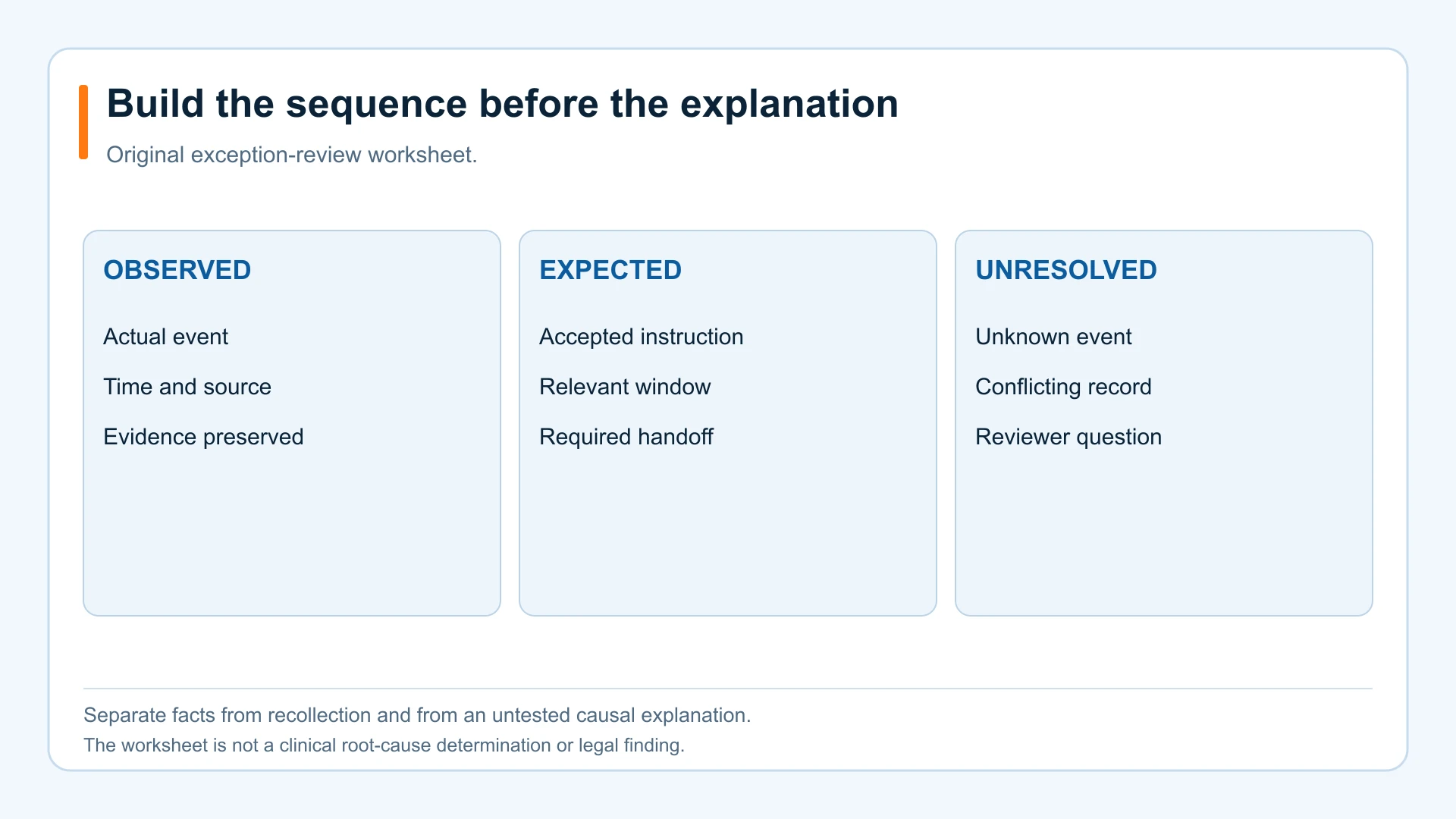
Build a timeline of request, acceptance, readiness, instruction changes, collection, arrival and handoff events where those facts are relevant and available. Record the source for each point. Different systems may display event time, entry time and notification time. Treat those as different concepts until their meaning has been confirmed.
Ask what instruction was available to each role at the relevant moment. A later correction should not be used to judge an earlier action as though the corrected information had always been visible. Conversely, an old instruction should not excuse ignoring a properly accepted revision. The review must establish which version actually applied.
Use authorized records rather than informal recollection alone. Staff interviews can explain context, but memories and screenshots have limitations. Ask what the record supports and what it cannot establish. A location update may not prove a completed handoff; a signature may not prove that every product requirement was met.
Review electronic proof of delivery and Secure Chain of Custody in relation to the actual service. Confirm which records are available and how authorized staff may use them. Do not imply that a particular record automatically settles clinical or legal acceptance.
Look for contributing conditions, not a convenient person to blame
The AHRQ PSNet root cause analysis primer discusses systems-focused investigation and the importance of meaningful action and evaluation. Its healthcare safety context is not a universal courier procedure. The narrow lesson used here is to examine contributing conditions rather than treating individual blame as the whole explanation.
Ask how the work was arranged. Was the collection point current? Did the receiving window change? Were responsibilities split across people who did not share the same instruction? Did a message require acknowledgment that nobody expected to send? These are review questions, not conclusions about a particular shipment.
Distinguish an observation from an interpretation. “The instruction field was blank in the reviewed order” is an observation if supported by the record. “Staff did not care” is an interpretation that the field does not establish. Neutral language allows people to identify a fix without first defending themselves against an unsupported judgment.
Some conditions require qualified technical or healthcare review. An application failure, a privacy concern or a cargo-specific question should go to the relevant reviewer. Do not stretch an operational meeting into a diagnosis of every possible system or clinical issue.
Use a courier corrective action ledger with a verification column
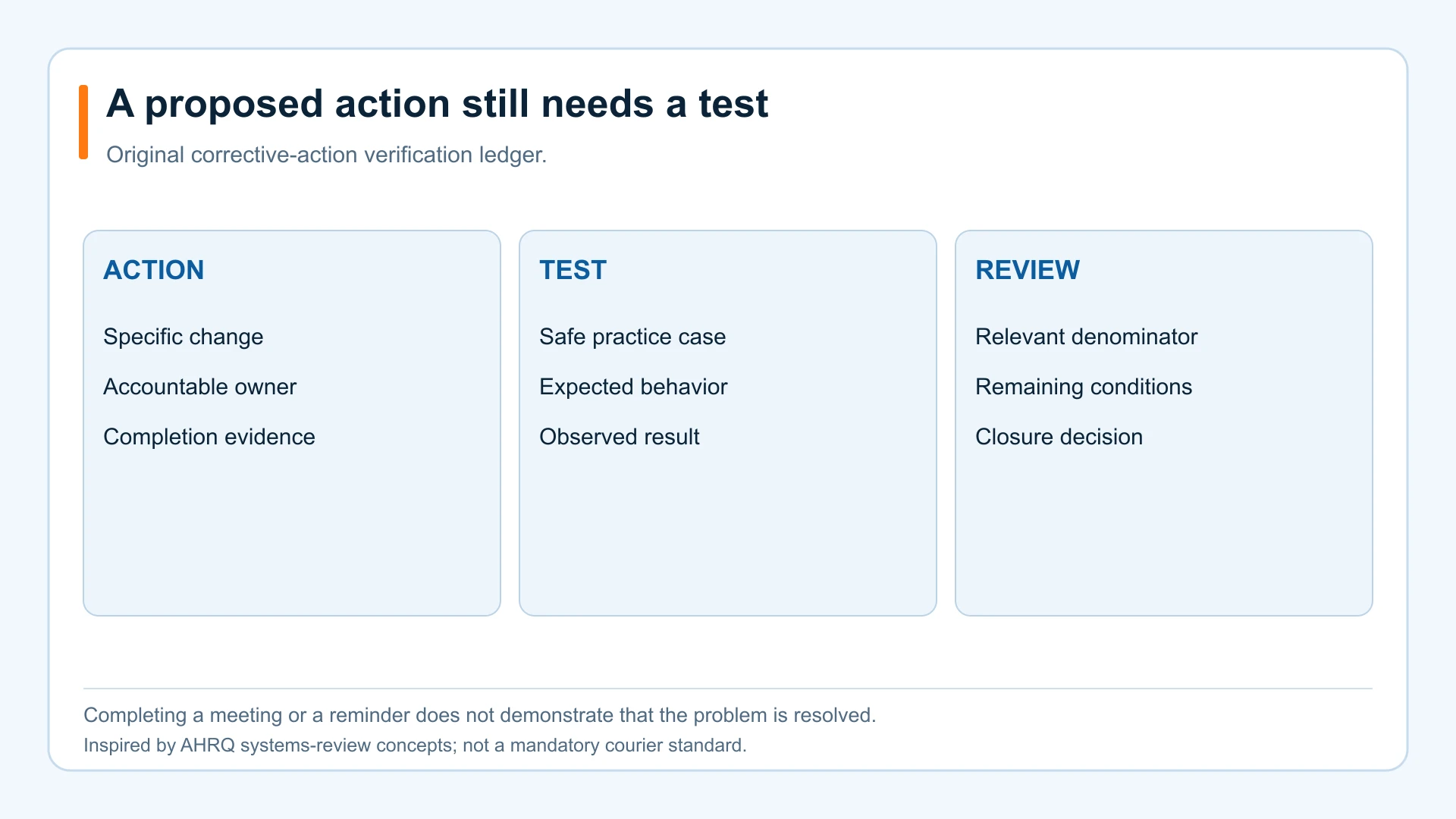
A useful action statement connects a supported condition to a change, an owner and an observable test. “Communicate better” is too broad to verify. “Replace the outdated receiving instruction through the approved process and demonstrate that an authorized backup can retrieve it” is more assessable, if the review has actually established that instruction problem.
| Field | What to record | What not to assume |
|---|---|---|
| Exception | Agreed outcome and supported difference | Every requested deadline was accepted |
| Evidence | Relevant source, event and time context | A screenshot proves every handoff fact |
| Contributing condition | Observed issue and remaining uncertainty | A person’s intention explains the system |
| Proposed action | Specific change connected to the condition | A reminder alone fixes the workflow |
| Owner | Role authorized to implement the change | A meeting attendee owns every decision |
| Verification | Harmless test and expected observation | Sending a revised document proves use |
| Follow-up | Review period, scope and unresolved items | One successful event proves permanent improvement |
Record dependencies between actions. A revised receiving instruction may require site approval before the provider can accept it. A software change may need testing before staff training. Marking the last task complete while its prerequisite remains unresolved creates a misleading impression of readiness.
Keep the ledger in an approved environment and limit access appropriately. The public worksheet contains no real incident details. Do not circulate patient information, personnel allegations or sensitive system records merely to make the review appear thorough.
Verify the change with a realistic, harmless test
Choose a test that addresses the identified condition. If the problem was an unclear backup contact, test the backup handoff. If it was an ambiguous order status, test whether authorized staff can explain the status correctly. A general team meeting does not demonstrate that either condition has changed.
Use dummy references, empty units or an approved test environment when appropriate. Do not create real duplicate orders, disable safeguards or expose patient information to make an exercise realistic. The responsible customer and provider teams should agree the test method and any limitations.
Define the expected observation before the test. Then record what was actually observed and who reviewed it. If the result does not match the expectation, keep the action open or revise it through the approved process. Avoid changing the test definition after the fact solely to obtain a pass.
Include ordinary variation: a different authorized staff member, a backup receiving role or the relevant site-access condition. The variation should remain safe and within the agreed scope. The aim is to find whether the revised plan is understandable when its author is not standing beside the user.
Measure the follow-up without hiding the denominator
A follow-up report should identify the population reviewed. How many relevant orders were accepted? How many had the condition being tested? Which were excluded and why? A count of successful events alone can hide unresolved work. Choose a definition that answers the question the review actually set out to resolve.
Do not compare periods whose scope or event definitions differ without explaining the difference. A site closure, changed service hours or a new cargo mix can affect the interpretation. The responsible reviewer should decide whether the periods provide a meaningful comparison rather than simply placing two percentages side by side.
Separate process evidence from outcome claims. Staff being able to retrieve a revised instruction is evidence about instruction access. It does not establish a universal reduction in late deliveries, patient harm or cost. Report the supported result in plain language and keep broader conclusions proportionate.
Discuss the relevant reporting capabilities with the provider. MOVE’s live-tracking information can frame a conversation about operational visibility, but this article does not promise a particular analytics dashboard, incident workflow or improvement percentage.
Close the review with an owner, not just a reassuring sentence
A review can close when the responsible people have accepted the evidence, verified the agreed actions and assigned any remaining issues to the proper process. “We will do better” is not the same as an accepted revised instruction or a demonstrated change. Keep the closure decision and its scope understandable.
Communicate the change to affected roles through the approved channels. Tell staff which instruction is current, where it is maintained and who owns future updates. Do not leave an old temporary workaround in use because nobody informed the backup team that the review had ended.
Use recurring service meetings to discuss patterns without republishing confidential incident details. Some exceptions will be unrelated; others may share a condition worth investigating. Let the evidence guide that distinction. Avoid declaring a systemic cause from a small sample or dismissing a repeated problem because each event appears minor in isolation.
For ongoing local healthcare work, start an account conversation with MOVE about your accepted handoffs, responsible contacts and review needs. For an individual order, Quick Quote with clear pickup and receiving details. A better plan starts with work that both sides can understand and evidence they can use.
Apply the Ledger to a Fictional Backup-Contact Problem
Imagine an accepted delivery reached the agreed site, but the usual receiving contact was unavailable. The reviewed order contained an old backup instruction. That evidence supports an instruction-version question; it does not prove that the courier ignored a current instruction or that the site failed every receiving obligation. Preserve those distinctions while the responsible teams establish what actually applied.
A proposed action might replace the obsolete instruction through the approved process, identify its owner and show how an authorized backup retrieves the current version. Verification could use a dummy order and an empty practice unit during a controlled walkthrough. The reviewer records whether the backup found the correct instruction without relying on the regular contact to explain it.
If the backup still finds the old version, the action is not verified simply because a revised document was emailed. Review the distribution path and retest the relevant condition. If the narrow test passes, report that result with its limits. The example describes no real MOVE exception, patient outcome or guaranteed reduction in delivery delays.
Courier corrective action questions
Is an apology a corrective action?
An apology can acknowledge an experience, but it does not demonstrate a changed condition. A corrective action needs a specific improvement, an authorized owner and suitable verification connected to the reviewed issue.
Does every delivery exception require a formal clinical investigation?
This guide cannot decide that. Responsible healthcare, legal and technical reviewers determine applicable requirements. Operational staff should escalate relevant concerns and preserve appropriate evidence without making clinical conclusions.
Can one successful test prove the problem will never recur?
No. State the test scope and its limitations, then review the agreed follow-up evidence. A useful report explains what was demonstrated and what remains uncertain instead of promising permanent results from one event.