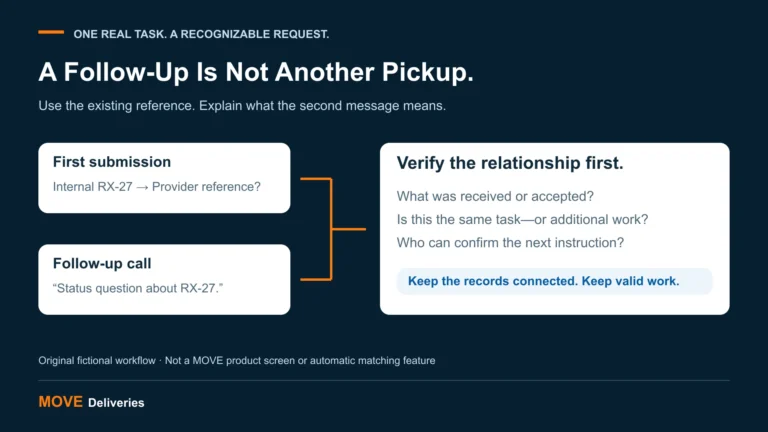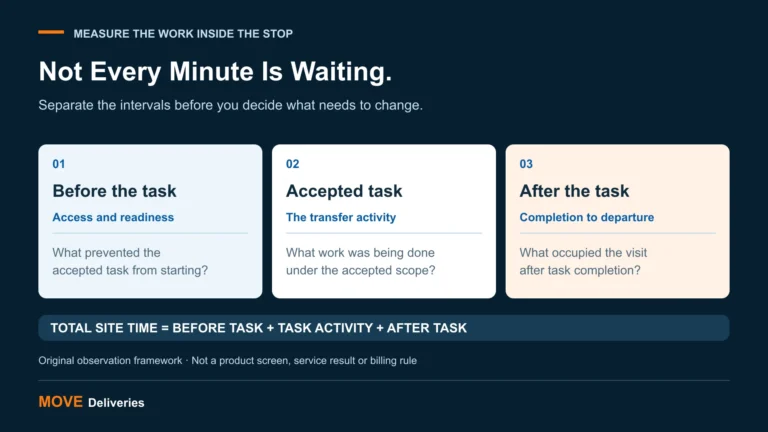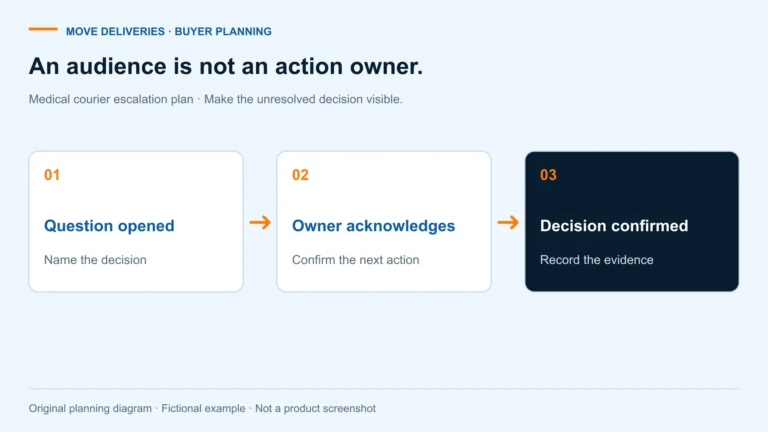

Delivery driver workforce data can improve a courier buying conversation when you understand what it measures. National employment projections describe broad occupations. They do not tell you whether a provider has the right person, vehicle and instructions available for your next local healthcare delivery.
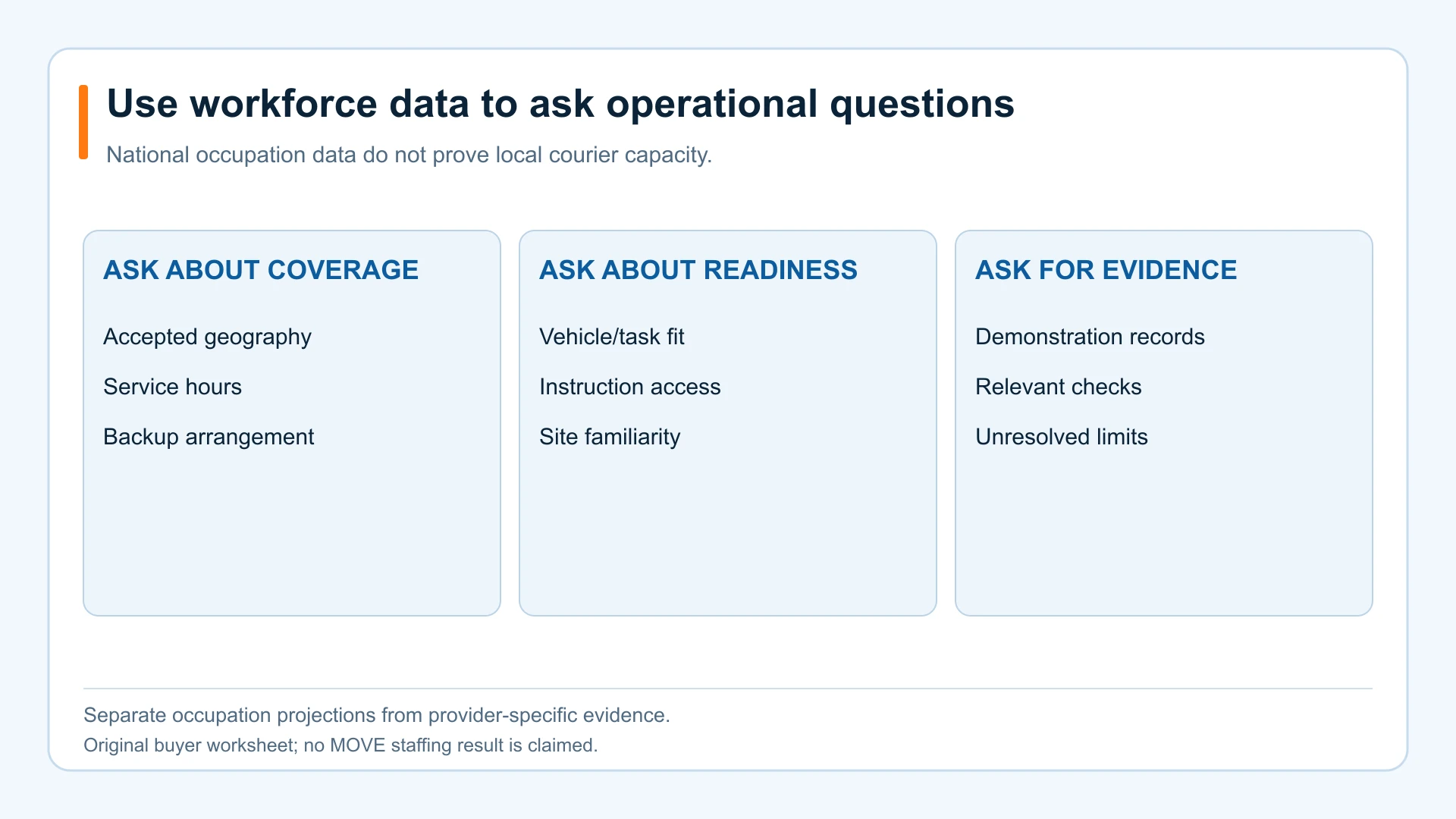
The useful approach is to separate market context from service evidence. Use public workforce data to frame questions about continuity, training and capacity. Then ask your provider to demonstrate the arrangements that apply to your locations. A growing occupation is not proof of a staffed route, just as a large national headcount is not proof of coverage at one clinic.
This article presents a reproducible analysis of Bureau of Labor Statistics figures and an original staffing-continuity worksheet for buyers. It does not estimate medical-courier employment, publish MOVE staffing numbers or promise delivery-driver jobs. The planning examples are hypothetical and should be adapted to an accepted local service arrangement.
What the BLS figures actually describe
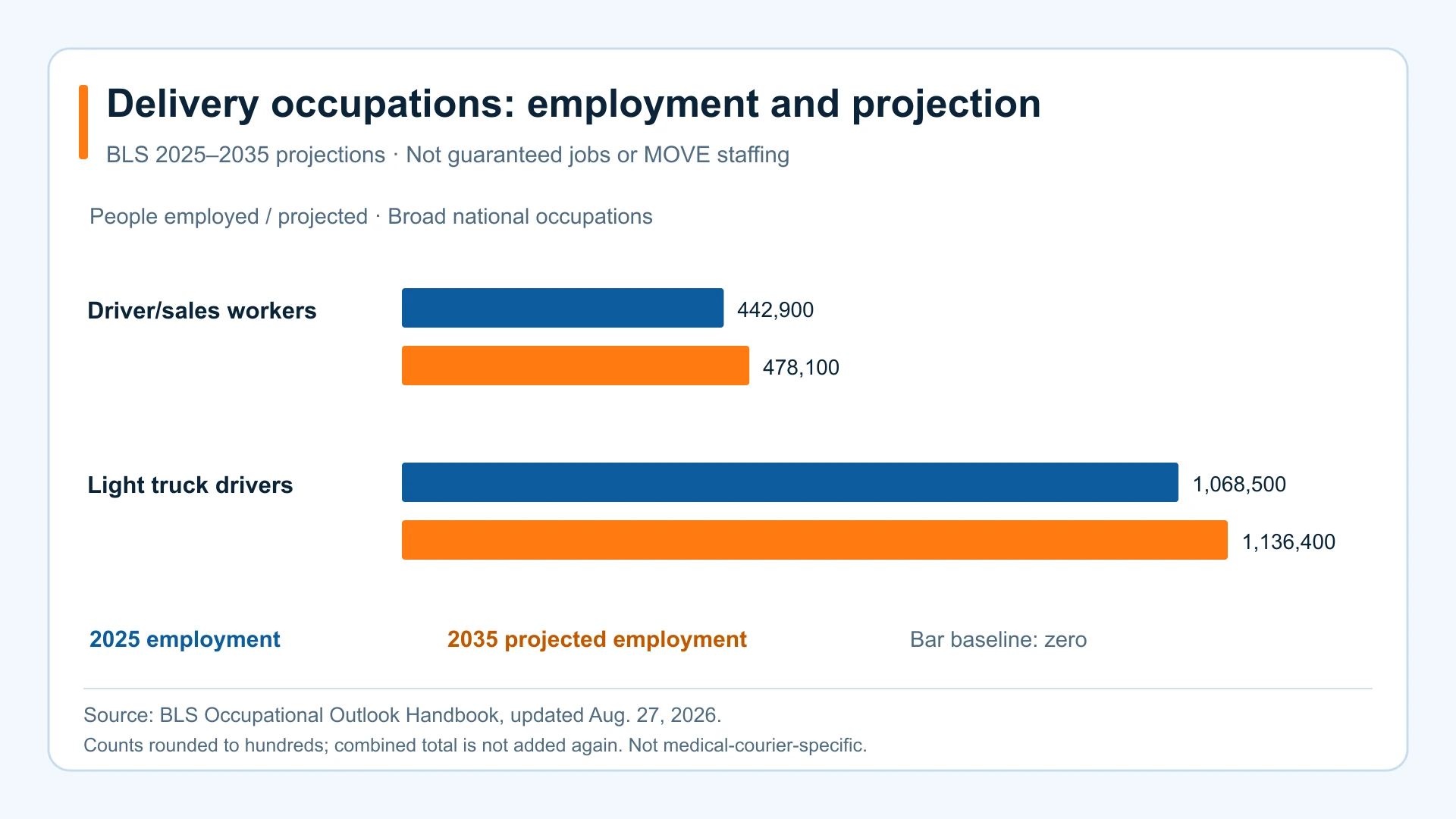
The BLS occupational profile, updated August 27, 2026, reports separate data for driver/sales workers and light truck drivers. Its projection period is 2025–2035. These categories cover broad work across industries; neither is a medical-courier-specific occupation in this report.
The published 2025 counts are 442,900 driver/sales workers and 1,068,500 light truck drivers. BLS projects respective 2035 employment of 478,100 and 1,136,400. Our graphic plots those separate categories. It does not add the combined category again, which would count the same workers twice.
BLS also gives approximately 152,700 annual openings for the combined occupations over the projection period. Openings include replacement needs as well as growth. They are not the same quantity as net added employment, and they are not confirmed vacancies at a particular company. Keep that distinction visible when the figures enter a presentation or procurement report.
| Broad occupation | 2025 employment | 2035 projected employment | Calculated added employment |
|---|---|---|---|
| Driver/sales workers | 442,900 | 478,100 | 35,200 |
| Light truck drivers | 1,068,500 | 1,136,400 | 67,900 |
| Combined occupations | 1,511,400 | 1,614,400 | 103,000 |
Method: added employment equals the displayed projected count minus the displayed base count. Published rounded component counts produce a 100-person difference between the sum of the two displayed component changes and the displayed combined change. Do not force them to reconcile by altering an input. Use the published combined total for combined analysis and identify rounding in component comparisons.
BLS separately publishes a light-truck numeric change of 67,800, while subtraction of its displayed rounded endpoint counts produces 67,900. The worksheet’s calculation is therefore not a replacement for the published change column. Retain both labels when the distinction matters, and do not interpret the small rounding difference as an economic finding.
Ask for local capacity evidence instead of a national proxy
Start with the service you actually want to commission. Name the release locations, receiving constraints, transport-unit dimensions and demand pattern. Then ask how the provider confirms availability for that scope. A workforce trend can motivate the question, but it cannot answer it. The provider’s acceptance of a specific arrangement is the operational fact you need.
Distinguish available personnel from suitable personnel. A driver may be available yet lack the instructions, vehicle configuration or accepted task scope required for the request. Ask who verifies fit before dispatch and how a mismatch is reported. Avoid assuming that a staffing number proves readiness for every type of healthcare cargo.
Explore dedicated courier service when your workload needs an ongoing capacity discussion. Confirm what coverage, backup arrangements and accepted work apply to the proposed service. A dedicated arrangement should be assessed against your actual operating pattern, not selected because a broad occupation is projected to grow.
Review continuity when the usual driver is unavailable
A service that works only when one familiar person remembers every site instruction has an avoidable continuity risk. Ask how a replacement receives current release and receiving details. The question is not whether the backup knows every historical story. It is whether they can access the maintained instruction and recognize which decisions need an authorized contact.
Discuss how the provider confirms a replacement’s accepted responsibilities. Site access, loading assistance, shipment identification and evidence requirements should not be transferred through an informal “just do what the last driver did” message. A buyer can verify the process without asking for unnecessary personal employment information or private records.
Keep provider staffing decisions distinct from the buyer’s service expectations. Your organization can define the outcomes and authorized handoff requirements it needs. Qualified legal and operational reviewers should assess how the actual working arrangement is managed. Do not turn a service-continuity worksheet into an improvised employee-classification policy.
Make site knowledge portable
Write site instructions so an authorized person who has never attended the location can understand them. Specify the approved entrance, where to ask for the releasing role, the receiving department and what to do when access differs from the instruction. Avoid unnecessary personal details and keep sensitive access information in approved channels.
Assign a maintenance owner at each location. A document can become obsolete when a desk relocates, opening hours change or a usual contact leaves. Record when the instruction became effective and how superseded versions are retired. Otherwise, the replacement driver may follow a perfectly clear instruction that no longer describes the facility.
Use a controlled handover test. Give a permitted backup the current instructions and ask them to explain the release and receiving process. Let their unanswered questions identify improvements. This is more useful than assuming a training certificate proves familiarity with an entrance that changed yesterday.
| Continuity question | Evidence to discuss | What remains separate |
|---|---|---|
| Can the accepted work be staffed locally? | Provider confirmation for named locations, cargo scope and timing. | National BLS projections do not confirm a specific route. |
| Can a backup find current site instructions? | Maintained instruction, version owner and authorized access process. | Personal familiarity is not a substitute for a maintained process. |
| What if demand exceeds the agreed capacity? | Approved escalation, provider acceptance of additional work and customer decision owner. | Additional work is not automatically included because drivers exist elsewhere. |
| Who checks task suitability? | Vehicle fit, task instructions and responsibility confirmation before dispatch. | Technical cargo decisions stay with qualified personnel. |
| How are continuity problems reviewed? | Relevant event evidence, contributing conditions, assigned actions and follow-up. | An isolated anecdote does not establish a workforce trend. |
Describe demand in operational units
A monthly order count alone does not reveal staffing demand. Several requests arriving together can create a different capacity problem from the same number spread across a day. Transport-unit size, release delays, loading tasks, receiving access and the geography of stops also affect the work. Use your own authorized records to describe these conditions.
Prepare a simple demand profile showing requested work, accepted work and relevant changes by suitable time period. Separate transport tasks from internal requests that never became accepted orders. Keep canceled work visible where it explains the pattern. A provider can discuss capacity more clearly when the buyer’s description reflects actual release and receiving dependencies.
Do not present the profile as a forecast with false precision. If your clinic plans to add a department, show the expected change as an assumption and identify who supplied it. Confirm what evidence will validate the estimate after launch. Capacity planning should distinguish observed workload, planned change and uncertainty rather than blending them into one convincing number.
Do not confuse recruiting activity with service readiness
A provider’s recruiting page can describe the type of work it wants applicants to consider. It does not prove that the people and vehicles for your proposed service are already available. Ask procurement questions through the service conversation and recruitment questions through the appropriate career process. Mixing the two can create expectations neither team has confirmed.
Similarly, a national employment projection does not establish an individual driver’s pay, status or training. Those depend on the actual role and arrangement. A buyer should not infer compensation from a workforce growth chart or assume that all delivery occupations use the same employment model.
For applicants comparing opportunities, see MOVE’s driver information and ask about the specific opportunity available in your area. For buyers, keep the emphasis on accepted service, task suitability, continuity and evidence. Each audience needs an accurate answer to a different question.
A fictional expansion: two new sites, one useful capacity conversation
Imagine a medical supplier adding two local care sites. It expects more deliveries but has not yet verified the sites’ receiving hours or the loading assistance required. A workforce chart suggests broad occupational growth, but it does not resolve either missing fact. The buyer first gathers the actual site requirements before asking the provider about additional capacity.
The provider then reviews the accepted work and proposed additions together. One site has a clear receiving arrangement; the other still needs an approved access instruction. Instead of treating both as ready, the parties identify which proposed work can be discussed now and which depends on a site decision. They also examine whether the additions affect existing accepted stops.
Finally, the buyer asks how current instructions reach any replacement driver and how additional work is confirmed when the normal operating pattern changes. This is a hypothetical planning example, not a MOVE service commitment. Its point is that staffing resilience comes from connected decisions and evidence, not from quoting a large employment number.
Review continuity with evidence, not assumptions
Before adding capacity, ask whether the relevant constraint is actually staffing. A prepared shipment may still wait because no authorized release owner is available; a suitable vehicle may still be unable to complete an arrival because receiving access is unconfirmed. Adding another driver does not automatically resolve either condition. Trace the specific dependency before commissioning more work.
A practical review can compare the current instruction with one observed exception and identify the decision that was missing. Keep the question narrow enough for an owner to answer. If the team cannot distinguish an access problem from a capacity problem, collect better event evidence before treating a national labor trend as the explanation.
During a recurring service review, examine material continuity events: changed staffing, obsolete access details, task mismatches or demand outside the accepted arrangement. Ask which condition affected the service and what action would improve it. Do not attribute every exception to a labor shortage merely because a news headline described one somewhere else.
Separate immediate recovery from longer-term improvement. Confirming an accepted alternative arrangement may resolve today’s order. Updating site instructions or revisiting agreed capacity may reduce recurring friction. Each action needs an owner and a suitable follow-up check. A replacement being found once does not establish that the continuity process will work the next time.
Use the national figures again only when they genuinely add context. They can frame a wider planning discussion about replacement needs and occupational change. The review of your own service still depends on your locations, accepted work and verified events. Keep the two levels of evidence separate in reports and presentations.
Delivery driver workforce data: common questions
Does BLS report the number of medical couriers in this profile?
No. The profile covers broad driver/sales and light truck occupations. Its figures should not be labelled medical-courier employment, MOVE headcount or local healthcare capacity. A separate, appropriately defined dataset would be needed to support those claims.
Are annual openings the same as net new jobs?
No. Annual openings include replacement needs as well as growth. Net added employment compares projected employment with the base period. The quantities answer different questions and should not be combined into a single unsupported market-size claim.
Can projected growth guarantee a staffed delivery route?
No. A route requires confirmation of local availability, task suitability and the accepted arrangement. Projections describe a possible broad occupational trend over time, not an individual provider’s future performance or a promise that a particular opportunity exists today.
Ask a better capacity question
Bring MOVE the locations, transport units, release pattern and receiving conditions that define your work. Review scheduled delivery or dedicated courier support according to the actual need. Use Start an Account for a capacity conversation grounded in your service, rather than a national statistic standing in for an answer.