
A list of local care sites is not yet a courier route. It becomes a route when the stops, package readiness, receiving windows and handoffs fit a repeatable sequence. Without that work, the same line on a map can create waiting at one site and a timing conflict at the next.
For hospitals, clinics, pharmacies and medical suppliers, a multi-stop arrangement can be worth discussing when several local deliveries are connected. The planning goal is not simply to shorten driving distance. It is to create a sequence the releasing and receiving teams can actually support.
This guide provides a route-design worksheet, a three-stop planning example and a review process. It concerns local same-day deliveries within the relevant market, not cross-country consolidation. Any material-specific packaging, release or handling requirements remain subject to the organization’s qualified personnel and the confirmed service scope.
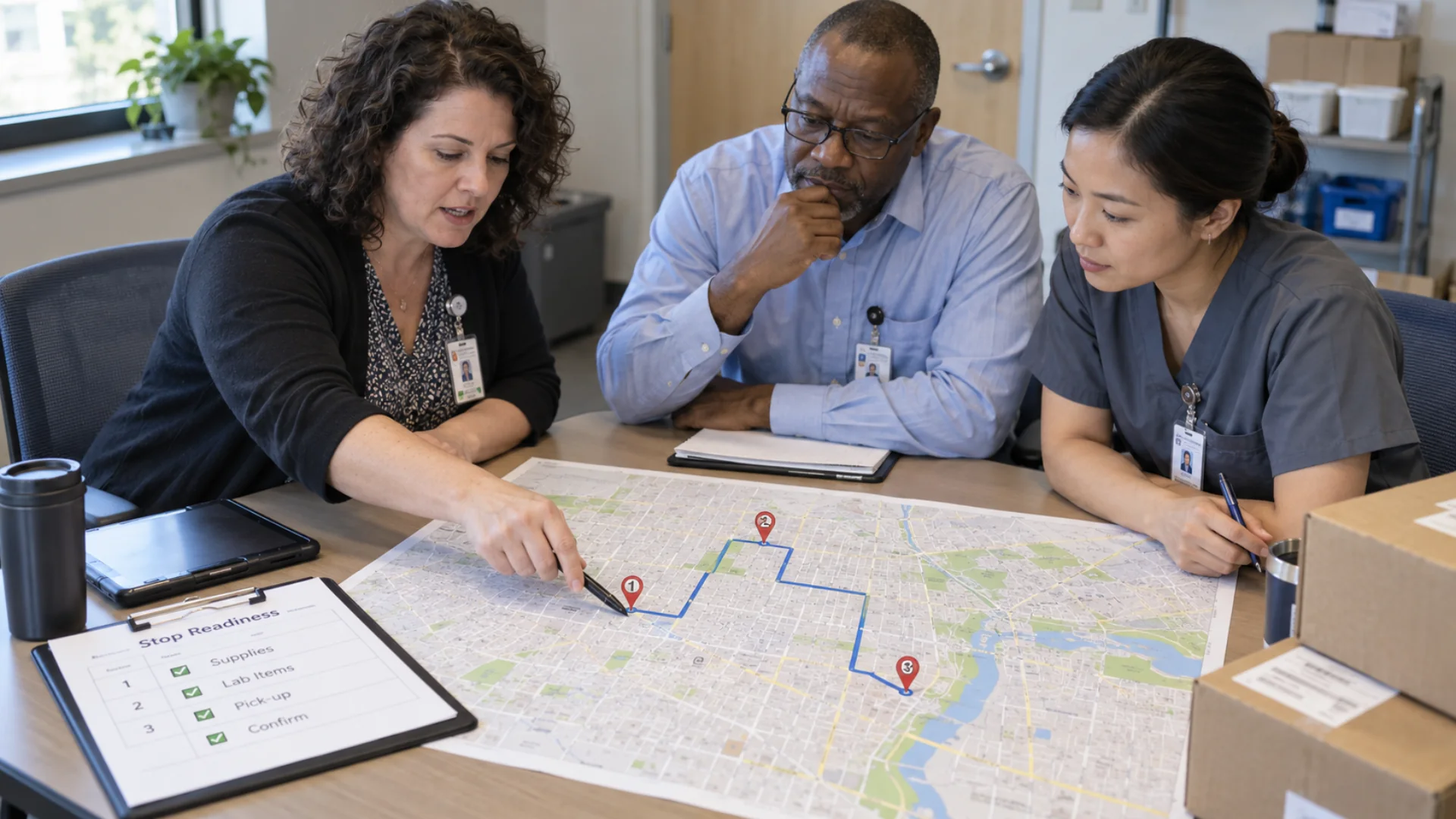
Name The Route’s Purpose In One Sentence
Describe the job before drawing the line. For example, a route may connect prepared supply transfers from a local distribution point to several staffed clinics. Another may collect ready packages from local sites and deliver them to one receiving facility. Those patterns have different origin, capacity and timing questions.
State the operating days and expected frequency. Several unrelated requests that happen to occur once are not automatically a recurring route. If the organization cannot identify a repeatable pattern, individually confirmed requests or scheduled pickups may be a better starting point.
Explore fixed-route delivery with a clear purpose. The service team can then review the actual work instead of inferring it from a list of facility names. Keep the first scope focused enough to test rather than adding every possible local errand.
Inventory The Stops As Handoffs
For each stop, record the full address, approved entrance, release or receiving point and relevant contact. Describe what is collected or delivered and the expected package range. A map pin identifies a place, but it does not explain what must happen there.
Mark stops with multiple buildings or departments. A hospital campus may require a specific receiving bay; a clinic may use a reception desk; a supplier may have a staged release point. These differences affect access and coordination even when the local driving distance is short.
Identify who owns the stop record. If the doorway, contact or receiving window changes, that person should update the maintained instructions through the agreed process. A route becomes difficult to repeat when every employee carries a slightly different version of the site details.
Separate Package Readiness From Site Opening Hours
An open site does not necessarily have a package ready for release. Ask the releasing team when preparation and its required checks are complete on an ordinary day. Record meaningful variation. A preferred pickup time that rarely matches readiness can affect the entire sequence.
At delivery stops, confirm the actual acceptance window. Building hours may not match department receiving hours. A route that reaches a property on time can still miss the intended handoff if the receiver is unavailable.
Keep these two constraints separate in the worksheet: when a package can leave and when it can be accepted. The route must connect them. Qualified staff determine the shipment’s release and handling requirements; a driving sequence should not pressure them to bypass those decisions.
Review Sequence Constraints Before Distance
Begin with the narrowest readiness or receiving requirement. Then review the other stops, local travel and site access. The nearest stop is not automatically the right first stop. A later-ready collection may create waiting, while a time-limited receiver may need an earlier position.
Consider the cumulative effect of each handoff. Loading, finding the approved receiving point and resolving an unavailable contact all take operational attention. A route estimate based only on driving overlooks those events. Ask the service team to assess the actual sequence rather than treating mileage as the whole job.
A simple local map helps orient the discussion. It should show city-level connections, not lines crossing state boundaries when the work is local. MOVE’s nationwide driver presence supports separate local service conversations across markets; it does not convert this route plan into interstate transport.

Use A Route-Design Worksheet
Complete the worksheet with each site owner. Mark estimates and unresolved details clearly. The table is a planning tool, not an automatic dispatch instruction or a commitment that the proposed route is available.
| Stop Input | What To Record | Why It Matters |
|---|---|---|
| Handoff Point | Address, building, entrance and release or receiving desk | Avoids treating property arrival as completion |
| Readiness | Usual release window and meaningful variation | Shows whether the collection fits its position |
| Receiving | Acceptance window and contact process | Defines the destination constraint |
| Package Workload | Count range, packaged size and approximate weight | Supports capacity and suitability review |
| Access | Relevant loading or entrance conditions | Identifies handoff work beyond the drive |
| Exception Owner | Primary and backup decision contacts | Clarifies who approves a changed sequence |
Add an observation column during a representative trial. Compare the planned readiness and access with what actually happened. A specific discrepancy helps the team improve the plan; a general statement that the route was “slow” does not identify the cause.
Use A Three-Stop Example To Test The Logic
Consider a planning example with three local sites. Site A has a prepared transfer early in the day. Site B becomes ready later. Site C has a narrow staffed receiving window. Starting with the shortest map distance may place the vehicle at Site B before the package is ready and reduce the time available for Site C.
The team should compare possible sequences against those constraints. It may revise a pickup window, review whether one request belongs outside the route or ask whether the proposed scope is workable at all. The example does not establish a guaranteed schedule or a MOVE customer result; it illustrates why timing inputs matter.
Ask each site what could make its stated window unreliable. A release contact with conflicting duties or a receiving desk that closes temporarily can change the plan. The route discussion should expose those facts before a neat diagram creates false confidence.
Read the proposed sequence back to all three site owners. Ask each to confirm the event that happens at its stop, rather than merely agreeing that the address is correct. This can reveal an assumed collection that another team understood as a delivery, or a receiving appointment that was never confirmed. Resolve the mismatch before evaluating the route as a complete plan.
Review Package Capacity Across The Sequence
Describe normal and higher-volume patterns for every stop. Capacity changes as packages are collected and delivered. A route assessed using only the final destination’s count may overlook the largest combined load earlier in the sequence.
Use packaged dimensions when they help assess fit, especially for larger medical supply items. Approximate weight and loading conditions also matter. Do not assume a vehicle suitable for small cartons can accept a new bulky equipment transfer without another review.
Keep different shipment categories visible. Adding an unrelated work type can change handling, access and scope. Discuss the change with qualified personnel and the service team rather than treating an established route as permission to add any package that fits through the door.
Define Exception Decisions Before The Route Starts
Decide who is contacted when a collection is not ready, a receiving desk is unavailable or an address instruction is incorrect. Clarify who may approve waiting, a revised sequence or another arrangement. A route should not depend on an employee making an unauthorized decision because no one else can be reached.
Separate routine visibility from exception communication. Not every status update requires action, but an issue affecting downstream windows needs a clear response owner. Include the relevant site contact and a backup in the maintained plan.
Review the commercial scope for changed stops, waiting and work outside the original sequence. Do not assume a universal policy or price. An explicit conversation lets the organization understand what happens when the routine changes, instead of interpreting an unexpected situation after it has occurred.

Compare The Route With Other Service Models
Scheduled delivery may fit a repeat pickup without a connected sequence. STAT delivery may fit a separately reviewed time-sensitive exception. Dedicated courier service may deserve discussion when the workload requires coverage across defined hours.
Compare the same readiness, receiving and package requirements across models. A route is not automatically faster or less expensive because requests are grouped. The service proposal needs to explain what is included and how exceptions are handled.
Some operations may use a route for predictable work and another process for requests that do not fit it. That can be a deliberate design rather than a failure of the route. The important point is that staff know which work belongs in the sequence and which needs separate confirmation.
Use Route Visibility With A Responsible Coordinator
Tracking can help a named coordinator understand local progress and identify a timing change. Confirm how the relevant stop and request references appear. A single vehicle marker may not answer whether a particular package has been collected or accepted.
Use completion records to support handoff review. Confirm the fields and retrieval process during setup. A transport record should not be used to imply that a facility has completed its own inspection, intake or clinical acceptance responsibilities.
If information needs to appear in another system, discuss the integration workflow as a separate scoped capability. Identify the event, relevant data and destination. Do not assume every route record is automatically transferred merely because the platform supports visibility.
Test, Maintain And Expand The Route Deliberately
Choose a representative sequence and review period. Observe readiness, access, package workload, contact availability and final acceptance. Include meaningful variation if it occurs in the normal operation. One unusually smooth run is not enough to understand a complex recurring pattern.
Review findings with the site owners and service team. Distinguish a wrong entrance from a late-ready package or a receiving-window conflict. Each requires a different correction. Changing the driving order is not a universal fix for every kind of delay.
Confirm the actual local addresses through the California, Texas or relevant state map. Coverage pages help start the conversation; they do not confirm every route inside a state. Reassess new stops and meaningful workload changes before expanding.
Keep a short change history. Record why a stop moved, which receiving window changed and who approved the update. A new coordinator can then understand the maintained plan without relying on another employee’s memory. Share the current version with releasing and receiving staff so a trial correction becomes part of the actual routine.
Why MOVE Fits A Local Multi-Stop Route Review
MOVE supports local same-day deliveries for healthcare organizations with service options, human coordination and a proprietary platform for visibility and documented completion. We begin with the actual handoffs rather than treating a map line as a finished operating plan.
Explore hospital and clinic delivery, medical supplier delivery or laboratory transport to frame the work. Different organizations bring different readiness and acceptance needs, even when their sites share one local area.
Bring the proposed stops and worksheet to Quick Quote or Start An Account for recurring needs. MOVE can review route fit, service scope and local availability before the sequence is arranged.
Multi-Stop Route Questions
Should We Optimize Mileage First?
Review readiness and receiving constraints first, then assess local driving and access. The shortest distance may create an unworkable wait or acceptance conflict.
How Many Stops Make A Route Suitable?
There is no universal count. Repeatability, timing, package workload and handoff requirements matter. A small clear sequence can be more workable than a larger set of incompatible requests.
Can A New Stop Be Added Automatically?
Do not assume that. A new stop can affect capacity, access and downstream timing. Review it through the agreed change process before treating it as included.
What Should We Send MOVE First?
Provide the local addresses, approved handoff points, ready and receiving windows, package scope and decision contacts. Mark unresolved details so they can be clarified during the review.
Build A Route Your Sites Can Actually Support
Bring MOVE the local stops and their real operating windows. We can help review the sequence before a line on a map becomes an expectation for your staff.
Quick QuoteStart An Account